
Skip to product information
1 of 6

Vintage and Antique Gifts

Vintage 1940s Broom Label 🧹 Art Nouveau Maid with Daisies Original Lithograph #43 Blank Panel to Personalize Farmhouse Kitchen Wall Art Gift

Vintage 1940s Broom Label 🧹 Art Nouveau Maid with Daisies Original Lithograph #43 Blank Panel to Personalize Farmhouse Kitchen Wall Art Gift

Regular price $10.00 USD
Regular price Sale price $10.00 USD
Sale Sold out
Shipping calculated at checkout.

Size: 6" x 3 1/2"

🚚 Free US Shipping — ships within one business day. International shipping calculated at checkout.

Quantity

Who Was the Art Nouveau Broom Label Maid? 🧹 A Maid, a Rose, and Two Panels Still Waiting for a Name

Size: 6" x 3 1/2"

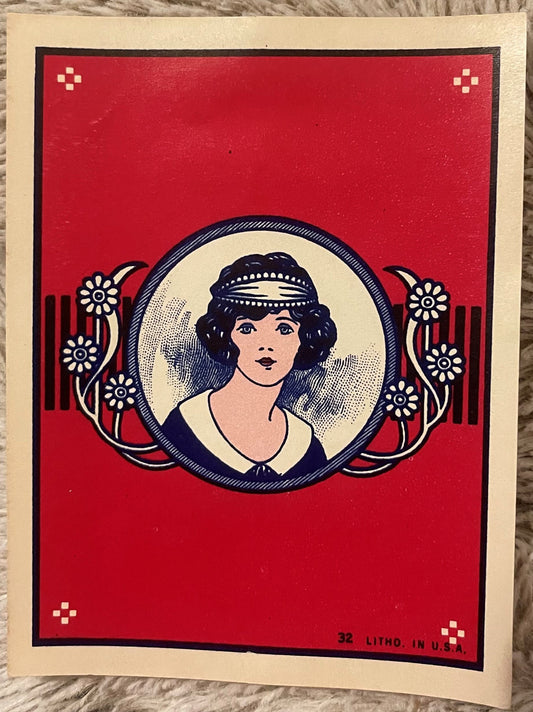
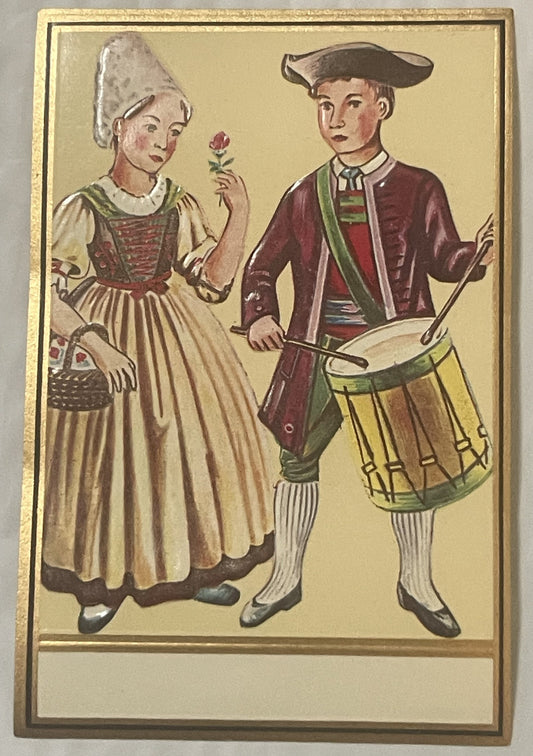
She was printed to help sell somebody's broom, and the name of that broom never went on. The green band above her head is empty. The red band at her feet is empty. The only words anywhere on the sheet are tiny ones along the bottom edge: 43 LITHO IN U.S.A. Those two bare panels were left open for a broom maker's name, and they are still open, which makes this label something more than a picture. It is a small piece of vintage commercial art with room left for a family name, a date, or a few words of your own.

This is a vintage 1940s broom label, never applied, measuring 6 x 3.5 inches. The maid stands under a yellow arch whose ends curl into scrolls, drawn in the Art Nouveau manner, with a corn broom, a red rose, white daisies and tall grass rising around her skirt. Look closely and the soft blues and pinks are built from fine printed tint patterns, wavy lines and stippled dots, which is ordinary commercial lithography. The back is blank, and the design shows through faintly from the front.


🔢 Ordered by Number, Printed in the 1940s

The little "43" is how a broom maker ordered her. Stock labels in this numbered series were sold by John L. Denning & Company of Wichita, Kansas, a broom-corn house that began in 1924 and grew to fourteen branches in different states. Denning's sample booklet said "Order by Number Only" on the cover and wouldn't take an order for fewer than 1,000 of any design. The "NN LITHO IN U.S.A." line, number first and then LITHO, is the style on the pages of that booklet, and the booklet's "Wichita 1" postal-zone address means it was printed between 1943, when zones began, and 1963, when ZIP codes replaced them. That puts this printing in the 1940s, whatever the costume in the drawing suggests.


✏️ The Blank Panels: A Label You Can Finish

Labels like it were printed with their panels left open, so a broom maker could have its own name added. This sheet never reached that step, and that is what makes it such a good gift now. A family name hand-lettered into the green panel, a wedding or housewarming date in the red one, "Cleaning Crew" or "The Laundry" for a utility room, or a line from the old proverb below: the label was designed to carry a name, and the choice of name is yours. Practice on scrap paper first and use an archival pen, then frame it.


🎨 The Art Nouveau Look

The curling arch, the whiplash scrolls at its ends and the long, flowing stems around the maid all come from Art Nouveau, the style that flourished between about 1890 and 1910. Art Nouveau took its lines from the curves of plants and flowers, spread through graphic arts, textiles and furniture, and turned the advertising poster into an art form in the hands of artists like Alphonse Mucha. By 1914 it was fading. A broom label with a flower-framed woman under a scrolled arch is that same style carried down to the most everyday product on the store shelf. The drawing looks older than the printing, and that was normal: Denning's booklet sold an Edwardian lady and a Victorian-style peacock right beside a cartoon bird in 1950s style, all by number, all in the same years.


🌾 From a Seed on a Whisk Broom to a Million Brooms a Year

Every broom this label was meant for started as broomcorn, the tall sorghum grown for its long, stiff brush. American broom history even comes with its own legend. In 1899 the Idaho Statesman told what it called "a very pleasant little fairy story": Benjamin Franklin, examining a whisk broom brought over from England, found a single seed on it, planted it, and raised the plant from which all the broomcorn in the United States descended. The seed story is legend, but Franklin's own letters put him in the tale: on February 21, 1757, writing from Philadelphia, he sent his sister Jane Mecom "some whisk-seed" he had brought from Virginia.

The broom as a business began on a Massachusetts farm. In 1797 Levi Dickinson of Hadley made a broom of broomcorn for his wife, and a few extra to sell to his neighbors. The Shakers made it flat: Theodore Bates of the Watervliet Shaker community is credited with the flat broom in 1798, pressing the round bundle in a wooden vise and sewing it through with heavy twine so it held its shape. Broom machines with vises, clamps and a foot treadle followed, and by around 1850 more than a million brooms a year were being made in Massachusetts alone.


🏭 Broomcorn Capitals

The crop moved west. Oklahoma led the nation in broomcorn between 1915 and 1946. The Lindsay district planted its first crop in 1906 and grew twenty to thirty thousand acres a year, and Lindsay became known as "the Broomcorn Capital of the World." In 1939 the nation's broom factories turned out 7,188,947 dozen brooms. A broom sewn by hand took about fifteen minutes; with machinery a factory could finish two dozen an hour. Oklahoma had thirty-one broom factories in 1930 and twenty in 1945, and most of them had shut down by the 1960s as new floor technology and imported brooms took the market.

Lindsay was not the only town to claim the crown. Arcola, Illinois, still celebrates its broomcorn heritage under the very same boast, and broom companies such as Libman and Thomas Monahan still keep the town tied to the trade.


🌹 Broom Lore

Few household tools carry as much folklore as the broom. "A new broom sweeps clean" was already an old saying when John Heywood gathered it into his proverb collection of 1546 as "the green new broom sweepeth clean." Old wives' tales about brooms are still passed around:

  • sweep trash out the door after dark, and a stranger will come to visit
  • if someone sweeps over your feet, you will never marry
  • never take a broom along when you move; throw it out and buy a new one
  • drop your broom while sweeping near the front door, and expect company before the day is out
  • don't sweep at all on New Year's Day, or bad luck follows all year

And the rose she holds up has its own old language. In the nineteenth-century language of flowers, the red rose stood for romantic love.


🖼️ Display Ideas

  • 🖼️ Frame it on its own in a small frame for a kitchen, pantry or laundry room
  • ✏️ Letter a name or date into a blank panel and frame it as a housewarming or wedding gift
  • 🧹 Hang it by the broom closet or mudroom door, where the joke makes itself
  • 🌼 Group it with other flower-themed kitchen paper in a shadow box
  • 📚 Keep it in an archival sleeve in a collection of American advertising ephemera

❓ Questions People Ask

Is there a brand or maker printed on this broom label?

No name appears. Both panels are blank, and the only printing is a small printer's line on the lower border.

How old is the label?

It is a 1940s printing from the numbered stock-label series that John L. Denning & Company sold by number from Wichita, Kansas. Its arch and flowing stems follow the Art Nouveau style, which is older than the printing.

What size is it?

6 inches by 3.5 inches.

Has it been used?

No. It was never applied to a broom; the back is clean and blank.

Can I write in the blank panels?

Yes. Many people hand-letter a name, date or saying into the green or red panel before framing. Test your pen on scrap paper first.

What is the maid holding?

A corn broom in one hand and a red rose raised in the other, with a second rose at her neckline and daisies around her.

What is broomcorn?

A sorghum raised for the brush at the top of its stalk rather than for grain; that brush is what a traditional corn broom is made of.

Where does "a new broom sweeps clean" come from?

The saying was already an old one when it appeared in John Heywood's 1546 book of English proverbs.

Shipping

🚚 Shipping & Handling

  • Shipping costs and timing are calculated at checkout.
  • Items curated and shipped directly by me include U.S. shipping at no additional cost, professionally packed to ensure safe arrival of your artifact.

Items from Vetted Pro Collectors
Shipping for items offered by vetted Pro Collectors is determined at checkout. All Pro Collector listings are reviewed to ensure fair, reasonable shipping practices.

For full details, please refer to our Shipping Policy.

Returns & Exchange

Take your time — you've got a full six months. If a piece isn't right for you, send it back the way it reached you and we're good.

In the first 30 days your money goes straight back the way you paid. After that it's store credit, so you can put it toward something you'd rather have.

Return shipping we sort out between us, case by case. I don't make this difficult.

If something arrives damaged, or it isn't what I said it was, send me a photo within 48 hours and I'll make it right.

Email info@vintageantiquesgifts.com or call 802-356-9872 — that's me answering, not a call center.

The only things I can't take back are custom or special-order pieces and gift cards.

View full details

Preserving History: Authentic Objects Across Eras

— Curated by Travis Weigel