Skip to product information
1 of 4

Vintage and Antique Gifts

Vintage 1940s Bald Eagle Capitol Building Broom Label 🦅 Patriotic USA, Printer's Stock, Blank Panel

Vintage 1940s Bald Eagle Capitol Building Broom Label 🦅 Patriotic USA, Printer's Stock, Blank Panel

Regular price $11.00 USD
Regular price Sale price $11.00 USD
Sale Sold out
Shipping calculated at checkout.

Size: 6" x 3 1/2"

🚚 Free US Shipping — ships within one business day. International shipping calculated at checkout.

Quantity

What If a Broom Label Was Never Really About the Broom? 🦅

Size: 6" x 3 1/2"

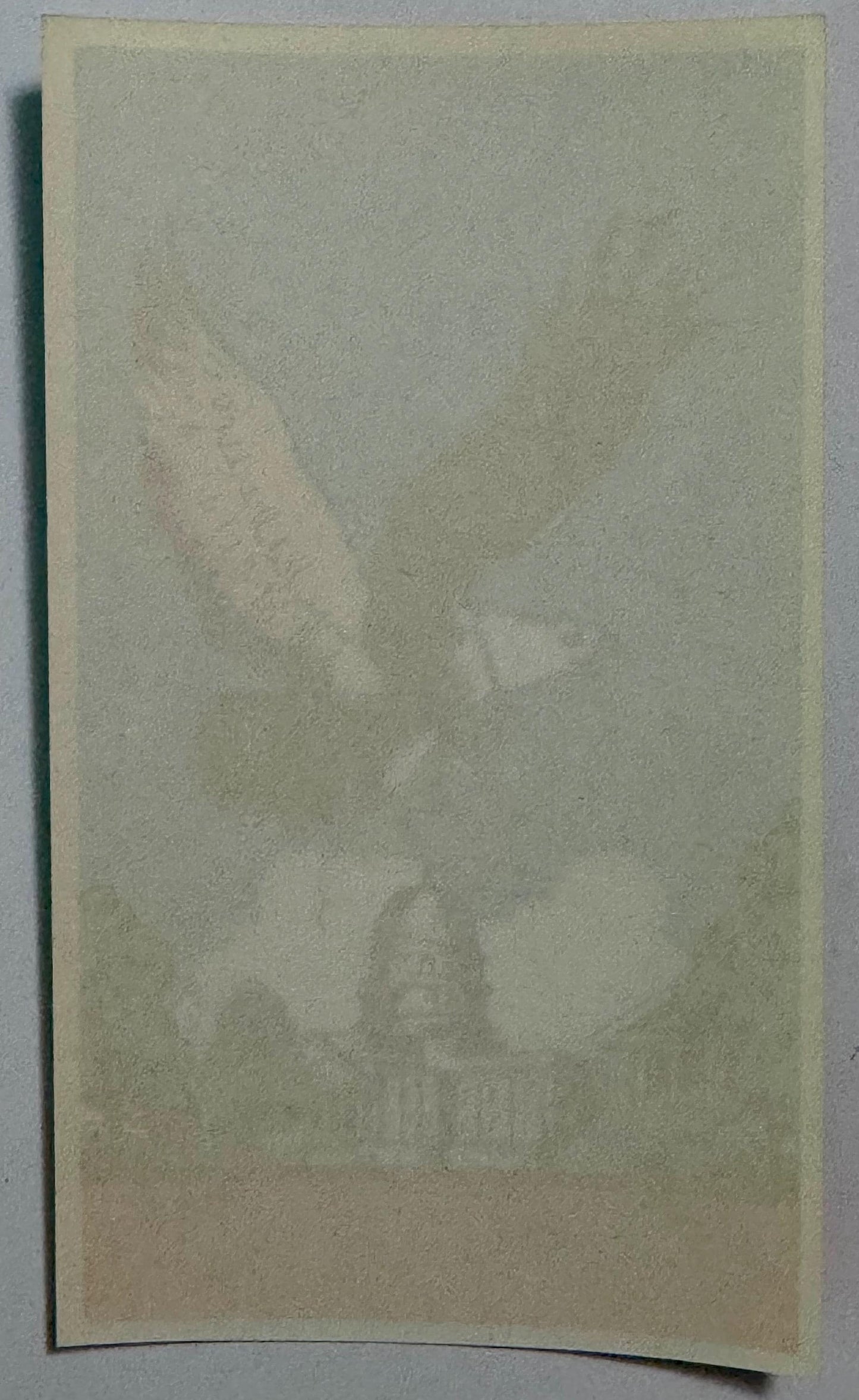
There is a particular kind of object that survives not because anyone planned to save it, but because it was too handsome to throw away. This lithographed broom label was printed to wrap around the handle of a working broom. It outlasted the broom, the company that made the broom, possibly the building where the broom was swept, and every practical purpose it was ever assigned. What remains is the eagle, banking hard over a neoclassical capitol dome with the easy authority of something that does not need to explain itself.

Six inches tall, three and a half inches wide, New Old Stock, never applied and never used, with the color still vivid and the edges still clean. This is not a reproduction and it is not a scan. This is the original.


🏷️ What This Is, Exactly

This is a vintage 1940s broom label, the decorative paper label broom manufacturers applied to handles or bundles of their finished product as a brand identifier and a point-of-sale draw. It is a full-color lithograph of a bald eagle in flight over a domed capitol, with trees and a bank of clouds, and a solid band at the base that was left open for the buyer to stamp their own name into. So it names no maker and no town, which is exactly what ties it to the stock-label side of the American broom industry, a story that runs deeper than most people outside the trade have ever been told.

The label is New Old Stock: it was printed, bundled and stored without ever being applied to a product. Whatever warehouse or back room held the stock was, in the end, the reason it survived at all.


🔢 Ordered by Number, Printed in the 1940s

In the broom trade this eagle was known by a number. Copies of the same picture carry a small "46 LITHO. IN U.S.A." foot line, and a loose copy turns up among Denning labels with no foot line at all. Numbered stock labels like it were sold by John L. Denning & Company of Wichita, Kansas, a broom-corn house that began in 1924 and grew to fourteen branches in different states. Denning's sample booklet carried one instruction on the cover, "Order by Number Only," and the company wouldn't take an order for fewer than 1,000 of any design.

The "NN LITHO IN U.S.A." line is the style on the pages of that booklet, and the booklet's "Wichita 1" postal-zone address means it was printed between 1943, when zones began, and 1963, when ZIP codes replaced them. That, and the eagle's place in the Denning numbered series, puts the printing in the 1940s. Old-fashioned art didn't date these things: the same booklet sold an Edwardian lady and a Victorian-style peacock right beside a cartoon bird in 1950s style.


🌾 The Broom Industry and Why It Needed Art

The American broom industry was not a modest trade. It was a serious manufacturing economy spread across several regional centers, each competing for shelf space in hardware stores, general mercantiles and the growing network of dry goods chains that stitched together small-town American commerce. Broom corn, a tall sorghum variety cultivated for its stiff, fibrous seed heads, was the raw material, and it flowed from midwestern farms into manufacturing towns in volume. The finished brooms needed to be sold, and before broadcast advertising, the label was the advertisement. It lived at the point of purchase and caught the eye at the hardware counter, and it said in a single image everything the manufacturer wanted the buyer to understand about the brand: quality, durability, pride, and, in the case of a patriotic label like this, something larger than a household cleaning tool.

The bald eagle over the capitol dome is not decoration. It is an argument. It says that this broom comes from serious people who take their work seriously, and they want you to know it. The artists behind stock designs like this were trained hands, people who understood how to use a limited palette to suggest motion, shadow and atmosphere. The open beak, the outstretched talons and the two wings, one catching full light and one pulling into shadow, are compositional decisions by someone who understood how birds move through air and could make a static image feel kinetic.


🖼️ Display Ideas

  • 🪞 Frame it as standalone art. A simple black or gilt frame with an off-white mat sets the eagle off beautifully. It reads as a finished illustration, not a commercial artifact, and will hold its own on any wall that respects American graphic history.
  • 🗺️ Group it with other vintage trade ephemera. Paired with period advertising, a railroad timetable or other household-goods labels, the eagle becomes the anchor piece of a commercial-art display.
  • 🦅 Build a patriotic ephemera vignette. Alongside other NOS labels, vintage postal covers or old trade cards with eagle and capitol imagery, it contributes to a cohesive visual story about how American identity was sold through commercial art.
  • 📚 Display it in a collector's reference library. Propped against books on American advertising and trade card history, it works as both decorative object and primary source.
  • 🏛️ Americana cabinet or curiosity shelf. Nestled among other small-format patriotic objects, such as political buttons, trade tokens and sheet music covers, its six-inch height makes it ideal for shelf display.
  • 🖼️ Float-mount under UV glass. For the serious paper collector, float-mounting makes the edges and paper texture part of the display while protecting the piece fully.

🎁 Who Collects These

Vintage broom labels and lithographed trade labels generally have a devoted collector community that spans several enthusiasms. Paper ephemera collectors, a category that includes trade cards, cigar labels, seed packets, fruit crate art and the full range of printed commercial material, are the natural home audience for a piece like this. They understand what NOS means, they know why never-applied condition matters, and they recognize the difference between a label stored flat and one that spent decades rolled or folded.

Americana collectors are a second strong constituency. The eagle-and-capitol imagery places the label in the tradition of American patriotic visual culture, which runs from the Federal-period eagles of the early republic through the full-throated commercial patriotism of the Progressive Era, when manufacturers understood that the bald eagle was not just a symbol but a sales tool of the first order. Collectors of printers' stock and unbranded trade ephemera form a third community, for whom an uncommitted brand panel is the specific point of interest. Finally, graphic design historians and illustration collectors have come to see the commercial label as a legitimate chapter in American art. The artists worked within real constraints (a limited palette, a small format, an image that had to read at arm's length across a hardware counter) and the best of them produced work that holds up as design by any standard. This eagle holds up.


❓ Frequently Asked Questions

What does "New Old Stock" mean for a paper label like this?

New Old Stock, NOS, means the item was produced but never put into use. For a broom label, that means it left the press and went into storage, never applied to a broom handle or bundle. For paper ephemera, NOS condition is the highest standard there is, because the color, the surface texture and the structural integrity of the paper are all in their original state. Nothing has been done to the label except time passing, and in this case, time passed gently.

How was it printed?

By lithography, the planographic process that prints from a flat surface holding ink only where the image was drawn. This is ordinary commercial lithography of the kind that turned out stock labels by the thousand: a handful of inks, with the soft tones in the wings and clouds built from fine dot screens rather than solid blended color. The "LITHO" in the series' foot line says exactly what the process was.

Is the eagle image on this label a standard design, or was it custom to one broom company?

It was a stock design. The numbered series was sold to many broom makers by number, so the same eagle could carry different companies' names in the open band, and the picture itself was never tied to a single client. That doesn't make it generic. The wing rendering and the placement of the capitol show a design that was taken seriously. The eagle does not feel generic. It feels intentional.

How should I store or display this label to preserve it long-term?

Paper ephemera of this age is best kept away from direct sunlight, high humidity and acidic materials. For storage, an archival polyester sleeve or acid-free envelope inside a flat, rigid archival box is the standard approach. For display, UV-filtering glass or acrylic is strongly recommended, because UV exposure is cumulative, and protecting the piece from unnecessary light is the single most important thing you can do to maintain its current condition.

Is the bald eagle a protected image in any way that affects collecting or resale?

Commercial images of the bald eagle, used as a symbolic or patriotic motif in trade labels, advertising art and ephemera, are historical artifacts and present no legal complications for collecting, display or resale. The Bald and Golden Eagle Protection Act governs the possession of actual eagle feathers, parts and, in some contexts, live birds, but it has no application to printed representations of the eagle. Eagle imagery on printed ephemera has been freely collected, traded, displayed and sold in the American antiques market for generations. You are buying a piece of printed paper, not a wildlife specimen.

How rare are NOS broom labels in this condition, and why did so few survive?

NOS broom labels in genuinely vivid, unapplied condition are meaningfully uncommon, and the reasons are straightforward. Labels were produced to be used. The default fate of a printed broom label was the broom handle, and the default fate of a labeled broom was decades of use followed by disposal. The survival of NOS stock depends almost entirely on a warehouse cache, a printer's overrun, or a shop owner's personal decision to keep what might otherwise have been discarded. These caches do surface, through estate sales, barn finds and the cleared-out back rooms of old commercial buildings, but they are not common, and the ones that surface in vivid condition represent the portion of whatever was stored that was protected from moisture, light and vermin. Someone decided it was worth keeping. They were right.

Shipping

🚚 Shipping & Handling

  • Shipping costs and timing are calculated at checkout.
  • Items curated and shipped directly by me include U.S. shipping at no additional cost, professionally packed to ensure safe arrival of your artifact.

Items from Vetted Pro Collectors
Shipping for items offered by vetted Pro Collectors is determined at checkout. All Pro Collector listings are reviewed to ensure fair, reasonable shipping practices.

For full details, please refer to our Shipping Policy.

Returns & Exchange

Take your time — you've got a full six months. If a piece isn't right for you, send it back the way it reached you and we're good.

In the first 30 days your money goes straight back the way you paid. After that it's store credit, so you can put it toward something you'd rather have.

Return shipping we sort out between us, case by case. I don't make this difficult.

If something arrives damaged, or it isn't what I said it was, send me a photo within 48 hours and I'll make it right.

Email info@vintageantiquesgifts.com or call 802-356-9872 — that's me answering, not a call center.

The only things I can't take back are custom or special-order pieces and gift cards.

View full details

Preserving History: Authentic Objects Across Eras

— Curated by Travis Weigel