Skip to product information
1 of 5

Vintage and Antique Gifts

Vintage Miss Priscilla Broom Label 🧹 – Hamburg Broom Works, Hamburg, PA Advertising Ephemera

Regular price 11.00 USD
Regular price Sale price 11.00 USD
Sale Sold out
Shipping calculated at checkout.

Description

🧹 Who Was Miss Priscilla, and Why Did a Broom Need a Lady's Name? 🧹

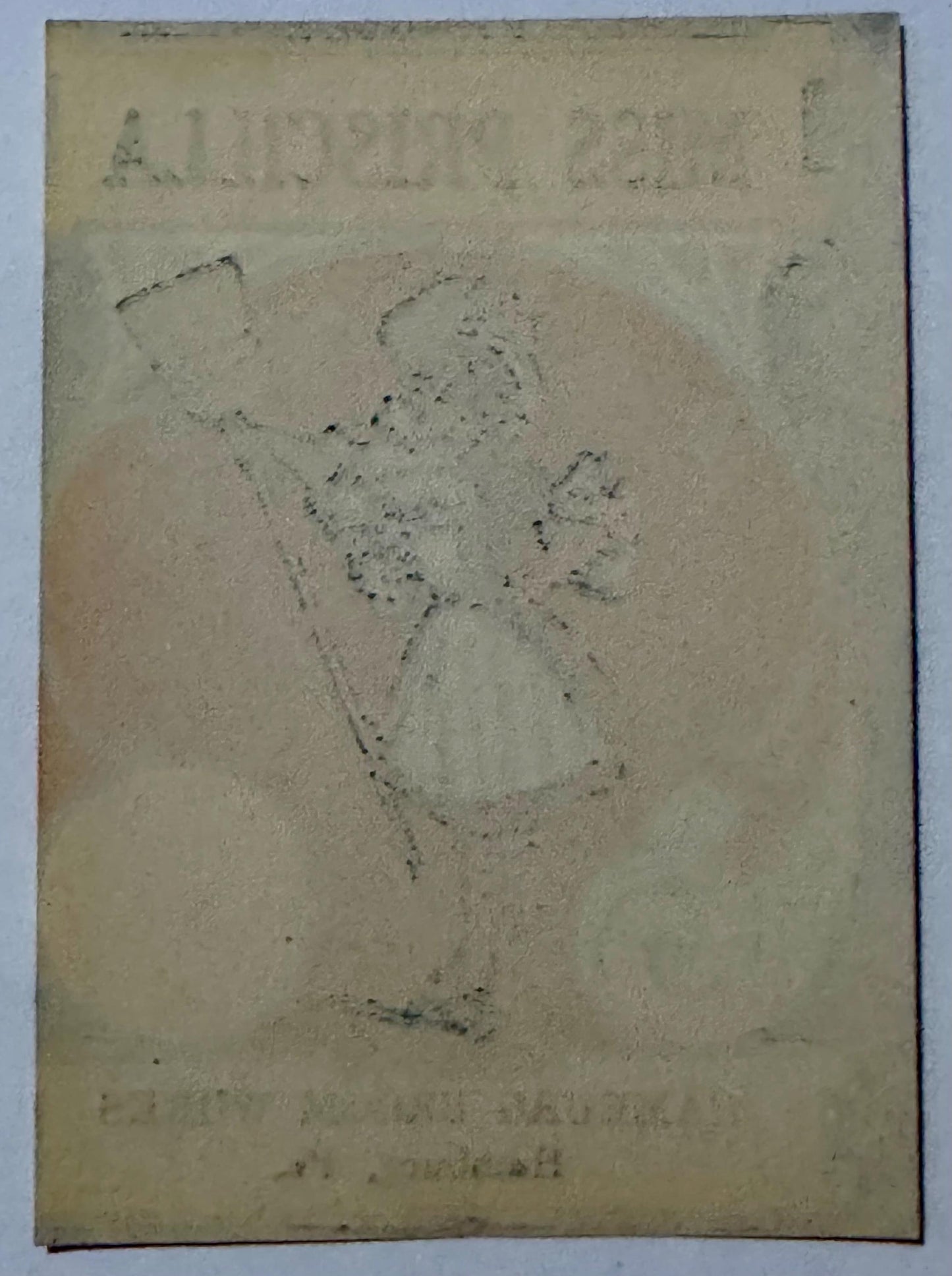
Long before anyone thought to put a barcode on a broom, a broom needed a personality. It needed a face, a name, a little painted lady standing proud in her bonnet and apron, holding her broom aloft like a scepter — because that was how a broom maker told you, right there on the handle, which grade of broom you were buying and whose good name stood behind it. This label is one of those faces: Miss Priscilla, forever caught mid-step in her navy bonnet and crisp apron, broom raised high against a field of red, framed in swirling Art Nouveau ironwork of teal and gold. She was the calling card of the Hamburg Broom Works of Hamburg, Pennsylvania — and she has outlasted the factory that made her.


📜 What You're Looking At

This is a piece of New Old Stock (NOS) advertising ephemera — a broom label produced for and by the Hamburg Broom Works of Hamburg, Pa., bearing the brand name "Miss Priscilla" in bold black lettering across a soft yellow banner. Below that banner, framed inside a red oval bordered in teal-green Art Nouveau scrollwork, stands the label's namesake herself: a young woman in a dark bonnet trimmed in white, her white pinafore apron over a navy dress, black stockings, and dark shoes, one arm akimbo and the other raised high, gripping the handle of a golden-bristled broom that stretches clean off the top of the card. Beneath her feet, the label closes out in a matching yellow band reading "HAMBURG BROOM WORKS / Hamburg, Pa." The whole design sits on a deep navy field, bordered top and bottom, with the sort of confident, storybook-illustration style that period broom, cigar, and produce labels were built on — bold outlines, flat saturated color, and a decorative border meant to catch a shopkeeper's eye across a general store. This label was never used — it comes to us new old stock, never applied to a broom handle, a clean surviving example of the printer's original run. Given its style and its kinship to other dated Hamburg Broom Works labels, it belongs to the broader era in which the company issued this style of illustrated brand label — roughly the early 1900s through the 1930s–1940s — though no exact printing date can be confirmed for this specific label.


🏭 The Hamburg Broom Works Story

The company behind Miss Priscilla was founded in 1894 by Wilson Schmick, who built his factory at 218 Pine Street in Hamburg, Pennsylvania. By 1912, the company was confident enough in its own operation to publish a promotional trade catalog boasting the title "Brooms: The Most Modern Broom Manufacturing Plant in the World" — and the numbers backed the bravado. At the time that catalog went to print, the plant was turning out 6,000 corn brooms a day, an output that placed it firmly among the larger broom manufacturers of its era. That same catalog walked customers through the plant's growing family of brands, each with its own name and purpose: the Eclipse, billed as "the finest of the silk ribbon brooms," the Model Garage broom built specifically for use on cement floors, along with whisk brooms and even broom-shaped toys. Miss Priscilla, and her documented sibling label "No. 1 Priscilla," clearly belonged to this same house style of naming every broom grade after a character — a marketing habit the company leaned on again and again, issuing labels for a "No. 7 Lady," an "Indian Queen," and locomotive-themed brands over the decades that followed. The company's corporate life stretched on for generations: it operated as a public company from 1923 to 1999, after which it went private and its assets folded into Hamburg Industries, Inc. — a firm that, in its later years, expanded beyond straw brooms into mops, brushes, and upright brooms as the market shifted around it. The plant is no longer operational today, but its footprint was significant enough to later warrant a federal EPA Superfund Site listing under the name "Hamburg – Broom Works, Inc." — a quiet, official reminder of just how large an industrial presence this small-town broom maker once was.


🏙️ Hamburg, Berks County, and the Broom Trade

Hamburg sits in Berks County, Pennsylvania, in a region with genuinely deep roots in broom-making. Henry H. Krouse is credited as the first major corn-broom manufacturer in nearby Reading, having started his business back in 1840, and by the later nineteenth century at least eight other broom makers were operating in Reading alongside him. Hamburg itself was no one-factory town, either — the Windsor Broom Company operated in Hamburg at the same time as Hamburg Broom Works, meaning Miss Priscilla and her sisters had real hometown competition on the shelf. Local lore passed down among broom-label collectors holds that Hamburg was once known, at least informally, as a broom capital in its own right, and that autumn air around town carried the dry, sweet scent of broomcorn stalks curing in the yards outside the factories — old-timers are said to have called it "the smell of prosperity." Whether or not that exact nickname was ever printed in a newspaper, it's the kind of detail that captures what this town must have felt like in broom season, when wagonloads of broomcorn rolled in by rail and the whole local economy leaned on the rhythm of the broom works' looms and winders.


👤 Wilson Schmick and the People Behind the Brand

Wilson Schmick, the founder of Hamburg Broom Works, was clearly a man of local standing — beyond the factory itself, he built a substantial home in Hamburg in 1909, a house that survives today and now operates as The Bismarck bed-and-breakfast, still standing as a tangible link to the man who built one of the town's largest employers. As for Priscilla herself — the bonneted, apron-clad figure striding across this label — no historical record ties her to a real, named person. Given the company's pattern of naming brooms after storybook women (a "Lady," a "Queen," a "Priscilla"), she was almost certainly a marketing invention rather than a flesh-and-blood woman: a colonial-tinged, homespun ideal of tidiness and hard work meant to appeal to the housewife choosing a broom off the shelf. That doesn't make her any less charming a hundred-plus years later — if anything, it makes her a small, perfectly preserved piece of turn-of-the-century American advertising instinct, dressing up a household tool in the imagery of a proper colonial housekeeper long before "vintage Americana" was a category anyone collected.


📉 The Vacuum Cleaner and the Slow Fade of the Broom Trade

The broom industry's long decline is well documented, and it has a very specific starting gun: in 1908, W. H. Hoover purchased Murray Spangler's patent and introduced the first electrified suction vacuum with a cloth filter bag — the invention historians point to as the beginning of the end for the corn-broom trade across Pennsylvania and the country at large. Hamburg Broom Works, remarkably, weathered that shift far longer than many of its peers, remaining a public company into 1999 and continuing on afterward as part of Hamburg Industries, Inc., broadening its product line to include mops and brushes as household cleaning habits modernized around it. That the company held on that long, through the entire rise of the vacuum cleaner and beyond, says something about how deeply rooted it had become in its town — and it's exactly that long, layered institutional life that makes a small paper label like this one worth holding onto: it's a genuine survivor from a company that outlasted the very technology that was supposed to replace it.


🏛️ Its Footprint on Hamburg Today

The physical plant that once turned out 6,000 brooms a day still occupies its old footprint in Hamburg, its brick walls and arched doorway entries visible in photographs alongside the same rail spur that once carried in raw broomcorn and carried out finished product. The Hamburg Area Historical Society maintains an active presence in town, keeping the memory of operations like this one part of the local record, while the Wilson Schmick house carries the founder's name into the present as a working bed-and-breakfast. For collectors of advertising ephemera, Americana, and small-town industrial history, labels like Miss Priscilla are often the last surviving trace of a company this size — the factory ledgers and payroll books are long gone, but a paper label meant to last one trip from warehouse to store shelf somehow survived instead, carrying the whole design language of a vanished industry in the palm of your hand.


🖼️ Display Ideas

  • 🧹 Paired with an antique corn broom or whisk broom for an authentic country-kitchen or farmhouse entryway vignette
  • 🖼️ Matted and framed alongside other early advertising labels — cigar box art, produce crate labels, feed sack graphics — for a themed Americana gallery wall
  • 🏠 Displayed in a laundry room, mudroom, or pantry as a nod to the household tools of an earlier era
  • 📚 Tucked into a scrapbook or ephemera album dedicated to Pennsylvania industrial and small-town history
  • 🛒 Set beside general-store or five-and-dime memorabilia to evoke the shopkeeper's counter where a broom like this once sold
  • 🎀 Shadow-boxed on its own to let the Art Nouveau scrollwork and bold color palette stand as a small piece of graphic art in its own right

🎁 Who Collects These

Miss Priscilla appeals to a wide circle of collectors: advertising ephemera and label enthusiasts who chase down brand names and printers town by town; Pennsylvania and Berks County local-history collectors building out a record of Hamburg's industrial past; Americana and folk-art decorators drawn to the bold, illustrated female "brand mascots" so common in early twentieth-century packaging; and household-tool historians tracing the corn broom's long run before the vacuum cleaner changed everything. It's also a natural pickup for anyone assembling a set — since Hamburg Broom Works issued a whole family of named labels (the "No. 1 Priscilla," "No. 7 Lady," "Indian Queen," and locomotive-branded lines among them), collectors often chase down as many of the company's characters as they can find.


❓ FAQ

Was Miss Priscilla a real person?

No documentation ties the name to an actual historical figure. She appears to have been a brand persona, in keeping with Hamburg Broom Works' habit of naming its broom lines after storybook women and characters — a "Lady," a "Queen," and a "Priscilla" among them.

How old is this label?

The manufacture mark isn't legible enough to confirm an exact print date. Based on comparable, dated Hamburg Broom Works labels, this style of illustrated brand label falls broadly within the early 1900s through the 1930s–1940s, the span during which the company was actively issuing labels of this kind.

Was this label ever used on a broom?

No — this is new old stock, an unused surviving example of the printed label itself, never applied to a finished broom handle.

What is the label made of, and how was it printed?

It's a lithographed/offset color print on paper stock, using the flat, bold color-block style typical of early advertising labels, finished with a decorative Art Nouveau scrollwork border in teal, gold, and navy.

Is Hamburg Broom Works still in business?

The original company operated as a public entity from 1923 through 1999, later continuing as part of Hamburg Industries, Inc., before the plant ultimately ceased operations.

Are there other Hamburg Broom Works labels like this one?

Yes — the company issued a range of named brand labels over the years, including a companion "No. 1 Priscilla" label, a "No. 7 Lady," an "Indian Queen," and locomotive-themed brands, all part of the same broom works' long-running product line.

What condition is this label in?

This is a new old stock example — genuine, unused surviving stock from the era in which Hamburg Broom Works was producing these labels, an excellent piece of early American advertising art in its own right.

Shipping

🚚 Shipping & Handling

  • Shipping costs and timing are calculated at checkout.
  • Items curated and shipped directly by me include U.S. shipping at no additional cost, professionally packed to ensure safe arrival of your artifact.

Items from Vetted Pro Collectors
Shipping for items offered by vetted Pro Collectors is determined at checkout. All Pro Collector listings are reviewed to ensure fair, reasonable shipping practices.

For full details, please refer to our Shipping Policy.

Returns & Exchange

Take your time — you've got a full six months. If a piece isn't right for you, send it back the way it reached you and we're good.

In the first 30 days your money goes straight back the way you paid. After that it's store credit, so you can put it toward something you'd rather have.

Return shipping we sort out between us, case by case. I don't make this difficult.

If something arrives damaged, or it isn't what I said it was, send me a photo within 48 hours and I'll make it right.

Email [email protected] or call 802-356-9872 — that's me answering, not a call center.

The only things I can't take back are custom or special-order pieces and gift cards.

View full details