
Skip to product information
1 of 4

Vintage and Antique Gifts

Vintage 1960s Pursuit Brand Crate Label ✈️ Exeter Fruit Association California, Propeller Fighter Plane, Unused NOS

Vintage 1960s Pursuit Brand Crate Label ✈️ Exeter Fruit Association California, Propeller Fighter Plane, Unused NOS

Regular price $7.00 USD
Regular price Sale price $7.00 USD
Sale Sold out
Shipping calculated at checkout.

Size: 13" x 4"

🚚 Free US Shipping — ships within one business day. International shipping calculated at checkout.

Quantity

Who Packed Pursuit Brand in Exeter? A Fighter Plane Named With a Word the Air Force Had Already Retired

Size: 13" x 4"

Look at the address on this label: "Exeter, California 93221." That five-digit number is a ZIP code, and ZIP codes did not exist until July 1, 1963. Now look at the brand: Pursuit, with a propeller fighter tearing across a navy sky. "Pursuit" was the old American word for a fighter plane. The famous 1st Pursuit Group of 1918 had become the 1st Fighter Group by May 1942. On June 11, 1948, the new U.S. Air Force retired the P for Pursuit in its aircraft names and began using F for Fighter. So an Exeter fruit house was still selling under a pilot's word at least fifteen years after the Air Force stopped using it, on a label printed in the ZIP code age. It is a bright piece of San Joaquin Valley pride: the propeller age, kept flying on a label meant for a fruit box.

The Label

An original Pursuit Brand fruit crate label, new old stock, never applied to a box, measuring 13 x 4 inches, the long narrow format made for the end of a wooden lug. It is printed in bold color on paper, and the back is blank cream with only a faint mirror-image ghost of the front showing through.

Across the left, PURSUIT climbs in huge shadowed block letters, tilted as if the word itself is taking off. Above it: "Grown and Packed by Exeter Fruit Association, Exeter, California 93221." In the middle sits the Blue Anchor roundel of the California Fruit Exchange. On the right, a single-engine propeller fighter streaks in from the edge, its propeller a see-through spinning disc, exhaust stacks along the nose, and a pilot in goggles under a framed canopy, with speed lines trailing behind. "Produce of U.S.A." runs across the top right and "Reg. U.S. Pat. Off." sits beneath the tail.

Dating It: The ZIP Code and the Anchor

No year is printed on this label, so its words do the dating. The ZIP code 93221 puts the printing on or after July 1, 1963. The anchor still reads "California Fruit Exchange," the name the cooperative carried until 1969, when it took its famous trademark as its company name and became Blue Anchor, Inc. Between the two, this Pursuit label was printed in the 1960s.

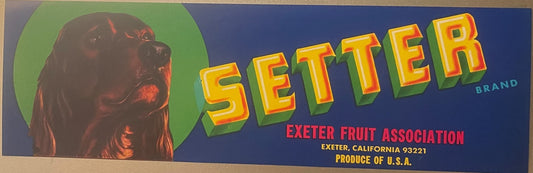
Here is a nice wrinkle, though: the Pursuit name is older than this printing, and that little "Reg. U.S. Pat. Off." under the tail is the real thing. The Exeter Fruit Association first used PURSUIT on October 20, 1939, and the U.S. Patent Office registered it on January 20, 1942 (No. 392,984) as a brand for fresh grapes. So the brand was born while "pursuit" was still the Army's own word for a fighter plane, and the registration stayed on the books until 2002. Pursuit wasn't the association's only grape brand, either. Its Setter brand had been in use since May 1928 and was registered in 1950.

An Exeter Shipper Under the Blue Anchor

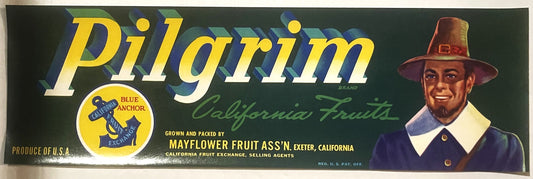
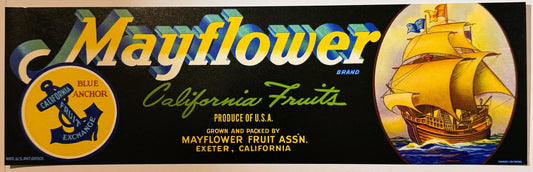
The label names its grower and packer plainly as the Exeter Fruit Association, and the anchor tells you how that fruit reached market. Growers from across the state incorporated the California Fresh Fruit Exchange in 1901 and renamed it the California Fruit Exchange in 1903. Fruit growers' associations from Loomis, Newcastle and Penryn were members from the day it incorporated, May 1, 1901. From its Sacramento headquarters it sold members' fruit under the Blue Anchor brand. The anchor on this label goes back almost to the start. George H. Cutter, one of the Exchange's founders, suggested it as early as 1903. It was first used in 1904, slowly became the company's emblem, and in 1923 it was registered as a trademark for the Exchange's top-quality fruit. At its peak the Exchange represented about 1,000 growers of tree fruits and table grapes, along with papayas, kiwi and European cucumbers raised in California, Arizona, Hawaii, Chile, Mexico and New Zealand, and its primary markets reached more than 300 towns and cities in North America. With gross sales of over $60 million in 1981, it was described as the world's largest deciduous fruit marketing cooperative. Deciduous fruit means tree fruit like peaches, plums, pears and cherries, from trees that drop their leaves each winter.

Its headquarters, the Blue Anchor Building in Sacramento, was built in 1931 in the Spanish Colonial Revival style to designs by the firm Starks and Flanders, housed the Exchange from 1932 to 1966, and was listed on the National Register of Historic Places on February 3, 1983. The cooperative carried on under the Blue Anchor name until 2000, when it announced that one of the last mighty fruit marketing cooperatives was packing it in after nearly 100 years.

Exeter, California

Exeter grew up beside the railroad. By 1888 tracks had reached this part of the San Joaquin Valley, and D.W. Parkhurst, a Southern Pacific Railroad representative, bought land from early settler John Firebaugh and formed a town he named after his hometown of Exeter, England. It incorporated on March 2, 1911. The town sits in Tulare County near the Sierra Nevada foothills, and ranching grew there on a grand scale: the Gill Cattle Company was once the largest such business in the United States.

Fruit packing shaped the town, and the cardboard carton reshaped fruit packing. Local growers formed the Exeter Citrus Association in October 1925, and in 1954 it was among the first packing houses to convert from wooden boxes to cardboard cartons, the switch that ended the working life of most paper crate labels. Don't mix that house up with the one on this label. The Exeter Citrus Association is a Sunkist citrus house, merged in 2000 into today's Exeter-Ivanhoe Citrus Association, which sells all its citrus through Sunkist. The Exeter Fruit Association was a separate outfit that sent its grapes to market under the Blue Anchor. It's an easy mix-up, since Sunkist itself went by the California Fruit Growers Exchange until 1952. Exeter's history carries hard chapters too. In October 1929 a mob stormed a Filipino work camp there, beating 50 Filipino laborers and burning their camp to the ground, part of the story of the people who worked the valley's harvests. Today 31 murals of regional history cover downtown walls, and the 2020 census counted 10,321 residents.

The Last Years of the Paper Label

Paper crate labels first appeared in the United States in the 1880s, when advances in lithographic printing and the spread of the railroads let growers ship far and made them want boxes that stood out in distant markets. Pre-printed cardboard cartons, with the brand printed straight onto the box, gradually took their place. A label carrying a ZIP code comes from the tail end of that story, when some houses were still ordering paper labels for wooden lugs.

That ending is why unused labels exist at all. When the cartons took over, large quantities of labels were left behind in packing sheds and printing houses, and the collectors' market grew out of those leftovers, along with lithographers' proofs and warehouse finds. This Pursuit was never pasted to a box.

Pursuit: From the Western Front to a Fruit Box

The word on this label has a real war history. On May 5, 1918, the American Expeditionary Forces formed the 1st Pursuit Group at Toul-Croix de Metz Aerodrome in France. Eddie Rickenbacker, who became an ace over the Toul sector that spring, finished the war with 26 victories, and Quentin Roosevelt, Theodore Roosevelt's youngest son, was shot down and killed flying with the group's 95th Aero Squadron on July 14, 1918. The group became the 1st Fighter Group on May 15, 1942, and on June 11, 1948 the U.S. Air Force redesignated its P-80C jets as F-80Cs, part of the switch from P for Pursuit to F for Fighter that ended the word's official life.

The artist behind this label kept all of that romance. The plane carries no insignia or markings that name a model; it is simply a single-engine propeller fighter at full speed beside a brand name that also means speed.

ZIP Codes, Mr. ZIP and the Swingin' Six

The number that dates this label has its own story. In May 1943 the Post Office Department set up postal zones for 124 large cities, to help inexperienced clerks sort mail while experienced postal workers went into the army. Robert A. Moon, a postal inspector, proposed a national code in 1944 and is remembered as the father of the ZIP Code, short for Zone Improvement Plan. Non-mandatory five-digit ZIP Codes were introduced nationwide on July 1, 1963. The Post Office promoted them with a cartoon character called Mr. ZIP, a name coined by postal executive D. Jamison Cain, who appeared on postage stamps and in promotions that included a variety show with the Swingin' Six. In 1967 ZIP Codes became mandatory for second- and third-class bulk mailers, after which the system was widely adopted.

Who It Is For

Crate label collectors who want a named San Joaquin Valley shipper with the Blue Anchor mark; aviation fans, pilots and veterans; anyone with roots in Exeter or Tulare County; and lovers of bold commercial lettering. Its long shape frames beautifully over a desk, a doorway or a bookshelf.

Questions People Ask

How old is this Pursuit crate label?
From the 1960s. The ZIP code in its address did not exist before July 1, 1963, and the Blue Anchor roundel uses the Exchange's old name, which changed in 1969.

Is it an original or a reproduction?
An original label printed for a fruit box and never pasted onto one.

What airplane is on it?
An artist's single-engine propeller fighter at speed, with no markings that identify a model.

What is the Blue Anchor?
The brand of the California Fruit Exchange, the Sacramento grower cooperative founded in 1901 that marketed fresh deciduous fruit for nearly a century.

How big is it?
13 by 4 inches.

Is the back clean?
Yes, blank cream paper with a faint ghost of the front printing.

Shipping

🚚 Shipping & Handling

  • Shipping costs and timing are calculated at checkout.
  • Items curated and shipped directly by me include U.S. shipping at no additional cost, professionally packed to ensure safe arrival of your artifact.

Items from Vetted Pro Collectors
Shipping for items offered by vetted Pro Collectors is determined at checkout. All Pro Collector listings are reviewed to ensure fair, reasonable shipping practices.

For full details, please refer to our Shipping Policy.

Returns & Exchange

Take your time — you've got a full six months. If a piece isn't right for you, send it back the way it reached you and we're good.

In the first 30 days your money goes straight back the way you paid. After that it's store credit, so you can put it toward something you'd rather have.

Return shipping we sort out between us, case by case. I don't make this difficult.

If something arrives damaged, or it isn't what I said it was, send me a photo within 48 hours and I'll make it right.

Email info@vintageantiquesgifts.com or call 802-356-9872 — that's me answering, not a call center.

The only things I can't take back are custom or special-order pieces and gift cards.

View full details
  • 5 stars: 2 (100%)
  • 4 stars: 0 (0%)
  • 3 stars: 0 (0%)
  • 2 stars: 0 (0%)
  • 1 star: 0 (0%)
g
g***s (245)

Good quality label. Great graphics. Great condition. Highly recommend this seller.

n
n***2 (2587)

Good deal good job and a pleasure doing business with you. One of e bays best.

Preserving History: Authentic Objects Across Eras

— Curated by Travis Weigel