

Skip to product information
1 of 4

Vintage and Antique Gifts

Vintage 1950s-60s Liberty Broom Label 🧹 NOS Statue of Liberty Patriotic Lithographic Advertising Art

Vintage 1950s-60s Liberty Broom Label 🧹 NOS Statue of Liberty Patriotic Lithographic Advertising Art

Regular price $9.00 USD
Regular price Sale price $9.00 USD
Sale Sold out
Shipping calculated at checkout.

Size: 6" x 3 1/2"

🚚 Free US Shipping — ships within one business day. International shipping calculated at checkout.

Quantity

What Does It Mean When Something That Was Never Supposed to Survive — Does? 🗽

Size: 6" x 3 1/2"

There is a particular kind of melancholy that attaches itself to ephemera. Not sadness, exactly — more like the bittersweet awareness that the things designed to disappear are the ones that tell us the most about who we were. A broom label was never meant to be collected. It was never meant to be framed, studied, or passed between careful hands at an antique show. It was meant to be glued to a broom handle in a hardware storeroom and ridden out the door with a customer who needed to sweep the porch. The very fact that this one didn't — that it slipped through the cracks of American commercial history still unused, still vivid, still carrying every color and contour it had on the day it came off the press — is what makes it so quietly extraordinary. Hold it and you are holding the thing that almost vanished. That's the nostalgic gut-punch. That's why collectors come for ephemera and stay forever.

What This Is, Exactly 🧹

This is an original vintage Liberty broom label from the 1950s or '60s, and it is New Old Stock, NOS in collector shorthand: printed, put into inventory, and never applied. It has never touched adhesive. It has never been glued to a handle, never sat on a dusty hardware shelf long enough to yellow at the edges, never suffered the indignity of being peeled away by a curious child or a bored stockroom clerk.

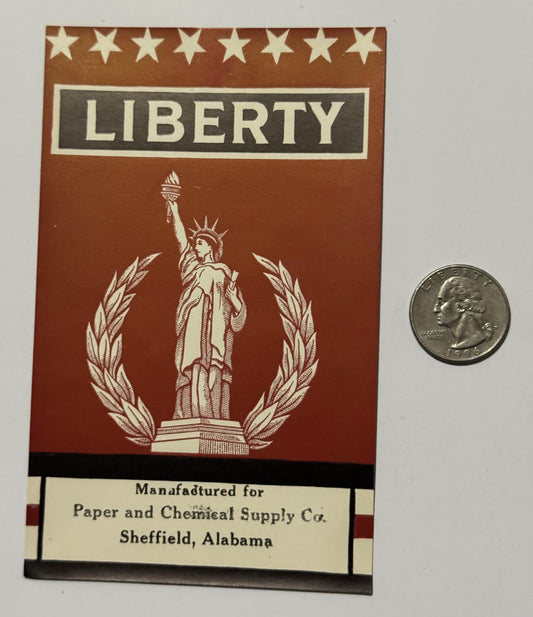
Look down in the bottom margin and you'll find two small things that tell you exactly what it is: the number 107 and PRINTED IN U.S.A. That's a stock design number, and the empty panel above it is the other half of the story.

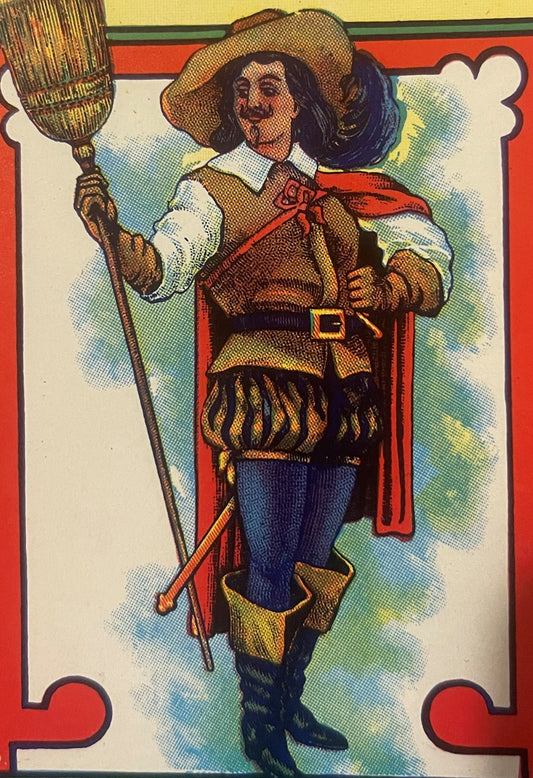
Patriotism was a shared national grammar on American store shelves, and this label speaks it fluently: LIBERTY in a box, eight stars, and Lady Liberty with her torch up, inside a laurel wreath that reads like a medal.


🏭 The Art and Industry of the Broom Label — America's Most Overlooked Commercial Canvas

To understand why a broom label matters, you have to understand what the broom industry was in early twentieth-century America. This was not a cottage trade. By then, broom manufacturing had consolidated into a serious regional industry, centered largely in the Midwest and reaching into the South and Mid-Atlantic states, built around the cultivation and processing of broomcorn — a variety of sorghum whose stiff, fibrous stalks were bundled, trimmed, and bound to wooden handles with wire and string in factories that ran year-round.

The industry had its own commodity markets, its own labor politics, its own trade publications. And it had ferocious competition. A hardware store might carry half a dozen broom brands, all roughly equivalent in construction, all fighting for the same wall hook, the same customer's dollar. The label was the product's entire marketing department.

It had to work instantly. It had to communicate quality, trustworthiness, and value in the two seconds a customer's eye moved across the shelf, and the most powerful shorthand a label designer could reach for was patriotic imagery.

The Statue of Liberty, gift of France and dedicated in 1886, had long since become fully American. She appeared on war bonds, on recruitment posters, on the mastheads of newspapers, and yes, on the paper wrapped around broom handles in hardware stores from Maine to Oregon. The Liberty broom label is not a curiosity at the margins of this story.

It is a primary document of it.

🧹 Ordered by the Number

Most broom factories didn't commission their own label art. They picked a design out of a sample book and ordered it by number. One of those books, from John L. Denning & Company of Wichita, Kansas, a broom-corn house that started in 1924 and grew to fourteen branches, reads "Order by Number Only" and "Orders Not Accepted for Less Than 1000 of Any Design". Its labels carry the same kind of small design number and LITHO or PRINTED IN U.S.A. line as this one, and the book's "Wichita 1" postal-zone address puts it between 1943 and 1963. Another label from the same numbered family, design 111, carries a ZIP code, so it was printed in 1963 or later. That's the family this Liberty label belongs to, and it puts it in the 1950s or '60s.

The blank panel was the whole point. A broom maker, or the supply house that sold its brooms, had its own name printed in there. A Sheffield, Alabama supply house did exactly that with another Liberty design from the same family: "Manafactured for Paper and Chemical Supply Co., Sheffield, Alabama", misprint and all. These never got a name, so they're just as they came off the press, printed in flat, solid inks the way mid-century label printers turned them out by the thousand.

🗽 The Statue of Liberty as Commercial Icon — Her Second Life in American Advertising

Lady Liberty had barely finished greeting immigrants through New York Harbor before American commerce claimed her as its own. Through the twentieth century she was the most versatile patriotic symbol in the commercial artist's repertoire — more flexible than the eagle, more immediately legible than the flag, and carrying a weight of meaning that resonated with the enormous immigrant consumer population that had passed beneath her torch on their way to becoming Americans.

A broom labeled with her image was, in its quiet way, making an argument: this is an American product, made by American workers, for American homes.

The name Liberty, paired with her image, was a serious commercial asset, and whoever picked this design out of the book knew exactly what they were doing with it.


🖼️ Display Ideas — Ways to Live With This Label

  • 🪟 Frame it solo in a deep-set shadowbox against a cream or natural linen mat — the navy field and red banner will read like a miniature oil painting, and the 6 x 3.5-inch format suits any gallery wall without overwhelming it.
  • 🏛️ Group it with other NOS patriotic paper ephemera — seed labels, cigar bands, trade cards — in a multi-opening frame for a salon-style display that tells the full story of American commercial lithography in one wall grouping.
  • 🛒 Install it in a vintage general store or farmhouse kitchen vignette alongside period hardware, wooden crates, and early American advertising tins — it will anchor the display as the authentic document it is.
  • 📚 Archive it properly in a Mylar sleeve inside an archival portfolio for a collector who prioritizes preservation — this NOS piece has survived this long in extraordinary condition, and proper archival housing will carry it forward another century.
  • 🎨 Feature it as the centerpiece of a Statue of Liberty collection — it holds its own alongside trade cards, postcards, and souvenir medals as one of the most unexpected formats the icon ever turned up in.
  • 🧹 Display it as part of a broom and household-goods advertising collection — this is one of the most graphically compelling labels from the category, and it lends immediate visual authority to any such grouping.

🎁 Who Collects These — and Why They Come Back

The collectors who seek out vintage paper advertising labels like this one are a specific and deeply knowledgeable community, and they tend to arrive from several different directions. There are the Americana specialists — collectors who have built lives around the visual culture of early twentieth-century America and understand immediately what it means when a piece of NOS commercial art survives with this degree of vividness and integrity.

For them, condition is everything. Then there are the Statue of Liberty completists — and yes, they exist, and they are serious. Lady Liberty appears in hundreds of formats across American material culture: postcards, souvenir spoons, pressed glass, trade cards, ribbon badges, sheet music covers — and an original NOS broom label featuring her in full figure is a format most of them have never seen, which makes this an automatic acquisition for anyone building a comprehensive Liberty collection.

There are the advertising art collectors who come for the lithography itself — for the quality of the color work, for the design confidence of the era, for the mid-century label-printing trade that is gone now. And there are the gift-givers: people who know someone turning sixty or seventy who grew up with this kind of Americana as wallpaper — literally and figuratively — and who understand that a piece of original period advertising art is a more meaningful and lasting gift than anything newly manufactured could be.

Across all of these collector types, the same qualities matter: authenticity, condition, and the resonance of the image. This label has all four.


❓ Frequently Asked Questions — What Collectors Ask About This Label

What does NOS mean, and why does it matter so much for a piece like this?

NOS stands for New Old Stock — a term used across collecting categories to describe items that were manufactured and placed in inventory but never sold, used, or applied. For paper ephemera like this broom label, NOS status is transformative. An applied label would have been glued to a wooden handle, potentially exposed to moisture, heat, handling, and wear, and eventually discarded with the broom itself. A NOS label skipped all of that. It has never touched adhesive. It has never been rolled, folded, or trimmed. It exists exactly as it left the press — which is why the colors on this piece are not faded approximations of what they once were, but the genuine, saturated palette the original designer and printer intended. Most commercial labels of this era were consumed exactly as intended — by commerce, by use, by time. The ones that survived without being applied tend to have done so through very specific accidents of storage and neglect, which is the beautiful irony at the heart of NOS collecting: the pieces that were overlooked are the ones that endured.

Is the color really as vivid as it looks? What condition is this label in?

Yes — the color is genuinely vivid. This is one of the qualities that stops people when they encounter a piece like this: the expectation, reasonable and learned from experience with old paper goods, that the colors will be muted, browned, or faded. With NOS labels that have been stored away from light and moisture, that expectation is simply wrong. The navy blue field on this label is deep and saturated. The red banner is fully realized — not orange, not rust, not brick, but red, the way it was printed. The white figure and lettering are clean and crisp. What you are looking at is the actual printed object in the actual printed condition. Printing inks that are kept away from UV light and moisture are remarkably stable. The very storage conditions that kept this label from being used also kept it from degrading. It is not a miracle of preservation — it is simply what happens when a well-made object is left alone.

How was this label printed, and does that affect its value?

It's a mid-century commercial label in flat, solid inks, printed as stock design 107 (the number sits in the bottom margin beside PRINTED IN U.S.A.) for broom makers who ordered their labels by the thousand. Its value comes from the design, its condition, and the fact that it survived unused.

How does this fit into a Statue of Liberty collection?

Statue of Liberty collecting is a well-established specialty within American memorabilia, with dedicated collectors who track the icon across dozens of categories: souvenir ceramics, pressed glass, ribbon badges, trade cards, postcard sets, sheet music, cigar bands, and more. Within that collecting universe, original paper advertising labels from the mid-century are an unusual and often underrepresented format. Most Liberty collectors will have multiples of the common souvenir categories and will be actively looking for pieces they've never seen before — pieces that demonstrate the reach of the icon into everyday American commerce. A broom label is exactly that kind of piece: unexpected and format-specific. The full-figure representation of Liberty within the laurel wreath, with the torch raised and the tablet at her side, is iconographically complete — this is Lady Liberty rendered with full fidelity to her established visual identity, not a simplified or abbreviated version. For a collector building toward comprehensiveness, this is an important acquisition.

What size is this label, and how should I display or store it?

The label measures 6 inches by 3.5 inches — a format that is intimate enough to be displayed in a small frame or shadowbox and substantial enough to read clearly as a stand-alone piece. For display, a deep-set shadowbox with an archival mat in cream or natural linen will allow the navy field to project without contact with the glazing, and UV-filtering glass or acrylic will protect the colors from light degradation going forward. For storage rather than display, a Mylar or polyester archival sleeve, housed flat in an archival portfolio or box, is the appropriate approach — standard practice among serious paper ephemera collectors. Given that this label has survived better than half a century in remarkable condition, proper archival housing will carry it forward indefinitely. The label should not be folded, rolled, or subjected to temperature or humidity extremes.

Is this a reproduction? How can a collector be confident in the age?

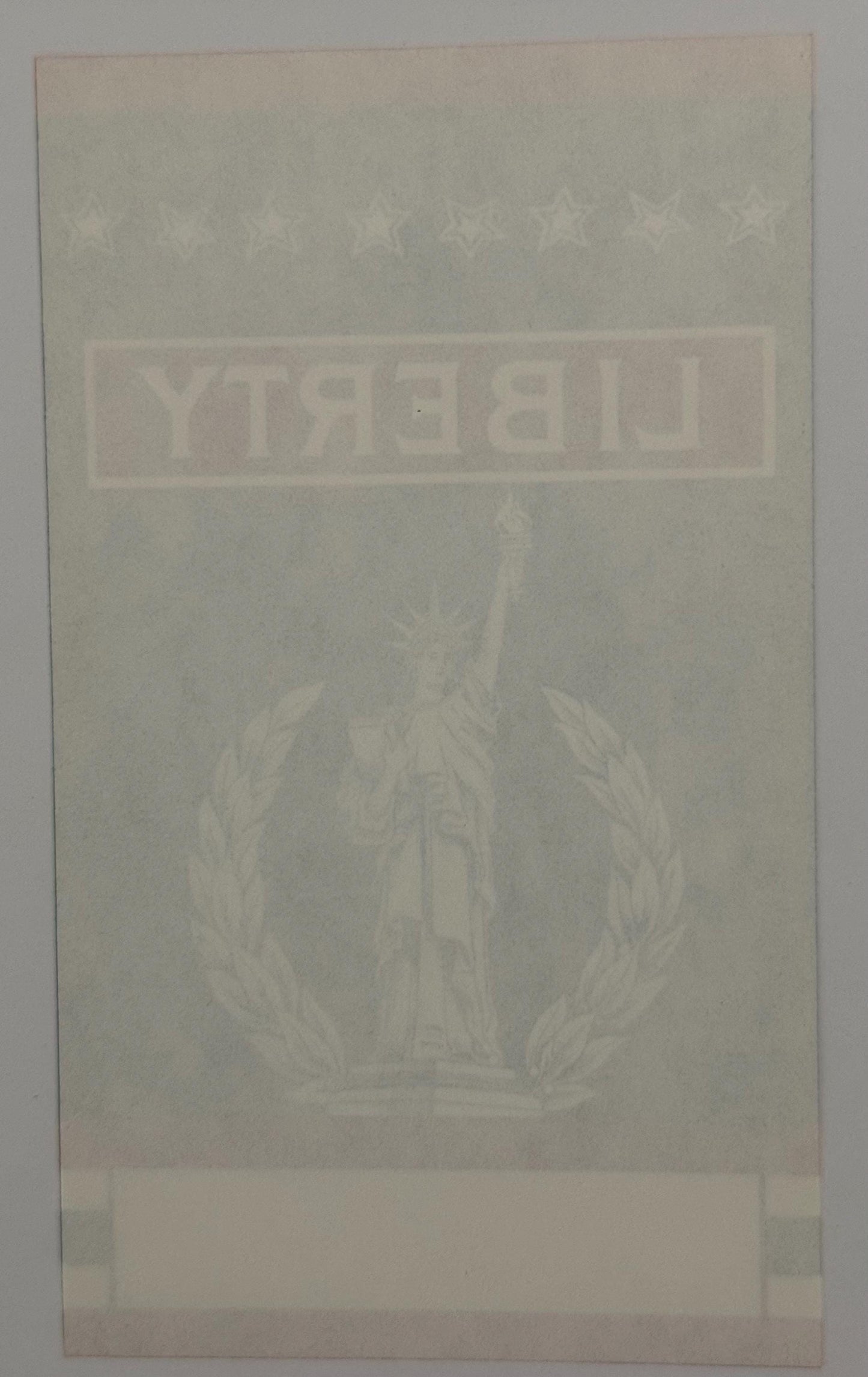
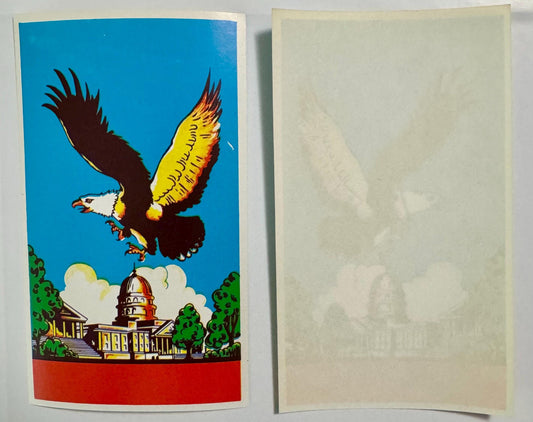
This is an original label, not a reproduction. It carries its printer's design number, 107, and PRINTED IN U.S.A. in the bottom margin, the same way the other numbered stock broom labels of its family do, and it is new old stock that was never applied. The back is plain paper with the design showing through faintly, the way thin label stock does.

Is a broom label a serious collectible, or is this more of a decorative curiosity?

Vintage broom labels occupy a respected position within the broader field of American advertising ephemera collecting, and the most serious paper ephemera specialists treat them as primary historical documents — which is exactly what they are. The American broom industry was a significant manufacturing sector for generations, and the labels produced for it were designed by trained commercial artists, printed by skilled lithographers, and distributed through established trade networks. They reflect the visual culture, the commercial priorities, the patriotic feeling, and the printing craft of their specific historical moment more directly and honestly than almost any other class of object, because they were made for immediate use without any expectation of preservation. That is precisely what gives surviving NOS examples their authority: they were not made to impress posterity, and they impress it anyway. Collectors of Americana, advertising art, paper ephemera, Statue of Liberty material, and early twentieth-century patriotic imagery all have legitimate reasons to want this piece, and the overlap between those collecting communities is where the real depth of interest lies.

Shipping

🚚 Shipping & Handling

  • Shipping costs and timing are calculated at checkout.
  • Items curated and shipped directly by me include U.S. shipping at no additional cost, professionally packed to ensure safe arrival of your artifact.

Items from Vetted Pro Collectors
Shipping for items offered by vetted Pro Collectors is determined at checkout. All Pro Collector listings are reviewed to ensure fair, reasonable shipping practices.

For full details, please refer to our Shipping Policy.

Returns & Exchange

Take your time — you've got a full six months. If a piece isn't right for you, send it back the way it reached you and we're good.

In the first 30 days your money goes straight back the way you paid. After that it's store credit, so you can put it toward something you'd rather have.

Return shipping we sort out between us, case by case. I don't make this difficult.

If something arrives damaged, or it isn't what I said it was, send me a photo within 48 hours and I'll make it right.

Email info@vintageantiquesgifts.com or call 802-356-9872 — that's me answering, not a call center.

The only things I can't take back are custom or special-order pieces and gift cards.

View full details

Preserving History: Authentic Objects Across Eras

— Curated by Travis Weigel