Skip to product information
1 of 4

Vintage and Antique Gifts

Vintage 1950s William Tell Brand Apples Crate Label 🍎 R.N. Barber & Co. Waynesville NC Chromolithograph Fruit Crate Advertising Art

Vintage 1950s William Tell Brand Apples Crate Label 🍎 R.N. Barber & Co. Waynesville NC Chromolithograph Fruit Crate Advertising Art

Regular price $6.00 USD
Regular price Sale price $6.00 USD
Sale Sold out
Shipping calculated at checkout.

Size: 9" x 8"

🚚 Free US Shipping — ships within one business day. International shipping calculated at checkout.

Quantity

Who Grew William Tell Apples? 🏹 A Sure Shot From an Orchard That Is Gone: William Tell Brand Apples of Waynesville, N.C.

Size: 9" x 8"

The orchard that shipped William Tell apples was foreclosed in 1988, cut into 170 parcels, and later placed on the federal Superfund list. What is left of the brand is paper like this: a 1950s crate label from R.N. Barber & Co. of Waynesville, North Carolina, where a bearded Swiss marksman sights down a crossbow at a barefoot boy with an apple balanced on his head. It borrowed a legend set in 1307 to promise "A Sure Shot to Finest Quality," and it rode on crates from a Haywood County mountainside that once carried 30,000 bearing apple trees.


🔍 What Is on the Label

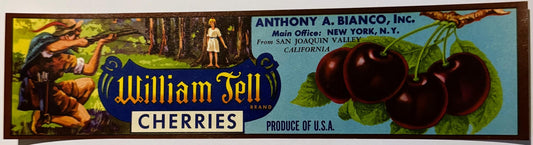
The scene fills the whole sheet. At left stands the archer, William Tell himself: blond beard, brown hat with a long pink feather, a loose blue tunic cinched with a red belt, yellow hose with orange cross-laced leg wrappings. He holds a wooden crossbow to his cheek with the bolt loaded and aimed across the sky. At right, a barefoot blond boy in a rust-red shirt and green shorts stands with his hands on his hips against the trunk of a great shade tree, a red apple on his head. Between them, three slender trees stand on a ridge in front of a blue-gray mountain, under a pale sky with drifting clouds.

The type is as bold as the picture:

  • "A Sure Shot to Finest Quality" in dark blue script across the sky, in quotation marks
  • William Tell in tall red-orange letters across the dark lower half
  • BRAND in small brown capitals and APPLES in pale blue-gray
  • GROWN BY R.N. BARBER & Co. Waynesville, N.C. in light blue along the bottom

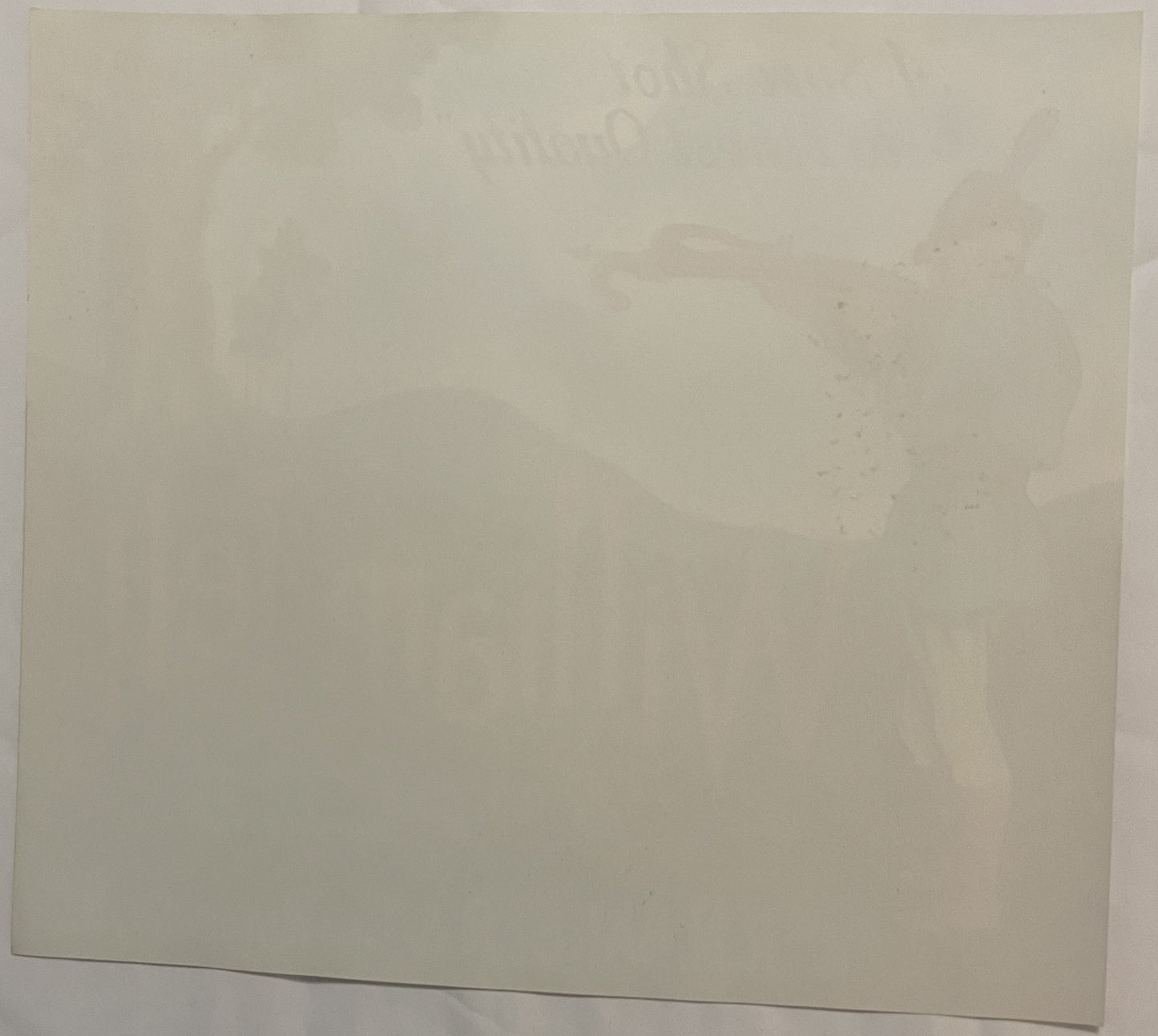
It measures 9 x 8 inches and is printed in rich layered color by lithography, with the fine stippled texture of the process visible in the sky and the tree. The back is plain paper, with the front showing through faintly in reverse. This is new old stock: a label that was never pasted to a crate. Label dealers also record a later William Tell label for R.N. Barber & Co. in a slightly smaller size, about 7 3/4 x 8 3/4 inches.


🍎 R.N. Barber & Co. and the Barber Orchard

The orchard's story begins in upstate New York. Richard Barber Sr., a North Carolina native traveling as a sales representative for McCormick and Deering farm machinery, visited the Geneva Agricultural Experiment Station and was so taken with its apple production that he bought land in the Saunook community of Haywood County in 1890 and began planting trees around 1903. The founding date depends on who tells it. The Ephemera Society of America gives 1903 for R.N. Barber & Co.'s start in growing and packing apples, federal environmental records date the orchard's operation from 1908, and the family that runs the Barber Orchards Fruit Stand today says 1910.

The man who built it into a mountain institution was the founder's son, Dick Barber Jr. He took over in 1929, at 23 years old, the year the country slid into the Great Depression. He started with 120 acres, 10,000 trees, 26 mules, and eight to ten wagons. By the time he sold, the orchard covered more than 400 acres with some 30,000 bearing trees. He installed cold storage, which let him move away from the old thick-skinned keeping apples toward newer varieties like Golden Delicious and Gala. William Tell was not an apple variety. Barber sold his apples under grade names: William Tell for the premium grade, along with grades called Water Rock Knob and Clay Hill. Barber's William Tell apples were sold through A&P Tea Company grocery stores across the Southeast, and the A&P was one of the orchard's first customers. He never pretended it was easy. "It's a long-term venture," he said. "You've got to accept freeze-outs and hailstorms."

He sold the orchard in 1977 to Glenn and Gerald Stewart of West Palm Beach, Florida, and retired at 72; he died in 2003. The Stewarts came in with the same energy the Barbers had, trying new varieties and opening a bakery, but they hit terrible timing: high interest rates on loans in the 1970s and a run of freezes, frosts and hailstorms that brought seven crop failures in a row. In 1988 the mortgage holders foreclosed, and the Federal Land Bank became holder of the 400-plus acres.

The Barber name did not disappear with the trees. The orchard's retail fruit stand opened in 1932. Benny and Jane Arrington, whose family has grown apples in Haywood County for generations, bought the Barber Orchards Fruit Stand in March 1993, and the Arringtons still sell apples, cider and baked goods there every fall. In 1999 Benny and Jane also bought the last piece of the old Barber orchard itself, the one you can see from Highway 74, and added it to their farm. By the stand's own history, those 12 acres are all that's left of about 500 acres of Barber orchards.


⚠️ What the Orchard Left in the Ground

Here is the part of the William Tell story that the label never had to tell. For decades the orchard's pesticides were mixed at stations on the mountainside, drained down to a compressor building, and pumped back up to the trees at 800 pounds per square inch through a buried network of pipes. After the 1988 foreclosure the land was divided into 170 parcels and sold for homes, farms and businesses. In 1999 a resident's well tested positive for contamination. Investigators found organochlorine pesticides in the groundwater and arsenic and lead in the soil, much of it traced to the old underground spray lines.

The Environmental Protection Agency added the 438-acre Barber Orchard site, three miles west of Waynesville, to the National Priorities List in 2001. Crews removed contaminated soil from 28 residential properties in 1999 and 2000, and in 2010 excavated and replaced about 200,000 tons of soil across the old orchard. Groundwater monitoring continues. It is the hard repercussion of decades of spraying, and it happened on the very slopes this label advertised.


🏹 The Legend on the Label

The story the grower borrowed is Switzerland's founding legend. As it is told, in 1307 a Habsburg reeve named Albrecht Gessler raised a pole under the village linden tree in Altdorf, in the canton of Uri, hung his hat on it, and ordered every passerby to bow. William Tell, a crossbowman from nearby Bürglen, walked past without bowing. Gessler's punishment was cruel and clever: Tell would shoot an apple off the head of his own son, Walter, or both would die.

Tell drew two bolts from his quiver and split the apple with the first. When Gessler asked about the second, Tell answered that if he had killed his son, the second bolt would have been for Gessler. He was arrested for that answer, escaped from the boat carrying him to the dungeon at Küssnacht, and ambushed Gessler on the sunken road through the rock between Immensee and Küssnacht known as the Hohle Gasse. In the legend, that shot helped set off the uprising that gave birth to the Swiss Confederacy.

The tale also has a quieter ending. The Swiss chronicler Aegidius Tschudi, writing around 1570, recorded that Tell died in 1354 trying to save a child from drowning in the Schächental of Uri. Historians find no fourteenth-century record of Tell as a real person; the story first appears in writing in the White Book of Sarnen, around 1474. None of that has slowed the legend. Friedrich Schiller turned it into a play that premiered in Weimar on March 17, 1804, and Gioachino Rossini turned Schiller's play into the opera Guillaume Tell, first staged in Paris in 1829.


🐎 Why Americans Knew William Tell by Ear

By the 1950s the name on this label rang a bell for American shoppers for a reason that had nothing to do with Switzerland. The galloping finale of Rossini's William Tell Overture was the theme of The Lone Ranger, which began on Detroit radio station WXYZ on January 31, 1933, ran for 2,956 radio episodes, and moved to ABC television from 1949 to 1957 with Clayton Moore in the mask. "A fiery horse with the speed of light, a cloud of dust and a hearty Hi-Yo Silver!" came over that music every week. The overture also turned up in Disney's The Band Concert and The Old Mill and in Looney Tunes shorts such as Bugs Bunny Rides Again. A crate carrying the name William Tell did not need to explain itself.


🏔️ Waynesville and Haywood County

Haywood County was carved out of Buncombe County in 1808 and named for John Haywood, North Carolina's long-serving state treasurer. As the county's own history puts it, Haywood "never set foot in or visited the region" that carries his name. The county seat took shape on 17 acres offered by Colonel Robert Love, land that set the line of present-day Main Street, and Love named the town Waynesville after his old commander, General "Mad" Anthony Wayne. Waynesville was founded around 1809-1810 as the seat of the newly formed Haywood County.

The mountains kept Waynesville small for a long time. It was incorporated in 1871, and the railroad did not arrive until 1884; the old Western North Carolina Railroad's Murphy Branch runs through the town's Frog Level district. Waynesville also holds a stubborn footnote from the Civil War: in May 1865, weeks after Lee's surrender at Appomattox, Confederates of Thomas' Legion skirmished with Union mounted infantry there, and some claim it was the last shot of the war fired east of the Mississippi River.

Today Waynesville is the largest town in North Carolina west of Asheville, with 10,140 people in 2020. About 40 percent of Haywood County lies within Great Smoky Mountains National Park and Pisgah National Forest, and the Blue Ridge Parkway winds through it.


🖨️ How Crate Labels Were Made, and Why They Stopped

Fruit crate labels were the billboards of the produce trade, pasted on the ends of wooden boxes so a buyer on a crowded dock could pick out a grower's fruit at a glance. Before about 1920 they were printed by stone lithography; after that, printers moved to offset lithography, which could turn out bright, layered color in large runs. Big lithography houses such as Schmidt Litho Co., Louis Roesch Co. and Stecher-Traung mass-produced them for growers across the country.

Paper crate labels stayed in use into the 1950s. World War II drained crate makers of workers and printers of metals and pushed the whole trade toward cutting costs, and produce shippers turned to cheaper disposable cardboard boxes with simpler text and images printed directly on the box. Labels like this William Tell, from the last years of the wooden crate, are what remains of that art form.


🎁 Who Collects This Label

  • Fruit crate label collectors, especially those who chase Appalachian and East Coast apple labels
  • Haywood County and Waynesville families with a connection to the Barber orchard
  • Swiss heritage collectors and anyone who loves the William Tell legend
  • Lone Ranger and old-time radio fans who hear the overture every time they see the name
  • Archery and crossbow enthusiasts
  • Kitchen, farmhouse and orchard-themed decorators who want real advertising art

❓ Questions People Ask

Is William Tell a variety of apple?

No. The label itself reads "William Tell BRAND APPLES." William Tell was the Barber company's brand name, used on the fruit it packed, not the name of a cultivar.

How old is this William Tell crate label?

It is a 1950s label, from the final years when fruit still shipped in wooden crates with paper labels.

What size is it?

9 x 8 inches.

Has this label been used?

No. It is new old stock, never glued to a crate, and the back is clean paper.

Is the Barber Orchard still in business?

The orchard itself was foreclosed in 1988 and divided into parcels, and the site later became an EPA Superfund cleanup. The Barber Orchards Fruit Stand near Waynesville has been owned by the Arrington family since 1993 and still sells apples.

Was William Tell a real person?

Historians have found no record of him from the 1300s. The tale reached paper more than a century and a half after the date it gives for the famous shot, and it has been told as Switzerland's national legend ever since.

Why is the boy standing against a tree?

In the legend, Gessler's hat hung on a pole beneath the village linden in Altdorf. The label's artist set the shot in a mountain meadow instead and stood the boy against a big shade tree.

Shipping

🚚 Shipping & Handling

  • Shipping costs and timing are calculated at checkout.
  • Items curated and shipped directly by me include U.S. shipping at no additional cost, professionally packed to ensure safe arrival of your artifact.

Items from Vetted Pro Collectors
Shipping for items offered by vetted Pro Collectors is determined at checkout. All Pro Collector listings are reviewed to ensure fair, reasonable shipping practices.

For full details, please refer to our Shipping Policy.

Returns & Exchange

Take your time — you've got a full six months. If a piece isn't right for you, send it back the way it reached you and we're good.

In the first 30 days your money goes straight back the way you paid. After that it's store credit, so you can put it toward something you'd rather have.

Return shipping we sort out between us, case by case. I don't make this difficult.

If something arrives damaged, or it isn't what I said it was, send me a photo within 48 hours and I'll make it right.

Email info@vintageantiquesgifts.com or call 802-356-9872 — that's me answering, not a call center.

The only things I can't take back are custom or special-order pieces and gift cards.

View full details
  • 5 stars: 1 (100%)
  • 4 stars: 0 (0%)
  • 3 stars: 0 (0%)
  • 2 stars: 0 (0%)
  • 1 star: 0 (0%)
k
k***e (4581)

Super seller!!! Personal experience…as described….thanks again!!!! A+++++

Preserving History: Authentic Objects Across Eras

— Curated by Travis Weigel