Skip to product information
1 of 11

Curated Gift Sets

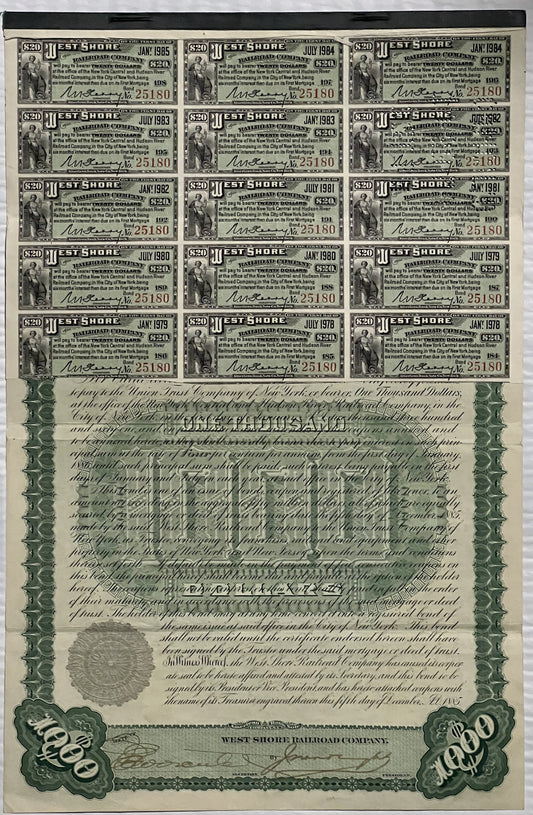
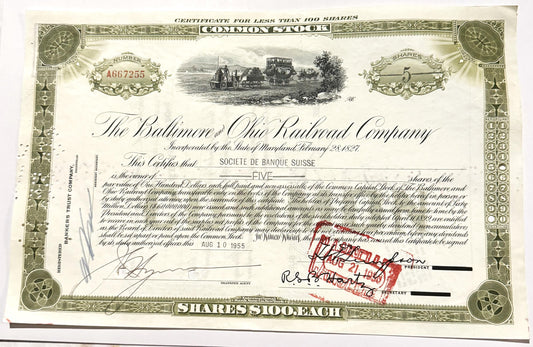
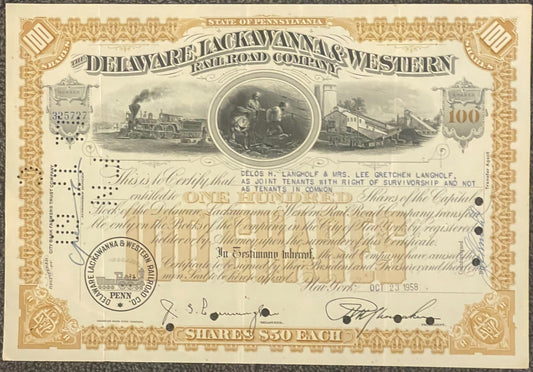
Antique 1900s-1980s Railroad Merger Stock Certificate Set 🚂 Pennsylvania, New York Central, Penn Central

Antique 1900s-1980s Railroad Merger Stock Certificate Set 🚂 Pennsylvania, New York Central, Penn Central

Regular price $19.00 USD
Regular price Sale price $19.00 USD
Sale Sold out
Shipping calculated at checkout.

Size: 12" x 8"

Quantity

🚂 How Did Two Old Railroad Rivals End Up in the Biggest Bankruptcy of Their Day? Pennsylvania, New York Central and Penn Central Stock Certificates

Size: Pennsylvania 12" x 8", New York Central 12" x 8", Penn Central 12" x 8" ~ Little to no wear. They vary a little one to the next.

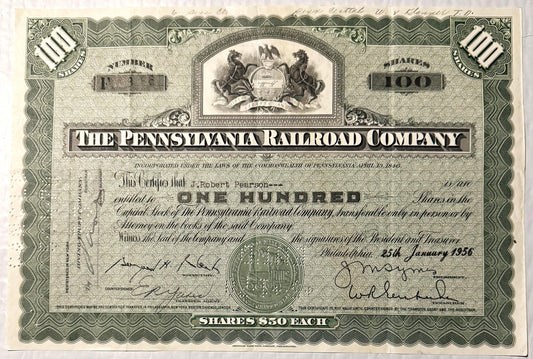
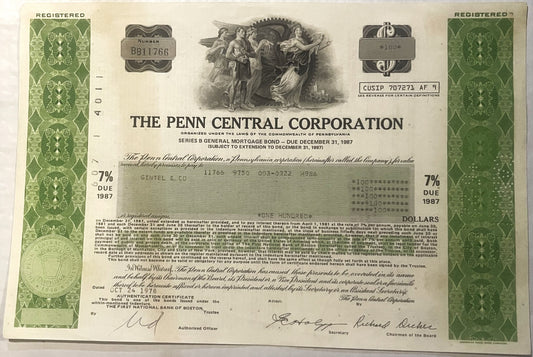
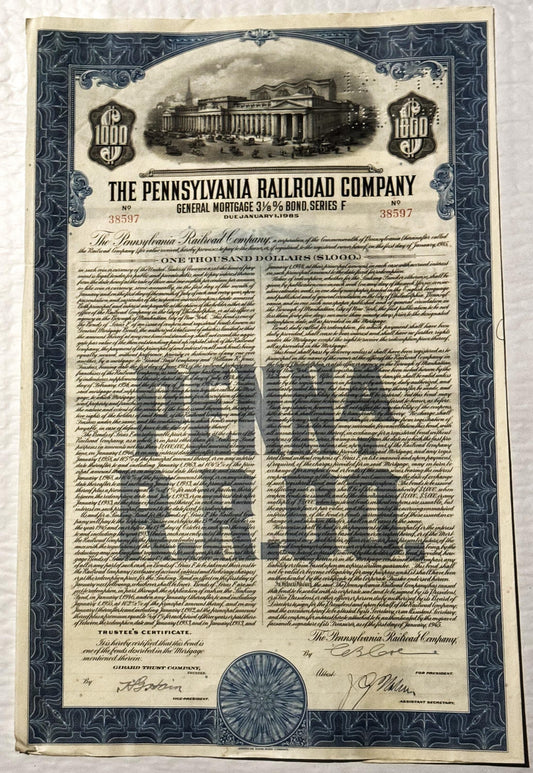
Put these three in a row and you can read the end of the old American railroad empire from left to right. An orange Pennsylvania Railroad certificate, a blue New York Central certificate with the old gentleman in the white cravat looking out at you, and a Penn Central Corporation certificate from the years after the famous crash. The first two were rivals for decades. The third is what was left after they gave up and got married.

🐎 The Pennsy: Standard Railroad of the World

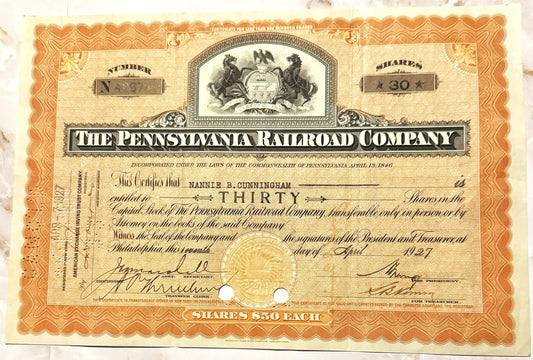
The Pennsylvania was born out of civic worry. Philadelphia's merchants watched Maryland's Baltimore & Ohio push west toward the Ohio Valley, so the Commonwealth chartered its own line on April 13, 1846, and that date is printed right on the certificate. By 1852 there was a continuous line from Philadelphia to Pittsburgh, and on February 15, 1854 it opened its own way over the Alleghenies at the Horseshoe Curve, five miles west of Altoona. I still think that's one of the best pieces of railroad engineering in the country.

By 1882 it was the largest railroad in the world by traffic and revenue and the largest corporation of any kind on the planet. Its president from 1899 to 1906, Alexander Cassatt, brother of the painter Mary Cassatt, drove it under the Hudson River into Manhattan and planned the great Pennsylvania Station, though he died four years before it opened in 1910. In 1916 it put its own motto on the map: the Standard Railroad of the World.

Across the top of this one is the Pennsylvania coat of arms, drawn by Caleb Lownes of Philadelphia in 1778: two rearing horses, an eagle, and a shield with a ship, a plough and three sheaves of wheat over the ribbon VIRTUE LIBERTY AND INDEPENDENCE. Local legend among Philadelphians holds that so many households owned a few shares of the Pennsy that it was almost a rite of belonging, passed down with the family silver. Collectors still call it widow-and-orphan stock. The first warning came in 1946, when the railroad reported a net loss for the first time in its history.

🌊 The Central: America's Water Level Route

The New York Central goes back to 1853, when the New York legislature let a string of little separately chartered lines between Albany and Buffalo merge into one trunk railroad. Cornelius Vanderbilt got control in 1867 and in 1869 married it to his Hudson River Railroad. Its line followed the Hudson, the Mohawk Valley and the Erie Canal route through the gap in the Appalachians, and the company turned that geography into a slogan railroad old-timers still repeat with a grin: America's Water Level Route. In 1913 came Grand Central Terminal, and the story everybody tells about its great concourse is that the starry ceiling was painted backwards.

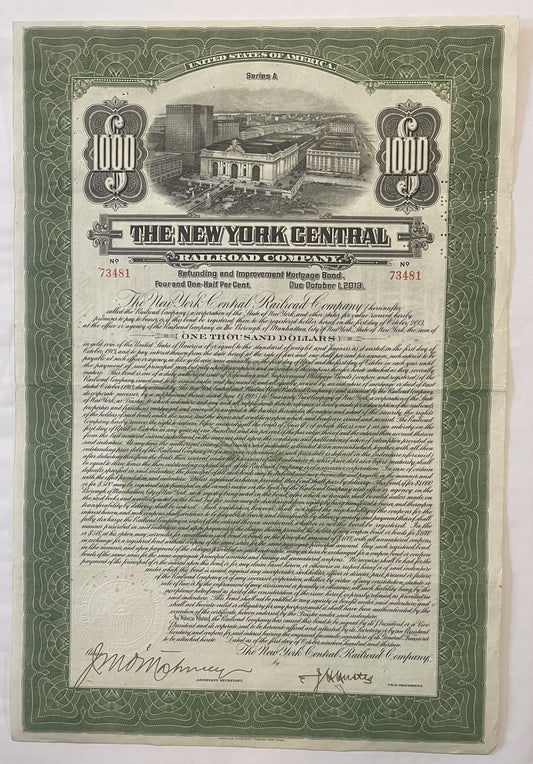
The oval portrait on this blue sheet isn't named, but the trade has always called it Commodore Vanderbilt. The registrar printed on it, Manufacturers Hanover Trust, only came into being in 1961, and the Central disappeared in 1968, so this printing belongs to the railroad's last independent years. It could change hands in New York or in Chicago, the other end of the main line.

🌹 The Race to Chicago

Here's where the two run side by side. The Central's pride was the 20th Century Limited, sixteen hours overnight between New York and Chicago, streamlined by Henry Dreyfuss in 1938. The Pennsy answered with the Broadway Limited, the most famous train it ever ran, and the two raced each other between the same cities for decades. Legend passed down among rail fans holds that "red carpet treatment" comes straight from the crimson carpet rolled out at Grand Central for the Century's passengers. True or polished with age, it's too good not to pass along.

📉 February 1, 1968

The big Eastern railroads were hurting, losing business to automobiles, buses and trucks on the new limited-access highways, and they couldn't change a fare or a freight rate, merge or abandon a line without the Interstate Commerce Commission's approval. On February 1, 1968 the Pennsylvania took over its old rival and the Penn Central was born, and regulators made it take in the bankrupt New York, New Haven and Hartford too.

It didn't last. On June 21, 1970 the board voted to file for bankruptcy. Penn Central, then the sixth-largest corporation in the United States, became the largest corporate insolvency in U.S. history until Texaco in 1987. On April 1, 1976 its working rail lines went to the federally owned Conrail. Along the way there was a fight that still matters: Penn Central wanted an office tower on top of Grand Central, New York City's landmarks commission said no, Jacqueline Kennedy Onassis was one of the loudest voices for saving it, and in 1978 the Supreme Court sided with the city.

⚙️ The Third Certificate, and the Date on Its Seal

This is the one I like best, because it's the punch line. The Penn Central Corporation paper in this set isn't from the railroad's two bad years. It's what came after. In 1978 the old Pennsylvania Railroad company itself absorbed its parent and changed its name to The Penn Central Corporation, and ran as a small conglomerate with interests from pipelines to entertainment. The empire had reached well beyond trains already, with the Buckeye Pipeline, the Six Flags theme parks and a 24 percent stake in Madison Square Garden among its holdings. In January 1981 it received $2.1 billion in cash for its rail properties, and in March 1994 it changed its name again, to American Premier Underwriters.

That's why the facsimile seal on this certificate says 1846. Look at the orange sheet and the last one together and you'll see the Pennsylvania's charter year at both ends of the row. Up top is a finely engraved group of classical figures around a great gear wheel, with orange-red lathe-work down both sides.

🖼️ About These Three

The orange Pennsylvania design runs from the 1900s into the 1950s, the blue New York Central is from the 1960s and the Penn Central comes from the 1980s, so this is a span, not one moment. Each piece is drawn from my stack and every one was really issued, so owners, numbers, dates and stamps change from one to the next and yours may look a little different from my pictures. They're engraved on heavy paper like a dollar bill, only stiffer. Frame them in a train room or an office with a picture of Penn Station and Grand Central between them. There is no new press run coming. When the last of these are hanging in collections and galleries, they will be very hard to track down for sale.

Shipping

🚚 Shipping & Handling

  • Shipping costs and timing are calculated at checkout.
  • Items curated and shipped directly by me include U.S. shipping at no additional cost, professionally packed to ensure safe arrival of your artifact.

Items from Vetted Pro Collectors
Shipping for items offered by vetted Pro Collectors is determined at checkout. All Pro Collector listings are reviewed to ensure fair, reasonable shipping practices.

For full details, please refer to our Shipping Policy.

Returns & Exchange

Take your time — you've got a full six months. If a piece isn't right for you, send it back the way it reached you and we're good.

In the first 30 days your money goes straight back the way you paid. After that it's store credit, so you can put it toward something you'd rather have.

Return shipping we sort out between us, case by case. I don't make this difficult.

If something arrives damaged, or it isn't what I said it was, send me a photo within 48 hours and I'll make it right.

Email info@vintageantiquesgifts.com or call 802-356-9872 — that's me answering, not a call center.

The only things I can't take back are custom or special-order pieces and gift cards.

View full details

Preserving History: Authentic Objects Across Eras

— Curated by Travis Weigel