Skip to product information
1 of 9

Vintage and Antique Gifts

Antique House of Crane Cigar Band 🦢 Gold Embossed Indianapolis Tobacciana Collector's Piece

Antique House of Crane Cigar Band 🦢 Gold Embossed Indianapolis Tobacciana Collector's Piece

Regular price $5.50 USD
Regular price Sale price $5.50 USD
Sale Sold out
Shipping calculated at checkout.

Size: 2 3/4" x 3/4"

🚚 Free US Shipping — ships within one business day. International shipping calculated at checkout.

Quantity

If It Comes From the House of Crane, Is It a Good Cigar? 🦢 An Antique Crane's Imported Gold Embossed Cigar Band, Indianapolis

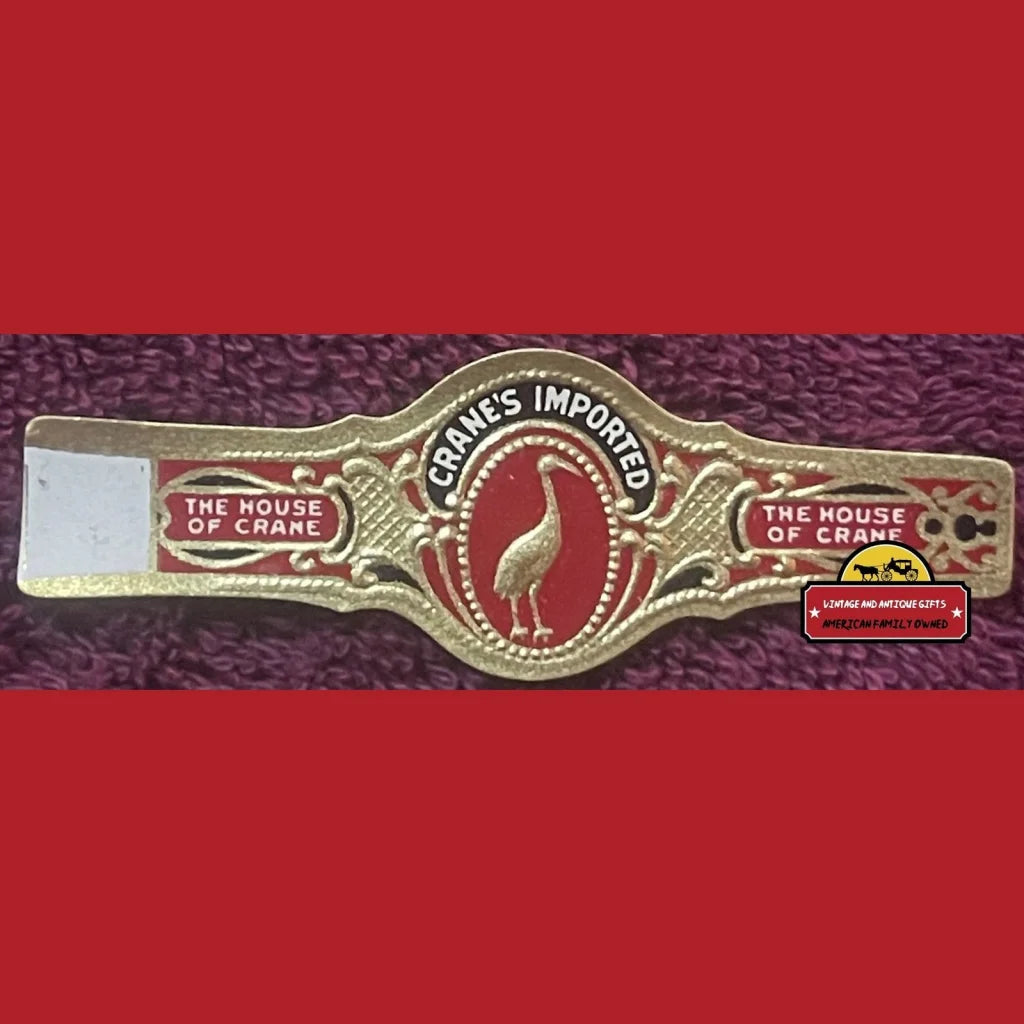
Size: 2 3/4" x 3/4" ~ NOS unused stock, little to no storage wear.

Here is a cigar band that never made it onto a cigar. A gold crane stands in a red oval at the center. Above it, CRANE'S IMPORTED curves across a black banner in white letters, and on each side THE HOUSE OF CRANE is lettered on a red panel. One end is left plain, the tab where the glue would have gone. Turn the band over and you can see the crane and the scrollwork pushed through the back. That's what embossed means, the design pressed up out of the paper so you can feel it.

🦢 Who the House of Crane was

The House of Crane was a cigar importer and jobber in Indianapolis. It started out as H. Crane & Son: when the cigar trade paper The Tobacco World wrote the firm up in 1915, it said the family firm had come into the Indianapolis jobbing trade twenty years before, and about ten years after that had dropped the old name and become The House of Crane - the very name printed on both ends of this band. E. L. Crane told the paper he wanted a name "that could be left, without change, for my sons." It was a prominent one, too. By 1915 the paper was calling it "the most extensive cigar jobbing house in Indianapolis territory," doing better than a million dollars of business a year with twelve traveling men covering Indiana, Illinois and Kentucky, and it ran for close to seventy years, most of them down on South Meridian. A jobber is the middleman. He buys cigars from the people who roll them and sells them on to the shops that sell to you. The firm's old paper carried its slogan, and I love it: "If it comes from The House of Crane, It's a Good Cigar." That is a company with some nerve.

🌴 What IMPORTED meant

CRANE'S IMPORTED, the name across the top of this band, was the House of Crane's own trademark. The House of Crane, Inc. filed it with the U.S. Patent Office on September 11, 1930, swearing it had used the name since 1915, and it went on the register that December as No. 278,132 for cigars. In 1915 it was one of the house's ten-cent cigars, twice the price of its nickel brands.

And the word meant what it said. By the late 1920s the trade's directory of Manila cigar factories listed CRANES IMPORTED as a brand of the La Yebana factory, No. A-4-331, right beside Manila Blunts and Manila Stubs, with the House of Crane of Indianapolis as agent. These were cigars rolled in Manila and shipped to Indiana. Here's something I know about that. Manila tobacco and Cuban tobacco were both imported and worked up here in the USA, and the two went back and forth every year over which one was the higher quality. Cuba won more often than Manila, but some years Manila took it. Tony Hyman's cigar history timeline has the trade calling Philippine cigar tobacco close to Cuban quality as early as 1899, with Manila cigars often costing more than their Cuban counterparts on the world market, and once Philippine cigars came into the country free of import duties in 1909, they poured in.

The House of Crane kept its cigars coming from Manila right up to the war. In January 1942 Paul and Richard Crane told The Tobacco Leaf that the brands their company had been having made in Manila would be made in this country from then on, and they named them: El Mezzo, Manila Blunts, Crane's Imported, Nabob and Manila Stubs. This band says IMPORTED and nothing about the U.S.A., so it fits the Manila years.

🏛️ The building on South Meridian Street

Edward Beck built an Italianate commercial building on South Meridian Street in 1866 and 1867, meant for wholesalers selling liquor, hats, clothes, coffee, hardware and more. The House of Crane moved into the south half in 1911. By 1916 it had remodeled the storefront and the inside and taken over the whole place, and the prism glass transoms from that remodel were there to throw daylight deep into the rooms. The marker for the site says cigars were wholesaled in that building for nearly 70 years.

🚂 The Wholesale District

That block belonged to the Indianapolis Wholesale District. Henry Schnull, a German immigrant and businessman, started it in the 1860s. His idea was to tie the railroad freight terminals and Union Station to the shops at Meridian and Washington, so goods came off the train and went straight on to the retailers. A 1907 photo on the street marker shows the view up Meridian toward the Soldiers' and Sailors' Monument, streetcar wires overhead and wholesalers on both sides selling china, glass, cigars, toys, hats, liquor, hardware and groceries. The district's business peaked in the early 1900s, and that's the world this band came out of.

🧱 Gone, but not all of it

The building came down in 1990, but the front wall didn't. The House of Crane facade was saved along with the Schnull-Rothschild and Malott fronts and worked into Circle Centre, the downtown mall that opened in 1995. The Union Station and Wholesale District is listed on the National Register of Historic Places.

💬 The nickel-cigar wars

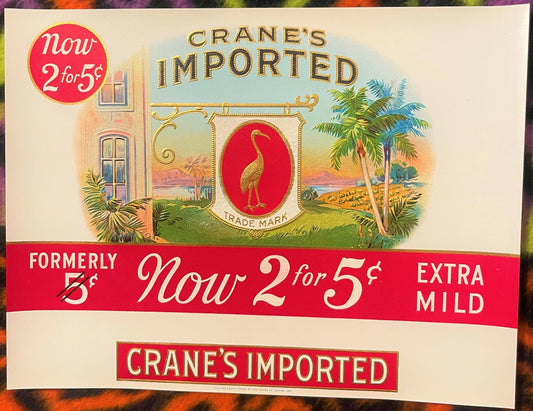
Here's the local story. Old-timers in the Indianapolis tobacco trade used to say Crane's Imported was a scrappy brand, and that in the nickel-cigar price wars its bands ended up on cigars marked down from five cents to two and a half. It's easy to believe. In a town with more than 90 cigar factories in the 1880s, a nickel cigar was bound to turn into a fight. And the markdown is on the record, just a little later than the old-timers had it: Crane's Imported was still a nickel cigar in the Indianapolis Times in September 1932, and on May 11, 1936 the House of Crane ran a full-page ad there announcing it at two for five cents.

The most famous nickel-cigar line of all has an Indiana accent. Thomas R. Marshall was governor of Indiana from 1909 to 1913 and then Woodrow Wilson's vice president from 1913 to 1921. One day he was presiding over the Senate while Kansas senator Joseph Bristow worked through his long list of what the country needed, and Marshall cracked, "What this country needs is a really good five-cent cigar." That one line is what he's remembered for. He didn't invent it, though. A version was already in print in 1875, credited to the New York Mail, and Kin Hubbard, the Indianapolis News cartoonist, had his Abe Martin character saying it too. Marshall was a fan. When his Washington years were over he practiced law in Indianapolis, and he's buried there.

🎨 Why dress a cigar like that?

Nobody could judge the tobacco by looking at the outside of a cigar. The band was what the buyer saw, so the band was the brand's advertisement, and a firm that wanted a name for good cigars put gold on it. Bands like this were printed one color at a time and then embossed. Kids a century ago saved them in albums, and collectors still do. The hobby even has a name, vitolphilia.

📅 How old is it?

Nothing on the band is dated. I put it in the 1910s to 1920s. The name CRANE'S IMPORTED only goes back to 1915 - that's the first use the House of Crane swore to when it registered the trademark - so the band can't be any older than that. House of Crane paper turns up from about 1915 into the 1930s, and the Indiana State Library's Indiana Album lists a House of Crane band with a gold crane on a black and red ground as about 1920.

🦢 About these bands

Every one of mine is unused, with the gold still bright. It makes a great little piece for a band album, a small frame, or a shadow box next to an old photo of Meridian Street, and it's a natural for anybody from Indy. The supply is finite. Once these last unused bands are gone into collections, they'll be very difficult to acquire.

Shipping

🚚 Shipping & Handling

  • Shipping costs and timing are calculated at checkout.
  • Items curated and shipped directly by me include U.S. shipping at no additional cost, professionally packed to ensure safe arrival of your artifact.

Items from Vetted Pro Collectors
Shipping for items offered by vetted Pro Collectors is determined at checkout. All Pro Collector listings are reviewed to ensure fair, reasonable shipping practices.

For full details, please refer to our Shipping Policy.

Returns & Exchange

Take your time — you've got a full six months. If a piece isn't right for you, send it back the way it reached you and we're good.

In the first 30 days your money goes straight back the way you paid. After that it's store credit, so you can put it toward something you'd rather have.

Return shipping we sort out between us, case by case. I don't make this difficult.

If something arrives damaged, or it isn't what I said it was, send me a photo within 48 hours and I'll make it right.

Email info@vintageantiquesgifts.com or call 802-356-9872 — that's me answering, not a call center.

The only things I can't take back are custom or special-order pieces and gift cards.

View full details
  • 5 stars: 1 (100%)
  • 4 stars: 0 (0%)
  • 3 stars: 0 (0%)
  • 2 stars: 0 (0%)
  • 1 star: 0 (0%)
D
Dale Overholt (Brookfield, US)

Great experience! Cigar band was perfect and shipping was fast. Free cute thank you gift too. Thanks!

Rescuing American History Since 2007

— Travis & the Kids