Skip to product information
1 of 7

Vintage and Antique Gifts

Antique 1930s Peoples-First National Bank Stock Certificate 🦅 Hoosick Falls NY

Antique 1930s Peoples-First National Bank Stock Certificate 🦅 Hoosick Falls NY

Regular price 18.00 USD
Regular price Sale price 18.00 USD
Sale Sold out
Shipping calculated at checkout.
Style
Quantity

Size: 12 x 8 inches

🦅 A Depression-Era Stock Certificate from a Real Upstate New York Town

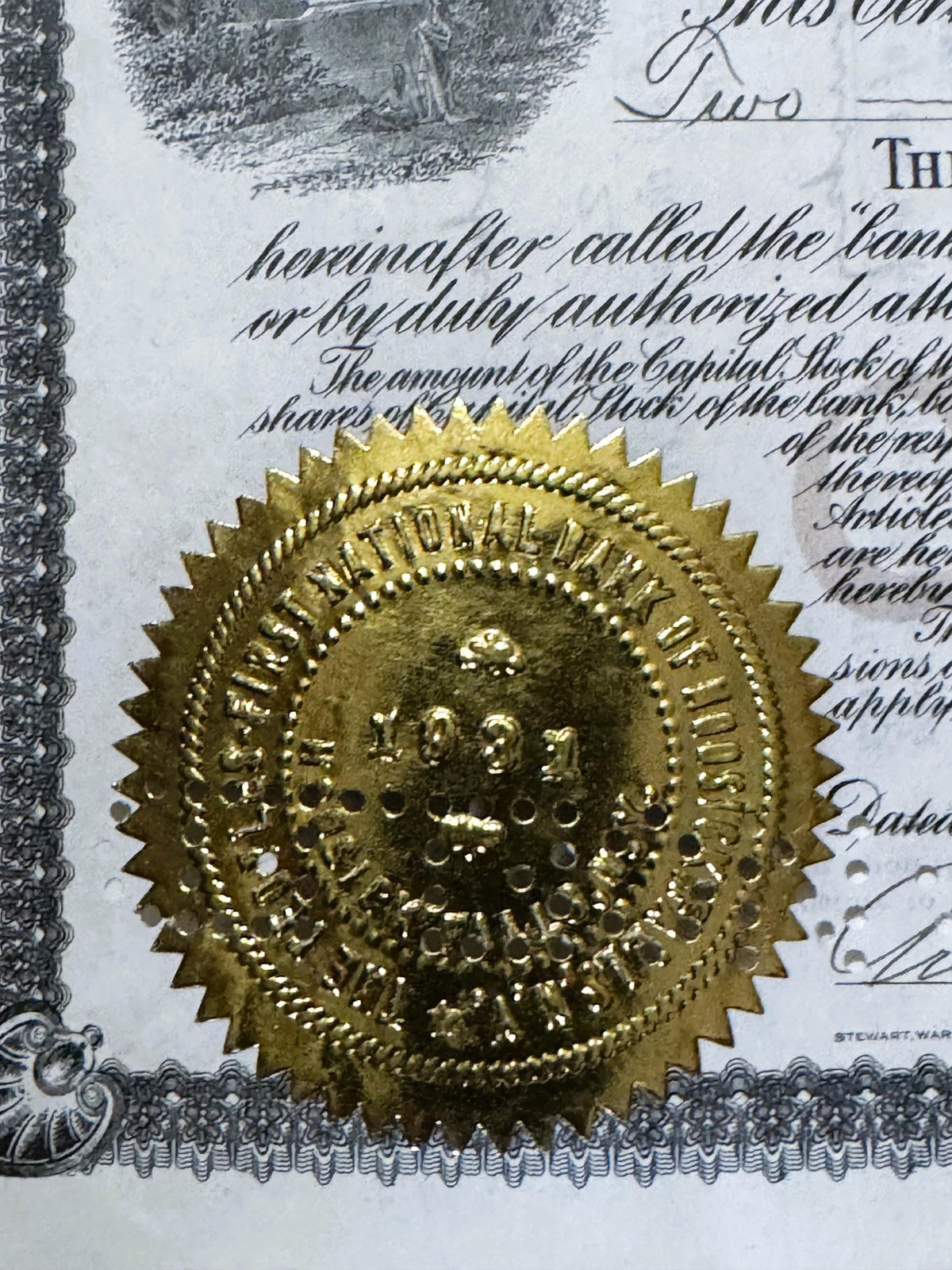
This is a genuine 1930s stock certificate of The Peoples-First National Bank of Hoosick Falls, New York — a beautifully engraved piece of small-town American banking history, offered here in two variants so you can choose the one that suits you: an affordable one where the cancellation punches run through the gold foil seal, and a scarcer one where the punches miss the seal and leave it whole. Because the bank issued these across a whole series of certificates, please read this as a description of the issue rather than of one single sheet: each certificate was hand-completed at the bank with its own share count, date and registered owner, so those particulars differ from copy to copy, and the certificate you receive will be another authentic example of the same printed type, the same design, and the variant you select. The photographs show representative examples of the issue. What is common to every one — the bank, the town, the engraving, the gold seal, the $25.00 par value — is what this page is about.


🏦 The Peoples-First National Bank of Hoosick Falls

The certificate is headed "State of New York" and "The Peoples-First National Bank of Hoosick Falls," organized, as the engraving states, "under the National Banking Laws." That phrase is a whole era in four words. After the National Banking Acts of the 1860s, the United States built its financial backbone out of locally chartered "national banks" — hometown institutions, owned by hometown shareholders, that anchored the Main Street of nearly every American town. A share of a bank like this was not an abstraction traded in a distant city; it was a stake in your own community's bank, held by neighbors, farmers and local businessmen. The gold foil seal embossed into each certificate carries the bank's own charter date, 1931, at its center, ringed by the bank's name — a small, gleaming proof of a real chartered institution doing real business through the hardest economic decade in the nation's history. To hold one of these is to hold a piece of how ordinary American towns banked, saved and invested during the Great Depression.


🎨 The Engraving: Eagle, Waterfall and Gold

These certificates are genuinely lovely documents. The steel-engraved artwork is anchored by two vignettes in the fine, hair-line style of period bank-note work. At the center, a magnificent American bald eagle spreads its wings over a rocky nest of eaglets — the classic emblem of a national bank, protective and proud. To the left sits a quieter, exquisite scene: a woodland waterfall tumbling over a ledge among trees, a small figure at its foot — a fitting nod to the very falls on the Hoosic River that gave Hoosick Falls its name and once powered the village's mills. The bank's name arcs across the top in bold engraved capitals, the par value of $25.00 per share is printed to the right, and the whole sheet is bordered in an intricate engine-turned frame. Anchoring the lower left is the gold foil embossed seal, sunburst-edged and stamped with the 1931 charter date — the single spot of real metallic shine on an otherwise black-and-white engraving, and the detail that makes these frame so beautifully.


🏘️ Hoosick Falls — A Small Town Worth Knowing

Part of what makes a certificate like this special is that it comes from a real, specific place with a real story. Hoosick Falls is a village in Rensselaer County in the northeast corner of New York State, near the Vermont and Massachusetts lines, set on the Hoosic River whose falls gave the town both its name and its early industrial power. In the nineteenth and early twentieth centuries it was a genuine manufacturing town, best remembered as the home of the Walter A. Wood Mowing and Reaping Machine Company — once one of the largest makers of horse-drawn farm machinery in the world, whose mowers and reapers were shipped from this little upstate village to farms across the globe. Hoosick Falls is also fondly remembered as the town where the beloved American folk painter Anna Mary Robertson "Grandma" Moses is buried. A bank certificate from such a place is a tangible thread back to that world — the local mill town, its factory payrolls, its farmers and shopkeepers, and the hometown national bank that held their money and sold them its shares.


✂️ Punches Through the Gold Seal, or Clear of It — Choosing Your Variant

This listing offers the same historic certificate in two honest variants, and the difference is simple and visible:

  • 🕳️ Punch-Cancelled — this certificate carries a pattern of small holes punched through the paper. Punch cancellation was the ordinary, official way a bank retired a certificate from its books once the shares were transferred, redeemed or the account closed. The holes are proof that the certificate genuinely lived its working life as a real financial instrument. This is the more affordable entry point: a completely authentic, fully engraved certificate for the collector, decorator or history lover who wants the piece for the least outlay.
  • No Punch Gold Seal — here the cancellation punches miss the gold foil seal, so the seal and the engraving beneath it stay whole and unbroken. These are scarcer and present better for framing, since nothing interrupts the eagle, the waterfall or the gold seal. This is the choice for the buyer who wants the strongest display piece and the harder of the two states to find.

Both are genuine period certificates of the same bank and the same beautiful design; the only difference is the presence or absence of the cancellation holes. Choose the affordable version with the punches through the seal, or the scarcer one with the seal left whole.


🖋️ The Lost Art of Bank-Note Engraving

The certificate is a small masterpiece of a craft that has all but disappeared. Documents like this were produced by steel-plate engraving, the same painstaking, security-minded process used for paper money — an artist cutting the design in reverse into a hardened steel plate, line by hair-fine line, so that the printed result could not easily be copied or forged. That is why the eagle's feathers, the waterfall's spray and the fine geometric border all carry such astonishing detail: every line was hand-cut. The engine-turned frame — those intricate, machine-lathed guilloché patterns around the edge — was another anti-counterfeiting flourish that happens to be beautiful. In an age of laser printers it is easy to forget that a humble bank share was once dressed in the finest graphic art the printing trade could produce, and holding one of these is the best possible reminder.


📈 What a Stock Certificate Actually Was

For anyone new to these, a stock certificate was the physical proof of ownership in a company — in this case, of shares in the bank itself. Before ownership became a line in a computer database, a shareholder received an engraved paper certificate stating the number of shares and their par value, signed by the bank's officers and stamped with the corporate seal. The "$25.00 par value" printed on this certificate was the nominal face value assigned to each share. When shares changed hands or were redeemed, the certificate was surrendered to the bank and retired, which is why so many survivors are punch-cancelled. Every one of these sheets, then, is a genuine former financial instrument — a real receipt for a real stake in a real hometown bank — which is exactly what makes them such tangible, human artifacts of American economic life.


📜 An Introduction to Scripophily

Collecting antique stock and bond certificates has a name of its own — scripophily — and a devoted following, because these documents sit at a perfect crossroads of history, art and finance. Collectors pursue them for the engraving, for the famous (and infamous) companies they represent, for the autographs of officers, and for the stories of the towns and industries behind them. A small-town national bank certificate like this one is a wonderful entry point: it is genuinely old, genuinely beautiful, historically rich, and still remarkably affordable compared with the fine art it resembles. Whether you frame a single striking example or begin a themed collection of banks, railroads and local industries, this certificate is the kind of piece that draws people in and starts them collecting.


🖼️ Ways to Enjoy It

  • 🖼️ Float-mount and frame it — the eagle, the waterfall and the gold seal make a striking framed piece for a study, office or entry.
  • 🏦 A natural gift for a banker, a finance professional, an accountant or an economics buff — a real artifact of American banking.
  • 🗽 Pair it with other New York or Depression-era Americana, or with Hoosick Falls / upstate local history.
  • 📜 A wonderful starter piece in scripophily — the collecting of antique stock and bond certificates for their history and their art.
  • 🎁 A thoughtful, affordable, genuinely old gift that carries a story far larger than its size.

Engraved eagle, hometown waterfall, gold 1931 seal and a real Depression-era share in a real American town's bank — an authentic small piece of history, offered your way: punches through the gold seal, or punches clear of it.

These are issued instruments rather than blanks. Certificates of this type were filled in for a holder in ink, countersigned by the transfer agent and registered by the registrar, then punch- or cut-cancelled when they were redeemed and retired. Expect financial writings, markings, stamps, hole punches and staple holes as part of the life of the instrument: endorsements and signatures, transfer-agent and registrar stamps, revenue or documentary tax stamps, cancellation punches, staple holes from being bound into a transfer book, pencil ledger notations. That is the paper trail of a security that actually did its job, and it is what separates a document that lived from a blank that never did. No two are alike: holder details, serial numbers, dates, signatures, stamps and punch patterns vary from example to example, so the photographs show the type rather than the exact sheet that ships.

Shipping

🚚 Shipping & Handling

  • Shipping costs and timing are calculated at checkout.
  • Items curated and shipped directly by me include U.S. shipping at no additional cost, professionally packed to ensure safe arrival of your artifact.

Items from Vetted Pro Collectors
Shipping for items offered by vetted Pro Collectors is determined at checkout. All Pro Collector listings are reviewed to ensure fair, reasonable shipping practices.

For full details, please refer to our Shipping Policy.

Returns & Exchange

Take your time — you've got a full six months. If a piece isn't right for you, send it back the way it reached you and we're good.

In the first 30 days your money goes straight back the way you paid. After that it's store credit, so you can put it toward something you'd rather have.

Return shipping we sort out between us, case by case. I don't make this difficult.

If something arrives damaged, or it isn't what I said it was, send me a photo within 48 hours and I'll make it right.

Email info@vintageantiquesgifts.com or call 802-356-9872 — that's me answering, not a call center.

The only things I can't take back are custom or special-order pieces and gift cards.

View full details