


Skip to product information
1 of 6

Vintage and Antique Gifts

Antique 1930s East West Emperors Grape Crate Label 🍇 Paul Dobson Exeter California Lithograph Monoplane Airplane Map USA

Antique 1930s East West Emperors Grape Crate Label 🍇 Paul Dobson Exeter California Lithograph Monoplane Airplane Map USA

Regular price $5.50 USD
Regular price Sale price $5.50 USD
Sale Sold out
Shipping calculated at checkout.

Size: 13" x 4"

🚚 Free US Shipping — ships within one business day. International shipping calculated at checkout.

Quantity

What Does EMPERORS Mean on a Paul Dobson Grape Label? ✈️ An Antique 1930s East West Emperors Grape Crate Label, Paul Dobson, Exeter, California

Size: 13" x 4" ~ NOS unused stock, little to no storage wear.

EAST and WEST, in tall red letters, stretch across a green map of the United States with the Great Lakes up in the corner. A little single-wing propeller plane is flying between the two words with its nose pointed toward the East Coast. Under it the label reads EMPERORS, GROWN & PACKED BY PAUL DOBSON, EXETER, CALIFORNIA, and NET WEIGHT 25 LBS. sits down in the corner. The back is plain tan paper. It never went on a lug box.

My photographs simply do not do this one justice. In my opinion, the lithographic process used to produce California crate labels is unparalleled as a commercial printing art form, even by today's standards.

🍇 What EMPERORS means

The Emperor is a red table grape, and Tulare County grew a lot of it. Growers there, with the University of California farm advisor, started training their Emperors on a T trellis in 1930 to get better color. A 1928 Keystone View Company stereograph in the Library of Congress shows vines loaded with Emperors in Tulare County. The fruit rode east in shallow wooden lug boxes with a label like this on the end. Exeter's own planning documents say oranges later took over the town's farmland from earlier crops that included Emperor grapes, dry-land wheat and barley.

🏡 Paul Dobson and Exeter

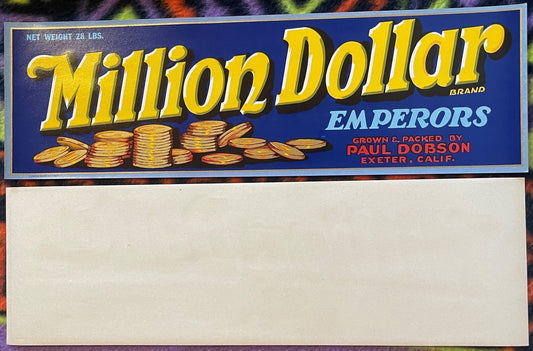
The label says the grapes were grown and packed by Paul Dobson. A Paul A. Dobson, 1897 to 1978, came to Tulare County with his wife Elizabeth in 1923, and Exeter's Dobson Field is named for him. The local history post about the family does not say what he farmed. Paul Dobson of Exeter put out a second grape brand, Million Dollar Emperors, which Cal State San Bernardino's Pfau Library keeps in its crate label collection.

Exeter sits in Tulare County in the Sierra foothills. A Southern Pacific man, D. W. Parkhurst, bought the land from an early settler named John Firebaugh when the railroad reached the valley in 1888. He named the town for his own hometown, Exeter, England. It was incorporated on March 2, 1911. The Kaweah was dammed in the 1930s, which gave the farms a steady water supply, and the city calls itself the Citrus Capital of the World today. Downtown has 31 murals of local history.

Packers in town each had their own grape brand. Dofflemyer Bros. packed East Bound, A. E. Pruner had Exeter Lily, and the Exeter Grape Growers shipped Emperor City. Another name from the grape days is B. F. List, who left the lumber business and moved to Exeter for grapes. He owned vineyards and a packing house, B. F. List and Son. His grandson Robert List swept its floors as a boy and became governor of Nevada. The Las Vegas Review-Journal says cartons were iced down and loaded onto rail cars bound for the East Coast and Canada. It says Exeter was known as the home of the Emperor grape.

✈️ The plane

A single-wing monoplane was the newest thing in the sky after Charles Lindbergh flew the Spirit of St. Louis, a single-engine high-wing monoplane, from New York to Paris on May 20 and 21, 1927. On a grape label, it says fast, fresh fruit from the West to the East. Nothing on the label names the plane or Lindbergh. It is just a plane, but a good one.

🖼️ Crate labels

Paper labels for fruit boxes began in Southern California in the 1880s, and the railroads made them worth printing. Each packer wanted the most eye-catching brand on the loading dock, and the first full-color lithographed labels showed up between 1880 and 1885. Most were printed by lithographers in San Francisco, and some of those shops were big names. Schmidt Lithograph grew out of the shop of Max Schmidt, a German-born sailor who reached San Francisco in 1871 and set up in the 1870s. The 1906 earthquake and fire wiped him out, he rebuilt, and his company went right on printing labels for fruit crates. Louis Roesch Co. dated from 1879. And Stecher-Traung came about when San Francisco's Traung company took over the Stecher firm of Rochester, New York. Grape labels came in a long narrow shape for the end of a lug. Cardboard boxes printed right on the side took over by the mid-1950s, and that ended the labels. The University of California, Davis keeps more than 4,800 of them, and its Lug and Can Label Collection includes an Exeter Emperor label.

📅 How old is it?

Nothing on it is dated. I have always had it as a 1930s label. A different version of the design is out there that adds PRODUCE OF U.S.A. and reads NET WEIGHT 28 LBS. This is the 25-pound version without it.

🌎 About these labels

Every one I have is unused. It is a great gift for an aviation fan, a map lover or anybody from the San Joaquin Valley, and it looks right in a kitchen or a den. The supply is finite. Nobody prints crate labels like this anymore, and once the last of these unused labels are framed, they will be very difficult to acquire.

Shipping

🚚 Shipping & Handling

  • Shipping costs and timing are calculated at checkout.
  • Items curated and shipped directly by me include U.S. shipping at no additional cost, professionally packed to ensure safe arrival of your artifact.

Items from Vetted Pro Collectors
Shipping for items offered by vetted Pro Collectors is determined at checkout. All Pro Collector listings are reviewed to ensure fair, reasonable shipping practices.

For full details, please refer to our Shipping Policy.

Returns & Exchange

Take your time — you've got a full six months. If a piece isn't right for you, send it back the way it reached you and we're good.

In the first 30 days your money goes straight back the way you paid. After that it's store credit, so you can put it toward something you'd rather have.

Return shipping we sort out between us, case by case. I don't make this difficult.

If something arrives damaged, or it isn't what I said it was, send me a photo within 48 hours and I'll make it right.

Email info@vintageantiquesgifts.com or call 802-356-9872 — that's me answering, not a call center.

The only things I can't take back are custom or special-order pieces and gift cards.

View full details

Rescuing American History Since 2007

— Travis & the Kids