
Skip to product information
1 of 4

Vintage and Antique Gifts

Antique 1920s Qualite Surfine Three Star Neck Label ✨ French Brandy Bottle Band, NOS Die Cut Paper

Antique 1920s Qualite Surfine Three Star Neck Label ✨ French Brandy Bottle Band, NOS Die Cut Paper

Regular price $6.00 USD
Regular price Sale price $6.00 USD
Sale Sold out
Shipping calculated at checkout.

Size: 3 1/2" x 1 1/4"

🚚 Free US Shipping — ships within one business day. International shipping calculated at checkout.

Quantity

What Does Qualité Surfine Mean on a Brandy Bottle? ✨ Antique 1920s Three Star Neck Label, NOS Die-Cut

Size: 3 1/2" x 1 1/4"

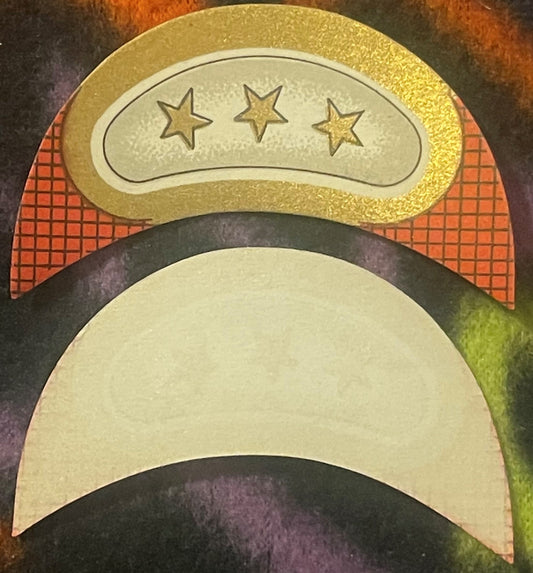
Three gold stars, two French words and a curling parchment shield, all on a strip of die-cut paper made to wrap the neck of a bottle. The French name for a label like this is collerette, the same word they use for a little frilled collar, and that is exactly how it sits: a small collar ringing the bottle's neck. I have always dated these to the 1920s and '30s and kept them with my alcohol labels. Each one is New Old Stock, never glued to a glass neck.

🔍 What's on the Paper

  • Qualité on the left ribbon, Surfine on the right, lettered in black gothic script with only the capital Q and S picked out in red
  • Golden ribbon scrolls edged with red pinstripes, curling over at both ends
  • A parchment shield in golden orange, shaded with fine black hatching, its bottom edge rolled up like a document
  • Three stars set two over one, printed in metallic gold, each with a thin black edge on one side like a drop shadow
  • DÉPOSÉ D 1 in small capitals under the shield, and the initials L N set apart to the right
  • Cut to the outline of the ribbons and the round center, so the band sweeps up gently at both ends
  • Blank cream back

No distillery, no town and no drink is named anywhere on the front. That blank is the whole story of how labels like these were sold.

🏷️ A Label Off the Printer's Shelf

French label printers didn't just wait for orders. They drew up their own designs and sold them out of pattern books to anyone with bottles to dress. The trade called these passe-partout labels, the goes-with-anything kind. A wine grower, a small liqueur maker, or a merchant who bought rum in bulk and bottled it himself could leaf through a printer's catalog, point to a design, and take home labels that already looked like a proper house had made them.

Roland Moser, an Alsace winemaker, wrote about the old wine labels of his region for the Revue d'Alsace and describes those catalogs. The printer could combine pictures, frames and lettering any way the customer liked; the big motifs cost 50 to 70 francs and the little ones 2 to 5; and the Deberny catalog was still in use into the 1930s. One grower, Xavier Sipp of Ribeauvillé, chose model no. 641 out of the book and paid 8 francs for it.

Rum was labeled the same way. Pierre Moreau, a French collector of rum labels, explains that rum arrived in France in bulk and was bottled by merchants who needed something to put on the glass, so publishers printed passe-partout labels carrying the word rhum, a few pictures, and a blank space where the bottler could add his own name. The deposited labels he went through at Compiègne run from the 1860s to about 1930. He calls the old ones véritables petits chefs d'œuvre, real little masterpieces, and I'm happy to stand next to him on that.

A collerette goes one step further: it names nothing but a grade. Qualité Surfine flanking three stars would have looked right on brandy, on rum or on a liqueur, and the bottler would have paired it with whatever body label carried his own name.

⭐ Three Stars: Maurice Hennessy's Idea

The stars go back to Cognac, France, in 1865. Maurice Hennessy, of Jas. Hennessy & Co., came up with a way of grading his cognacs by stars, more stars for an older brandy, and it gave rise to Hennessy's Three Star. Hennessy never trademarked the stars; Martell took up the same system, the rest of the trade followed, and stars stayed the age mark on cognac for roughly a hundred years.

Here's the part I like best. In the 1860s Hennessy marked its bottles with a neck shield carrying one, two or three stars. A shield full of stars, worn at the neck of the bottle: that is exactly what these little collerettes are.

The story goes that Maurice found his star in the decorative handle of his office window. I love that one: a grading mark the brandy trade copied, borrowed from a bit of window hardware.

What three stars actually promised kept moving, because no law ever stood behind them. In 1868 a three-star cognac was meant to be ten years old; by 1906 the promise was at least twelve; by the middle of the last century it had slid to about six. By the 1970s the one- and two-star grades had died out and three stars gave way to the letters VS. Today the cognac rule for VS, or 3 étoiles, is at least two years of aging.

The stars didn't stay in Cognac, either. Armagnac and calvados still carry a three-star grade. In Puerto Rico, Pedro Fernández, who had studied in France in the 1860s and got interested in brandy and cognac there, began selling rum in 1880; it has been made ever since at Hacienda Santa Ana in Bayamón, and the original blend is still called Ron del Barrilito Tres Estrellas, three stars, a habit he took home from French brandy making. French cheese makers put trois étoiles on camembert, and a Vals-les-Bains mineral water carried it too. By the time collerettes like these came off the press, three stars on a bottle neck meant "the good bottle" to anybody who could count to three.

📜 Surfine: Finer Than Fine

Surfine is 19th-century French merchant's talk, built from sur (over) and fin (fine): finer than other goods of the same kind. The Académie française gives liqueur surfine as one of its own examples, and Larousse puts the word on chocolate. On old drink labels it shows up over and over: Anisette Surfine, Kirsch Qualité Surfine from the Black Forest, Cassis de Dijon Qualité Surfine, Crème de Vanille Qualité Surfine, a Swiss absinthe extract, Belgian-bottled rum marked surfin. Put Qualité in front of it and you have a bottle bragging in two words, in any French-speaking cellar.

🏛️ DÉPOSÉ D 1: Registered

Déposé means "deposited," in other words registered. France's first trademark law came in 1857, and after it a maker could file his mark, whether a drawing, an engraving or a stamp, with the clerk of the commercial court in his own département, on a square form 18 centimeters a side, filled out in two copies. Those filings survive by the hundred thousand: close to 5,000 registers holding more than 740,000 marks from 1857 to 1965, bottle labels among them. A 1909 law then gave the creator of a new design the sole right to use and sell it for up to fifty years.

On a stock label that names no product, the thing worth protecting was the design, and the design was the printer's. You can see the habit on an anisette label from the Paris shop of G. Nissou: Anisette Surfine and Qualité Supérieure on the front, with the printer's name, Déposé and a number, 227. Jean Gustave Nissou, born in Angoulême in 1823, printed in Paris from 1845 to 1872, ran one of the biggest print shops in the city with some fifty presses, and was on record as the inventor of a system for printing labels in several colors. In Lyon, Gougenheim et Gaud, in business from 1872 and specialists in labels and posters until the middle of the twentieth century, numbered their stock designs too; one of their rum labels is marked modèle déposé, registered design, with its number, 496. On these collerettes D 1 rides right beside DÉPOSÉ, the way those model numbers do.

🎨 Why I Like It

It's the lettering that gets me. Gothic letters with a red capital are the look of an old illuminated page, and with that curling parchment shield the whole band reads like a cellar master's seal. For a stock design sold to whoever walked in, somebody took real care: every curl of the ribbon is shaded, and the gold stars still catch the light.

🖼️ Ideas for One

  • Float one on a cream mat in a small frame so the die-cut outline shows all the way around
  • Add a few to an album of French wine and spirits labels, beside the body labels they would have ridden with
  • Prop one on the bar cart next to the brandy
  • Or glue one around the neck of your own homemade liqueur. It's what they were printed for, and I won't tell.

📦 Condition

New Old Stock, unused. Each one is the same printed design with a plain cream back; the photos show one of them front and back.

Shipping

🚚 Shipping & Handling

  • Shipping costs and timing are calculated at checkout.
  • Items curated and shipped directly by me include U.S. shipping at no additional cost, professionally packed to ensure safe arrival of your artifact.

Items from Vetted Pro Collectors
Shipping for items offered by vetted Pro Collectors is determined at checkout. All Pro Collector listings are reviewed to ensure fair, reasonable shipping practices.

For full details, please refer to our Shipping Policy.

Returns & Exchange

Take your time — you've got a full six months. If a piece isn't right for you, send it back the way it reached you and we're good.

In the first 30 days your money goes straight back the way you paid. After that it's store credit, so you can put it toward something you'd rather have.

Return shipping we sort out between us, case by case. I don't make this difficult.

If something arrives damaged, or it isn't what I said it was, send me a photo within 48 hours and I'll make it right.

Email info@vintageantiquesgifts.com or call 802-356-9872 — that's me answering, not a call center.

The only things I can't take back are custom or special-order pieces and gift cards.

View full details

Preserving History: Authentic Objects Across Eras

— Curated by Travis Weigel