
Skip to product information
1 of 5

Vintage and Antique Gifts

Antique Liqueur St. Benoit 1920s - 1930s Bottle Neck Label 🏅 Orange Heraldic Crest DW Shield Ephemera

Antique Liqueur St. Benoit 1920s - 1930s Bottle Neck Label 🏅 Orange Heraldic Crest DW Shield Ephemera

Regular price $5.50 USD
Regular price Sale price $5.50 USD
Sale Sold out
Shipping calculated at checkout.

Size: 3 3/4" x 1 1/2"

🚚 Free US Shipping — ships within one business day. International shipping calculated at checkout.

Quantity

The Orange St. Benoit Neck Label: A Courtrai Liqueur Mark 🏷️

Size: 3 3/4" x 1 1/2"

St. Benoit was a liqueur mark tied to Courtrai, the French name for Kortrijk in Belgian Flanders: the cloth and flax town where Flemish weavers and guildsmen on foot beat the knights of France in 1302. This is one of its neck labels, the orange colorway, printed in the 1920s - 1930s to wrap the neck of a liqueur bottle and never put on one. Three words and a coat of arms carry a saint's name, a pair of initials and a Belgian drinks trade that worked under one of the tightest spirits laws of its day.

What the Label Shows

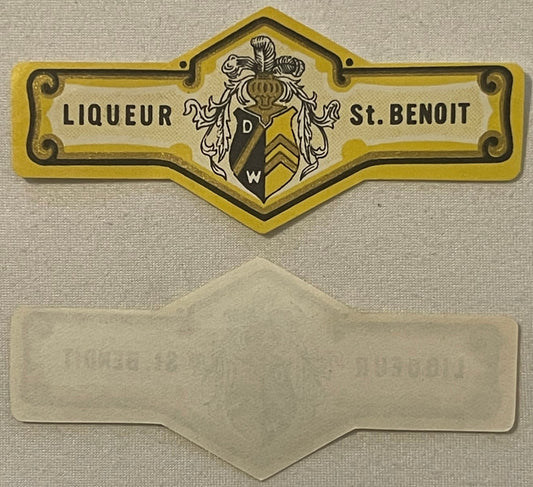
It is a die-cut paper band shaped for a bottle neck: two long flat wings either side of a pointed center that rises above the band and drops below it. The border is a strong orange, lined inside with a black rule and a metallic gold rule, and each end finishes in a gold scroll curl. Across the wings run two cream panels stippled with fine orange dots, lettered in heavy black capitals: LIQUEUR on the left, St. BENOIT on the right. Two small black dots sit where the inner border steps up toward the center.

The center holds the coat of arms. A gold barred helm faces straight out under three white plumes drawn in fine black line, and black-and-white leafy mantling curls down both sides. The shield is divided straight down the middle. Its left half is black, crossed by a gold diagonal band, with a white D above the band and a white W below it; its right half is orange with two gold chevrons stacked one above the other.

The reverse is plain, unprinted paper, with the lettering and crest showing faintly through in mirror image. There is no glue on the back and no sign it ever met a bottle: this is unused new old stock, 3.75 x 1.5 inches.


🇧🇪 Where St. Benoit Came From

Nothing printed on this orange label names a town or a country. The place comes from the brand. A Creme de Cacao label printed for the same St. Benoit mark carries the words Marque Déposée, registered trademark, and the line R. C. Courtrai above a register number. R.C. is the abbreviation of registre du commerce, the trade register, and the number is the firm's entry in it; Courtrai is Kortrijk, in the province of West Flanders. That register line ties the St. Benoit mark to Belgium, and the French words on this label are at home there, since French is one of Belgium's official languages.

Keep it apart from Bénédictine, the liqueur of Fécamp in Normandy. St. Benoit is a different mark, and the D and W on its shield belong to its own crest.


⚔️ Kortrijk, the Town of the Golden Spurs

On 11 July 1302 the civic militias of the Flemish towns, weavers, fullers and common townsmen fighting on foot, met the mounted knights of the King of France under Count Robert II of Artois outside Kortrijk and destroyed them. The Flemings took about 500 pairs of spurs from the French dead and presented them to Kortrijk's Church of Our Lady. French troops carried the spurs away again in 1382, after the Battle of Roosebeke, but the name held: the Battle of the Golden Spurs. In 1973, 11 July was formalized as the official holiday of the Flemish Community.

Kortrijk was a cloth town, and then a flax town. Along the river Leie, the Lys in French, "Courtrai flax" became renowned as the best flax obtainable and was sought internationally. Kortrijk's Texture museum, set in a 1912 flax depot on the banks of the Leie, tells that story today.


⛪ The Saint in the Name

Benoît is French for Benedict. Benedict of Nursia, born about 480 and died about 547, founded twelve communities of monks at Subiaco in Italy before establishing Monte Cassino around 530, and he wrote the Rule of Saint Benedict, the guide to monastic life that made him the founder of Western Christian monasticism. Pope Paul VI proclaimed him patron protector of Europe in 1964, and his feast is kept on 11 July, the same day as the Golden Spurs. Putting his name on a liqueur borrowed fourteen centuries of monastic reputation in two words.


🛡️ Reading the Coat of Arms

The crest on this label follows the grammar of real heraldry. The helm sits above the shield, and in heraldry the rank of the bearer governed both the type of helm shown and the direction it faced; this one looks straight out. The leafy scrolls pouring down either side are mantling, which began as a small cloak hung down the back of a knight's helm, probably as protection from the sun, and became a decorative flourish around the arms. A chevron is heraldry's inverted V, and a shield divided vertically, as this one is, is called per pale. The label does not spell out what the D and W stand for.


🍾 What a Neck Label Was For

The French trade word for a neck label is collerette: a small label stuck on the neck of a bottle, which on wine usually gave the vintage year. On this liqueur the neck carried the brand itself, LIQUEUR and St. BENOIT either side of the crest, and the bow-tie cut with its center peak was made to sit on the curve of the glass.


🥃 Liqueur in Belgium Between the Wars

The Vandervelde law, named for Justice Minister Emile Vandervelde, came into effect on 29 August 1919 and took spirits out of Belgium's pubs and cafés. For drinking at home, Belgians could still buy spirits in shops, but only in quantities of at least two liters. The law was not abolished until 1 January 1984.

Belgian beer lore credits the Vandervelde law with the country's strong beers, the story being that drinkers who could no longer order a spirit in the café ordered a heavier beer instead. Beer historians have taken that legend apart: the average Belgian beer was 3.29% alcohol in 1900 and 3.36% in 1930. The legend is still repeated.


⭐ How It Survived

A neck label was pasted round a bottle and went out with the empty, so the ones that survive unused are leftover stock that never reached a bottle.


🖼️ Display Ideas

  • 🍾 Float it in a narrow frame over a home bar, beside a period liqueur glass.
  • 🇧🇪 Hang it with a print of Kortrijk's Church of Our Lady for a Flanders corner.
  • 🛡️ Group it with other heraldic labels; the orange border and black-and-gold crest carry across a room.
  • 📚 Keep it flat in an archival sleeve in a drinks label album.

  • 🎁 Who Collects These

    Collectors of Belgian and European liqueur labels, heraldry enthusiasts, families with roots in Kortrijk and West Flanders, home bar decorators who want a real period label rather than a reproduction, and ephemera collectors who look for unused die-cut neck labels.


    ❓ Questions People Ask

    Is this a French or a Belgian label?

    No country is printed on it. The St. Benoit mark is tied to Courtrai (Kortrijk), Belgium, by the R. C. Courtrai register line on the brand's Creme de Cacao label, and French wording was normal in Belgian commerce.

    Is it from a Bordeaux château?

    No. Nothing on it names a château, a wine or Bordeaux. It is a liqueur label, and the brand's register line points to Courtrai in Belgium.

    How old is it?

    It dates to the 1920s - 1930s.

    Is St. Benoit the same as Bénédictine?

    No. Bénédictine is a different liqueur, from Fécamp in Normandy. St. Benoit is a separate mark.

    What do the D and W on the shield mean?

    They are the initials on the St. Benoit crest. Nothing printed on the label spells them out.

    Has it been used?

    No. It was never applied to a bottle, and the back is clean, unprinted paper.

    How big is it?

    3.75 x 1.5 inches.

    Shipping

    🚚 Shipping & Handling

    • Shipping costs and timing are calculated at checkout.
    • Items curated and shipped directly by me include U.S. shipping at no additional cost, professionally packed to ensure safe arrival of your artifact.

    Items from Vetted Pro Collectors
    Shipping for items offered by vetted Pro Collectors is determined at checkout. All Pro Collector listings are reviewed to ensure fair, reasonable shipping practices.

    For full details, please refer to our Shipping Policy.

    Returns & Exchange

    Take your time — you've got a full six months. If a piece isn't right for you, send it back the way it reached you and we're good.

    In the first 30 days your money goes straight back the way you paid. After that it's store credit, so you can put it toward something you'd rather have.

    Return shipping we sort out between us, case by case. I don't make this difficult.

    If something arrives damaged, or it isn't what I said it was, send me a photo within 48 hours and I'll make it right.

    Email info@vintageantiquesgifts.com or call 802-356-9872 — that's me answering, not a call center.

    The only things I can't take back are custom or special-order pieces and gift cards.

    View full details

    Preserving History: Authentic Objects Across Eras

    — Curated by Travis Weigel