Skip to product information
1 of 8

Vintage and Antique Gifts

Vintage 1970s Coach and Four Ginger Beer Label 🐎 from Philadelphia

Vintage 1970s Coach and Four Ginger Beer Label 🐎 from Philadelphia

Regular price $5.50 USD
Regular price Sale price $5.50 USD
Sale Sold out
Shipping calculated at checkout.

Size: 3 1/2" x 2 1/2"

🚚 Free US Shipping — ships within one business day. International shipping calculated at checkout.

Quantity

Ginger Beer or Ginger Ale? 🐎 Vintage 1970s Coach and Four Ginger Beer Label, Philadelphia

Size: 3 1/2" x 2 1/2"

This label is very collectible. Really cool stagecoach and colors! And the story behind that little stagecoach turned out to be a good one, so pull up a chair.

🐎 What's on it

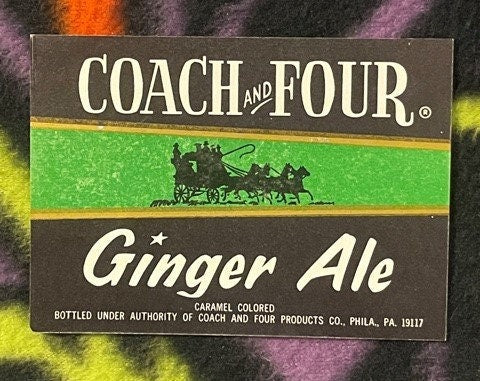
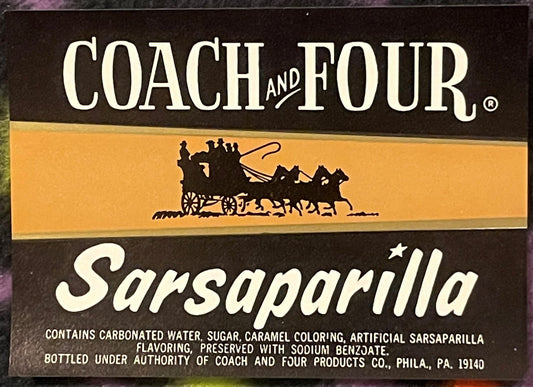
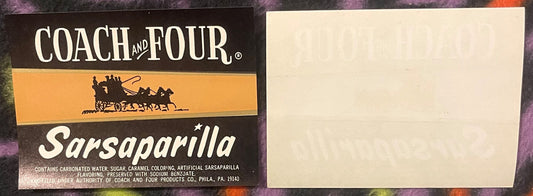
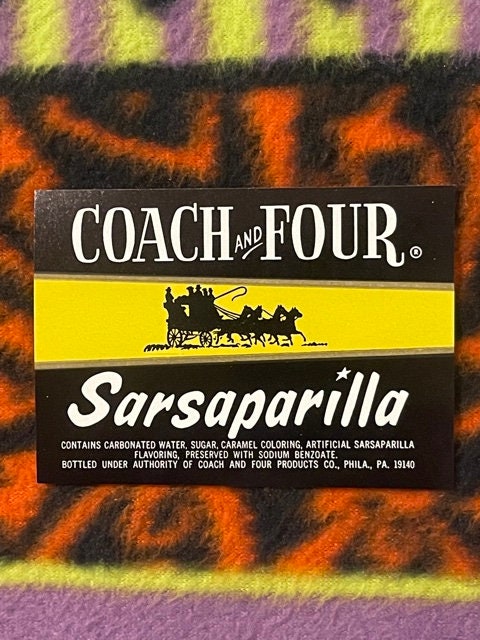
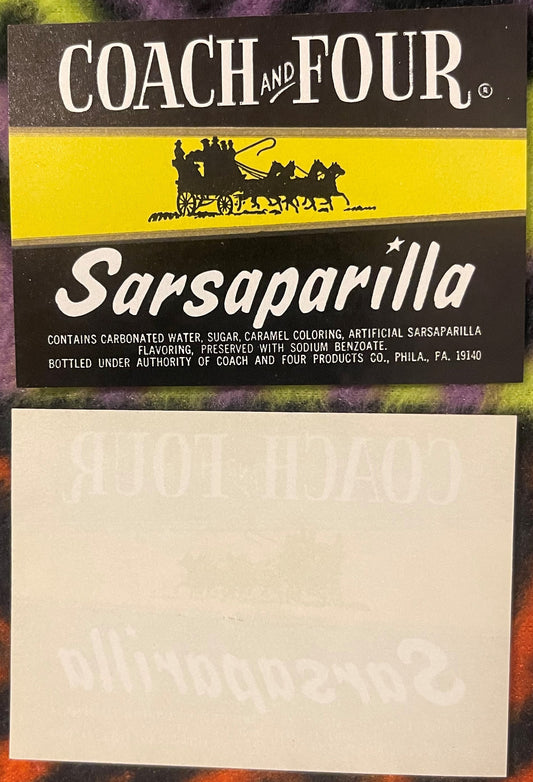
A small paper bottle label for Coach and Four Ginger Beer. Across the top, COACH AND FOUR ® over a white silhouette of a coachman driving four horses at full trot, on a black band. Then Ginger Beer, and the fine print, word for word: "Contains carbonated water, sugar, Jamaica ginger, citric acid and citrus oils. Preserved with sodium benzoate." Along the foot: "Bottled under authority of Coach and Four Products Co., Phila., Pa. 19140." The back is plain paper.

👬 The people behind the stagecoach

This is my favorite part. The name went on soft drinks for the first time on June 26, 1956, spelled COACH'N FOUR back then, and a month later it was filed with the U.S. Patent Office by Sheffield Bottling Co., a Philadelphia partnership doing business as "Coach 'N Four Products Co." It was registered on January 29, 1957 as trademark No. 640,759, for "maltless soft drinks and carbonated waters." That's the little ® you see on the label. Signing for Sheffield, as a partner, was Harry Labovitz.

On July 11, 1969, Sheffield handed the name and all its goodwill to a new partnership, Coach and Four Products Company, made up of Harry Labovitz and Arthur Labovitz, on North 6th Street in North Philadelphia. That is the exact company name printed on this label, and in January 1971 the registration was amended to the new owner and to the COACH AND FOUR form printed here. The trademark was renewed in 1977 and finally lapsed in 1997, forty-one years after that first bottle in 1956.

🏠 The family bottling works behind the stagecoach

Coach and Four was a brand of Sheffield Bottling Co., a family soda works at 3727-3729 North 6th Street, listed there in a bottlers' trade journal as early as 1945. Sheffield told the Patent Office it had used its mark on soft drinks since October 6, 1931. In 1949 Mr. Labovitz of Sheffield was president of the Philadelphia Manufacturers of Carbonated Beverages and sat on the board of the Pennsylvania Bottlers Association, and in 1950 Sheffield was packing Logan Beverages for the Penn Mutual Grocery Co. A 1974 Philadelphia industrial directory still lists the Sheffield Beverage company at 3729 N. 6th St., ZIP 19140, making soft drinks with 20 employees, Harry and Arthur Labovitz partners.

A grandson of the family got in touch with me about this brand, and the way the family tells it, Coach and Four was meant to be the more polished line next to the everyday Sheffield label. Sheffield's own list ran to ginger ale; the stronger ginger beer, with its Jamaica ginger, is one of the mixers that carried the stagecoach instead. A big part of the business was filling seltzer bottles for Philadelphia's hotels and bars and for the dining cars of the Pennsylvania Railroad, headquartered right here in Philadelphia, and when Sheffield bought out smaller bottlers it kept their labels, Girard and Rising Sun among them, running on the old routes so the customers got what they were used to.

⚖️ The milk company that wanted the name

In November 1961 Sheffield applied to register its own label: SHEFFIELD on a red-and-gold pennant with a chess knight and the word "Tingly." National Dairy Products Corporation, the company behind New York's Sheffield Farms milk, opposed it, and its own Sheffield Farms carbonated drinks, ginger ale and club soda among them, came up in the case. The Trademark Trial and Appeal Board dismissed the opposition on June 7, 1967. National Dairy appealed to the U.S. Court of Customs and Patent Appeals, and that appeal was dismissed on May 9, 1969. Two months later the Coach and Four name went to its own company. The family remembers the legal bills of fighting for the Sheffield name, with more still coming, as the reason everything moved over to Coach and Four. And that chess knight? The grandson says his dad loved carved chess pieces.

"Bottled under authority of" names the brand owner: the company owned the name and the recipes, and the bottles were filled and capped by the family's own Sheffield works on the same North 6th Street block. Two Labovitzes, a stagecoach, and a lineup of mixers. The Coach and Four line ran to ginger ale, ginger beer, tonic water, bitter lemon, club soda, sarsaparilla and black raspberry, the kind of set you'd find behind a Philadelphia bar or in a family's basement fridge.

📅 How old is it?

The label dates itself three ways. That five-digit ZIP, 19140, can't be earlier than July 1, 1963, the day ZIP codes began. The maker's name reads exactly the way the 1969 Labovitz partnership was named. And the COACH AND FOUR form across the top only went onto the registration in January 1971. So this is a 1970s label, a true vintage piece of Philadelphia soda history.

🫚 Ginger beer, the real thing

Ginger beer is older and fiercer than ginger ale: more ginger, less sweet. It was first brewed in Yorkshire, England, in the mid-1700s and reached North America around 1790. The old brewed kind could run about 11 percent alcohol until England capped it at 2 percent in 1855. It was fermented with a "ginger beer plant," which isn't a plant at all but a living partnership of a yeast and a bacterium, first described by the botanist Harry Marshall Ward in 1892. In the United States ginger beer hit its peak around 1920, before Prohibition pushed the milder ginger ale to the front.

Two ginger beer stories every collector should know. On August 26, 1928, May Donoghue sat in the Wellmeadow Café in Paisley, Scotland, and poured out a ginger beer float. Out came, she said, the remains of a snail. Her case, Donoghue v Stevenson, reached the House of Lords in 1932, and Lord Atkin's "neighbour" principle, that a maker owes care to the people who will use what he makes, became the foundation of modern negligence law. A bottle of ginger beer changed the law across the English-speaking world.

And in 1941 ginger beer met vodka. Jack Morgan, whose company made Cock 'n' Bull ginger beer, got together with John G. Martin of Heublein and Rudolph Kunett of Smirnoff, and the Moscow Mule was born: two ounces of vodka, a squeeze of lemon and Morgan's ginger beer. (A bartender named Wes Price later claimed he invented it to clear dead stock out of the cellar. Take your pick!)

🌎 Why "Jamaica ginger"?

The label names its ginger: Jamaica ginger. It's a proud line on a soda label, but those two words carry a dark bit of American history too. During Prohibition, "Jamaica ginger" was also a patent medicine, an extract that was 70 to 80 percent alcohol and sold legally while liquor wasn't. In 1930 Harry Gross and Max Reisman of Hub Products swapped in a cheap industrial plasticizer to get their extract past government tests. Somewhere between 30,000 and 50,000 people were left partly paralyzed, lifting their feet high with the toes flopping, a tap-click walk that became known as the "jake walk," and blues singers like Tommy Johnson and Ishman Bracey sang about it. That was a different product entirely from the ginger in this soda, but it's why "Jamaica ginger" still makes an old-timer's ears prick up.

🎨 A coach and four

A coach and four is a carriage drawn by four horses, all four driven "four-in-hand" by one driver holding every rein. Philadelphia has the most famous one in American art. Around 1879 to 1880, Fairman Rogers, a Philadelphia engineer and devoted coachman, had Thomas Eakins paint him driving a coaching party through Fairmount Park. The painting, The Fairman Rogers Four-in-Hand, hangs in the Philadelphia Museum of Art, and Eakins posed its horses from Eadweard Muybridge's 1878 photographs of horses in motion, which makes it one of the first paintings to show exactly how horses move. A Philadelphia soda company choosing a coach and four for its label was picking one of the city's own great images.

🏡 Display

Imagine hanging this vintage advertising on your wall as home decor in any room! It's right at home in a bar, a kitchen or a game room, and it pairs up nicely with the rest of the Coach and Four flavors if you want the whole set together.

Shipping

🚚 Shipping & Handling

  • Shipping costs and timing are calculated at checkout.
  • Items curated and shipped directly by me include U.S. shipping at no additional cost, professionally packed to ensure safe arrival of your artifact.

Items from Vetted Pro Collectors
Shipping for items offered by vetted Pro Collectors is determined at checkout. All Pro Collector listings are reviewed to ensure fair, reasonable shipping practices.

For full details, please refer to our Shipping Policy.

Returns & Exchange

Take your time — you've got a full six months. If a piece isn't right for you, send it back the way it reached you and we're good.

In the first 30 days your money goes straight back the way you paid. After that it's store credit, so you can put it toward something you'd rather have.

Return shipping we sort out between us, case by case. I don't make this difficult.

If something arrives damaged, or it isn't what I said it was, send me a photo within 48 hours and I'll make it right.

Email info@vintageantiquesgifts.com or call 802-356-9872 — that's me answering, not a call center.

The only things I can't take back are custom or special-order pieces and gift cards.

View full details

Preserving History: Authentic Objects Across Eras

— Curated by Travis Weigel