Skip to product information
1 of 7

Vintage and Antique Gifts

Antique 1930s Cornwall Arms Embossed Cigar Labels 🚬 Combo All 3! Philadelphia, PA

Antique 1930s Cornwall Arms Embossed Cigar Labels 🚬 Combo All 3! Philadelphia, PA

Regular price $10.00 USD
Regular price Sale price $10.00 USD
Sale Sold out
Shipping calculated at checkout.

Size: 9 1/2" x 7", 9" x 5 1/2"

🚚 Free US Shipping — ships within one business day. International shipping calculated at checkout.

Quantity

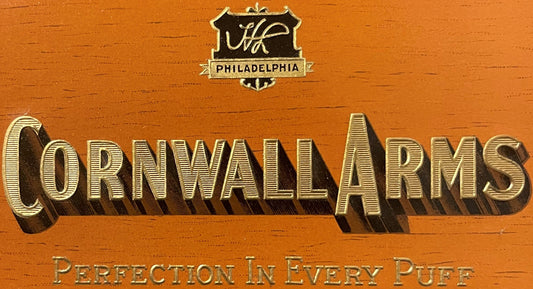
Want All Three Cornwall Arms Cigar Labels? 🏛️ Three Antique 1930s Cornwall Arms Cigar Labels, Gold Embossed, Registered by Harold Levy of Philadelphia

Size: 9 1/2" x 7", 9" x 5 1/2" ~, 5 1/2" x 2 1/2" ~ The small and medium label does have some little to slight edgewear.

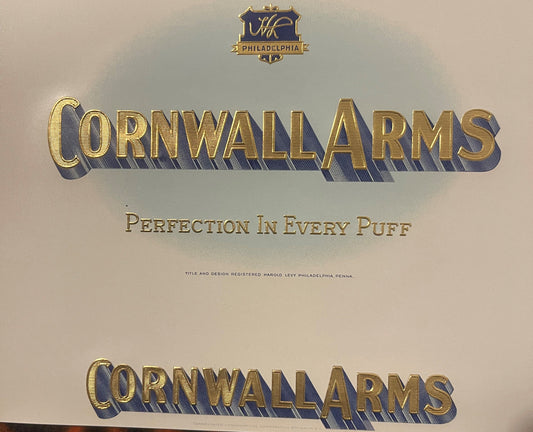
There's a real pleasure in a label like this. Run a finger over the lettering and the gold is raised right up off the paper, which tells you somebody paid for dies and extra press passes because he wanted his cigar box to say something before it was ever opened. And Harold Levy put his own name on it: "TITLE AND DESIGN REGISTERED. HAROLD LEVY, PHILADELPHIA, PENNA." is printed right on the big sheet. You get all three sizes of the Cornwall Arms label in this set.

🎨 What's Printed on Them

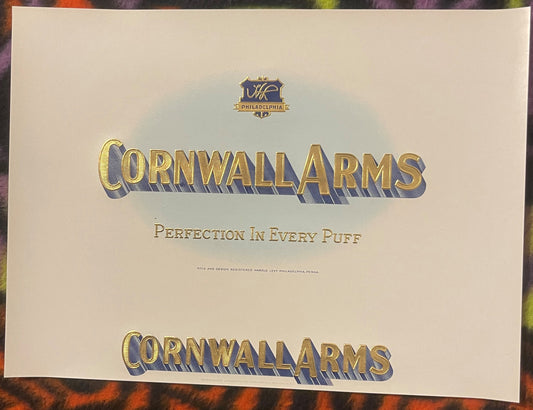
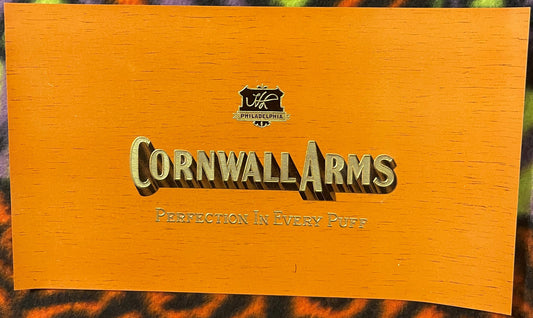
The two big ones carry a little shield at the top with an HL monogram, Harold Levy's own initials, over a gold banner reading PHILADELPHIA. The small one is just the name and the slogan. Below the shield, CORNWALL ARMS runs in bold gold-embossed capitals with a deep cast shadow, and under that, in spaced gold capitals, the promise: PERFECTION IN EVERY PUFF.

The large white sheet has a pale blue oval behind the lettering, the registration line under the slogan, and a second CORNWALL ARMS wordmark across the bottom. Along its bottom edge, in small type, is the printer's own credit: CONSOLIDATED LITHOGRAPHING CORPORATION, BROOKLYN, N.Y. The medium label is printed all over with a wood grain, an imitation of the cedar cigar boxes were known for, with a brown cast shadow behind the lettering. The small label is CORNWALL ARMS and the slogan on a pale blue-gray ground inside a printed gold border, with no shield.

🏭 The Brooklyn Press That Dates Them

That little foot line is the key to the whole set. The Consolidated Lithographing Corporation opened for business on January 1, 1926, when it took over two older shops, the Pasbach-Voice Lithographing Company and Wm. Steiner Sons & Co. Jacob A. Voice ran it, first as general manager and by 1930 as president. It went on to take in Schmidt & Co. and Heywood, Strasser & Voigt, two more old names in label printing, and in 1930 it bought the cigar-label business that had passed from the American Lithographic Company to U.S. Printing & Lithograph. From the Depression into the early 1960s it was one of the biggest label printers in the country. So these labels were printed in Brooklyn, New York, and the brand itself gives an even tighter clock: the tobacco trade's register shows CORNWALL ARMS entered on September 18, 1929, by Consolidated Litho. Corp. of Brooklyn, for all tobacco products. Consolidated stayed in Brooklyn until 1952, and Cornwall Arms was already a nickel cigar on the drugstore counters by 1934, so these are 1930s labels.

👤 Cornwall Arms, a Working Brand

Cornwall Arms wasn't just a pretty sample. The brand had its own cigar band, gold and blue, and its labels went out to the trade in a salesman's sample book in these same three sizes. Levy's HL shield is on the two big pieces, so whoever rolled the cigars, the name on these belonged to him.

That was how the cigar business worked back then. Plenty of factories made cigars "for the trade only." They had no brands of their own. They rolled cigars for the wholesalers, distributors and stores that owned the names, and the owner's name went on the label. Tony Hyman, who built the National Cigar Museum, figures this country has seen close to 2,000,000 cigar brands.

Here's how the story fits together. Cornwall Arms started out as one of the printer's own titles. Printers registered handsome names like this and sold the labels to whatever cigar man wanted them, and this one went to Harold Levy of Philadelphia, whose HL shield and registration line are on it.

The cigars themselves really sold. Peoples Drug Stores in Washington ran Cornwall Arms at a nickel apiece in 1934, and in 1943 a box of fifty went for $1.95, with ads in Ohio and Pennsylvania offering five for 23 cents. At some point the brand also belonged to A. J. Golden, a cigar man in Baltimore and later Red Lion, Pennsylvania, and there's a version of this same label with an AJG monogram in the shield instead of Levy's HL. As late as 1979 the trade-name books still listed Cornwall Arms as an A. J. Golden cigar.

🏙️ Philadelphia, Cigar City

Levy put Philadelphia on his label with good reason. Around 1900 the city had something like nine hundred tobacco factories, and a 1912 federal report put Pennsylvania first in the nation for cigar making, with Philadelphia one of its big centers. It had its own great label house too, George Harris & Sons, one of the eight firms that printed about 80 percent of the country's cigar labels. Out in York County, the little town of Red Lion made something like a tenth of all American cigars at its peak. By 1920 it was so busy that York County kept two tax offices, one for the county and one just for Red Lion. By 1927 Red Lion was turning out a fifth of all the nickel cigars made in America. Levy still sent his gold work up to Brooklyn.

Pennsylvania had been in tobacco from the start. The first settlers used it to pay their taxes and land rents to William Penn, and by 1706 about 800 hogsheads of it (big shipping barrels) were going out of Philadelphia. Farmers in the southeast started growing cigar leaf to sell in the 1830s, and by 1859 Lancaster County grew 65 percent of the state's crop. Lancaster gave us the word "stogie" too. It comes from the Conestoga wagon, whose drivers smoked long, cheap, strong cigars that ended up named after the wagon.

The nickel cigar is a big part of this story. When the Depression hit, smokers traded down fast. By July 1931 nickel cigars made up 73 percent of all cigar sales. Philadelphia's biggest cigar maker, Bayuk, cut its Phillies from a dime to a nickel in 1933, and in two years sales jumped from 17 million to 365 million cigars, the best seller in the country. Cornwall Arms was right there in that nickel crowd.

📜 Why Cigar Labels Got This Fancy

Starting in 1868, federal law made every cigar box carry its factory number, district and state, plus a printed caution notice. Once every box had to wear the same government paperwork, the brands fought it out with the artwork, and embossed gold was the top of the line. A label like this was doing the selling before the lid ever came up.

✨ How the Gold Got There

A label like this went through the press again and again. Every color got its own run. A good label used about 12 colors, and some used more than 20. After 1890 the fancy ones got extra runs for the raised work and the gold. The sheet was squeezed between a matched pair of brass dies, one raised and one sunken, and by 1892 the presses doing that work pushed 38 tons. Then the raised parts got their gold, either 22-karat gold leaf or bronze powder buffed up with a wheel, a lot like shining a shoe. That's the raised gold you feel when you run a finger across these.

By the time these were printed, the big days of the fancy label were winding down. The first fully automatic cigar machine came out in 1919. Ten years later more than 4,000 of them were running, and each one made more cigars in an hour than a hand roller could make in a day. Cigarettes were taking over too, and after 1920 labels got plainer and fewer. A gold embossed set like this one is a printer still doing it the old way.

Shipping

🚚 Shipping & Handling

  • Shipping costs and timing are calculated at checkout.
  • Items curated and shipped directly by me include U.S. shipping at no additional cost, professionally packed to ensure safe arrival of your artifact.

Items from Vetted Pro Collectors
Shipping for items offered by vetted Pro Collectors is determined at checkout. All Pro Collector listings are reviewed to ensure fair, reasonable shipping practices.

For full details, please refer to our Shipping Policy.

Returns & Exchange

Take your time — you've got a full six months. If a piece isn't right for you, send it back the way it reached you and we're good.

In the first 30 days your money goes straight back the way you paid. After that it's store credit, so you can put it toward something you'd rather have.

Return shipping we sort out between us, case by case. I don't make this difficult.

If something arrives damaged, or it isn't what I said it was, send me a photo within 48 hours and I'll make it right.

Email info@vintageantiquesgifts.com or call 802-356-9872 — that's me answering, not a call center.

The only things I can't take back are custom or special-order pieces and gift cards.

View full details

Preserving History: Authentic Objects Across Eras

— Curated by Travis Weigel