Skip to product information
1 of 4

Vintage and Antique Gifts

Vintage 1940s Pacific Pride Brand Emperor Grapes Crate Label 🍇 — Pacific Fruit Exchange, San Francisco CA — Bridge & Steamship Art

Vintage 1940s Pacific Pride Brand Emperor Grapes Crate Label 🍇 — Pacific Fruit Exchange, San Francisco CA — Bridge & Steamship Art

Regular price $7.00 USD
Regular price Sale price $7.00 USD
Sale Sold out
Shipping calculated at checkout.

Size: 13" x 4"

🚚 Free US Shipping — ships within one business day. International shipping calculated at checkout.

Quantity

Who Was Pacific Pride? 🍇 Vintage 1940s Emperor Grapes Crate Label, Pacific Fruit Exchange, San Francisco

13" x 4" ~ Little to no storage wear. Sorry for the glare.

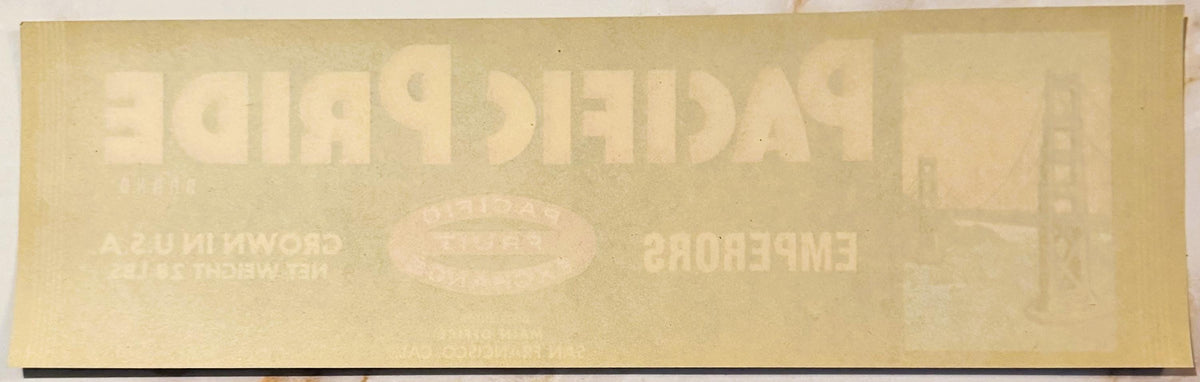
Behold this beautiful label, adorned with a classic steamship going under the San Francisco bridge, a true masterpiece of aesthetic value.

🌉 That Is the Golden Gate, and It Is the Best Thing on This Label

Let us not be coy about it. The bridge in the panel is the Golden Gate Bridge — International Orange, the stepped Art Deco towers, the X-braced pier standing in the water at the Fort Point end, the Marin headlands rising behind it and a steamship sliding out underneath into a gold sunset. Nobody who has seen that bridge would mistake it for another one, and the artist did not intend them to.

That matters, because the bridge is what gives this label its moment. Construction started on 5 January 1933 and finished on 19 April 1937; it opened to the public on 27 May 1937, and people walked across it before any car did. Joseph Strauss was the chief engineer, with Leon Moisseiff and Charles Alton Ellis on the structure, and the man who decided what it would look like was the consulting architect Irving F. Morrow. The steel arrived coated in an orange primer, and Morrow argued that the primer color should stay — that International Orange sat better against the fog and the headlands than the gray or the black-and-yellow stripes that had been proposed. He won, and that is why the most famous bridge in America is orange.

Its main span of 4,200 feet made it the longest in the world, and it held that title until the Verrazzano-Narrows opened in 1964.

🪢 The Net, and the Half Way to Hell Club

There is a piece of this story that belongs on any page about that bridge. Strauss insisted on a safety net strung beneath the deck, at a cost of $130,000, which the money men thought extravagant. Over four years it caught nineteen men who would otherwise have died, and those nineteen formed themselves into the Half Way to Hell Club. The name came from the ironworkers' own grim shorthand — as the club member Al Zampa put it, a man who fell all the way had "gone to hell," so a man the net caught had only fallen half way.

Eleven men died building it even so, ten of them in a single accident near the end when a scaffold went through the net. For its day the bridge was still regarded as a landmark in industrial safety, which tells you something about what the days before it were like.

🍇 What the Label Actually Says

Every word printed on the sheet:

PACIFIC PRIDE BRAND · EMPERORS · PACIFIC FRUIT EXCHANGE, in a red ellipse · DISTRIBUTORS — MAIN OFFICE — SAN FRANCISCO, CAL. · GROWN IN U.S.A. · NET WEIGHT 28 LBS.

No year, no printer's imprint, no packing house, no grower. EMPERORS is the grape variety — the big late-season red table grape that came off the vines last and shipped best, which is why it traveled east by the carload when the thinner-skinned varieties could not. The 28 pounds is the lug it was nailed to.

The Emperor itself is a red-skinned, seeded grape with big oval berries, firm crisp flesh and a mild cherry flavor, and it was famous for holding up in cold storage, which is what made it the late-season and winter shipping grape. For a sense of how big that 28-pound lug was: when the federal marketing order for California table grapes cut its minimum box in 1996, it went down to 20 to 21 pounds.

One honest point of order: that San Francisco line is the distributor's main office. It tells you where the Pacific Fruit Exchange sold from, not where the grapes were grown, and the label does not say where they were grown.

And for the avoidance of confusion among collectors, since the names run together: the Pacific Fruit Exchange is not Sunkist, not the California Fruit Exchange whose mark was the Blue Anchor, and not the Pacific Fruit Express refrigerator-car line.

🏢 Who the Pacific Fruit Exchange Were

The Pacific Fruit Exchange was a San Francisco fruit house, and the Santa Clara County packing-house record calls it a dried fruit packer. It took on a big job in 1933. When Frank H. Buck was elected to Congress in November 1932, his family's Frank H. Buck Company of Vacaville got out of fruit shipping, and as the Stockton Daily Evening Record reported on 21 January 1933, the Pacific Fruit Exchange would handle all the shipping of the fruit from its orchards. The Exchange bought the Buck Co. that same year.

By 1936 its president was George H. Casey, a Santa Clara University man, and he sent out a promotional train carrying 200,000 pounds of prunes to be handed out along the route. A whole train of prunes. You have to love the 1930s.

Grapes were part of the business too. The San Joaquin County Historical Museum's product label collection files three grape brands under the Pacific Fruit Exchange name, out of Lodi: Fireflame, Pacific's Pride and Red Crush, for Tokay and Zinfandel grapes.

🖨️ The Printing

This is stone lithography doing what it did best — flat, saturated, unbroken color with no halftone dot anywhere in it. Look at the depth of the navy ground against the yellow of the lettering, and at the way the sunset behind the bridge goes from gold to green to blue in smooth bands. Each of those colors was a separate stone and a separate pass through the press, and they had to register perfectly or the whole thing turned to mud. There is no printer's mark anywhere on this sheet, so the lithograph house that did it remains unidentified.

🌉 About these

They're long and low, 13 by 4 inches, unused, never pasted to a crate, the colors full. Hang one above a doorway or along a shelf edge in a kitchen or a wine room, group it with your San Francisco things - it's period Golden Gate art - or frame it alone on a navy or black mat. The supply is finite - nobody's printing Pacific Pride labels again, and once the last of these are on display with collectors, they'll be very difficult to acquire.

Shipping

🚚 Shipping & Handling

  • Shipping costs and timing are calculated at checkout.
  • Items curated and shipped directly by me include U.S. shipping at no additional cost, professionally packed to ensure safe arrival of your artifact.

Items from Vetted Pro Collectors
Shipping for items offered by vetted Pro Collectors is determined at checkout. All Pro Collector listings are reviewed to ensure fair, reasonable shipping practices.

For full details, please refer to our Shipping Policy.

Returns & Exchange

Take your time — you've got a full six months. If a piece isn't right for you, send it back the way it reached you and we're good.

In the first 30 days your money goes straight back the way you paid. After that it's store credit, so you can put it toward something you'd rather have.

Return shipping we sort out between us, case by case. I don't make this difficult.

If something arrives damaged, or it isn't what I said it was, send me a photo within 48 hours and I'll make it right.

Email info@vintageantiquesgifts.com or call 802-356-9872 — that's me answering, not a call center.

The only things I can't take back are custom or special-order pieces and gift cards.

View full details

Rescuing American History Since 2007

— Travis & the Kids