Skip to product information
1 of 4

Vintage and Antique Gifts

Vintage 1940s Towne Tokays Grapes Crate Label 🍇 Sunny California, Red Tokay Grape Artwork

Vintage 1940s Towne Tokays Grapes Crate Label 🍇 Sunny California, Red Tokay Grape Artwork

Regular price $9.00 USD
Regular price Sale price $9.00 USD
Sale Sold out
Shipping calculated at checkout.

Size: 13" x 3 3/4"

🚚 Free US Shipping — ships within one business day. International shipping calculated at checkout.

Quantity

Who Packed Towne Tokays Grapes? 🍇 Towne Tokays Grapes from Sunny California Crate Label

Size: 13" x 3 3/4" ~ NOS unused stock, has minor edge damage, see pictures.

This is a label that is almost extinct. What I have left all has a little edge damage. You'd likely never notice once it's framed, but look at the pictures and decide for yourself. A heavy bunch of red Tokay grapes with their vine leaves hangs off the left end, Towne Tokays runs across in fancy italic, and GRAPES FROM SUNNY CALIFORNIA sits underneath.

🏷️ What's Printed on It

  • Towne Tokays
  • GRAPES FROM SUNNY CALIFORNIA

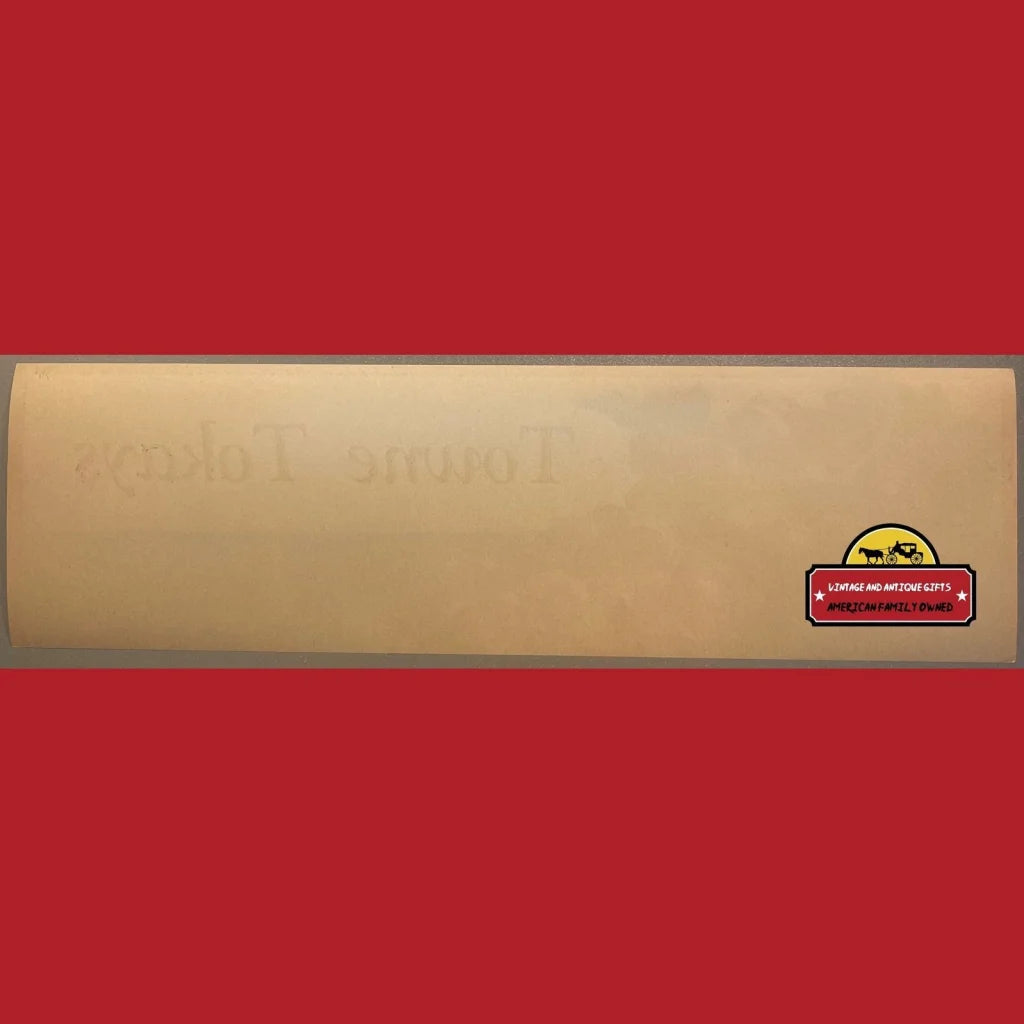
That's all it says, no packer and no town, just the grapes and California. The back is plain, with the lettering showing through.

I like a label that lets the fruit do the talking. No packing house bragging, no shipping point, no fine print. Just a great big cluster of red grapes, a brand name in script, and California. Grape labels like this went on the ends of the shallow wooden boxes grapes traveled in, the ones the growers called lugs. Paper labels like this stayed in use until about the 1950s, when cardboard boxes took over and the pretty paper went away.

🔥 The Flame Tokay

Tokay was the king of California table grapes, and Lodi was its capital. The Flame Tokay most likely arrived in the 1850s, and in 1864 George J. Leffler planted six acres of it at Lodi. Growers there could get that "flaming" pinkish red color that made those big heavy clusters so popular as an eating grape, and by 1879 Lodi grapes were riding the railroad in cattle cars to New York City, sixteen days on the rails. The 1907 season came to 1,141 carloads, and the saying went, "Grapes means money; Tokay means more money." That fall Lodi threw a three-day Tokay Carnival with a Tokay Grape Competition, and fun coincidence, one of the three top prizes went to Tokays grown and packed by a B.A. Towne. The other two went to E.W. Leffler and the Sanguinetti brothers.

The best years ran from the 1930s into the 1980s, and in 1974 the Lodi area alone shipped 2.7 million boxes of Flame Tokays. Then the new seedless grapes took over, and by 1990 Lodi's total had dwindled to 100,000 boxes.

The name fools a lot of people. The Flame Tokay has nothing to do with Hungary's famous Tokaji wine. The grape itself is known from Algeria, where it goes by Ahmeur bou Ahmeur, and it has picked up something like seventy names on its travels around the world. In California it was Tokay, and in Lodi it was money. Back in 1921 a single railroad car of 1,050 crates of Tokays sold for $3.80 a crate.

🎪 Queen Zinfandel and the Lodi Arch

That 1907 Tokay Carnival was a big deal for a farm town. The whole thing was Charles Ray's idea - a carnival to advertise the beauty and value of the Tokay grape. There was a "Queen Zinfandel" with a court of ten ladies - Bertha De Almado was the first, riding in an ornate carriage behind the Tokay City Band in the opening parade - and the Stockton Record figured some 30,000 people came over the three days, about 10,000 on the last day alone, on railroad cars packed with folks headed for "the Grape City." Out West Magazine wrote that packers were working right out on the streets, packing grapes beneath beautiful arbors. And for the occasion Lodi put up a grand Mission Revival arch over the street as the entrance to town, designed by architect E. B. Brown. One account puts it at 80 feet wide and 40 feet high, built of cement over metal lath. A California golden bear went up on top soon after, and the story goes that the very first bear was a papier-mâché prank. The carnival only happened once, but the Lodi Arch is still standing, one of the last Mission Revival ceremonial arches in California. It became California Historical Landmark No. 931 and went on the National Register of Historic Places in 1980.

When Prohibition ended, Lodi brought the party back as the Lodi Grape Festival in 1934. Police Chief Clarence Jackson got it going and stayed on as its manager until he retired in 1975, and the festival has been a September tradition for most of the years since. In 1960 artist John Garth even painted a mural of the Lodi Tokay harvest.

🍇 The end of the Tokay days

The seedless grapes that came along in the 1970s - the new seedless table grapes of 1973 - were the beginning of the end of the Tokay's nearly century-long run on top. Seedless grapes won the shoppers over, and by the mid-1980s demand for the big seeded Tokays had all but vanished. Thousands of acres around Lodi were pulled out and replanted to wine grapes, and Lodi turned into the wine country it's known as now. Labels like this one are what's left of the years when a crate of Tokays was the pride of the valley.

🖼️ Display

Crate labels are a leftover from a time that's gone, and in my book nobody's printed anything like them since. Museums and art institutes give crate labels their own galleries, and more collectors are hunting them every year to keep that history going. There aren't many left to sell - once they're on collectors' walls and in galleries, they'll be very difficult to acquire.

Picture this old grape label on your own wall instead of in a museum!

This is within 20 years of full antique status.

Shipping

🚚 Shipping & Handling

  • Shipping costs and timing are calculated at checkout.
  • Items curated and shipped directly by me include U.S. shipping at no additional cost, professionally packed to ensure safe arrival of your artifact.

Items from Vetted Pro Collectors
Shipping for items offered by vetted Pro Collectors is determined at checkout. All Pro Collector listings are reviewed to ensure fair, reasonable shipping practices.

For full details, please refer to our Shipping Policy.

Returns & Exchange

Take your time — you've got a full six months. If a piece isn't right for you, send it back the way it reached you and we're good.

In the first 30 days your money goes straight back the way you paid. After that it's store credit, so you can put it toward something you'd rather have.

Return shipping we sort out between us, case by case. I don't make this difficult.

If something arrives damaged, or it isn't what I said it was, send me a photo within 48 hours and I'll make it right.

Email info@vintageantiquesgifts.com or call 802-356-9872 — that's me answering, not a call center.

The only things I can't take back are custom or special-order pieces and gift cards.

View full details

Rescuing American History Since 2007

— Travis & the Kids