Skip to product information
1 of 4

Vintage and Antique Gifts

Vintage 1940s Yakima Chief Crate Label 🪶 | Native American Washington Produce Art

Vintage 1940s Yakima Chief Crate Label 🪶 | Native American Washington Produce Art

Regular price $9.00 USD
Regular price Sale price $9.00 USD
Sale Sold out
Shipping calculated at checkout.

Size: Choice Smaller 8 3/4" x 8 3/4" · Large Choice and Large Extra Choice 10" x 10"

🚚 Free US Shipping — ships within one business day. International shipping calculated at checkout.

Style
Quantity

Who Packed Yakima Chief Evaporated Apples? 🪶 The 1940s Washington Crate Label Whose Packer Beat the FDA

Size: Choice Smaller 8 3/4" x 8 3/4" · Large Choice and Large Extra Choice 10" x 10"

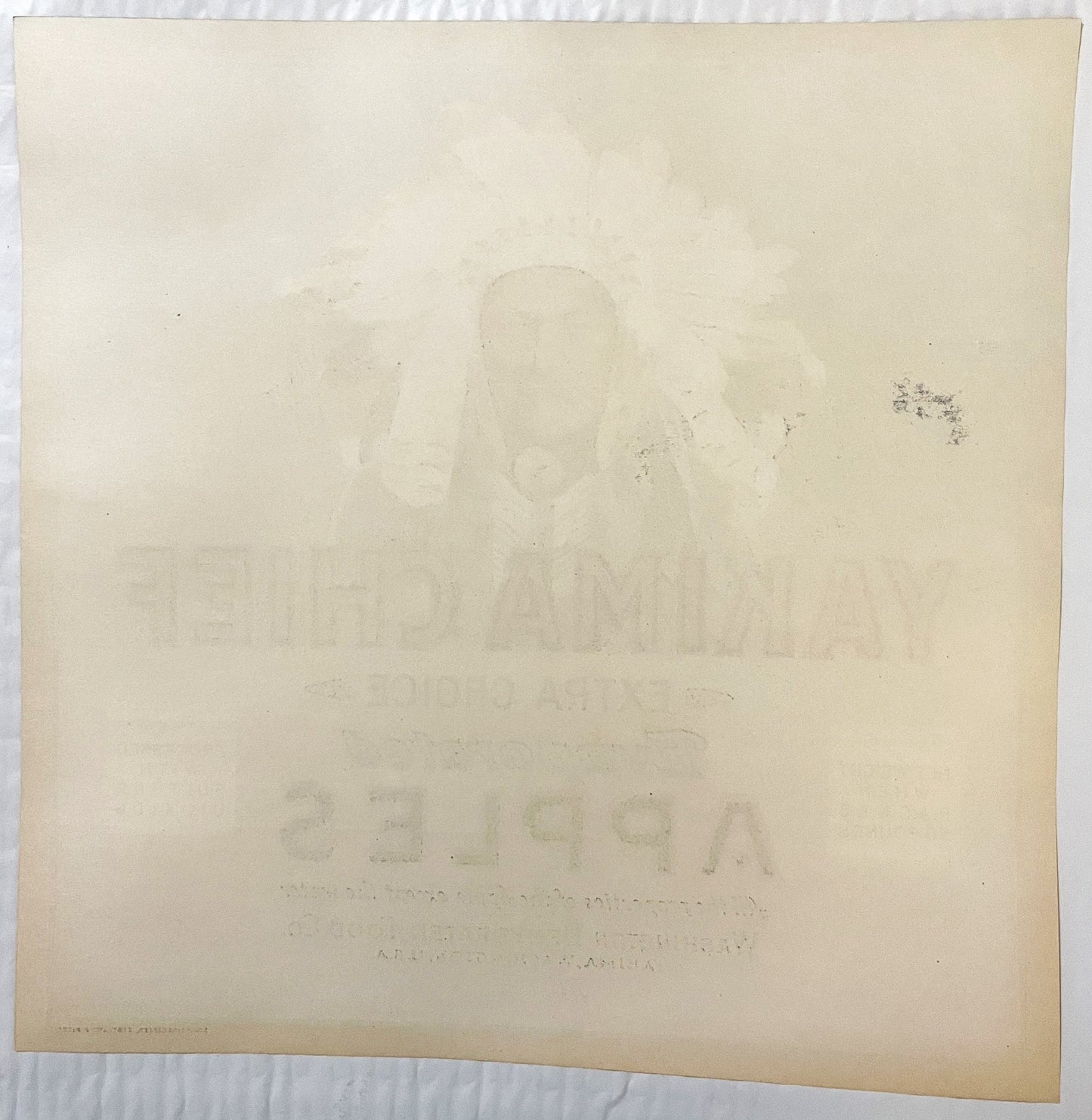
These are original 1940s Yakima Chief crate labels for evaporated apples from the Washington Dehydrated Food Co. of Yakima, Washington, and the man who ran that company told two FDA inspectors no and won at the U.S. Supreme Court.

🍎 Three versions, pick yours

These are original, unused labels from old stock, never pasted to a box. I have them in three versions:

  • Choice Smaller, 8 3/4" x 8 3/4": CHOICE, "Net weight when packed 25 pounds", no border.
  • Large Choice, 10" x 10": CHOICE, "Net weight when packed 50 pounds", with a thin green keyline border and the printer's line in tiny type at the lower right.
  • Large Extra Choice, 10" x 10": EXTRA CHOICE, 50 pounds, with the same border and printer's line.

All three carry the same Native American chief in a feathered war bonnet against a sky that fades from deep navy to gold and orange, YAKIMA CHIEF in big red letters, and little arrowhead ornaments either side of the grade word. The side panels say "Processed with sulphur dioxide," and across the bottom runs my favorite line on the whole label: "All the properties of the Apple except the water."

🏷️ What "Choice" and "Extra Choice" mean

The grade words are about the apples in the box, not the label. Dried apples were sold by grade, and this company was doing exactly that by the carload. In June 1919 it sold 60,000 pounds of "choice evaporated apples" at 18½ cents a pound, with extra choice priced at 19 cents and fancy at 19½. In a 1927 deal its president agreed terms on two carloads of apples "extra choice 50s," which the court explained meant fruit packed in 50-pound boxes, the same pack the two big labels name. The grades are older than the company, too: an 1895 New York farm report already sorts evaporated apples into fancy, choice, prime and poor to common.

🏭 Twenty-one kilns in Yakima

Washington Dehydrated Food Co. ran a fruit-drying plant in Yakima, and a 1941 federal court opinion paints a good picture of it: twenty-one kilns, four rows of five plus one big "jumbo" kiln, each about twenty feet square with wooden slat floors, shipping 75 to 100 carloads a season. Apples were most of it, with the odd run of cherries, prunes, apricots or pears. That case began with two night-shift workers let go in October 1937 and a charge filed by UCAPAWA Local No. 1 of Yakima, the cannery and packing workers' union.

They also made "apple chops": apples washed to get the orchard spray off, then sliced without peeling or coring and dried down to a fifth of their size. In 1937 a shipment of 993 sacks went to St. Louis to become apple butter, syrup and cider. The government claimed the chops still carried too much lead-arsenate spray residue; the courts sided with the company.

👨‍🔬 A botanist in the dried-apple business

The founder, president and general manager was Ira D. Cardiff, and he was no ordinary fruit man. He held a Ph.D. from Columbia, taught botany at Columbia, Utah and Washburn College, and in 1912 came to Pullman as plant physiologist, where he went on to head botany and plant pathology and to direct Washington's agricultural experiment station. He pushed for a research station to serve Central Washington's 250,000 acres of irrigated land; the Prosser station got its land in 1918, after he had moved on.

⚖️ The day he told the FDA no

Here's the story I like best. On March 31, 1950, two FDA inspectors turned up at the Yakima plant at a reasonable hour and asked to look around. Cardiff refused. The government prosecuted him for it, the Ninth Circuit reversed and ordered an acquittal, and in December 1952 the U.S. Supreme Court agreed. In United States v. Cardiff, Justice Douglas wrote that the law was too vague to be fair: it made an inspection depend on the owner's consent, then made refusing that consent a crime. So the company behind this label has its president's name on a Supreme Court decision.

🖨️ Printed by Simpson-Doeller

The two big labels carry the printer's line SIMPSON-DOELLER, PORTLAND & BALTO. John Simpson started printing labels in Baltimore in 1886 and was in business with Henry Doeller from 1896; the firm was known for stock labels and was bought by the United States Printing Company in 1954. The same Portland and Baltimore imprint turns up on other Pacific Northwest labels, from a Yakima fruit brand to an Astoria salmon-egg bait. The small 25-pound label has no printer's line at all.

🗓️ How old are they?

No year is printed on them. Collectors date Yakima Chief to the 1940s, and that sits right inside the paper trail: the company is on record from 1919 to 1952, and Simpson-Doeller was sold in 1954.

They ship flat and well protected, and they look terrific framed, a real bit of Yakima Valley history on the wall, especially the small Choice hung next to one of the big ones.

Shipping

🚚 Shipping & Handling

  • Shipping costs and timing are calculated at checkout.
  • Items curated and shipped directly by me include U.S. shipping at no additional cost, professionally packed to ensure safe arrival of your artifact.

Items from Vetted Pro Collectors
Shipping for items offered by vetted Pro Collectors is determined at checkout. All Pro Collector listings are reviewed to ensure fair, reasonable shipping practices.

For full details, please refer to our Shipping Policy.

Returns & Exchange

Take your time — you've got a full six months. If a piece isn't right for you, send it back the way it reached you and we're good.

In the first 30 days your money goes straight back the way you paid. After that it's store credit, so you can put it toward something you'd rather have.

Return shipping we sort out between us, case by case. I don't make this difficult.

If something arrives damaged, or it isn't what I said it was, send me a photo within 48 hours and I'll make it right.

Email info@vintageantiquesgifts.com or call 802-356-9872 — that's me answering, not a call center.

The only things I can't take back are custom or special-order pieces and gift cards.

View full details

Preserving History: Authentic Objects Across Eras

— Curated by Travis Weigel