Skip to product information
1 of 3

Vintage and Antique Gifts

Vintage 1950s Royal Blush Brand Crate Label 🂡 — Anthony Abbate Fruit Distributors, Fresno CA — Schmidt Litho, Poker Art

Vintage 1950s Royal Blush Brand Crate Label 🂡 — Anthony Abbate Fruit Distributors, Fresno CA — Schmidt Litho, Poker Art

Regular price $7.00 USD
Regular price Sale price $7.00 USD
Sale Sold out
Shipping calculated at checkout.

Size: 11" x 4 1/2"

🚚 Free US Shipping — ships within one business day. International shipping calculated at checkout.

Quantity

Royal Blush or Royal Flush? 🂡 Vintage 1950s Crate Label, Anthony Abbate Fruit Distributors, Fresno CA

11" x 4 1/2" ~ little to no wear.

🂡 A Royal Flush, Dealt in Fruit

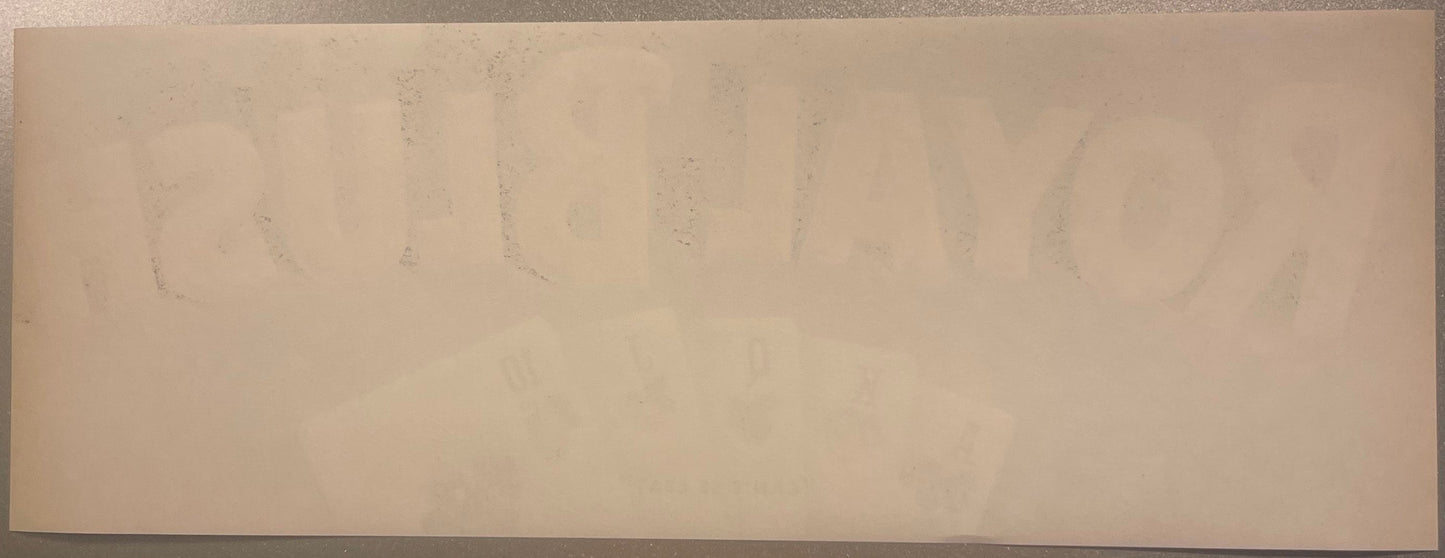
The whole brand is one joke, and it is a good one. ROYAL BLUSH stands in three-dimensional gold letters across a deep magenta ground, and fanned out below it is a poker hand: A · K · Q · J · 10. Five cards in sequence to the ace — a royal flush, the best hand there is, the one nothing beats. And printed across the middle card in navy: "CAN'T BE BEAT."

Then look at the pips. Every one of them has been replaced with painted fruit. The ace carries a pair of red-brown plums on a leafy stem. The king has an orange peach with a green leaf. The queen has a single dark purple plum. The jack has a smaller round apricot. The ten carries two bunches of red grapes. So the hand is not just a royal flush — it is a royal flush made of the packer's own produce, and "Royal Blush" is a pun on both the hand and the blush on a ripe peach.

There is no joker in it, and there should not be. A joker would make it a wild-card hand, and a natural royal flush needs no help.

📜 Everything Printed on the Sheet

ROYAL BLUSH · BRAND · the five cards A K Q J 10 · "CAN'T BE BEAT" · DISTRIBUTED BY ANTHONY ABBATE FRUIT DISTRIBUTORS, INC. — MAIN OFFICE, FRESNO, CALIFORNIA · PRODUCE OF U.S.A. · and, in microtype along the bottom edge, the printer: SCHMIDT L. CO. FRESNO.

No year. No packing house. No grade, no net weight, no variety named. Fresno is given as the distributor's main office, which is where the fruit was sold from rather than grown.

🖨️ Max Schmidt, Who Printed It

That microtype at the foot is worth more than it looks. Max Schmidt was born in Germany in 1850, and at fourteen — not wanting to go into the family's medical practice — he went to sea as a cabin boy and stayed there for six years, sailing around the world. He landed in San Francisco in 1871 speaking little or no English, took whatever work he could get, and found his way into engraving and lithography shops where he learned the trade properly.

He started his own printing business in 1873 and became one of the first printers working in lithography on the West Coast. In 1874 he went into partnership with Frederick Beuhler making pictorial cuts by zincography, then a new etching technique. His plant burned down twice, in 1884 and again in 1886, and he rebuilt both times. By the 1890s he was running a factory in San Francisco with branches in Portland and Seattle, and the Schmidt name became one of the two or three that every California packing house knew.

The imprint on this sheet reads Fresno rather than San Francisco, which tells you the firm had put a plant down in the middle of the valley where the fruit actually was.

🌾 Fresno

Fresno grew up around agriculture and the railroad, in the flat heart of the San Joaquin Valley, and by the middle of the twentieth century it was moving more fruit than almost anywhere on earth. Grapes, plums, peaches and apricots — exactly the five fruits painted onto these cards — came out of the surrounding country by the trainload, and every crate of them needed a label that would stand out on a warehouse floor stacked ten high. That is the pressure that produced artwork like this: not a gallery commission, but a fight for a buyer's eye at forty feet.

❔ Anthony Abbate

Anthony Abbate Fruit Distributors, Inc. of Fresno appears on this label and on other Royal Blush sheets, and the firm remains one of the valley's undocumented ones — no founding date, no family history in any record reachable online. Several of the archives that would hold it, including the California business registry and the digitised California newspaper collections, block automated access, so this is a closed door rather than an empty room. A Fresno city directory or the Fresno Bee's own archive would very likely open it, and that is exactly the kind of thread a local collector is best placed to pull.

🖼️ Display Ideas

  • 🃏 Game room, card table or bar — this is the obvious home for it, and it earns the spot.
  • 🍑 Kitchen grouping with other California fruit labels — the magenta ground makes it the loudest thing on the wall.
  • 🖼️ Framed alone — at 11 by 4 1/2 inches the proportion suits a long horizontal frame over a doorway.
  • 🎁 For a poker player — a genuine period royal flush, printed by a man who went to sea at fourteen.

🎁 Who Collects These

Crate label collectors treat California fruit labels as the great popular art of American agriculture, and Schmidt sheets sit at the top of that field. Poker, gambling and playing-card collectors cross over for anything with a hand printed on it, and a royal flush is the hand they want. Fresno and San Joaquin Valley local historians take it as a piece of the valley's trade. And graphic designers want it for the lettering, which is worth a long look on its own.

❓ Frequently Asked Questions

Is it original?

Yes — an original stone-lithographed crate label, unused, never applied to a crate. His note on it: little to no wear.

What are the fruits on the cards?

Ace: a pair of red-brown plums. King: an orange peach. Queen: a dark purple plum. Jack: a smaller orange apricot. Ten: two bunches of red grapes. They are the valley's own crops, which is the point of the design.

Why is there no joker?

Because a joker would spoil it. A royal flush made with a wild card is not the same hand as a natural one, and the slogan on the middle card is "Can't Be Beat."

Where was the fruit grown?

The label does not say. Fresno appears only as the distributor's main office.

How should I frame it?

A long horizontal at 11 by 4 1/2 inches, so give it generous space top and bottom rather than a tight mat. Black or deep plum picks up the magenta ground; cream lifts the gold lettering.

Crate labels are a reminder of a bygone era, and the lithography on them is unparalleled even to this day, in my opinion. Museums and art institutes have galleries dedicated to them, and more and more collectors are seeking them out to preserve their history. Once the limited supply for sale is gone and on display with collectors or in galleries, they will be very difficult to acquire.

Shipping

🚚 Shipping & Handling

  • Shipping costs and timing are calculated at checkout.
  • Items curated and shipped directly by me include U.S. shipping at no additional cost, professionally packed to ensure safe arrival of your artifact.

Items from Vetted Pro Collectors
Shipping for items offered by vetted Pro Collectors is determined at checkout. All Pro Collector listings are reviewed to ensure fair, reasonable shipping practices.

For full details, please refer to our Shipping Policy.

Returns & Exchange

Take your time — you've got a full six months. If a piece isn't right for you, send it back the way it reached you and we're good.

In the first 30 days your money goes straight back the way you paid. After that it's store credit, so you can put it toward something you'd rather have.

Return shipping we sort out between us, case by case. I don't make this difficult.

If something arrives damaged, or it isn't what I said it was, send me a photo within 48 hours and I'll make it right.

Email info@vintageantiquesgifts.com or call 802-356-9872 — that's me answering, not a call center.

The only things I can't take back are custom or special-order pieces and gift cards.

View full details
  • 5 stars: 1 (100%)
  • 4 stars: 0 (0%)
  • 3 stars: 0 (0%)
  • 2 stars: 0 (0%)
  • 1 star: 0 (0%)
G
Gunnar

Awesome and unique piece that you wouldn’t find anywhere else.

Preserving History: Authentic Objects Across Eras

— Curated by Travis Weigel