Skip to product information
1 of 3

Vintage and Antique Gifts

Vintage Fantasia Brand Fruit Crate Label 💃 — 1980s Tri-Boro Fruit Co. Fresno California, Flamenco Dancer Pinup Art

Vintage Fantasia Brand Fruit Crate Label 💃 — 1980s Tri-Boro Fruit Co. Fresno California, Flamenco Dancer Pinup Art

Regular price $10.00 USD
Regular price Sale price $10.00 USD
Sale Sold out
Shipping calculated at checkout.

Size: 11 3/4" x 4"

🚚 Free US Shipping — ships within one business day. International shipping calculated at checkout.

Quantity

Who Packed Fantasia Brand Grapes in Fresno? 💃 A Risqué Dancer, a Fresno Grape House, and a Family That Started Over

Size: 11 3/4" x 4" ~ little to no storage wear.

She stretches one ankle-strapped red heel across the top of the word FANTASIA and leans back as if the grape box were a stage. That was the whole job of this label: stop a produce buyer on a busy wholesale floor long enough to remember a brand. Behind the pinup glamour sits a better story than most crate labels carry — a Fresno fruit house that took its name from a New York landmark, built by an Italian-American family that lost a macaroni factory to fire and started over on grapes bought off the railcars.

🏷️ What Is Printed on It

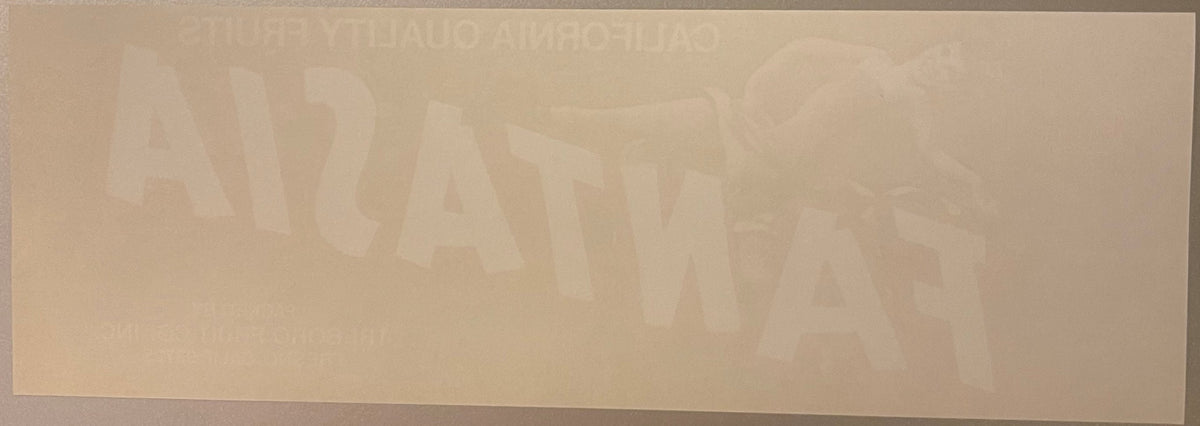
A long, narrow lithographed paper label on a deep navy ground. A dark-haired dancer in a fitted flame-red dress, her skirts flounced in red and yellow, reclines across the upper left with a red rose at her ear and a pale green fan-shaped ornament in her hair. "California Quality Fruits" runs across the top in yellow capitals; FANTASIA sweeps through the center in huge cream letters edged in red; "Produce of U.S.A." sits in red at the left; and the lower right carries the packer's line, "Packed by Tri-Boro Fruit Co., Inc., Fresno, Calif. 93725." The back is blank paper, with the front printing showing softly through in mirror image — what a label looks like when it was never pasted to a box.

🌉 Why a Fresno Company Is Named for a New York Bridge

"Tri-Boro" is the Triborough Bridge, the complex of spans that joins Manhattan, the Bronx and Queens across the East River. Work on it began in October 1929, just as the stock market crashed, and it opened to traffic on July 11, 1936. New Yorkers still call it the Triborough, even though it was officially renamed the Robert F. Kennedy Bridge in 2008.

The Fazio family story, as the produce trade tells it, goes like this. The family were Italian immigrants in New York City, where the father ran a macaroni factory. In the early 1930s the factory burned down. To survive, he began buying grapes from the rail operations and selling them, and to secure a steady supply he sent his son Chris to Fresno. There the family founded Tri-Boro Fruit Company — carrying the name of a New York landmark clear across the continent and into the vineyards of the San Joaquin Valley.

👨‍👩‍👦 The People: Chris Fazio and Four Generations of Grapes

Domenico "Chris" Fazio was born in New York on August 20, 1918, the youngest of nine children of Italian immigrant parents. Along with his father and brothers he helped lead the family to California, where they founded Tri-Boro Fruit Company, growing, packing and shipping wine and table grapes and dehydrating raisins. Chris spent his working life in the fresh fruit business and served on the board of the California Fresh Fruit Association until he retired in 1995. He died in Fresno on December 21, 2014, at the age of 96, survived by his children Don, Joe and Ann.

In 1984 Don Fazio and his son Tony formed Fazio Marketing, with Tri-Boro Fruit Co. as its sister company — a full-service grower, packer and shipper of California table and wine grapes. The trade press counts the family's grape business at four generations, and business directories still list Tri-Boro at 2500 S. Fowler Avenue in Fresno, inside the very ZIP code printed on this label.

🍇 Grapes Off the Railcars: How Prohibition Built the Trade

A New York immigrant buying California grapes off the rail lines in the early 1930s was not a quirk of one family. It was one of the strangest trades in American history. Prohibition outlawed the sale of wine, but it let a head of household buy wine grapes and make up to 200 gallons of wine a year at home. Immigrant families in the eastern cities, Italian-American households above all, kept their winemaking tradition alive that way, and at every harvest thousands of carloads of red wine grapes rolled east from California on the railroads.

California growers answered by planting more vineyard, and the home-wine grape trade changed the state's farm country — more acreage, more packing sheds, more shippers in the valley towns. Repeal came in December 1933, but the rail link between California vineyards and eastern kitchens did not vanish, and it is the same link that sent a New York macaroni maker's son to Fresno to stand at the source of the fruit.

🌹 The Lore of the Señorita on the Box

California fruit was never sold on flavor alone. It was sold on a dream of California itself. In the mid-1940s the journalist Carey McWilliams gave that dream a name: the "Spanish Fantasy Heritage," a sunny, romanticized legend of old California, of gallant dons and rose-crowned señoritas, that had very little to do with how people had actually lived. Historians count orange and fruit crate labels among the places that myth lived most publicly, shipped on the ends of boxes to grocers from coast to coast.

A flamenco-styled dancer in a red dress, a rose tucked at her ear, lounging above a brand called Fantasia, sits squarely in that tradition. By the time this sheet was printed, the fantasy had long outlived the missions-and-mantillas boosterism that spawned it — and it was still doing its old job, catching an eye on a stack of California grapes.

📅 How Old Is This Label?

The label sets its own lower limit. The packer's line carries a five-digit ZIP code, and the Post Office Department introduced ZIP codes on July 1, 1963, so this printing cannot be older than that. It is a 1980s printing. The Fantasia brand has a place in a public collection as well: the California Museum in Sacramento holds a Tri-Boro Fantasia label with a dancing woman and a basket of fruit.

The museum's catalog puts that one around the 1950s. You can see that older Fantasia on other copies, too: the same dancer kicking her leg up over FANTASIA, but with a big cornucopia of grapes and fruit at her feet and the packer's line reading just "Fresno, Calif." with no ZIP code at all. The same museum keeps a Tri-Boro label for Fresno Bella grapes out of Del Rey too, and its note on the company says it plainly: Tri-Boro Fruit Co. "was named after the bridge that links Manhattan to the Bronx and Queens."

The name itself was on the federal trademark register by 1958, when a firm called C. & R. Fazio of Del Rey, down in Fresno County, registered FANTASIA for fresh fruits. They filed in May 1957, the registration came through on February 25, 1958, and it ran until it lapsed in 1987. Tri-Boro Fruit Co. filed for FANTASIA in its own name in June 1983 and had it registered in 1984 - on July 31, the very same day as its TRI-BORO mark for fresh grapes, which claimed the name had been in use on grapes since August 30, 1967. Both of Tri-Boro's registrations were cancelled in 2016. So Fantasia was already on California fruit back in the 1950s. The ZIP code in the corner puts this one no earlier than the summer of 1963, a later label than those early Fantasias.

📦 Why It Was Never Used

Packing houses bought labels as inventory, in string-tied bundles of a thousand, and a bundle took up almost no room. Leftovers went into a label room or a corner of the warehouse and stayed there; the way the trade tells it, some packing houses were poor housekeepers. Nearly every unused crate label on the market today came out of finds like that, anywhere from a thousand to tens of thousands of sheets at a time. A few people began gathering labels in the 1960s, and crate labels have since become a recognized field of American commercial art.

🔍 Condition

Unused and never pasted. The navy is deep, the reds and yellows strong and the cream lettering crisp, and the blank reverse shows only the soft mirror-image show-through of the front. Offered as pictured.

💃 About these

The supply is finite - nobody's printing Fantasia labels for Tri-Boro again, and once these last unused ones are gone, they'll be very difficult to acquire.

Shipping

🚚 Shipping & Handling

  • Shipping costs and timing are calculated at checkout.
  • Items curated and shipped directly by me include U.S. shipping at no additional cost, professionally packed to ensure safe arrival of your artifact.

Items from Vetted Pro Collectors
Shipping for items offered by vetted Pro Collectors is determined at checkout. All Pro Collector listings are reviewed to ensure fair, reasonable shipping practices.

For full details, please refer to our Shipping Policy.

Returns & Exchange

Take your time — you've got a full six months. If a piece isn't right for you, send it back the way it reached you and we're good.

In the first 30 days your money goes straight back the way you paid. After that it's store credit, so you can put it toward something you'd rather have.

Return shipping we sort out between us, case by case. I don't make this difficult.

If something arrives damaged, or it isn't what I said it was, send me a photo within 48 hours and I'll make it right.

Email info@vintageantiquesgifts.com or call 802-356-9872 — that's me answering, not a call center.

The only things I can't take back are custom or special-order pieces and gift cards.

View full details
  • 5 stars: 1 (100%)
  • 4 stars: 0 (0%)
  • 3 stars: 0 (0%)
  • 2 stars: 0 (0%)
  • 1 star: 0 (0%)
8
8***4 (320)

Beautiful item. Shipped quickly. Easy transaction. Great item! Thx!

Rescuing American History Since 2007

— Travis & the Kids