Skip to product information
1 of 5

Vintage and Antique Gifts

Vintage 1980s Cooke's Combo Labels ๐Ÿน Collectible

Vintage 1980s Cooke's Combo Labels ๐Ÿน Collectible

Regular price $6.00 USD
Regular price Sale price $6.00 USD
Sale Sold out
Shipping calculated at checkout.

Size: 3 3/4" x 3"

๐Ÿšš Free US Shipping โ€” ships within one business day. International shipping calculated at checkout.

Quantity

Remember Cooke's English Cordials? ๐Ÿน Dilute to Taste: Three English Cordial Labels That Date Themselves

Size: 3 3/4" x 3"

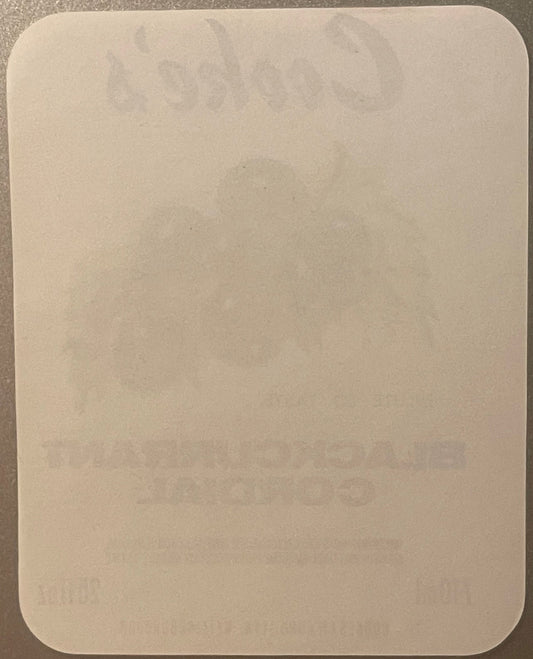
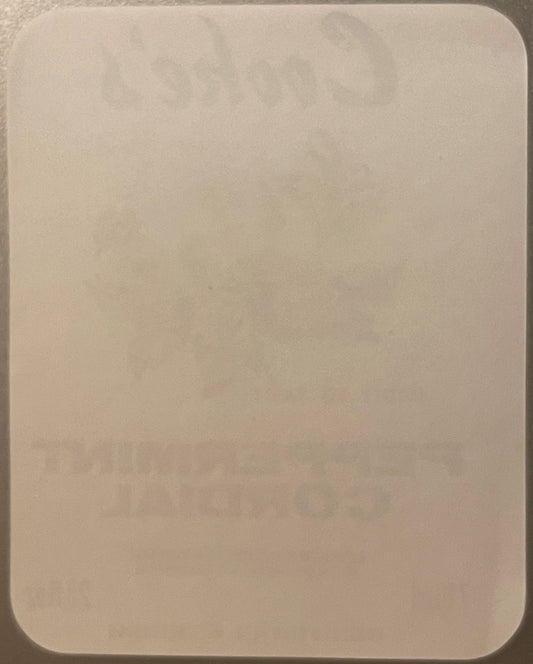
Three bottle labels from Cooke's (W'boro') Ltd. of Wellingborough, England: Peppermint Cordial, Lemon & Barley Water and Blackcurrant Cordial, each with a painted-style picture of its herb or fruit, a big brush-script "Cooke's" across the top and DILUTE TO TASTE beside the picture. Read the small print and the labels tell you when they were printed. Every additive is declared by its European E number: preservatives E210, E220 and E221, and on the blackcurrant, colors E102 and E142. These are 1980s labels from an English market town, and the blackcurrant one carries two things America kept out: a green food dye that is not approved in the United States, and a fruit whose farming the United States banned in the early 1900s.

Each paper label measures 3 3/4" x 3" ~, printed on white stock with rounded corners, marked 710ml and 25 fl oz, and signed along the bottom with the same maker's line: COOKE'S (W'BORO') LTD. WELLINGBOROUGH. The backs are blank.

๐Ÿ”Ž What Each Label Says

Peppermint Cordial. A spray of serrated green leaves with clusters of dusky pink flowers. The ingredients: water, sugar, citric acid, oil of peppermint, artificial sweetener (saccharin), preservative E210.

Lemon & Barley Water. A glistening wedge of lemon crossed by two golden ears of grain. The ingredients: water, sugar, lemon juice, citric acid, barley flour, flavoring, artificial sweetener (saccharin), preservatives E221 and E220.

Blackcurrant Cordial. A cluster of glossy blackcurrants on green leaves. The ingredients: water, sugar, blackcurrant juice, citric acid, flavoring, saccharin as the sweetener, preservative E220, colors E102 and E142.

๐Ÿงช How the Small Print Dates Them

E numbers began as a single European list of approved food additives. It was first agreed for food colorings in 1962, preservatives followed in 1964, antioxidants in 1970, and emulsifiers, stabilizers and thickeners in 1974; the E stands for Europe. In Britain the Food Labelling Regulations 1984 set out how additives had to be named in an ingredients list, with a schedule of serial numbers for them, and Cooke's labels list theirs exactly that way, number by number. All three also file their saccharin under "artificial sweetener," which was that 1984 law's own category name; by the Food Labelling Regulations 1996 the category had become plain "sweetener." So the panels were set under the 1984 rules, and I put them in the 1980s.

The numbers make a small tour of the additive list. E210 is benzoic acid, E220 sulfur dioxide and E221 sodium sulfite, all preservatives. E102 is tartrazine, a synthetic lemon-yellow dye discovered in 1890 by the Swiss chemist Johann Heinrich Ziegler in Basel. E142 is Green S, a synthetic green dye used in mint sauce, desserts, gravy granules, sweets, ice cream and tinned peas, and not approved in the United States, Canada, Japan or Norway.

Tartrazine is one of the food colors said to cause food intolerance and hyperactive behavior in children, though the evidence for it is weak. A 2007 study commissioned by the UK Food Standards Agency, known as the Southampton study, found a possible link between a mix of six artificial colors, tartrazine among them, plus the preservative sodium benzoate, and increased hyperactivity in children. Since 2010 the European Union has required foods containing it to carry the warning "May have an adverse effect on activity and attention in children." The blackcurrant label's plain "COLOUR E102" comes from before all that.

๐Ÿซ Blackcurrant: Britain's Wartime Fruit, America's Banned One

Blackcurrant has a lasting popularity as a flavor in Britain, and it became much less common in the United States. The reason is history. During the Second World War, with German submarines sinking cargo ships, oranges and other fruits rich in vitamin C became almost impossible to get in Britain, and the government encouraged the growing of blackcurrants. Under the Vitamin Welfare Scheme, launched in December 1941, blackcurrant syrup was given free to children under two from 1942. The best-known blackcurrant drink, Ribena, had been developed by Vernon Charley and Audrey Green, with research at the Long Ashton station near Bristol, and was introduced in 1938 by H. W. Carter & Co; its name comes from the botanical name for blackcurrant, Ribes nigrum. The story often told is that those wartime spoonfuls are the root of the flavor's hold on the British.

America went the other way. Currants are one of the two hosts white pine blister rust needs to complete its life cycle, the other being white pines, and in the early 1900s currant farming was banned as a threat to the logging industry. The federal ban passed to the individual states in 1966, and New York lifted its ban only in 2003, through the efforts of Greg Quinn, a horticulturist.

๐ŸŒพ Lemon & Barley Water: Kings and Tennis

Barley water was a drink from the domestic kitchen long before anyone bottled it: pearl barley and water, known at least as early as 1320. The seventeenth-century writer Thomas Fuller called it "an invention which found out itself", and the diarist Fanny Burney reported that George III refreshed himself with barley water as he rode home from a hard day's hunting, though his courtiers did not share his enthusiasm. The bottled lemon version belongs to Robinsons, a company founded in 1823 that made Patent Barley. In 1930 Eric Smedley Hodgson combined its barley crystals with real lemon juice and sugar, and lemon barley water was marketed alongside the Wimbledon tennis championships from 1935 until that sponsorship ended in 2022.

๐ŸŒฟ Peppermint Cordial: A Victorian Street Cry

Before cordials came in factory bottles they were home-made: highly flavored, syrupy drinks with the body of a liqueur, meant to tempt an invalid or brought out on special occasions, and, if desired, diluted to taste. In Tudor times a sweetened cordial for invalids was flavored with rosewater, violets or cinnamon. Peppermint is one of the few that lived on commercially as an essence-based cordial, and in Victorian London the journalist Henry Mayhew heard the hawkers at Billingsgate crying "Glass of nice peppermint, this cold morning a ha'penny a glass!"

๐Ÿฅค A Very British Bottle

Squash, often called cordial in British English, is a concentrate made to be mixed with water, commonly one part to four or five, and it is popular in the United Kingdom and the Commonwealth but not widely drunk in the United States. Concentrated lemon squash was introduced into Britain just before the First World War. The Second World War changed the drink again: wartime conditions gave concentrated drinks a push that carried on into peacetime, and blackcurrant drinks made the most of home-grown vitamin C. A 710ml bottle marked DILUTE TO TASTE belongs to that tradition.

๐Ÿ™๏ธ Wellingborough: The Well Town

Cooke's shortened its town to W'BORO' in its own company name. Wellingborough, in Northamptonshire, received its market charter from King John in 1201, and its coat of arms carries five wells. The name was written Wendlesberie in the eleventh century and means Waendel's fortification, but it was the wells that made the town famous. Its waters were fashionable by about 1624, when the Duchess of Buckingham came to drink them. Three years later Charles I and Queen Henrietta Maria received the Mantuan ambassador there, and the Queen seems to have come again in 1628. The legend, as an 1837 writer told it, is that the King and Queen lived in tents a whole season to drink the water of the Red Well pure at its source. By that 1837 telling, the well had become a stone watering trough for horses.

The town grew on boots and shoes and on iron. James Rixon and William Ashwell opened a major ironworks there in 1870, supplied by ironstone quarries around Finedon, and Midland Road railway station, opened in 1857, is still in use. In the second half of the twentieth century Wellingborough grew fast as a new home for families moving out of London, and by 2021 it counted 56,564 people.

๐Ÿ–ผ๏ธ Display

These labels are becoming uncommon. Imagine hanging this vintage advertising on your wall as home decor in any room: the three pictures, lemon yellow, blackcurrant black and peppermint green, make a natural row in a kitchen, a cafรฉ corner or a bar. My pictures seriously don't do them justice.

๐Ÿน About these

The supply is finite - nobody's printing these Cooke's labels again, and once these last unused sets are gone, they'll be very difficult to acquire.

Shipping

๐Ÿšš Shipping & Handling

  • Shipping costs and timing are calculated at checkout.
  • Items curated and shipped directly by me include U.S. shipping at no additional cost, professionally packed to ensure safe arrival of your artifact.

Items from Vetted Pro Collectors
Shipping for items offered by vetted Pro Collectors is determined at checkout. All Pro Collector listings are reviewed to ensure fair, reasonable shipping practices.

For full details, please refer to our Shipping Policy.

Returns & Exchange

Take your time โ€” you've got a full six months. If a piece isn't right for you, send it back the way it reached you and we're good.

In the first 30 days your money goes straight back the way you paid. After that it's store credit, so you can put it toward something you'd rather have.

Return shipping we sort out between us, case by case. I don't make this difficult.

If something arrives damaged, or it isn't what I said it was, send me a photo within 48 hours and I'll make it right.

Email info@vintageantiquesgifts.com or call 802-356-9872 โ€” that's me answering, not a call center.

The only things I can't take back are custom or special-order pieces and gift cards.

View full details

Preserving History: Authentic Objects Across Eras

โ€” Curated by Travis Weigel