Skip to product information
1 of 9

Vintage and Antique Gifts

Vintage Susan Rini World Champion 1969 Miracle Mets Uncut Postcard Sheet โšพ Tom Seaver Nolan Ryan, Historic Limited Editions MLB Licensed Art

Vintage Susan Rini World Champion 1969 Miracle Mets Uncut Postcard Sheet โšพ Tom Seaver Nolan Ryan, Historic Limited Editions MLB Licensed Art

Regular price 28.00 USD
Regular price Sale price 28.00 USD
Sale Sold out
Shipping calculated at checkout.
Quantity

Size: 22 x 17 inches ~ Unused and uncut.

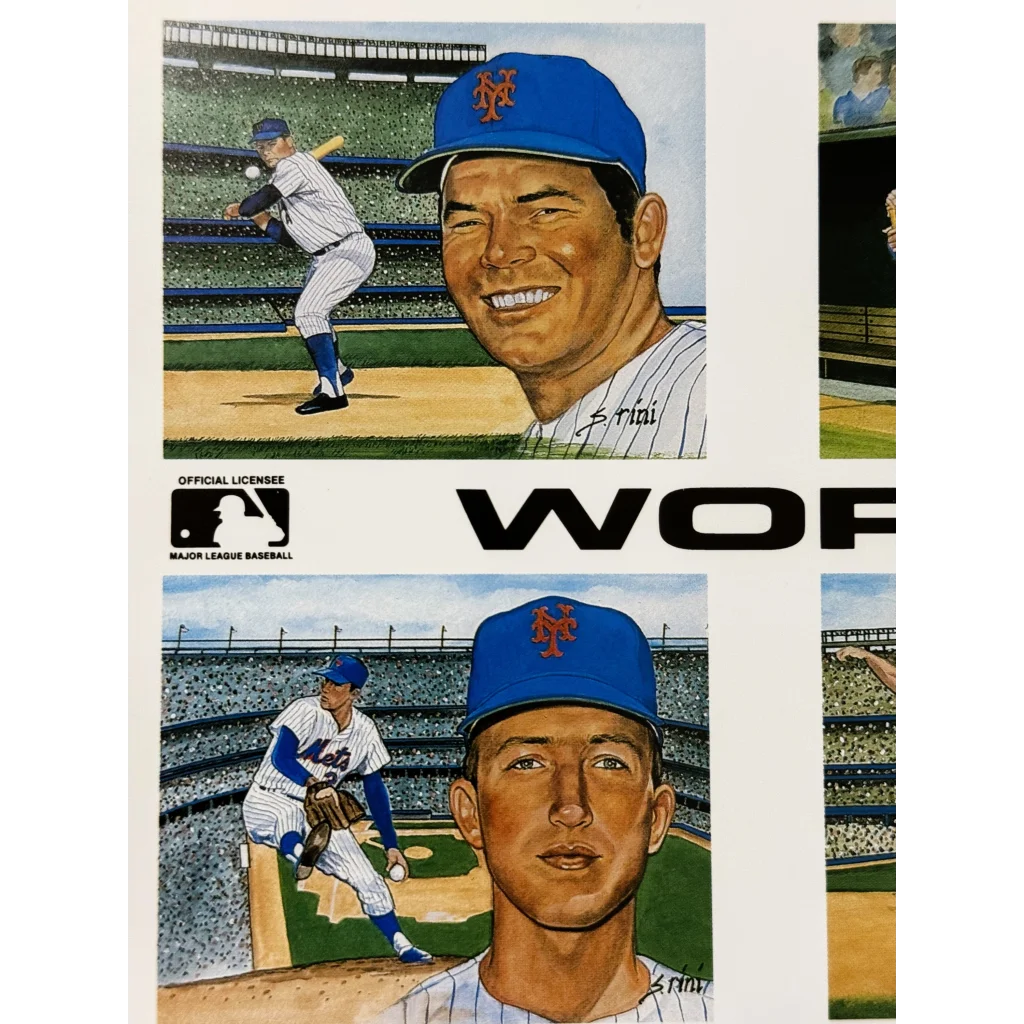
I love it when the whole set turns up in one piece, and that's what this is: Susan Rini's thirty-six paintings of the 1969 World Champion Mets, uncut and laid out just the way they came off the press, with Tom Seaver, Nolan Ryan and Yogi Berra among the faces looking back at you under a black WORLD CHAMPION 1969 METS band. Here's a fact I like to lead with - Nolan Ryan pitched twenty-seven years in the majors and appeared in exactly one World Series game in his whole career. It was Game 3 of this Series, and he came on with the bases loaded to get the last seven outs. That's the team you're looking at.

โšพ Thirty-Six Panels, One Team

The sheet is six panels across and six down, split into two blocks of three rows by that black title band, with the Major League Baseball batter-silhouette logo - OFFICIAL LICENSEE over MAJOR LEAGUE BASEBALL - sitting at each end of it. Rini signed almost every panel "S. Rini" in a lower corner.

Most panels pair a close portrait in a blue Mets cap with a small full figure playing the game behind it - a pitcher mid-delivery, a batter at the plate, a fielder kneeling in the grass. Where a uniform number is readable, it matches the real 1969 roster: 41 for Tom Seaver, 45 for Tug McGraw, 43 for Jim McAndrew, 12 for Ken Boswell, 6 for Al Weis, 3 for Bud Harrelson. Yogi Berra, the Mets' first base coach that year, sits in the grass wearing his number 8. A few panels step outside the roster: the World Championship Trophy on a blue ground, the curved exterior of Shea Stadium, and three broadcaster panels for the men who called the games - Lindsey Nelson, Bob Murphy and Ralph Kiner, who sat together in the Mets booth for seventeen seasons and are all three in the Baseball Hall of Fame now. The back of the sheet is plain, unprinted stock. Every sheet in my stack is unused and uncut like this one, and they vary a little one to the next - a touch more edge wave here, a shade less there.

๐Ÿ“ฎ The Same Paintings, No Frames

Historic Limited Editions turned these same thirty-six paintings into a postcard set, and one of the actual postcards shows the difference. Ron Swoboda's card frames his painting in blue, with NEW YORK METS and the Mets skyline logo beside it and his name printed underneath - and that's the same painting sitting at the left end of the third row here. Flip the postcard over and the back is printed: "1969 NEW YORK METS," the player's name, "From original artwork by Susan Rini," the MLB licensee mark, PUBLISHED BY HISTORIC LIMITED EDITIONS with a Williston Park, NY address, LIMITED ISSUE 5,000 SETS, a series and card number, and a spot for a stamp. None of that printing is on this sheet - no frame, no team name or player name beside any panel, no card number, and the back is blank. What's here is the paintings alone, uncut, with the title band and the two license marks running between the rows. Besides Ryan and Seaver, the set carries Art Shamsky, Rod Gaspar, catcher J.C. Martin, pitching coach Rube Walker (he ran the Mets' own pitching staff that year) and pitcher Jack DiLauro.

And thirty-six is the whole thing. The Mets set Historic Limited Editions put out was thirty-six cards, not a sampler and not a partial run - so the sheet's thirty-six paintings match the set's thirty-six cards.

๐ŸŽจ Susan Rini

Susan Rini was the artist Historic Limited Editions commissioned to paint these team sets, which the publisher released from the late 1980s into the early 1990s. Every set was a limited printing, with the number produced printed on the back of each postcard - on this Mets set, that number is LIMITED ISSUE 5,000 SETS.

๐Ÿ† Worst to First

The Mets were born in 1962 and lost 120 games their first year - still the most losses by any team in a modern season. Through their first seven years they never finished better than ninth in a ten-team league. Gil Hodges took over as manager in 1968, and in 1969 the National League split into two divisions for the first time, putting the Mets in the new NL East against a Chicago Cubs team that had led the division since opening day.

By mid-August the Mets were ten games back. Then, on September 9 at Shea, a black cat came out of the stands, circled Cubs third baseman Ron Santo in the on-deck circle and sat staring into the Chicago dugout at Leo Durocher before it disappeared under the stands. Santo said he knew right then they were in trouble. Seaver won that game 7-1. The next day the Mets swept a doubleheader from Montreal, a 22-year-old Nolan Ryan striking out 11 in the nightcap, and for the first time in team history the Mets were in first place. They went on to win 100 games, finish eight ahead of the Cubs, and sweep the Atlanta Braves in the first National League Championship Series ever played.

Baltimore had won 109 games and opened as heavy favorites. Don Buford hit Seaver's second pitch of Game 1 for a home run and the Orioles won 4-1. The Mets took the next four straight. Jerry Koosman won Game 2. In Game 3, Tommie Agee made two remarkable catches in center field and Ryan worked the last two and a third innings for the save - the only World Series appearance of his career. In Game 4, Ron Swoboda dove flat out to rob Brooks Robinson of extra bases, and J.C. Martin's bunt in the tenth brought home the winning run. Game 5, on October 16, is the one Mets fans still tell: down 3-0 in the sixth, Gil Hodges walked out and showed the umpire a smudge of shoe polish on a pitch that had grazed Cleon Jones, and Jones was sent to first. Donn Clendenon followed with his third home run of the Series, Al Weis - a career .219 hitter who'd hit exactly seven home runs in the big leagues - tied it in the seventh with the only one he ever hit at Shea Stadium, and Koosman finished what he started, a complete game, for the title. Clendenon was named the Series MVP.

๐Ÿงข The Faces

Tom Seaver, 41. Twenty-five wins against seven losses, a 2.21 ERA, and the National League Cy Young Award on 23 of 24 first-place votes. On July 9 that year he retired the first twenty-five Cubs he faced before Jimmy Qualls broke it up with a clean single, one out into the ninth - Seaver himself always called it his Imperfect Game.

Nolan Ryan, 30. A hard-throwing 22-year-old in 1969, traded to the California Angels after the 1971 season for shortstop Jim Fregosi, one of the most lopsided deals in the sport's history. Ryan went on to 5,714 career strikeouts and seven no-hitters, and that 1969 Series save stayed the only World Series inning he ever threw.

Yogi Berra, 8. Coached first base under Hodges in 1969, then took over as manager after Hodges died suddenly in April 1972 and led the Mets to the 1973 pennant.

Tug McGraw, 45. The lefty reliever of the '69 bullpen, who four years later stood up in a Mets team meeting and shouted "Ya Gotta Believe" - the line that carried the 1973 club to another pennant.

Al Weis, Bud Harrelson, Ken Boswell and Jim McAndrew round out the roster here, each painted with his number showing: the utility man who tied Game 5, the shortstop, the second baseman and a young starter.

๐ŸŸ๏ธ Shea Stadium, Painted In

Rini set her players inside their own ballpark, and it's there behind the portraits if you look: the Rheingold name on the outfield wall, a scoreboard, a sign ending in "Tribune," and grandstands built up out of thousands of tiny dots of color. Shea Stadium opened April 17, 1964, in Flushing Meadows, Queens, named for William A. Shea, the attorney most responsible for bringing National League baseball back to New York after the Dodgers and Giants left for the coast. The Beatles played there on August 15, 1965, in front of about 55,600 people. Rheingold, brewed across the river in Brooklyn, was the Mets' official beer from 1962 through 1973.

โญ The Batter in the Corner

That silhouette logo at each end of the title band was brand new in the Mets' championship year. Jerry Dior, a designer at the New York firm Sandgren & Murtha, drew it in 1968 for baseball's centennial and is said to have finished it in a single afternoon with a set of markers. The story has long held that the hitter was Harmon Killebrew; Dior always said otherwise - he worked from photographs of several players and kept the figure deliberately ambiguous, a batter who could be anyone. The same mark has stood for the league ever since, and here it's what certifies Rini's art as officially licensed.

Shipping

๐Ÿšš Shipping & Handling

  • Shipping costs and timing are calculated at checkout.
  • Items curated and shipped directly by me include U.S. shipping at no additional cost, professionally packed to ensure safe arrival of your artifact.

Items from Vetted Pro Collectors
Shipping for items offered by vetted Pro Collectors is determined at checkout. All Pro Collector listings are reviewed to ensure fair, reasonable shipping practices.

For full details, please refer to our Shipping Policy.

Returns & Exchange

Take your time โ€” you've got a full six months. If a piece isn't right for you, send it back the way it reached you and we're good.

In the first 30 days your money goes straight back the way you paid. After that it's store credit, so you can put it toward something you'd rather have.

Return shipping we sort out between us, case by case. I don't make this difficult.

If something arrives damaged, or it isn't what I said it was, send me a photo within 48 hours and I'll make it right.

Email info@vintageantiquesgifts.com or call 802-356-9872 โ€” that's me answering, not a call center.

The only things I can't take back are custom or special-order pieces and gift cards.

View full details