Skip to product information
1 of 21

Vintage and Antique Gifts

Victorian Brass Double Inkwell ✨ Ornate Late 19th Century Inkstand, Antique Desk Accessory & Writing Standish

Victorian Brass Double Inkwell ✨ Ornate Late 19th Century Inkstand, Antique Desk Accessory & Writing Standish

Regular price 135.00 USD
Regular price Sale price 135.00 USD
Sale Sold out
Shipping calculated at checkout.
Quantity

Size: 9.5 x 6 inches

✒️ The Desk Where Every Letter Began

Before a message could travel by satellite, by cable, or by pressing send, it began here: at a writing desk, in the quiet, with a pen in one hand and a well of ink at the elbow. For most of the nineteenth century this was how the world corresponded, kept its accounts, drafted its contracts and confessed its affections — one dipped nib and one careful line at a time. The inkstand was the still center of that ritual, the object a writer reached for without looking, dozens of times in a single sitting. This is one of those inkstands: an ornate late-19th-century brass double inkwell, built to hold two inks at once and dressed, from edge to edge, in the dense relief ornament the Victorians adored. It is not a reproduction of the writing desk's world. It is a survivor of it.

What makes this piece worth slowing down for is that it was never meant to hide in a drawer. A desk inkstand sat out in the open, in full view of anyone who came to the writing table, and so it was made to be looked at — which is exactly why, more than a century later, it still rewards a long look. Study the photographs and you can read the whole life of it: the gold catching on the high points, the shadows pooling in the recesses, the green of age settled into every crevice. Everything below describes only what those photographs show. There is no invented history here, no maker's name pulled from thin air, no story the object cannot back up itself.


📜 What You Are Actually Looking At

This is a rectangular brass inkstand — a flat, generously bordered base plate carrying a raised central platform, and set into that platform, two round ink wells side by side, each closed by its own hinged, domed lid. It is a compact desk piece rather than a large one; a US quarter sits beside it in several of the photographs so you can judge its true scale for yourself, and it is the kind of object that settles comfortably into the corner of a working desk rather than dominating it. Every surface that faces up is worked in deep, busy relief, and the two lids are the crown of it — each capped with a raised, starburst rosette medallion, a flower-form boss ringed by radiating petals and a beaded border, so that from above the piece reads as a pair of glowing metal blossoms framed in scrollwork.

The double-well form is the whole point of the object and the reason it exists. A single inkwell holds one ink; this was built to hold two, and everything about its layout — the twin wells, the matched lids, the decorative band that divides them — flows from that simple, practical idea. To understand why a nineteenth-century writer wanted two inks within arm's reach, and why that made the double inkstand one of the most useful objects on the desk, you have to step back into the daily choreography of writing with a dip pen.


🖋️ Why Two Wells? The Case for a Second Ink

The dip pen, for all its romance, was a demanding instrument. A steel nib in a wooden or bone holder held only a few words' worth of ink at a time; you wrote a line or two, dipped again, and went on, and the rhythm of dip-and-write set the pace of an entire century's correspondence. In that world, a second well was not a luxury — it was a genuine convenience, because the serious writing desk almost always ran two inks at once.

The everyday pairing was black and red. Black — or the blue-black of iron-gall ink that dried to a deep, permanent shade — carried the body of the work: the letter itself, the entry in the diary, the paragraphs of a document. Red was the desk's second voice. It ruled the lines and margins of a ledger, drew the columns of an account book, underscored a heading, marked a correction, flagged the figure that mattered, entered the balance in the language every bookkeeper understood at a glance. A person keeping accounts, editing a manuscript, teaching, or running a household of any complexity moved constantly between the two, and doing so meant keeping both inks open, lidded against the air, and side by side. That is precisely what a double inkstand is for. One well for the words, one well for the marks upon them — the whole working grammar of a Victorian desk, held in a single ornamented object.


🪶 The Ritual the Lids Remember

There is a reason each well wears a hinged lid, and it is not decoration alone. Dip ink is a living, drying thing: leave a well open and the surface skins over, the ink thickens toward the edges, and dust drifts down into it. The lid was the well's guardian. You lifted it, dipped, and let it fall closed, and in that small, repeated gesture — open, dip, close — lived the entire tempo of writing before the fountain pen. A double inkstand meant doing it twice over, choosing your ink by which lid you raised, black for the sentence and red for the line beneath it, without ever setting the pen down or crossing your hands. Watch the open-lid photographs and you can almost feel the motion in them: the domed cap swinging up on its little hinge, the dark round mouth of the well beneath, waiting for the nib. This object did that thousands upon thousands of times. It is, in the most literal sense, a machine for the act of writing.

That history is also why we are honest, further down, about the state of the wells and the lids today. An inkstand that truly worked for a living will show it, and this one does. The wear is not damage to apologize for; it is the residue of purpose, the mark of an object that spent its first life doing exactly the job it was made for.


🏛️ A Feast of Renaissance-Revival Ornament

Now look at how it is dressed, because the decoration is where this piece earns its presence. The whole visible surface is worked in the dense, exuberant relief the later nineteenth century borrowed from the Renaissance and the Baroque and made its own — the ornate vocabulary Victorian makers reached for when an object was meant to be admired. A broad border runs the full perimeter of the plate, filled with scrolling acanthus foliage that curls and doubles back on itself, punctuated by rosettes and flowerheads, and centered top and bottom on a raised shell-and-scroll cartouche. The corners are anchored by clustered bosses of fruit and berries, little swelling knots of metal that catch the light and give the frame its weight.

Inside that border sits the raised platform, itself edged in beaded and dart-like moldings, and at its center a slender vertical band divides the two wells — a strip of stylized foliage and a small anthemion-like blossom, flanked by rows of tiny beads, doing the quiet work of separating one ink from the other. Small acorn or bud-shaped bosses mark the platform's inner corners. And crowning it all, the two lid medallions: raised rosettes of radiating petals gathered around a central knop, ringed by twisted-rope borders, sitting proud of the surface like a matched pair of flowers pressed into the metal. It is a lot of ornament for a small object — and that abundance is exactly the point. This was made in an age that believed a thing worth making was a thing worth decorating to the last available inch.


🌿 The Colour of Age, Written on the Metal

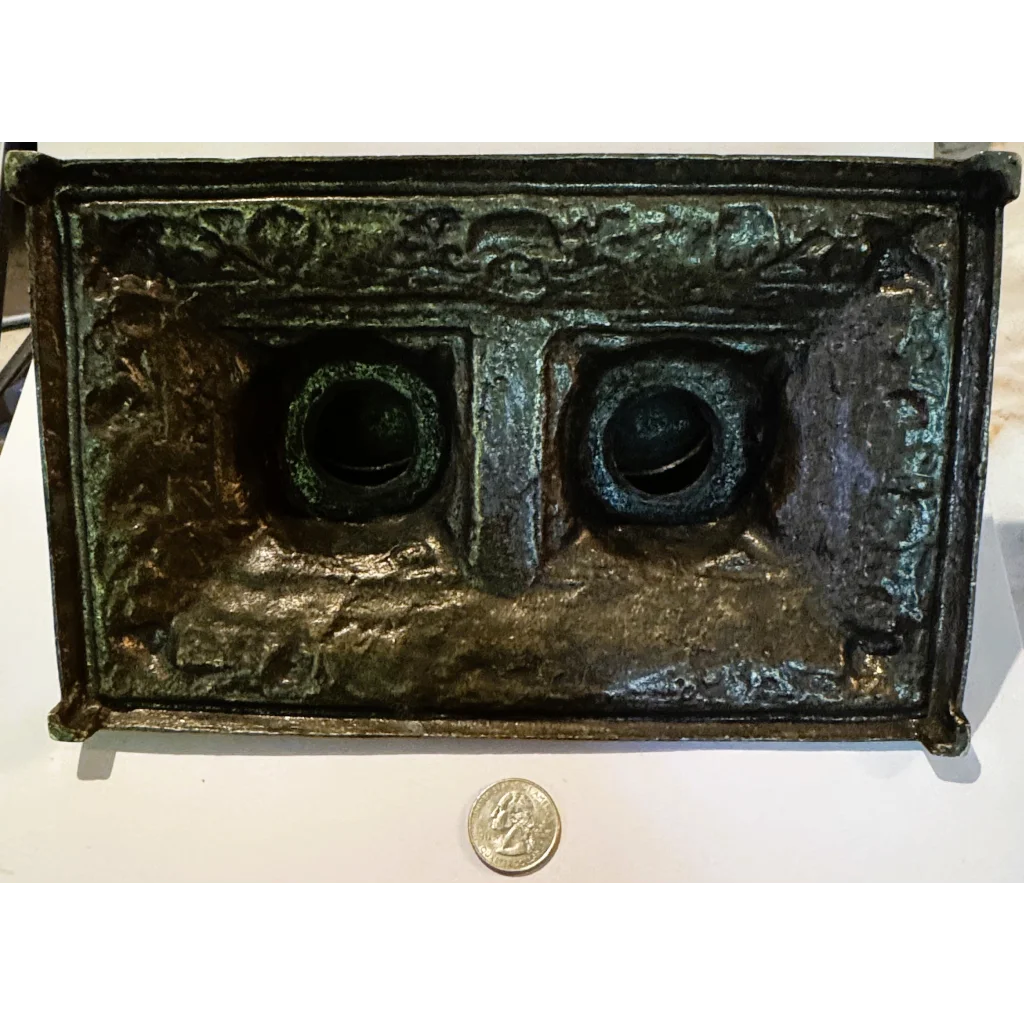
One of the most beautiful things about this inkstand is something no maker put there and no one could fake convincingly: the way time has coloured it. The raised ornament — the high points of the scrolls, the crowns of the rosettes, the ridges of the border — still reads as warm, bright gold where hands and light have kept it burnished. Sink into the recesses, though, and the tone deepens to a dark, aged brown-bronze, and in the deepest crevices the metal has gone green: verdigris, the soft blue-green bloom that only genuine old brass and bronze grow, gathered along one edge, around the bases of the wells, and — as the reverse photograph shows — spread richly across the unfinished back. This is not a flaw to be hidden. It is the single most honest thing about the object, the visible proof of the decades it has actually lived. A brand-new brass casting is uniform and dead; this one has a map of its own age drawn across it in gold, brown and green, and no two square inches of it are quite alike.

Turn it over, as one of the photographs does, and you meet the plain truth of the piece: the reverse is raw, unfinished metal, hollow behind the wells, with the two well-housings dropping down through the plate and small feet at the corners lifting it just clear of the desk. The back was never meant to be seen, so it was never dressed — and that untouched, heavily patinated underside is its own quiet certificate of age.


🔍 An Honest Look at the Wells and Lids

We would always rather tell you exactly what you are getting than let a photograph flatter it, so here is the plain condition of the working parts, described from the same pictures you can see.

The wells are bare brass inside — unlined. Many inkstands of this era were fitted with a small glass or porcelain liner dropped inside each well to hold the ink; this one has none. Lift either lid and you look straight down into the bare cylindrical brass socket, dark with age, exactly as the open-lid and macro photographs show. There is no glass to chip and none to be missing; the wells are simply the raw metal cups they were cast as. It is an honest thing to know up front, and it is shown plainly in the images rather than tucked away.

Both lids are present, both hinges are intact — and one lid folds back further than the other. This is the single most important condition note, and it is worth stating clearly. Each domed lid swings on its own small knuckle-and-pin hinge, and both hinges are sound and working. They do not, however, open to the same degree: one lid folds all the way back and lies nearly flat against the base, while the other opens but stops more upright, short of flat. You can see exactly this in the open-lid photograph, where the two lids sit at plainly different angles. It does not affect using or displaying the piece — both wells open, both lids close — but it is a real, visible characteristic of this individual object, and you should know it before it arrives rather than discover it after.

Beyond those two facts, the piece shows the honest, even wear of its age: the surface is warmly aged rather than polished bright, with the darkening and verdigris described above and the ordinary softening of a few high points that a long life brings. It is offered exactly as pictured, with nothing altered, nothing added, and nothing hidden.


🖼️ How to Live With It Now

An object like this no longer has to hold ink to earn its place — its second life is as a piece of sculpture with a story, and it slips easily into a modern room in more ways than one.

  • 📝 Give it back its old job on a working desk, styled among books, a brass lamp and a pen or two — the double inkstand was the original desk accessory, and it still reads instantly as one.
  • 🗝️ Let it be a small, secret catch-all: the two lidded wells are made to open and close, and they will happily keep paper clips, stamps, a spare key, cufflinks or a ring safe under their domed lids on a dresser or entry table.
  • 📚 Set it on a shelf or mantel purely as an object, where the gold high points and green-touched recesses can catch a lamp and the deep relief throws its own little shadows.
  • 🖋️ Pair it with a vintage dip pen, a wax seal or an old letter to build a small writing-desk vignette — it anchors that kind of grouping the way nothing new can.
  • 💛 Or simply keep it close and enjoy the fact of it: a real Victorian-era object that a real person once reached for, over and over, in the ordinary act of writing something down.

🎁 Who This Belongs With

This inkstand will mean the most to a handful of very different people, each for their own reason. There is the collector of antique inkwells and writing accessories, who knows a double-well standish when they see one and understands how much less common the twin-well form is than the single. There is the lover of Victorian and Renaissance-Revival decorative brass, who will read the acanthus, the rosettes and the shell cartouches at a glance and simply want to own a good, honest, richly ornamented example. There is the writer, the calligrapher, the keeper of fountain pens and journals, who wants the real object at the head of their desk rather than a modern imitation of it. And there is the person hunting a genuinely characterful gift — for a writer, a lawyer, a teacher, a bookkeeper, a graduate, anyone whose life runs on words and figures — who wants something with age and meaning in it rather than something merely new. For any of them, this is a single, specific, individual object, and there is only the one.


❓ Questions Worth Answering

Is it really from the late nineteenth century?

It is listed and described as a late-19th-century, Victorian-era brass double inkwell, and everything the photographs show is consistent with that: the Renaissance-Revival ornament, the dip-pen double-well form, and above all the genuine, decades-deep patina and verdigris that only real age produces. We do not name a maker, a country or an exact year, because the object itself does not, and we will not invent what we cannot show you.

Do the wells have glass liners?

No. The wells are bare brass inside, with no glass or porcelain liners — you look straight into the raw metal socket when you lift a lid. This is shown plainly in the open-lid and close-up photographs.

Do both lids work?

Yes. Both lids are present and both hinges are intact and functioning. One lid folds all the way back to nearly flat while the other opens but stops more upright — a real, visible difference you can see in the open-lid photograph, described honestly here so there are no surprises.

How big is it?

It is a compact desk piece rather than a large one. A US quarter is included in several photographs so you can gauge its true size directly from the images rather than from a description.

Can I still use it with ink?

You can certainly display a vintage pen with it or treat it as a working desk object, but as the wells are bare, unlined brass and this is a genuine antique, most owners keep it as a decorative and collectible piece — or use the lidded wells to hold small desk odds and ends — rather than filling it with ink.

What condition is it in overall?

Honest, aged and complete, offered exactly as pictured: warm gold high points, darkened and green-touched recesses, a raw patinated reverse, bare brass wells, both lids and hinges intact with one folding back further than the other. Nothing added, nothing hidden.


✨ Why It Matters

Some objects are collected because they are rare; this one is worth having because it is real. It is a genuine survivor of the age of the dip pen — a double inkstand built to keep two inks open at a writer's elbow, black for the words and red for the lines drawn under them, dressed in the ornate Renaissance-Revival relief its century loved and coloured now by the honest gold, brown and green of a long life actually lived. It carries no invented pedigree and needs none. What it offers is the thing itself: the object at the heart of a hundred years of correspondence, complete and characterful, bare brass wells and all, with one lid that folds a little further than the other and a back gone green with age. Bring it home and you are not buying a picture of the writing desk's world. You are keeping a piece of it.

Shipping

🚚 Shipping & Handling

  • Shipping costs and timing are calculated at checkout.
  • Items curated and shipped directly by me include U.S. shipping at no additional cost, professionally packed to ensure safe arrival of your artifact.

Items from Vetted Pro Collectors
Shipping for items offered by vetted Pro Collectors is determined at checkout. All Pro Collector listings are reviewed to ensure fair, reasonable shipping practices.

For full details, please refer to our Shipping Policy.

Returns & Exchange

Take your time — you've got a full six months. If a piece isn't right for you, send it back the way it reached you and we're good.

In the first 30 days your money goes straight back the way you paid. After that it's store credit, so you can put it toward something you'd rather have.

Return shipping we sort out between us, case by case. I don't make this difficult.

If something arrives damaged, or it isn't what I said it was, send me a photo within 48 hours and I'll make it right.

Email info@vintageantiquesgifts.com or call 802-356-9872 — that's me answering, not a call center.

The only things I can't take back are custom or special-order pieces and gift cards.

View full details