Skip to product information
1 of 8

Vintage and Antique Gifts

Antique 1870s-1910s Tin Tobacco Tag Set of 3 🏷️ Hampton's Home Spun, F.M. Bohannon's Special Drive & Thrasher Plug Tags

Antique 1870s-1910s Tin Tobacco Tag Set of 3 🏷️ Hampton's Home Spun, F.M. Bohannon's Special Drive & Thrasher Plug Tags

Regular price $22.00 USD
Regular price Sale price $22.00 USD
Sale Sold out
Shipping calculated at checkout.

🚚 Free US Shipping — ships within one business day. International shipping calculated at checkout.

Quantity

How Did a Man Know His Chew Before He Took a Bite? 🏷️ Three Antique Tin Tobacco Tags That Answer It

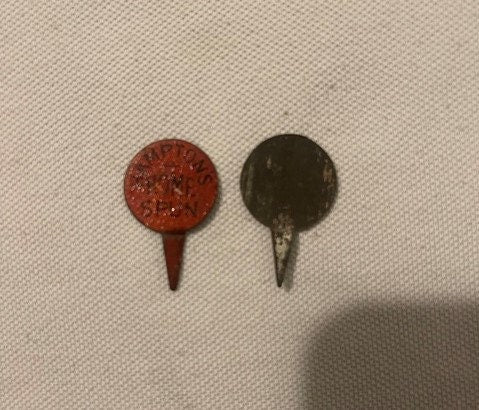
Size: Hampton's Home Spun 1 1/8" x 3/4" with its prong ~ F.M. Bohannon's Special Drive about 3/4" ~ Thrasher about 3/4" ~ three real tobacco tags wearing the warm tin patina only real age gives

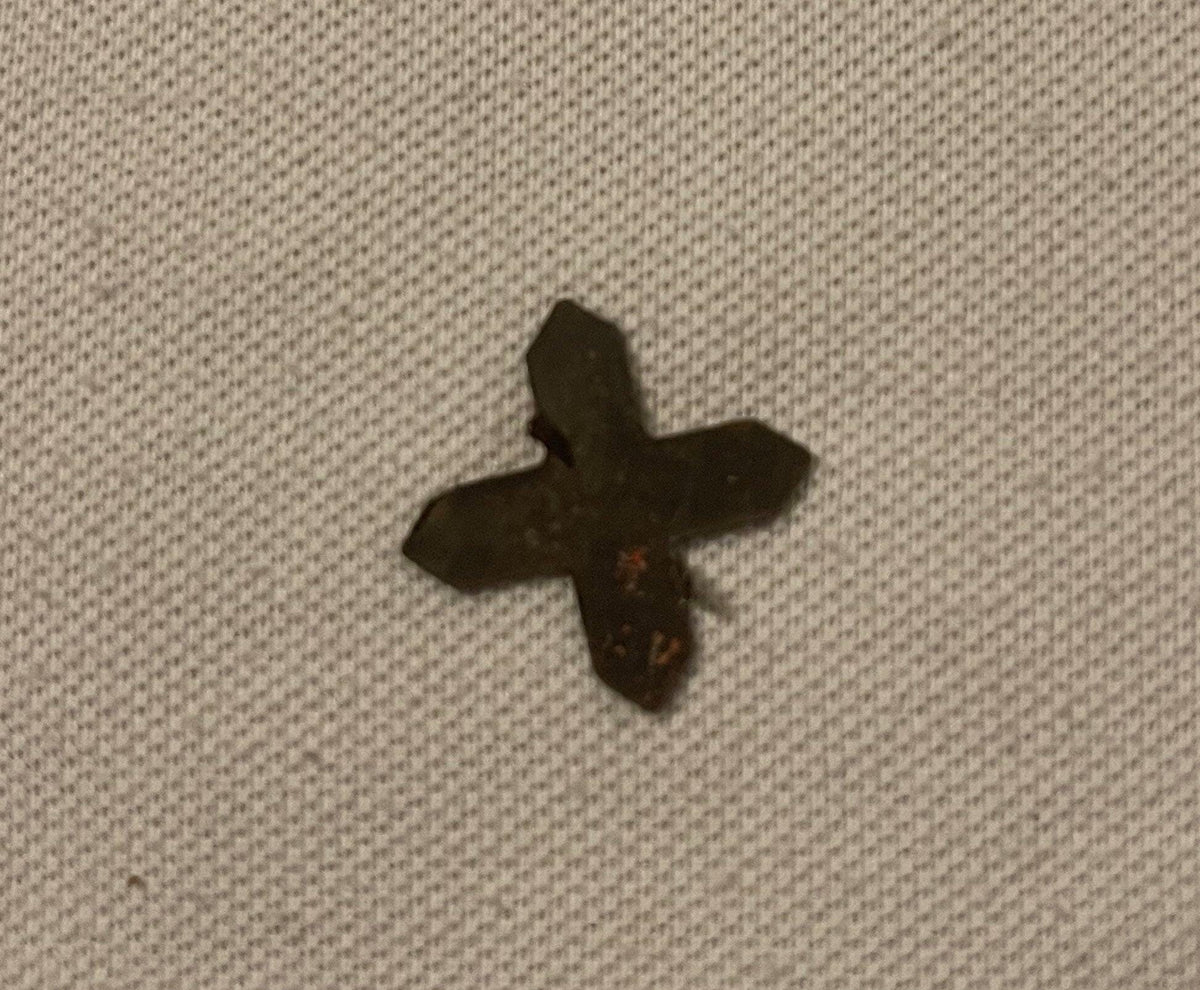
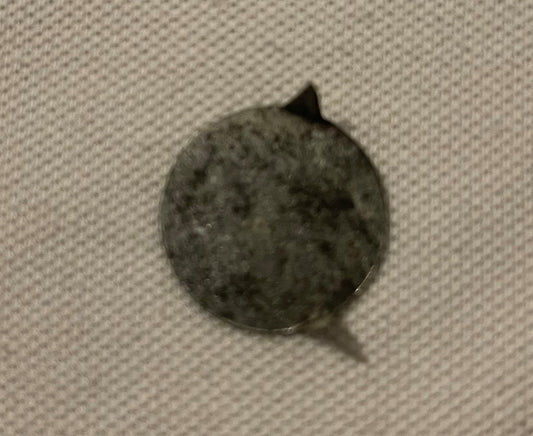
This is a set of three antique tin tobacco tags, the little tin tags that were pressed into plugs and twists of chewing tobacco. You get a round red HAMPTON'S HOME SPUN tag on one long prong, a round F.M. BOHANNON'S SPECIAL DRIVE tag about the size of your thumbnail, printed WINSTON.SALEM.N.C., and a red die-cut THRASHER cross lettered W.&McC. TOB.CO. All three are antique: the Thrasher's maker goes back to 1877, Hampton's Home Spun is a brand born in January 1900, and the Bohannon tag belongs to the 1910s.

Tiny, tough and full of history. Before there were cellophane wrappers and printed pouches, a man buying chew at the store counter knew his brand by a little piece of tin pushed right into the tobacco. That tin is the whole point: everybody at the counter could tell whose chew he was buying, by sight or by feel in a dim general store, before he ever cut off a bite. These three come from three different corners of the old tobacco country, Tennessee and Kentucky, North Carolina, and Ohio, and every one of them has a story I love telling.

🏷️ Why a Plug Wore a Tag

Right after the Civil War, demand for Southern tobacco soared, and tobacco makers large and small sprang up like weeds. Chew went out to the stores in wooden crates called caddies with the maker's name on the outside, but once the lid came off, one company's plug looked just like the next. Some storekeepers took advantage of that and refilled a good brand's empty caddy with cheaper tobacco. In the Centennial year of 1876 a few companies fought back by pounding little round wooden pegs into every plug before it left the factory.

Tin came next. As cigar historian Tony Hyman tells it, P. Lorillard, a firm going back to 1760, was the first to use tin tags, but it tucked them under the outside leaf, where nobody saw them until they cut or bit into the plug. Chipped teeth and unhappy customers! It took a Louisville man, Ben Finzer of the Ben Finzer Tobacco Company, to put the tag on the outside of the slab or twist where it belonged. He tried to patent the idea, the courts turned him down, and after that just about every maker in the country had a bright tin tag of its own, in every shape and color you can think of, so a man at a crowded counter could pick out his brand at a glance. Collectors have catalogued more than 12,000 different ones. Plug tags usually rode on two short prongs, while twist tags often had one long one, and this set has both kinds.

🧵 Hampton's Home Spun

The trademark papers tell this one's story. On April 24, 1947, the R. C. Owen Company of Blythe Street in Gallatin, Tennessee, filed HAMPTON'S HOME SPUN for chewing tobacco and swore the name had been in use since January 1900. The registration came through on August 23, 1949, was renewed in 1969, and finally lapsed in 1992. Owen filed a whole family of brands in 1947, among them Booster Natural Twist, Old Hill Side, Railroad Twist, Axton's Natural Leaf and Allen County.

Here's the part I love. Railroad Twist and Allen County were not new names in 1947. Both were twists made by the Ryan-Hampton Tobacco Company of Louisville, Kentucky. Ryan-Hampton grew out of the Hettermann Bros. cigar business, which two brothers from Germany, John and William Hettermann, started in Louisville in 1870. In 1895 the firm moved to South Floyd Street and took the Ryan-Hampton name, and it worked from there into the 1940s, selling twists as Allen County Twist, Railroad Twist and Shepherd Twist.

The Filson Historical Society in Louisville keeps nine photographs of that plant from 1914, with the workers forming and packing twists by hand. They were paid by the weight of twist they finished, not by the hour. The man who gave the pictures to the Filson spotted his own grandfather, Thomas L. Hampton, sitting in the front row of one of them. Put Hampton's Home Spun, Railroad Twist and Allen County all landing with R. C. Owen together, and every sign points the Hampton on this tag straight back to that Louisville plant. I love that a face from that plant survives right alongside a tag like this.

R. C. Owen was already making tobacco in Gallatin by 1923, when it registered a twist and plug tobacco called B'S WAX that it had been selling since 1915. And here's the best part: the company is still there, still making old-time twist chewing tobacco under names like Good Money, King B, Red Ox, Silver Tip and Railroad. In 1985 Robert Cogswell photographed Alfred Malone twisting tobacco by hand at the Owen plant, and that picture is in the Tennessee State Library and Archives, so the old ways hung on in Gallatin a long time.

Gallatin has a long story of its own. It was established on the Cumberland River and made the permanent county seat of Sumner County in 1802, named for Albert Gallatin, the U.S. Secretary of the Treasury, and it sits about 30 miles northeast of Nashville. Old homes like Cragfont, Rosemont and Trousdale Place are still open to visitors there.

That single long prong is the kind twist tags often wore, and twist is just what Ryan-Hampton and R. C. Owen made. The brand goes back to January 1900 by the company's own sworn word, and tin tags were how a chew like this wore its name until cellophane took over in the 1920s.

🪝 F.M. Bohannon's Special Drive, Winston-Salem

This one dates itself, which is my favorite kind of tag. The Moravians took up the land here in 1753 and started building Salem in 1766. In 1849 the Salem congregation sold land just north of town to the brand-new Forsyth County for its county seat, and in 1851 that new town was named Winston, after Joseph Winston, a local hero of the Revolutionary War. They tried to join up in 1879, and it fell apart because Winston wouldn't take the name Salem. The post office started using Winston-Salem in 1899, and the two finally became one city on May 13, 1913. A tag printed WINSTON.SALEM.N.C. can't be any older than 1899, and with the towns joined in 1913 and tin tags on their way out in the 1920s, I have this one as a 1910s tag.

F.M. Bohannon made plug chewing tobacco in Winston-Salem under a whole string of brands: Special Drive, Lucky Joe, Diamond in the Rough, Detective, Favorite, and Red, White and Blue. A country storekeeper ordered from a Bohannon salesman, and the plugs came to him by parcel post straight from the Winston-Salem factory.

That last brand landed Bohannon in the North Carolina Supreme Court. On January 5, 1939, up in Surry County, Mrs. Caudle bit into a plug of Red, White and Blue that her husband had bought at the store they traded with, and something slipped through her teeth and stuck in her lip. It was a fish hook. The doctors at Martin Memorial Hospital in Mount Airy treated her for about eleven weeks. W. W. Ball of Dobson testified that within two months of her injury he found something in a chew of the same brand that looked like a rat's claw or a squirrel's foot. A Surry County jury found for her, and on October 8, 1941, in Caudle v. F. M. Bohannon Tobacco Co., the Supreme Court let the verdict stand. Makes you look twice at your chew!

The independent company's run ended in 1942, when Taylor Brothers bought the Bohannon brands, the same Taylor Brothers who made Bull of the Woods. Taylor kept the names going: on July 1, 1947 it filed a pile of trademarks at once, and F. M. BOHANNON'S SPECIAL DRIVE was registered on January 10, 1950, registration 519,572, with first use claimed back to 1900. The drawing is an oval lined for red, the same mark as this tag, and it stayed on the books until 1992. Taylor Brothers had a long run of its own. William B. Taylor started it in Winston in 1883, it never got swallowed up in James B. Duke's tobacco mergers, and it held on to its independence until American Snuff bought it in 1952.

Winston's tobacco men did a lot of their own selling. After the war Pleasant Hanes ran a tobacco wagon trade, then traveled to promote the market while his brother John Wesley ran the plant, and Winston built its own sales force instead of selling on consignment. A tag this size went everywhere a plug did. And Winston had plenty to send out. It was known as the "storm center of the plug industry," and it stuck with flat plug made from bright leaf even while burley plug was booming elsewhere. Bright leaf got its big break at the tail end of the Civil War: in 1865, with Sherman's army in North Carolina, soldiers got hold of the bright leaf tobacco around Durham and found it the mildest they had ever tried. After the war they wrote back to Durham for more, and North Carolina tobacco stopped being a local business.

🌾 Thrasher, by W.&McC. Tob. Co.

Hold the Thrasher square and it's a plus sign; tip it onto a point and it's an X. I like it both ways. THRASHER runs across one bar, and the maker's initials, W.&McC. TOB.CO., run along the other. Those initials very likely belong to Wilson & McCallay of Middletown, Ohio: the same W.&McC. TOB. CO. turns up on the firm's Kingbolt tag, and other tags from the maker spell the name out in full, "THE WILSON & McCALLAY TOBACCO CO."

The McCallay half was Daniel A. McCallay, born in Dayton in 1839. He started out around 1857 clerking in Jacob Leibee's dry goods store in Middletown, worked his way up to partner, then ran a lumber and grain business with J. M. Robinson. In 1877 he and his brother-in-law, Robert Wilson, bought the Middletown tobacco factory Paul J. Sorg had been running, rated at 400,000 pounds a year. They pushed it to nearly a million pounds the first year and close to two million the second, with upward of 300 people working there, which made it one of the largest plug factories west of the Alleghenies. McCallay was president of the First National Bank of Middletown by 1882, and he died in 1918.

Wave Line and Gold Rope were two of the firm's brands, and through the 1880s Middletown turned out more plug tobacco than any American city but two, with Wilson & McCallay a big reason why. In 1901 the Continental Tobacco Company, the plug combine James B. Duke and his American Tobacco directors had put together in 1898, bought the factory and kept the popular brands going. The Ohio History Connection still keeps a Wilson-McCallay Tobacco Company collection.

Paul J. Sorg's story is a good one on its own. Born in Wheeling, Virginia, in 1840, he went into business in Cincinnati in 1864 with John Auer, a German-born tobacco roller. Auer could make the tobacco and Sorg could keep the books. In 1869 they joined another Cincinnati firm as Wilson, Sorg and Company, and a partner who lived in Middletown talked them into building a plant there. After that factory went to Wilson & McCallay, Sorg started over with the P. J. Sorg Tobacco Co. He built a 35-room stone Romanesque mansion in 1888 that still stands, opened the Sorg Opera House in 1891 (designed by Samuel Hannaford, and still home to Middletown's Sorg Opera), served in Congress from 1894 to 1897, sold his company to Continental in 1898, and died in Middletown in 1902.

Middletown sits on the Great Miami River in Butler County. Stephen Vail Jr. platted the village in 1802, and the Miami and Erie Canal, begun in 1825, tied it to Cincinnati on the Ohio River and Toledo on Lake Erie. It was a town of farms and paper mills, and for a good stretch plug tobacco too, until George Verity opened the American Rolling Mill Company's sheet steel plant there in 1900.

As for the name, the story among collectors is that "Thrasher" was a nod to the threshing machine, the big, loud, hard-working star of every harvest, picked for a chew sold mostly to farmers and field hands. Thrasher really is an old way of spelling thresher, and for a chew from a southwestern Ohio town ringed with farms, you could hardly pick a better name. Collectors also tell of tags printed with a value passing as small change in country stores short on coins. The Thrasher carries no value, just the brand and the maker. Wilson & McCallay came into being in 1877, so no W.&McC. tag is older than that, and the firm ran under that name until Continental took over in 1901. That puts the Thrasher between the late 1870s and the turn of the century, the old-timer of the set.

🎁 Saved by the Hundred

Folks hung on to these from the start. Tag collecting was already a popular hobby by the 1880s, with collectors in different parts of the country advertising in the newspapers and trading tags hundreds at a time. The tobacco companies noticed and started trading saved tags for premiums, first a short list on the back of a trade card, later thick catalogs. A man who couldn't afford silverware for his wife might save up 500 tags and get six Rogers knives and forks for free.

Over in Winston-Salem, R. J. Reynolds printed a 1902 catalog called "Valuable Presents Given for Tobacco Tags." 75 tags got you an English steel razor, 250 a watch, 500 a gentleman's toilet set, 1,200 a tea set, 1,350 a lady's rocker, 2,000 a dinner set and 3,000 a double-barrel hammerless shotgun. A Hamlin organ took 14,500, and a delivery wagon 28,500. Reynolds built a foundry in 1904 just to destroy the tags that came back in, and it closed its premium department at the start of 1907.

The tin tag's run ended in the 1920s, when machines started wrapping one-ounce bricks of plug in printed cellophane and paper coupons took over the premium job. A historical society board of tags collected around 1895 carries a note that metal tags had gone out of style by 1950. Louis Storino's book Chewing Tobacco Tin Tags, 1870-1930, published by Schiffer in 1995, lists more than 6,000 of them and pictures about 2,000.

🖼️ Three Little Survivors

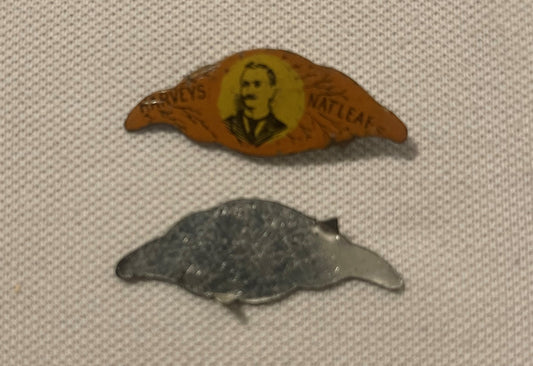
Thin tin like this was meant to go out with the last chew, so every tag that made it this far wears a patina to prove it. They're small enough to lose in your pocket, and plenty of them got lost. These three have been around a long, long time and they look it, in the good way. Each one carries its own little specks and rubs from all those years, so yours may look a touch different from the ones in my pictures. Everything here is stored in the dark, under 40% relative humidity, at a steady 72°F, climate controlled, so whatever age a tag shows, it had before it came to me.

Line the three up in a shadow box or a printer's tray on dark card and they look great, a little map of the old tobacco country from Tennessee to North Carolina to Ohio, and a neat bit of history for anybody with Forsyth County roots. They're plug tags, not pins, but you could push one through a jacket lapel by its prong if you're braver than me. That's a lot of history for three little pieces of tin. The supply is finite. Nobody is ever printing a Hampton's, a Bohannon's or a Thrasher tag again, and once these last few are gone and on display with collectors, they will be very difficult to acquire.

Any questions, just ask me!

Shipping

🚚 Shipping & Handling

  • Shipping costs and timing are calculated at checkout.
  • Items curated and shipped directly by me include U.S. shipping at no additional cost, professionally packed to ensure safe arrival of your artifact.

Items from Vetted Pro Collectors
Shipping for items offered by vetted Pro Collectors is determined at checkout. All Pro Collector listings are reviewed to ensure fair, reasonable shipping practices.

For full details, please refer to our Shipping Policy.

Returns & Exchange

Take your time — you've got a full six months. If a piece isn't right for you, send it back the way it reached you and we're good.

In the first 30 days your money goes straight back the way you paid. After that it's store credit, so you can put it toward something you'd rather have.

Return shipping we sort out between us, case by case. I don't make this difficult.

If something arrives damaged, or it isn't what I said it was, send me a photo within 48 hours and I'll make it right.

Email info@vintageantiquesgifts.com or call 802-356-9872 — that's me answering, not a call center.

The only things I can't take back are custom or special-order pieces and gift cards.

View full details

Preserving History: Authentic Objects Across Eras

— Curated by Travis Weigel