Skip to product information
1 of 4

Vintage and Antique Gifts

Vintage Honolulu Broom Factory Hula Girl Label ๐Ÿ–ผ๏ธ Hawaiian Lithograph Advertising, Honolulu Hawaii Broom Advertising Label #2

Vintage Honolulu Broom Factory Hula Girl Label ๐Ÿ–ผ๏ธ Hawaiian Lithograph Advertising, Honolulu Hawaii Broom Advertising Label #2

Regular price $16.00 USD
Regular price Sale price $16.00 USD
Sale Sold out
Shipping calculated at checkout.

Size: 5 3/4" x 4"

๐Ÿšš Free US Shipping โ€” ships within one business day. International shipping calculated at checkout.

Quantity

Why a Hula Girl on a Honolulu Broom Label? ๐ŸŒบ A Hula Girl With a Broom

Size: 5 3/4" x 4" ~ Bright, unfaded color, clean edges, never pasted to a broom.

I'm a sucker for old advertising labels, and this one's a favorite: a hula dancer, lei and grass skirt and all, sweeping the floor with a straw broom. She stands mid-sweep in front of two palm trees and pale rocks under a blue sky, dark hair loose, a red-and-white checked headband, a full lei of red and yellow blossoms, a yellow grass skirt and one bare foot forward on a red floor. Below her a crowned shield carries the numeral 2 over HONOLULU BROOM FACTORY, HONOLULU, HAWAII, all inside a border of green triangles on brown. That border has the look of Hawaiian kapa, the bark cloth the islanders stamped with geometric patterns, triangles among them, using little carved bamboo stamps. No printer's imprint and no date.

๐Ÿงน Three Generations of Brooms

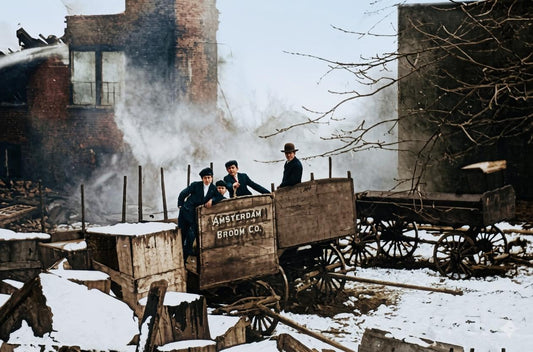
The Honolulu Broom Factory goes back to Wah Hin Lum, who came to Hawaii from China as a young boy around the turn of the last century to join his father. The neighborhood kids teased him until he learned English and cut off the pigtail he wore. At 16 he went to work for a clothing-store owner who became his mentor and taught him how to run a business, and in 1923 he opened his own broom factory, next door to his father's grocery on Vineyard Street near River Street, at the edge of Chinatown. The broom trade's national journal, Brooms, Brushes & Mops, had it on its books within a year or so: when a story in its pages called another island firm the only broom maker in Hawaii, the editors added a footnote that their records showed another one, "The Honolulu Broom Factory" at Honolulu. In 1932 the same journal reprinted one of his newspaper ads, address North Vineyard Street, and gave part of the credit for the campaign's success to how thoroughly it was carried out. His ads promised "All Kinds of Brooms Made in Hawaii" and "Honolulu Brooms Are Better and Cost No More," and a 1939-40 Japanese-American yearbook ran one for "Manufacturers of High Grade Brooms, On Sale at all Stores." The 1940 city directory lists Wah Hin Lum as the factory's manager, living on North Vineyard. His son ran it until he died in 1993, and then his grandson Brian Lum took over, by then on King Street in Kalihi-Palama. In 2002 Lum and three long-time employees, including master broom maker Sze Kee Yeung, who had been making brooms there since 1964, were turning out about 2,000 brooms a month for Longs Drug Stores, City Mill and a list of industrial and institutional customers. A newspaper reporter who watched them work came away saying there was both art and science to making the perfect broom. By 2011 it was called the only broom factory left in Hawaii.

That first shop sat at the edge of Chinatown, among the herbalists, noodle factories and temples - the Lum Sai Ho Tong temple is right there on River Street. The Lum Sai Ho Tong society was started in 1889 by former plantation workers, for families named Lum, and its building is home to Honolulu's Tin Hau temple, honoring the goddess of the sea. And at City Mill, the hardware chain that carried them, customers just asked for "the hula broom." The chain's housewares buyer told the paper they were very sturdy, the corn picking up the dust and the fiber adding strength, and that the store wasn't getting complaints about handles breaking.

Broom-making was a real trade of its own long before the vacuum cleaner came along and made it seem old-fashioned. A broom starts as broomcorn, a sorghum grown for its long, fibrous tassels, and back when every broom was sewn by hand, one took about fifteen minutes to make. Around the handle of each new broom went a rectangular paper label like this one, with the maker's name on it. In Wah Hin Lum's day the brooms were made entirely of broomcorn. By 2002 the best sellers mixed Mexican broomcorn with yucca fiber for stiffness, on handles of ramin, a light yellow wood Brian brought in from Indonesia. His grandson Brian said their brooms had the same basic makings as anybody else's, and the difference was all in how they were put together, starting with just the right amount of straw on the handle. "With practice, you know how much to grab," he said. Once the straw was wound onto the handle, a machine sewed on five rows of green and red stitches, and the ends were trimmed. He also admitted he once figured vacuum cleaners would put him out of business. They didn't, and I'm glad of it. Neither did NAFTA: when cheap Mexican brooms came in, customers who tried them came back complaining about the quality. As Brian put it, "In Hawaii, there are just some things you need a good broom for."

๐ŸŽจ The Hula Girl Herself

The company dates its hula-girl logo to 1935, and by then the hula dancer had been Hawaii's calling card on the mainland for better than thirty years. In 1903 the islands' merchants and hotel people put together the Hawaii Promotion Committee, which turned out brochures and souvenir postcards and sent troupes of hula dancers touring the country. Then at the 1915 Panama-Pacific Exposition in San Francisco, the Hawaiian pavilion's daily shows of island music and hula drew the biggest crowds of the whole fair and set off a mainland craze for anything Hawaiian. Tin Pan Alley answered with songs like "Hula Hula Dream Girl" (1924), with island scenery on the sheet-music covers. So 1935 put her right in the golden age of Hawaii's hula-girl advertising. Matson Navigation had opened the Royal Hawaiian Hotel in 1927 and put its new liner Malolo on the Honolulu run that same year, and its travel ads of the late 1930s made the hula dancer the face of the islands. Pualani Mossman, who danced at the Royal Hawaiian's opening, became the Matson poster girl in 1937. DeSoto Brown's book "Hawaii Recalls" shows this very broom label next to hula girls on soda bottles and macadamia-nut cans, and Jerry Hopkins's 1982 book "The Hula" pictures a Honolulu Broom Factory label too, calling the hula girl a popular trademark figure for dozens of products, brooms, saimin noodles and apples among them. One Hawaiiana book dates the design to the 1920s, but the company says 1935, and the Kovels point out that labels reading "Honolulu, Hawaii" instead of "Territory of Hawaii" usually come after statehood in 1959. Either way, she's been sweeping for a long time.

Shipping

๐Ÿšš Shipping & Handling

  • Shipping costs and timing are calculated at checkout.
  • Items curated and shipped directly by me include U.S. shipping at no additional cost, professionally packed to ensure safe arrival of your artifact.

Items from Vetted Pro Collectors
Shipping for items offered by vetted Pro Collectors is determined at checkout. All Pro Collector listings are reviewed to ensure fair, reasonable shipping practices.

For full details, please refer to our Shipping Policy.

Returns & Exchange

Take your time โ€” you've got a full six months. If a piece isn't right for you, send it back the way it reached you and we're good.

In the first 30 days your money goes straight back the way you paid. After that it's store credit, so you can put it toward something you'd rather have.

Return shipping we sort out between us, case by case. I don't make this difficult.

If something arrives damaged, or it isn't what I said it was, send me a photo within 48 hours and I'll make it right.

Email info@vintageantiquesgifts.com or call 802-356-9872 โ€” that's me answering, not a call center.

The only things I can't take back are custom or special-order pieces and gift cards.

View full details
  • 5 stars: 3 (100%)
  • 4 stars: 0 (0%)
  • 3 stars: 0 (0%)
  • 2 stars: 0 (0%)
  • 1 star: 0 (0%)
E
Etsy customer

What an outstanding Etsy shopping experience with a handwritten thank you note! The children's addition was so touching. Prompt secure shipping and detailed history sealed the deal. Many thanks!!!!

i
i***i (5410)

Mahalo nui

J
Janice

Bought as a gift for my brother who lives in Hawaii. Sure he will love it! Perfect condition.

Awww We hope he loves it!!! Thank you so much

Preserving History: Authentic Objects Across Eras

โ€” Curated by Travis Weigel