Skip to product information
1 of 7

Vintage and Antique Gifts

Vintage Penn Central Stock Certificate 🚂 From 1980s Railroad History

Vintage Penn Central Stock Certificate 🚂 From 1980s Railroad History

Regular price $9.00 USD
Regular price Sale price $9.00 USD
Sale Sold out
Shipping calculated at checkout.

Size: 12" x 8"

🚚 Free US Shipping — ships within one business day. International shipping calculated at checkout.

Quantity

Remember the Penn Central? 🚂 The Penn Central Corporation Common Stock Certificate

Size: 12" x 8" ~ Little to no storage wear. They vary a little one to the next.

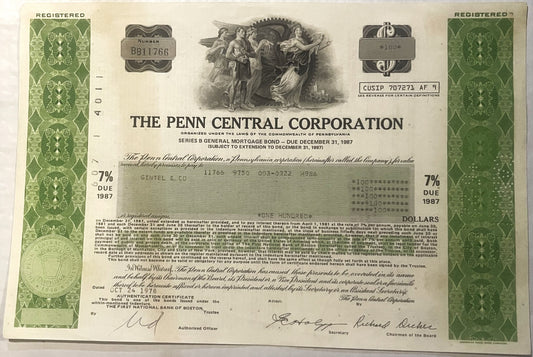
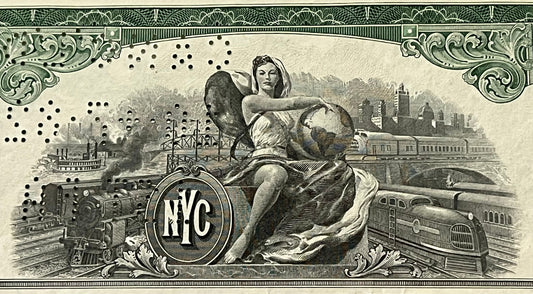
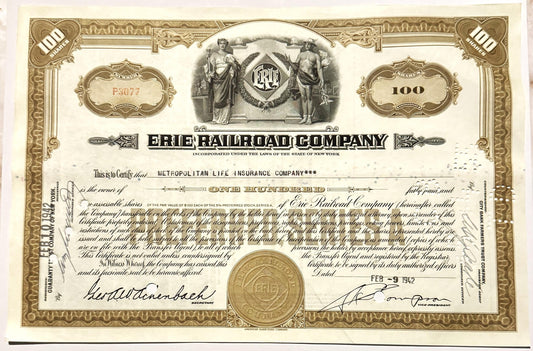
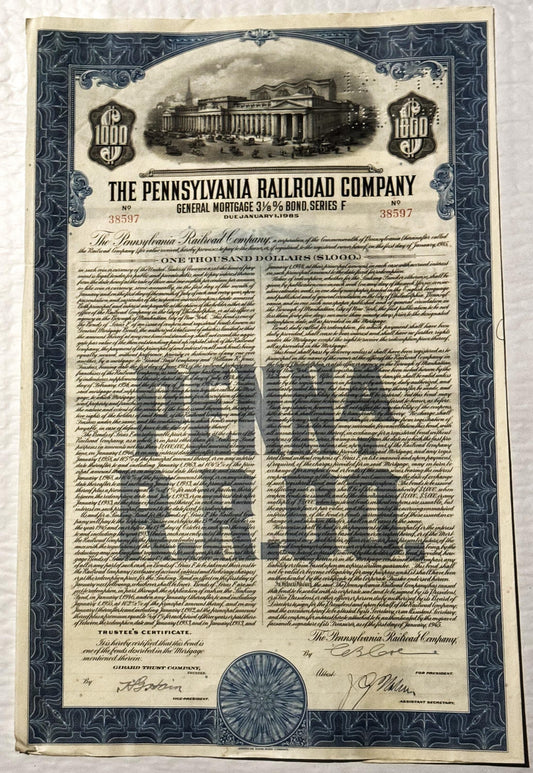
This is a real Penn Central Corporation common stock certificate from the years after the famous railroad crash, when the old company was reborn as a conglomerate. Up top is a finely engraved allegorical vignette of classical figures gathered around a great gear wheel, orange-red lathe-work panels run down both sides, and the company name and the facsimile corporate seal sit in crisp black on cream paper. My photographs can only capture a fraction of the beauty of these stock certificates, printed on heavy paper stock like a dollar bill, only stiffer.

🏷️ What's Printed on It

  • THE PENN CENTRAL CORPORATION
  • ORGANIZED UNDER THE LAWS OF THE COMMONWEALTH OF PENNSYLVANIA
  • COMMON STOCK, PAR VALUE $1 PER SHARE
  • CUSIP 707271 10 2
  • COUNTERSIGNED AND REGISTERED: MORGAN SHAREHOLDER SERVICES TRUST COMPANY, TRANSFER AGENT AND REGISTRAR
  • The facsimile corporate seal, dated 1846
  • CERTIFICATE FOR NOT MORE THAN 100,000 SHARES
  • PC/NY

These are issued certificates, so each one carries its own paper trail: typed holder and share details, signatures and endorsements on the back, transfer-agent stamps and the like. That's the record of the offices it passed through, not damage. The back carries the printed abbreviation key and the assignment form.

That abbreviation key on the back is a neat little lesson in itself: TEN COM means the owners held it as tenants in common, TEN ENT as tenants by the entireties (husband and wife), JT TEN as joint tenants with right of survivorship, and UNIF GIFT MIN ACT means it was held for a child under the Uniform Gifts to Minors Act. The assignment form underneath is where an owner signed the shares over when they were sold.

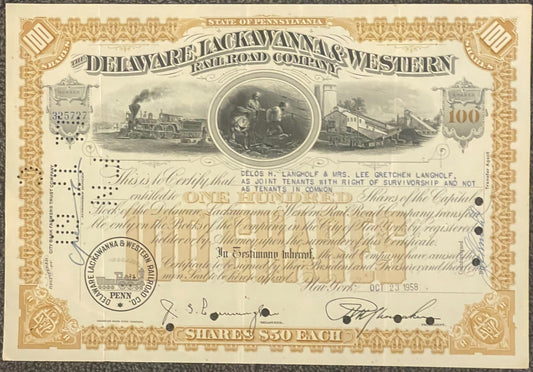
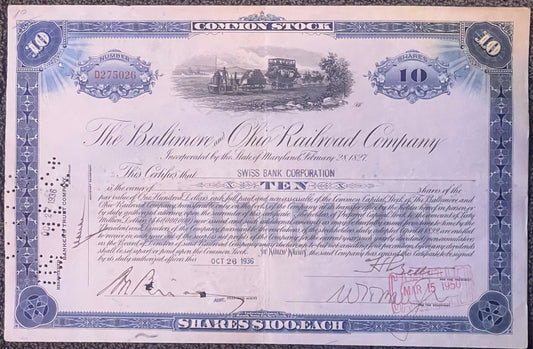
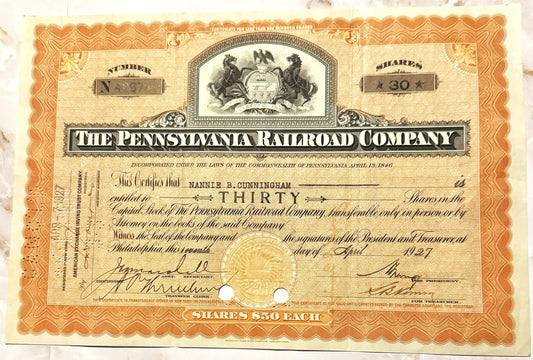
📜 Every one of these certificates had a working life, and it can show. Depending on the sheet, you may find staples or staple holes, cancellation punch holes (often right through the signatures), hand stamps from banks, brokers and transfer agents, real federal or state stock transfer tax stamps, handwriting or a filled-in transfer on the back, papers still attached, seals (a corporate seal pressed into the paper, a foil wafer seal, or a bank's signature-guarantee stamp signed across an endorsement), or a silver strip pasted over an officer's signature with the new officer's signature printed on top. That last one is what collectors call silvering: when the officers changed, the new signature could be pasted right over the old one on certificates already printed. None of that is damage. Each mark is part of the paper's own history, and they vary sheet to sheet, so no two are quite alike.

A word on the names in that bottom corner. A transfer agent kept the company's list of shareholders and recorded every change of owner, and a registrar made sure no more shares went out than the company was allowed to issue. Here one firm did both jobs, Morgan Shareholder Services Trust Company, and countersigned every certificate. The CUSIP number is the stock's own ID, from the numbering system the American Bankers Association's Committee on Uniform Security Identification Procedures (that's what CUSIP stands for) set up in 1964 and started issuing in 1967.

📉 The Biggest Crash in Railroad History

The big Eastern railroads were already hurting, losing business to automobiles, buses and trucks on the new limited-access highways, and in the fall of 1967 the Post Office pulled most of its mail contracts off the trains and put the mail on trucks and planes. They couldn't change a fare or a freight rate, merge or abandon a line without the Interstate Commerce Commission's approval. The Penn Central Transportation Company was born when the Pennsylvania Railroad took over its old rival the New York Central Railroad on February 1, 1968, and regulators made it take in the bankrupt New York, New Haven and Hartford too. It didn't last. On June 21, 1970, the board voted to file for bankruptcy, and Penn Central, then the sixth-largest corporation in the United States, became the largest corporate insolvency in U.S. history until Texaco in 1987. On April 1, 1976, its working rail lines went to the federally owned Conrail. The Penn Central empire had reached well beyond trains, with the Buckeye Pipeline, the Six Flags theme parks and a 24 percent stake in Madison Square Garden among its holdings.

Just think about the size of it. Penn Central ran about a third of all the passenger trains in the country and a big share of the freight in the Northeast, so when it went under, the whole region felt it. Even after Conrail took the working railroad, the company was left holding more than 5,000 miles of old rail lines that nobody else wanted, along with real estate, hotels and amusement parks.

That's where this certificate comes in. In 1978 the old Pennsylvania Railroad company itself absorbed its parent and changed its name to The Penn Central Corporation, the name printed here, and ran as a small conglomerate with interests from pipelines to entertainment. That's why the seal says 1846, the year the Pennsylvania Railroad was chartered, and why it's organized under the laws of Pennsylvania. In March 1994 it changed its name again, to American Premier Underwriters, and became part of Carl Lindner's American Financial Group. So these certificates come from the stretch between 1978 and 1994.

💼 From railroad to insurance company

Those 1846 roots run deep. The Pennsylvania legislature chartered the Pennsylvania Railroad on April 13, 1846, with Governor Francis R. Shunk signing it, and that old charter company is the one that carried on as The Penn Central Corporation.

The years these certificates were issued were a wild ride. In January 1981 the company got $2.1 billion in cash as compensation for the rail properties that had gone to Conrail, and it went shopping: Marathon Manufacturing, which built oil rigs, G.K. Technologies in electronics, Buckeye Gas Products in propane, and Sprague Electric, the capacitor maker. In January 1982 it sold Six Flags to Bally Manufacturing for $147.4 million, beating out Columbia Pictures. By 1982 Carl Lindner of Cincinnati had bought enough Penn Central stock to get himself elected to the board, and in 1983 he became chairman. The Buckeye pipeline and gas businesses were sold off in the mid-1980s, the company bought its first insurance company, Republic Indemnity Co. of America, a California workers' comp insurer, in 1989, and it sold the Vitro defense business in 1993. By the time the Penn Central name came off in 1994, the old railroad had turned itself into an insurance company.

🏡 Display

It's a great piece for any railroad fan, and it looks sharp framed in an office or a den next to a picture of Penn Station or Grand Central, the two great terminals of the railroads that made Penn Central.

📷 The Penn Station concourse and Grand Central Terminal photos near the end are there for history only and aren't included; you get the certificate.

Shipping

🚚 Shipping & Handling

  • Shipping costs and timing are calculated at checkout.
  • Items curated and shipped directly by me include U.S. shipping at no additional cost, professionally packed to ensure safe arrival of your artifact.

Items from Vetted Pro Collectors
Shipping for items offered by vetted Pro Collectors is determined at checkout. All Pro Collector listings are reviewed to ensure fair, reasonable shipping practices.

For full details, please refer to our Shipping Policy.

Returns & Exchange

Take your time — you've got a full six months. If a piece isn't right for you, send it back the way it reached you and we're good.

In the first 30 days your money goes straight back the way you paid. After that it's store credit, so you can put it toward something you'd rather have.

Return shipping we sort out between us, case by case. I don't make this difficult.

If something arrives damaged, or it isn't what I said it was, send me a photo within 48 hours and I'll make it right.

Email info@vintageantiquesgifts.com or call 802-356-9872 — that's me answering, not a call center.

The only things I can't take back are custom or special-order pieces and gift cards.

View full details

Rescuing American History Since 2007

— Travis & the Kids