


Skip to product information
1 of 3

Vintage and Antique Gifts

Vintage 1940s Up North Apples Crate Label 🍎 Dwinnell Bros. Orchards, Oroville, Washington

Vintage 1940s Up North Apples Crate Label 🍎 Dwinnell Bros. Orchards, Oroville, Washington

Regular price $10.00 USD
Regular price Sale price $10.00 USD
Sale Sold out
Shipping calculated at checkout.

🚚 Free US Shipping — ships within one business day. International shipping calculated at checkout.

Quantity

Who Packed Up North Apples? 🍎 Vintage 1940s Up North Brand Apples Crate Label, Dwinnell Bros. Orchards, Oroville, Washington

Size: 10" x 9" ~ Very minor edge wear and a little rippling, the kind you'd never notice on display.

This is a vintage 1940s Up North apple crate label from Dwinnell Bros. Orchards of Oroville, Washington, and it might be the happiest label the apple country ever printed for a box. A little Inuit kid is sitting on top of the world, hanging onto a candy-striped North Pole and holding up a big red apple like he just won it at the fair. And "Up North" was no stretch. Oroville is about as far north as Washington goes, at the foot of Osoyoos Lake and roughly four miles below the Canadian border. The Race and Ethnicity in Advertising archive keeps this same label in its collection.

🏷️ What's Printed on It

  • UP NORTH BRAND Apples
  • DWINNELL BROS. ORCHARDS, OROVILLE, WASH.
  • PRODUCE OF U.S.A.
  • 1 U.S. BUSHEL BY VOLUME

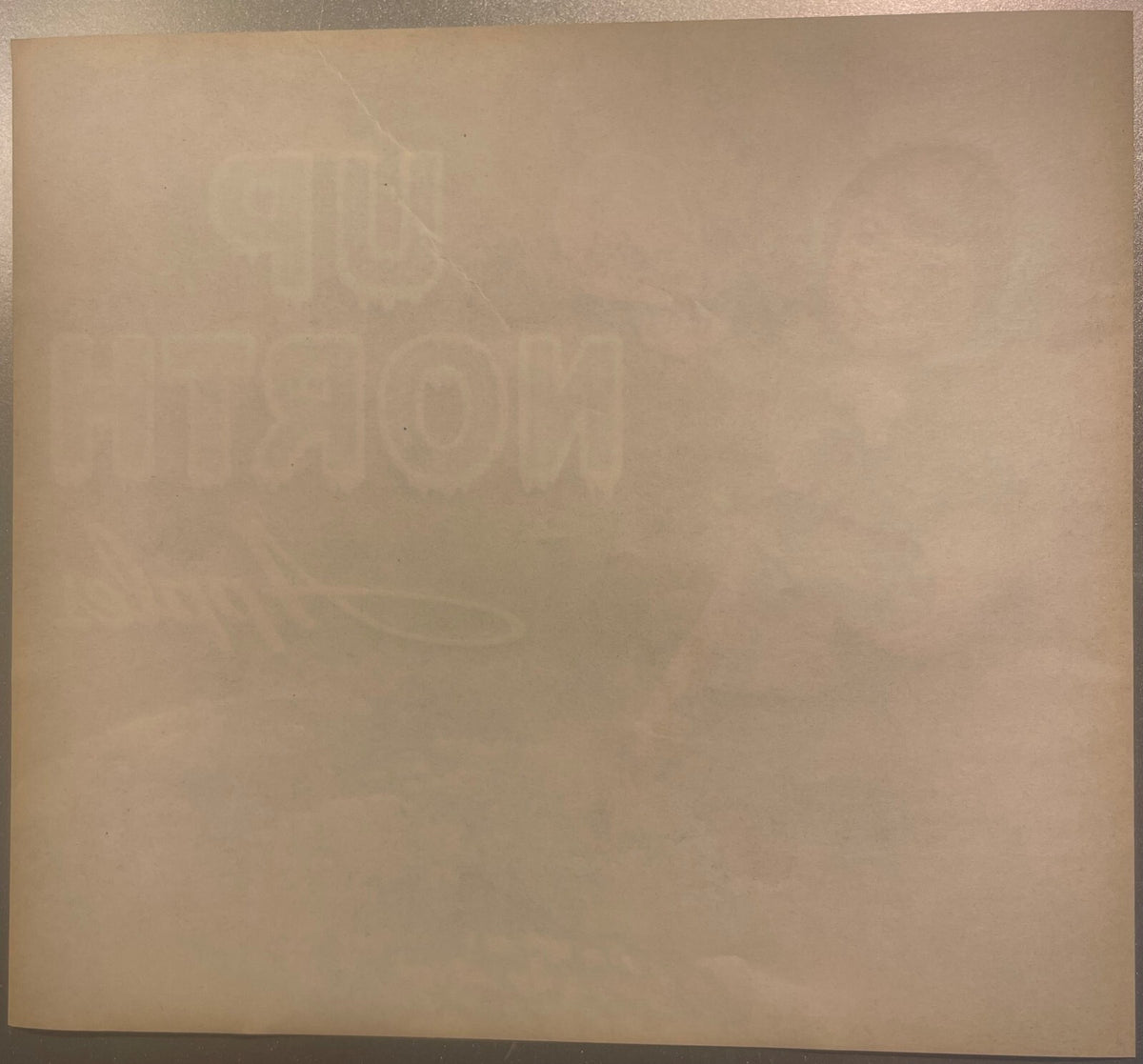
That last line is the box. A label like this went on the end of a wooden apple box, and the box held a bushel by volume. This one never made it onto a box, so the back is clean paper with the picture showing faintly through.

💙 Blue Meant the Best

Washington packers had a color code for their labels. A blue label generally meant Extra Fancy, the top grade, red meant Fancy, and green, yellow or white went on the C-grade cookers. This one is a deep, deep blue, and that fits the outfit behind it. When Dwinnell Bros. Orchards loaded a refrigerator car out of Oroville in May 1965, it was 560 boxes of Extra Fancy Winesaps.

🏛️ A Minnesota Senator's Orchard on the Canadian Line

Here's the part I love. Dwinnell Bros. Orchards was a Minneapolis family business. William Stanley Dwinnell was born in Lodi, Wisconsin, on Christmas Day 1862, studied law at the University of Wisconsin and came to Minneapolis in 1889. He practiced corporate law, served in the Minnesota House in 1899 and in the state Senate from 1911 to 1918, and branched out into real estate in the Canadian Northwest and timber land in California, Oregon and British Columbia, where he was president of the Fraser River Tannery. He died in 1930.

His family kept the apples coming. The business ran as the Estate of William S. Dwinnell, doing business as Dwinnell Bros. Orchards, out of the Plymouth Building in downtown Minneapolis, while the fruit grew and was packed halfway across the country in Oroville. The "Bros." were his sons, and Stanley W. Dwinnell was the name on the Oroville end. The family's other brand, Pride of the North, went on its first apples in October 1934 and was registered as a trademark in 1938 and again in 1949. Pride of the North, Up North... somebody in that family loved a northern name.

📣 Stanley Dwinnell Believed in Advertising

Stanley Dwinnell wasn't running things from a desk in Minneapolis. When Washington's apple growers met in Yakima at the end of 1952 for the Washington State Horticultural Association, they voted to raise their own advertising tax from a top of three cents a box to six, and the trade press named Stanley Dwinnell of Oroville a leader of the push. In December 1953 he chaired an afternoon session on marketing and grading at the association's meeting in Wenatchee. In 1954 he was warning growers that wholesalers buying for chains of grocery stores meant fewer buyers and lower prices, and at the association's 50th-anniversary meeting that December they elected him to the board. In 1960 he wrote to American Fruit Grower that growers would keep having rough times until they invested in promotion in proportion to the size of their crops. A man who talked like that was never going to ship his apples under a boring label.

📦 Fifty-Four Packers and a Few Hungry Deer

The Dwinnells packed their own fruit. When Congress weighed putting farm labor under unemployment insurance in June 1954, a wire from Oroville went into the hearing record: the year before, Dwinnell Bros. had employed 54 packing workers, and none of them year-round. Twenty-five women worked only through the harvest, 24 were itinerant workers, and 5 held other jobs part-time. That's the whole apple country in one telegram. The orchard had other visitors too. In 1953 the Washington Legislature listed Dwinnell Bros. among the farmers seeking relief from the state game fund, theirs for damages to young apple trees by deer.

🚂 Extra Fancy Winesaps, Bound for Chicago

On May 21, 1965, the company, by then Dwinnell Bros. Orchards, Inc., loaded 560 boxes of Extra Fancy Winesaps at Oroville into Western Fruit Express refrigerator car WFEX 72105, sold at $2.75 a box for the bigger sizes and $2.25 for the 150s, and billed it out for Chicago, with a stop in Wenatchee to fill out the load. The Chicago house said it had bought the fruit from the Wenatchee broker and owed Dwinnell nothing. Vice-president James B. Dwinnell took it to the U.S. Department of Agriculture under the Perishable Agricultural Commodities Act, and in 1967 the department ruled for the orchard. Western Fruit Express was the Great Northern Railway's refrigerator-car line, started in 1923, and its cars worked the Great Northern's fall apple season.

🏔️ Oroville and Washington's First Apple Trees

Oroville started out in the late 1850s as a gold camp folks called "rag town." In 1892 it was named Oro, Spanish for gold, and in 1909 the Post Office made it Oroville because Washington already had an Oso. The first railroad tied Oroville to Spokane, a branch south to Wenatchee opened in 1914, and that's the way the apple cars went. A couple of miles up the lake is Smith Point, where Hiram F. "Okanogan" Smith took up a claim in the late 1850s and planted 1,200 little apple trees he had brought from Fort Hope in British Columbia. That orchard is on the National Register as the one that started Washington's apple industry, and six of the original trees were still bearing fruit in 1972. The Native people gave Smith his nickname, because his place was where everybody gathered. So up north in Washington, the apples really did get there first.

🖼️ Display

Crate labels are what is left of a whole way of selling fruit, and in my opinion nobody has matched that old lithography since. Museums and art institutes give them whole galleries, and every year more collectors go looking for them to keep the history alive. The supply is finite - nobody is printing these again - and once the last ones are framed on collectors' walls or hanging in galleries, they will be very difficult to acquire.

Picture this one on your own wall instead of behind museum glass! It's a natural in a kitchen, it's a fun one to bring out at Christmas with that North Pole, and it makes a great gift for anyone with roots in Oroville, the Okanogan or Minneapolis.

Everything here is stored in the dark, under 40% relative humidity, at a steady 72°F, climate controlled - whatever age a sheet shows, it had before it came to me.

Shipping

🚚 Shipping & Handling

  • Shipping costs and timing are calculated at checkout.
  • Items curated and shipped directly by me include U.S. shipping at no additional cost, professionally packed to ensure safe arrival of your artifact.

Items from Vetted Pro Collectors
Shipping for items offered by vetted Pro Collectors is determined at checkout. All Pro Collector listings are reviewed to ensure fair, reasonable shipping practices.

For full details, please refer to our Shipping Policy.

Returns & Exchange

Take your time — you've got a full six months. If a piece isn't right for you, send it back the way it reached you and we're good.

In the first 30 days your money goes straight back the way you paid. After that it's store credit, so you can put it toward something you'd rather have.

Return shipping we sort out between us, case by case. I don't make this difficult.

If something arrives damaged, or it isn't what I said it was, send me a photo within 48 hours and I'll make it right.

Email info@vintageantiquesgifts.com or call 802-356-9872 — that's me answering, not a call center.

The only things I can't take back are custom or special-order pieces and gift cards.

View full details

Preserving History: Authentic Objects Across Eras

— Curated by Travis Weigel