Skip to product information
1 of 3

Vintage and Antique Gifts

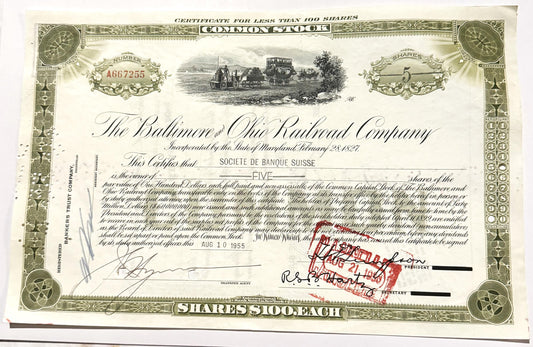
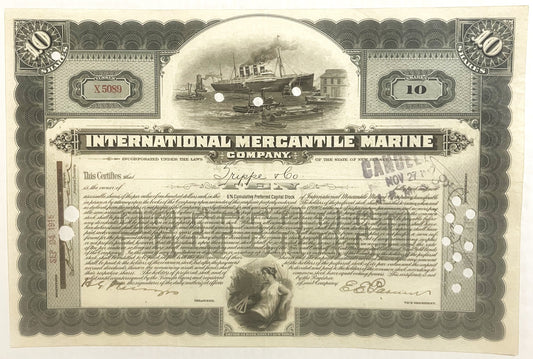
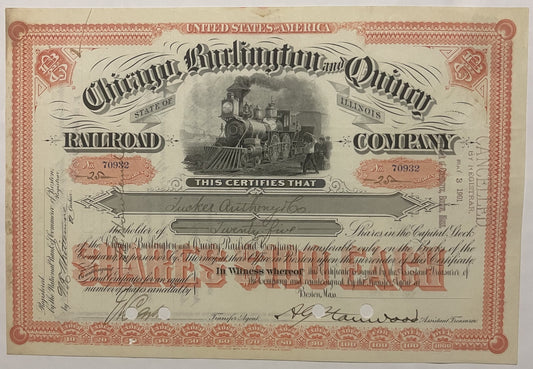
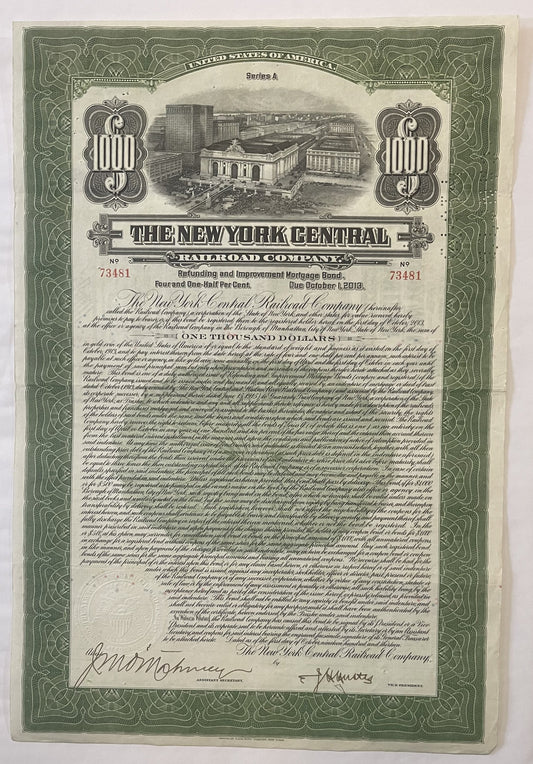
Vintage 1940s North American Light & Power Stock Certificate 📜 SEC Casualty Engraved Bank Note Company Share

Vintage 1940s North American Light & Power Stock Certificate 📜 SEC Casualty Engraved Bank Note Company Share

Regular price 9.00 USD
Regular price Sale price 9.00 USD
Sale Sold out
Shipping calculated at checkout.
Quantity

⚡ What Did It Feel Like to Hold a Piece of the Electric Age in Your Hand? ⚡

There's a particular kind of magic in an old stock certificate — heavier than a dollar bill, more ornate than a diploma, engraved with the same care a bank would give to currency itself. Long before anyone tracked a portfolio on a screen, owning a piece of a company meant owning this: a folio of dense cream stock, wrapped in a crimson guilloche border, stamped with allegory and authority, meant to be tucked into a safe deposit box and passed down like a deed to the family farm. This certificate carried a story of electrification itself — of a country still lit by gaslight in some corners and by dynamos in others, and of the company men who bet everything on the wire.


This is an original North American Light & Power Company common stock certificate, engraved and printed by the American Bank Note Company — the powerhouse of American security printing whose imprint appears along the certificate's base, the same mark you'll find on currency, bonds, and the finest corporate paper of the era.

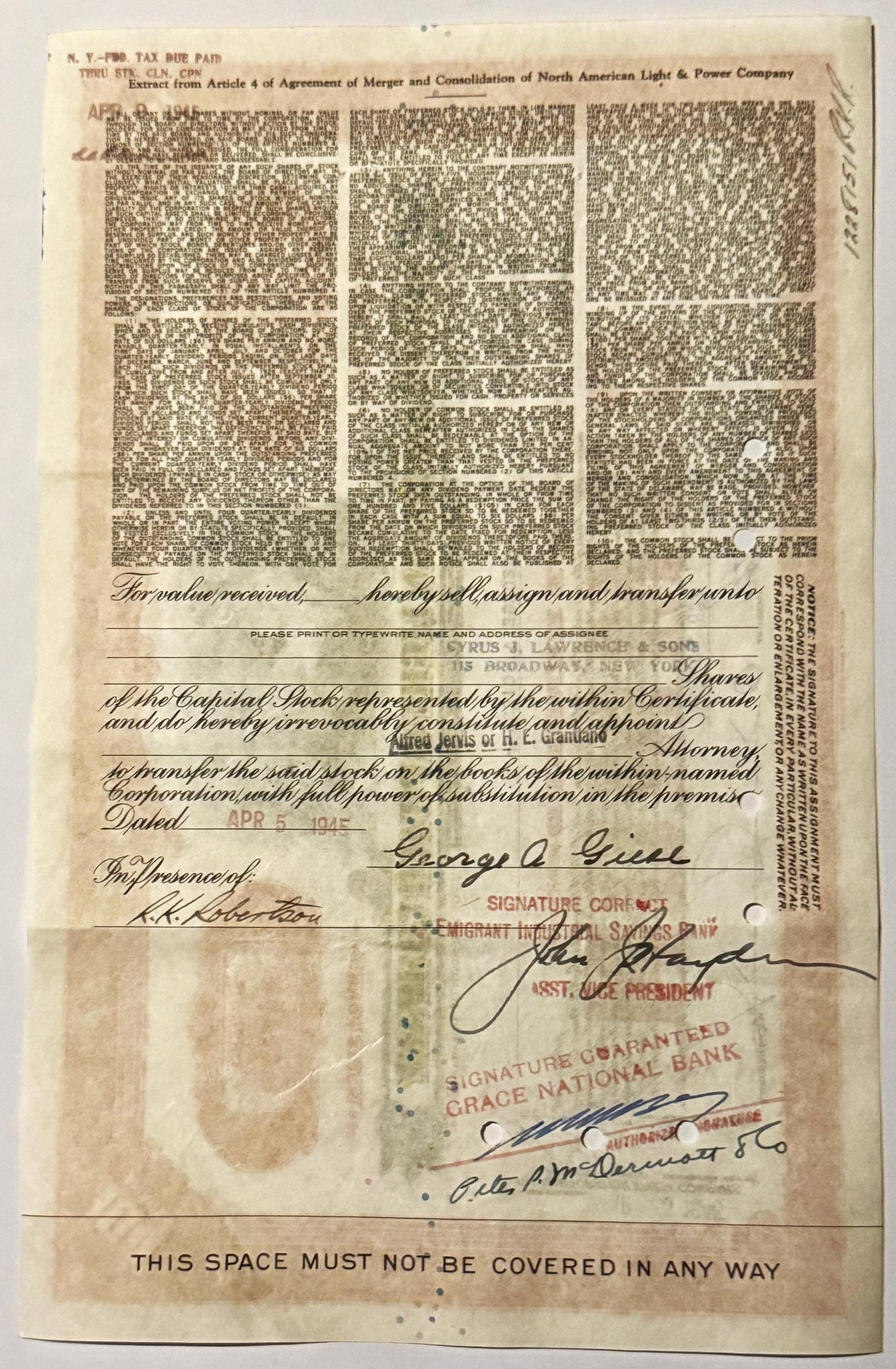
The certificate is dated to 1945, incorporated under the laws of the State of Delaware, and issued as common stock at a par value of one dollar per share through the Corporation Trust Company of Wilmington, Delaware, acting as transfer agent. Measuring a substantial 12 x 8 inches (30.5 x 20.3 cm), it's sized to command a wall or a portfolio page, not hide in a drawer.

The design centers on a striking engraved vignette — a reclining classical woman in flowing drapery, her headband tied at the brow like a figure from an allegorical frieze, holding aloft a glowing incandescent bulb like a torch, while a coiled dynamo or generator rests at her side. It's the visual language of the age: mythology reimagined to sell the miracle of electric current.

Above her, a deep red arch of scrollwork and acanthus leaf carries the eye down into bold black lettering — NORTH AMERICAN LIGHT & POWER COMPANY — and the certificate carries the period punch-cancellation and CANCELLED stamp typical of certificates that were formally retired from a shareholder's ledger, a hallmark scripophily collectors look for as proof the piece actually did its job in the world of finance before it became a keepsake.

This is an original period certificate from the era, an excellent example of mid-century American financial engraving and utility-industry Americana.


🏭 The Company Behind the Certificate: North American Light & Power

Local history and old scripophily lore both hold that the North American Light & Power Company traces its roots to South Bend, Indiana, where it was organized as a utility holding company and, as collectors and old-timers tell it, run from 1916 by its president Clement Studebaker, Jr. — yes, that Studebaker, a son of the family whose name was already stamped on wagons, carriages, and then automobiles rolling out of South Bend's great factories. It's a detail that delights collectors precisely because it ties two very different American industries together in one man: the family that helped move the country on wheels also had a hand in lighting it. Old-timers in utility-history circles like to point out that this wasn't unusual for the era — industrialist families frequently diversified from manufacturing into the young, capital-hungry utility sector, since electrification demanded exactly the kind of large-scale financing and engineering discipline that manufacturing dynasties already had in hand.

North American Light & Power operated for years as a subsidiary of the much larger North American Company, one of the sprawling utility holding conglomerates assembled in the late nineteenth and early twentieth centuries to knit together electric, gas, and traction companies across multiple states under a single corporate umbrella. These holding-company "pyramids," as financial historians came to call them, could tower many layers high — a single dollar of shareholder capital at the top controlling many dollars of physical infrastructure at the bottom, through layers of intermediate holding companies. It was an efficient way to finance the electrification of America. It was also, regulators eventually decided, a dangerously opaque way to run public utilities that ordinary families depended on for light and heat.

That's where the story turns, and where the phrase "SEC Casualty" earns its place in a collector's vocabulary. In the 1930s and into the 1940s, the U.S. Securities and Exchange Commission was handed sweeping new authority under the Public Utility Holding Company Act to force these towering conglomerates to simplify, divest, and in many cases dissolve entirely — breaking the pyramids back down into more transparent, regionally focused operating companies. Collectors use "SEC Casualty" today as a kind of shorthand for exactly this generation of certificates: shares in companies that were reorganized, merged, absorbed, or wound down as a direct result of that federal breakup. A certificate from this period is a paper witness to that reshaping of American capitalism — issued right in the thick of the very process that would eventually erase the layered ownership structure it represented.

🚗 South Bend, Indiana — Wagons, Automobiles, and Electric Wire

South Bend earned its place in American industrial memory almost a century before this certificate was ever engraved. The Studebaker name had been forged there since the 1850s, first as wagon and carriage builders supplying settlers headed west and armies headed to war, then as one of the great American automobile manufacturers of the twentieth century. Local legend around South Bend has always leaned proudly on this lineage — the idea that a family capable of building wagons sturdy enough to cross the Great Plains, and later automobiles sturdy enough to carry a growing middle class to work, would also turn its hand to the infrastructure of electric power feels almost inevitable in hindsight. Old-timers in the region still tell the story as a point of civic pride: that South Bend wasn't just a factory town, but a town that helped wire and drive modern America at the very same time.

Bringing electricity to towns like South Bend in the early twentieth century wasn't a simple matter of flipping a switch — it required capital, engineering nerve, and a public willing to trust that this strange new current running through wires overhead wouldn't burn the house down. Holding companies like North American Light & Power existed precisely to marshal that capital and confidence, financing generating stations, substations, and transmission lines town by town, county by county, at a pace individual municipalities could never have managed alone. The certificate in your hands is a small, tangible fragment of that much larger financing machine.

🎨 The Art of the Certificate — Reading the Vignette

Look closely at the central engraving and you're looking at a genre almost entirely its own: the "Age of Electricity" allegory, a favorite of American bank note engravers from roughly the 1880s through the mid-twentieth century. Rather than depict a power plant or a lineman on a pole, engravers reached for classical imagery — a reclining woman draped in flowing fabric, composed and serene, holding an illuminated incandescent bulb aloft the way an ancient sculptor might have posed a figure holding a torch or a laurel branch.

Beside her sits a dynamo, its coiled windings and iron housing rendered in exacting cross-hatched detail by a hand that clearly understood both classical composition and industrial machinery. It's a deliberate visual argument: electricity isn't some jarring modern intrusion, the image tells you, but a natural continuation of civilization's long march toward light and progress, worthy of the same dignified, mythic treatment once reserved for gods and muses.

Certificates carrying this style of vignette were prized by the utility companies that commissioned them precisely because they lent gravity and trust to a young, still slightly mysterious industry — asking ordinary investors to put their savings behind wires and generators, dressed in the reassuring language of classical art.

🖋️ American Bank Note Company — Engraving Trust Itself

The American Bank Note Company earned its reputation the hard way, over generations, as one of the preeminent security engravers in the country — a firm whose name on a document meant the same thing a mint mark meant on a coin. Founded from a consolidation of earlier American bank note engraving houses in the nineteenth century, the company went on to print currency, postage stamps, government bonds, and corporate stock certificates for clients across the globe, refining the steel-plate intaglio engraving process to a level of detail that counterfeiters simply could not match by hand.

That fine cross-hatching in the dynamo, the delicate feathering in the woman's drapery, the geometric lathe-work patterning in the red guilloche border across the top of the certificate — none of it is printed in the ordinary sense. It's engraved into steel plates and pressed into the paper under enormous pressure, leaving ink sitting slightly raised off the surface, a tactile signature of genuine security printing that no ordinary commercial press of the day could replicate.

Collectors of scripophily — the hobby of collecting old stock and bond certificates — often say the American Bank Note Company imprint alone elevates a piece, because it guarantees you're holding an actual product of the golden age of engraved finance, not a later imitation.

📜 Cancelled, Preserved, Collected — Why These Certificates Matter Today

Scripophily as a hobby has deep roots — collectors like to point out that the very first stock certificate on record was issued all the way back in 1606 by the Dutch East India Company, making paper shares one of the oldest continuously collected categories of financial ephemera in the world. That long lineage came to a symbolic close in 2013, when the Walt Disney Company issued what's remembered as one of the last paper stock certificates from a major American corporation before the industry shifted almost entirely to electronic recordkeeping.

A certificate like this one sits meaningfully along that timeline — a survivor from the paper era of American finance, from a period when a share of stock was something you could literally hold, frame, and pass down, rather than a line item in a brokerage account. Once these certificates were canceled and retired from active company ledgers, most were simply destroyed in bulk; the ones that escaped that fate and found their way into private collections and now into your hands are genuinely finite in number.

Every year, a few more disappear into museum archives and permanent private collections, never to circulate again — which is exactly why collectors of utility and Americana ephemera treat certificates like this one as small, irreplaceable windows into the financial and industrial history of the country.


🖼️ Display Ideas

  • ⚡ Frame it solo in a simple black or gilt frame to let the red guilloche border and the electric-age vignette take center stage on a home office or study wall.
  • 🏠 Pair it with other Americana or utility-industry ephemera for a themed "Age of Electricity" gallery wall.
  • 💼 Display it on a desk or credenza in a tabletop frame or acrylic stand as a conversation piece for finance-minded collectors and history buffs alike.
  • 🎓 Give it a spot in a home library or study alongside books on American industrial history, Indiana history, or the story of electrification.
  • 🎁 Present it as a distinctive gift for a Studebaker enthusiast, an Indiana native, a utility-industry professional, or anyone who loves financial history and fine engraving.
  • 🖋️ Showcase it near a collection of vintage bank notes or bonds to highlight the shared engraving craftsmanship of the American Bank Note Company.

🎁 Who Collects These

Scripophily draws a wonderfully varied crowd — collectors chasing beautifully engraved vignettes for the artwork alone, Indiana and South Bend history buffs tracing the Studebaker family's reach beyond automobiles, utility-industry historians documenting the rise and regulatory reshaping of America's great power conglomerates, and financial-history enthusiasts who simply love holding a tangible artifact of an era before digital trading. It's also a favorite among gift-givers looking for something genuinely different — a present with real substance and story behind it for the person who has everything, or a milestone gift tied to a birth year, an anniversary, or a family connection to the electric or automotive industries. For anyone drawn to Americana, engraved ephemera, or the quiet drama of American corporate history, a certificate like this rewards a second and third look every time it catches the light.


❓ FAQ

Is this a real, issued stock certificate or a reproduction?
This is an original certificate from the North American Light & Power Company, engraved and printed by the American Bank Note Company, carrying the period punch-cancellation and CANCELLED stamp that mark it as a genuine retired security rather than a modern novelty print.

What condition is it in?
It is an original period certificate surviving from its era, offered as an excellent example of mid-century American bank note engraving and utility Americana.

What does "SEC Casualty" mean in the title?
It's a term collectors use for certificates tied to utility holding companies broken apart or reorganized under the Securities and Exchange Commission's mid-twentieth-century enforcement of the Public Utility Holding Company Act — companies exactly like North American Light & Power and its parent conglomerate.

Does this certificate still hold any value as a stock?
No — it is sold strictly as a historical and decorative collectible, valued for its engraving, artwork, and connection to American utility and industrial history, not as an active financial security.

What's the connection to the Studebaker family?
Local history holds that North American Light & Power was led for years by Clement Studebaker, Jr., a member of the South Bend family famous for its wagon and automobile manufacturing, tying this utility certificate to one of Indiana's most storied industrial names.

Who printed and engraved the certificate?
The American Bank Note Company, one of the premier American security engravers of the era, known for the same steel-plate intaglio craftsmanship used on currency and government bonds.

How big is the certificate?
It measures 12 x 8 inches (30.5 x 20.3 cm), sized generously for framing and display.

Shipping

🚚 Shipping & Handling

  • Shipping costs and timing are calculated at checkout.
  • Items curated and shipped directly by me include U.S. shipping at no additional cost, professionally packed to ensure safe arrival of your artifact.

Items from Vetted Pro Collectors
Shipping for items offered by vetted Pro Collectors is determined at checkout. All Pro Collector listings are reviewed to ensure fair, reasonable shipping practices.

For full details, please refer to our Shipping Policy.

Returns & Exchange

Take your time — you've got a full six months. If a piece isn't right for you, send it back the way it reached you and we're good.

In the first 30 days your money goes straight back the way you paid. After that it's store credit, so you can put it toward something you'd rather have.

Return shipping we sort out between us, case by case. I don't make this difficult.

If something arrives damaged, or it isn't what I said it was, send me a photo within 48 hours and I'll make it right.

Email info@vintageantiquesgifts.com or call 802-356-9872 — that's me answering, not a call center.

The only things I can't take back are custom or special-order pieces and gift cards.

View full details
  • 5 stars: 1 (100%)
  • 4 stars: 0 (0%)
  • 3 stars: 0 (0%)
  • 2 stars: 0 (0%)
  • 1 star: 0 (0%)
J
Jim Eisfeller

Beautiful, intricately detailed, old stock certificate. Arrived in good condition in a protective plastic sleeve. Personal notes from the seller and his children were a nice touch.