Skip to product information
1 of 2

Vintage and Antique Gifts

Vintage 1950s Shirley Jones 🎬 Pin Up Pocket Mirror Made in Japan Hollywood Red Rim Dime-Store Lithograph Collectible

Vintage 1950s Shirley Jones 🎬 Pin Up Pocket Mirror Made in Japan Hollywood Red Rim Dime-Store Lithograph Collectible

Regular price 13.00 USD
Regular price Sale price 13.00 USD
Sale Sold out
Shipping calculated at checkout.
Quantity

Could a Two-Inch Mirror Hold an Entire Era? 🎬 The Dime-Store Magic of a 1950s Shirley Jones Pocket Mirror

There is a particular kind of object that American cultural history produces exactly once, in exactly one moment, and then never again. It isn't grand. It doesn't command a shelf by its size or announce itself by its weight. It fits in the palm of your hand — or, more accurately, it fits in a child's coat pocket after that child has walked up to a five-and-dime counter with a single dime and walked away feeling like the luckiest kid in Charleroi, Pennsylvania, or Topeka, Kansas, or anywhere else in the vast, dreaming, moviegoing middle of mid-century America. This is one of those objects. And to hold it now, decades later, is to feel that particular dime-store electricity all over again — the brightness of the lithograph, the snap of the red metal rim, the face of a woman the entire country had just fallen in love with, smiling up at you like she always did.

That woman is Shirley Jones. And this small, vivid, unapologetically joyful pocket mirror is one of the finest surviving relics of the moment she became a star.


🎭 What It Is — The Object Itself

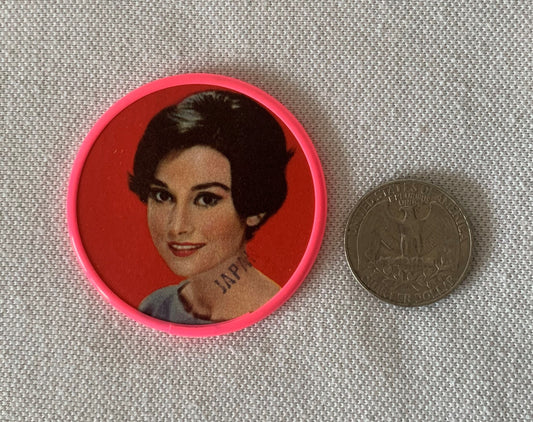
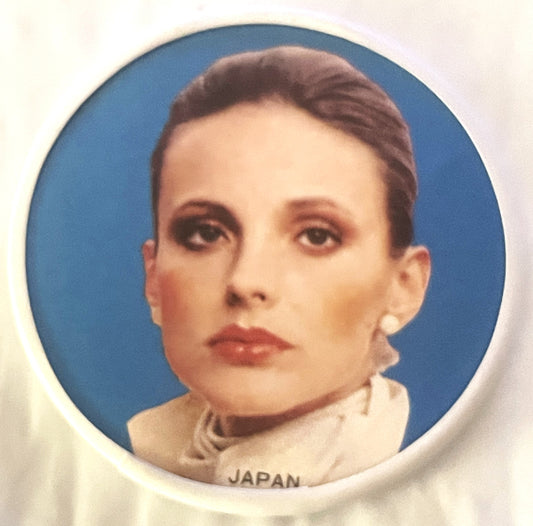
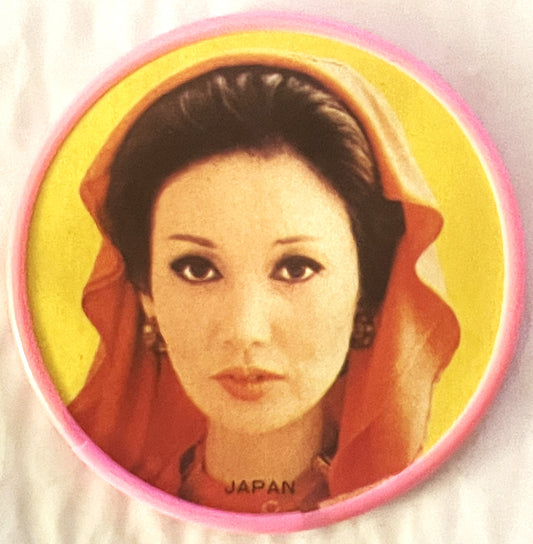
This is a vintage 1950s dime-store pocket mirror, round, approximately 2 inches in diameter, encased in a bold red metal rim that frames the lithograph face with a clean, confident border. The portrait at its center shows a smiling young woman — light curled hair swept back at one side, bright eyes, the kind of warm and natural radiance that defined Hollywood glamour in the mid-1950s before it got complicated or ironic. The background is green, a vivid, saturated mid-century green that makes the portrait pop with an energy that color photography of the era could rarely match. The image carries that slightly hand-painted quality that Japanese export lithography of this period achieved with remarkable consistency — a process that blended photographic source material with hand-applied color work, producing something that feels simultaneously mechanical and warmly human.

The word JAPAN appears on the face of the piece. Not OCCUPIED JAPAN. Not Made in Occupied Japan. Simply JAPAN — and that single word is a precise, verifiable timestamp. The Allied occupation of Japan formally ended on April 28, 1952, and with it disappeared the mandatory "Occupied Japan" export marking that had been required by American customs regulations since 1945. After that date, Japanese manufacturers exported their goods stamped simply with JAPAN or Made in Japan. This mirror, therefore, was produced after April 1952 — placing it squarely in the mid-to-late 1950s, the exact window when Shirley Jones was ascending from promising newcomer to full-blown American movie star. The marking confirms what the portrait suggests: this is a piece born of a specific, joyful, optimistic American moment.


⭐ Shirley Jones — From Charleroi, Pennsylvania to the Silver Screen

To understand what this mirror meant to the child who picked it up off a spinning rack in a five-and-dime, you have to understand what Shirley Jones meant to America in 1955 and the years immediately following. She was born on March 31, 1934, in Charleroi, Pennsylvania — a small western Pennsylvania steel and glass town on the Monongahela River, the kind of place that produced people with genuine warmth and an unaffected, grounded quality that no studio could manufacture. She grew up in Smithton, another small community just down the river, and she carried the particular character of the Mon Valley with her everywhere she went: open, direct, luminously pretty without being intimidating, the girl-next-door elevated to something mythic simply by being entirely herself on screen.

When Oklahoma! opened in 1955, audiences across the country saw something they hadn't quite seen before: a musical film heroine who felt genuinely wholesome rather than manufactured, whose voice was extraordinary without being theatrical, and whose smile — that wide, full, completely unguarded smile — seemed to come from a real person rather than a constructed celebrity. The film was a phenomenon. Rodgers and Hammerstein's beloved stage production translated to CinemaScope and Technicolor with a sweep and brightness that made it one of the defining cinematic experiences of the decade. And at the center of it, as Laurey, was Shirley Jones — suddenly, undeniably, unmistakably a star.

The dime-store industry moved fast in those years. Celebrity licensing was a looser, more instinctive business in the 1950s than it would later become, and manufacturers — particularly those working with Japanese export suppliers — could bring a product to market with a speed that modern supply chains would struggle to match. Within the same cultural moment that a star emerged, her face could appear on combs, mirrors, photo cards, fan booklets, and a dozen other small, affordable objects aimed directly at the adolescent girls and younger children who were, then as now, the most passionate consumers of celebrity culture. A pocket mirror at a dime-store price point was the perfect vehicle: small enough to produce inexpensively, personal enough to feel like a treasure, and bright enough to catch the eye of anyone passing the display.

By 1960, Jones had followed Oklahoma! with Carousel (1956) alongside Gordon MacRae, and then made one of the most startling pivots in 1960s Hollywood when she played a prostitute in Elmer Gantry opposite Burt Lancaster — a performance so committed and so far from her girl-next-door image that it won her the Academy Award for Best Supporting Actress. She would go on to even broader cultural fame as Shirley Partridge in The Partridge Family, but this mirror belongs to her earliest chapter: the Shirley Jones of Oklahoma! and Carousel, of Charleroi and Smithton and the Monongahela Valley, of the moment before complexity arrived and stardom was still simply golden.


🏭 The Art and Industry of Japanese Export Lithography

The craft that produced this mirror deserves its own moment of appreciation, because what Japanese export manufacturers accomplished with small-scale lithography in the 1950s was genuinely remarkable — a fusion of precision printing with hand-applied color work that gave their celebrity and novelty items a warmth and visual presence that mechanical reproduction alone could not achieve. The lithographic process used for pieces like this involved transferring an image — typically sourced from a studio publicity photograph — onto metal through a layered printing process, with color applied in successive passes that built up depth and saturation. Skilled colorists adjusted tints and highlights to compensate for the limitations of the medium, which is why these portraits so often carry that slightly painterly, slightly luminous quality that collectors find so appealing.

The Japanese export novelty trade of the late 1940s and 1950s was centered primarily in the Nagoya region and in smaller manufacturing clusters throughout the Aichi Prefecture, though export goods flowed through multiple ports and production hubs. The relationship between American importers and Japanese manufacturers in this period was close and well-established — American novelty and five-and-dime buyers worked with Japanese suppliers through trading companies, providing source imagery and product specifications, and the Japanese manufacturers executed them with a speed, consistency, and quality that made the partnership commercially essential for both sides. For American five-and-dime chains — Woolworth's, Kresge's, Ben Franklin stores, McCrory's, and dozens of regional operators — Japanese-made novelties were a cornerstone of the small-purchase impulse buy economy that kept those stores humming through the entire postwar decade.

It describes something real about the quality differential that collectors consistently notice between the most vivid, well-registered examples from this era and the more perfunctory work. This Shirley Jones mirror, with its saturated green background and the clean, warm rendering of her portrait, sits firmly in the finer category.


💄 The Five-and-Dime World — Where This Mirror Lived

To place this mirror properly in American life, you have to inhabit the five-and-dime for a moment. By the mid-1950s, the American dime-store was at the absolute peak of its cultural power — a ubiquitous, democratic, beloved institution present in virtually every town of any size in the country. Woolworth's alone operated more than 2,000 stores. S.S. Kresge, McCrory's, Ben Franklin, W.T. Grant — the variety store chains were woven into the fabric of daily American commercial life in a way that's genuinely difficult to convey to anyone who didn't experience it. These were not discount stores in the modern sense. They were community gathering places, lunch counter destinations, the first places many children experienced independent purchasing power.

The small novelty rack — spinning wire displays positioned near the front of the store, within easy reach of children's hands and eye level — was one of the defining retail environments of the era. Combs, barrettes, photo cards, small mirrors, key chains, miniature games: all priced at or near ten cents, all aimed at the demographic with the smallest budget and the most passionate enthusiasms. Celebrity novelties dominated that rack in the movie-mad 1950s, and a pocket mirror featuring the face of Shirley Jones at the height of her Oklahoma! fame would have moved briskly. Whether a particular store in western Pennsylvania near Jones's own hometown ever stocked her face on that rack is the kind of detail history doesn't record, but the image is almost too good to release: a girl from Charleroi, smiling from a dime-store mirror, in the very towns where people might have known her family.


🖼️ Display Ideas

  • 🎬 Hollywood Glamour Gallery Wall: Group this mirror with other 1950s celebrity lithograph items — fan cards, movie programs, lobby card reproductions — in a gallery arrangement that captures the full visual vocabulary of mid-century Hollywood fan culture. The red rim and green background make it a natural color anchor.
  • 🪞 Vanity or Dressing Table Vignette: Nestle this mirror among other 1950s beauty and grooming accessories — a vintage atomizer, a compact, a hair receiver — for a period-correct vanity display that evokes the full sensory world of a 1950s dressing table.
  • 🎶 Oklahoma! / Golden Age Musical Theater Shelf: Pair with an original Oklahoma! cast recording (the 1955 film soundtrack on Capitol Records is ideal), a movie program, or a lobby card for a focused tribute to the golden age of the American movie musical.
  • 🏪 Five-and-Dime Nostalgia Shadow Box: Frame this mirror in a deep shadow box alongside other dime-store era ephemera — penny arcade cards, a Woolworth's receipt, a small advertising tin — to recreate the visual experience of that spinning novelty rack.
  • Easel Display on a Collector's Bookshelf: A small plate easel at the right scale holds this mirror upright beautifully, allowing the portrait to face outward as a standalone decorative accent among books, memorabilia, and other small collectibles.
  • 🎁 Framed Collector Presentation: Mount the mirror in a small frame with archival matting alongside a printed reproduction of a 1955 Oklahoma! promotional image for a presentation-quality display piece that tells the full story at a glance.

🎁 Who Collects These

The collector community that gravitates toward pieces like this Shirley Jones pocket mirror is wonderfully varied, and understanding who they are helps locate this object in its proper cultural conversation. At the center of that community are the dedicated Shirley Jones fans — a loyal, multigenerational group that encompasses people who saw Oklahoma! in theaters in 1955, people who grew up watching The Partridge Family in the early 1970s, and younger admirers who've discovered Jones through classic film channels and streaming. For them, this mirror is a primary document: a physical artifact from the earliest chapter of her fame, produced within the same cultural moment that made her a star.

Beyond the Shirley Jones faithful, this mirror speaks to collectors of Japanese export novelties and lithographia — a focused and knowledgeable community that pursues the finest examples of postwar Japanese manufacturing with the same rigor that other collectors bring to American tin toys or Depression glass. The quality of the lithograph work on a piece like this, and the precision of its dating markers (that plain JAPAN marking, the post-occupation manufacture window), makes it genuinely interesting to this group on purely technical grounds.

Five-and-dime and Americana collectors are a third significant audience — people who are reconstructing, piece by piece, the material world of mid-century American retail and consumer culture. A celebrity pocket mirror from a Woolworth's or Kresge's rack is as authentic a dime-store artifact as a soda fountain menu or a tin advertising sign, and it carries the added resonance of connecting commercial culture to the celebrity ecosystem that animated it. Pennsylvanians with ties to the Charleroi and Monongahela Valley area represent a fourth group — local collectors and history enthusiasts for whom Shirley Jones is a genuine regional point of pride, a woman who carried that specific community's name into the widest possible American conversation.

And then there are the interior designers, the stylists, the nostalgic home decorators who understand that a small, beautiful, historically resonant object placed thoughtfully on a shelf or in a vignette does more for a room than almost anything else. For them, this mirror is simply perfect: visually striking, conversation-starting, and possessed of a genuine provenance story that reproduction pieces can never replicate.


❓ Frequently Asked Questions

How do I know this mirror is actually from the 1950s and not a later reproduction?

The dating markers on this piece are both clear and verifiable. The most important is the country-of-origin marking: the word JAPAN appears on the face of the mirror without any "Occupied" qualifier. American customs regulations required all Japanese exports to be marked "Made in Occupied Japan" or "Occupied Japan" from 1945 through April 28, 1952, when the Allied occupation formally ended.

After that date, that prefix was no longer required, and Japanese manufacturers returned to the standard JAPAN or Made in Japan marking. A piece marked simply JAPAN therefore dates to post-April 1952. Combined with the subject matter — Shirley Jones at her Oklahoma!-era fame — the manufacture window narrows convincingly to the mid-to-late 1950s.

The lithography style, the metal construction, the red rim treatment, and the color palette are all consistent with Japanese export novelty production of that specific decade. The lithograph portrait retains strong color saturation and the image is clearly legible and visually vibrant. The red metal rim frames the piece cleanly.

The mirror surface at the reverse is functional vintage glass. All photographs in the listing show the actual piece; what you see in the images is precisely what this mirror presents.

Was Shirley Jones from a specific place in Pennsylvania, and does that connection matter to collectors?

Yes — and for a particular category of collector, it matters enormously. Shirley Jones was born in Charleroi, Pennsylvania, a community on the Monongahela River in Washington County, western Pennsylvania, and grew up in nearby Smithton. The Mon Valley — the industrial corridor defined by the Monongahela River and its steel, glass, and mining communities — has a strong regional identity and an equally strong pride in its native achievers. Jones is one of the most celebrated figures to emerge from that area, and collectors with ties to Charleroi, Smithton, Washington County, or the broader western Pennsylvania region place particular personal and sentimental value on items connected to her career. A pocket mirror produced during her breakthrough Oklahoma! period is, for those collectors, a genuine piece of local history in portable form.

How does this mirror fit into a broader Shirley Jones collection?

Shirley Jones memorabilia from the 1950s occupies a relatively defined and not overly large collecting universe, which makes genuine period pieces — especially those tied to her Oklahoma! and Carousel era — genuinely worth acquiring when they appear. A comprehensive Shirley Jones collection might include original film lobby cards and posters, movie programs, fan magazine issues featuring her (she appeared on dozens of covers in the mid-to-late 1950s), studio publicity photographs, original cast recordings of her film soundtracks, and exactly this kind of small novelty item that represents the commercial side of celebrity culture in the era. The pocket mirror is particularly valuable in that context because it demonstrates the breadth of her cultural penetration — her face wasn't only in magazines and on theater marquees; it was on the dime-store novelty rack, available to any child with a dime, which is actually a more democratic and in some ways more meaningful form of stardom.

What does "Made in Japan" versus "Made in Occupied Japan" mean for dating and value?

This is one of the most reliable and well-documented dating tools in the vintage Japanese export collecting world. From September 1945 through April 28, 1952, all Japanese goods exported to the United States were required by the Supreme Commander for the Allied Powers (SCAP) and American customs regulations to carry the marking "Made in Occupied Japan" or "Occupied Japan." This was a political and administrative designation, not a quality or origin judgment. When the Treaty of San Francisco restored Japanese sovereignty and the occupation formally ended on April 28, 1952, the requirement was lifted immediately. Manufacturers returned at once to the standard JAPAN or Made in Japan marking. Therefore: any Japanese export item marked simply JAPAN was produced after April 28, 1952. Occupied Japan items (1945-1952) have their own devoted collector community and often command premium prices; post-occupation Japanese export items from the 1950s are equally collectible but date differently. For this Shirley Jones mirror, the JAPAN marking combined with the subject matter creates a confident and specific manufacture window: post-April 1952, most likely mid-to-late 1950s.

Is this a good piece for someone just beginning to collect 1950s celebrity memorabilia?

It's an excellent entry point, for several reasons. First, it is immediately accessible and visually engaging — you don't need specialized knowledge to appreciate a vibrant lithograph portrait of a famous actress on a beautifully rimmed pocket mirror. Second, it tells its own story: the JAPAN marking, the dime-store context, the Shirley Jones biography, the lithography process — all of that is readable from and around the object itself, and learning it gives a new collector a solid foundation in several adjacent areas of 1950s material culture. Third, pocket mirrors of this type are small, easily displayed, and self-contained — they don't require elaborate mounting, framing, or storage solutions. And fourth, pieces like this appear with enough infrequency that finding one in strong visual condition is genuinely satisfying and represents real collecting luck. For the experienced collector, it's a focused and high-quality addition to an existing Shirley Jones, Japanese export, or dime-store collection.

What makes the red rim significant — is that a standard feature of these mirrors?

The red metal rim on this mirror is both a period-correct design choice and a visually distinctive feature that lifts the piece above more plainly rimmed examples. In Japanese export novelty production of the 1950s, the rim color was a design decision — typically determined by the American importer or buyer who specified the product — and red was among the most popular choices precisely because of its visual impact and its association with Hollywood glamour, boldness, and the bright commercial aesthetic of mid-century American retail. Against the green background of the Shirley Jones portrait, the red rim creates a strong complementary contrast that makes the piece genuinely striking even at two inches in diameter. Collectors of Japanese export lithograph mirrors consistently note that rimmed examples — particularly those with colored rims rather than plain or silver-toned metal — display more effectively and show the manufacturer's attention to the complete aesthetic package rather than just the printed face. The red rim on this mirror is in good original condition and contributes meaningfully to both the visual appeal and the period authenticity of the piece.

Shipping

🚚 Shipping & Handling

  • Shipping costs and timing are calculated at checkout.
  • Items curated and shipped directly by me include U.S. shipping at no additional cost, professionally packed to ensure safe arrival of your artifact.

Items from Vetted Pro Collectors
Shipping for items offered by vetted Pro Collectors is determined at checkout. All Pro Collector listings are reviewed to ensure fair, reasonable shipping practices.

For full details, please refer to our Shipping Policy.

Returns & Exchange

Take your time — you've got a full six months. If a piece isn't right for you, send it back the way it reached you and we're good.

In the first 30 days your money goes straight back the way you paid. After that it's store credit, so you can put it toward something you'd rather have.

Return shipping we sort out between us, case by case. I don't make this difficult.

If something arrives damaged, or it isn't what I said it was, send me a photo within 48 hours and I'll make it right.

Email info@vintageantiquesgifts.com or call 802-356-9872 — that's me answering, not a call center.

The only things I can't take back are custom or special-order pieces and gift cards.

View full details