Skip to product information
1 of 3

Vintage and Antique Gifts

Vintage 1950s Lone Eagle Crate Label ✈️ Exeter, CA, Charles Lindbergh Tribute

Vintage 1950s Lone Eagle Crate Label ✈️ Exeter, CA, Charles Lindbergh Tribute

Regular price $5.50 USD
Regular price Sale price $5.50 USD
Sale Sold out
Shipping calculated at checkout.

Size: 13" x 4"

🚚 Free US Shipping — ships within one business day. International shipping calculated at checkout.

Quantity

Why Did Exeter Name Its Fruit for Lindbergh? ✈️ Vintage 1950s Lone Eagle Crate Label, Exeter, CA

Size: 13" x 4"

Five months after Charles Lindbergh landed in Paris, the fruit growers of Exeter, California, put his nickname on their fruit.

This is their label: LONE EAGLE in towering green letters, and banking across a teal sky, a cream plane with N-X-211 lettered in red on its wing, the registration of the Spirit of St. Louis. It was grown and packed by the Exeter Fruit Association in the San Joaquin Valley, sold under the Blue Anchor mark of the California Fruit Exchange, and printed in San Francisco by A. Carlisle & Co. By the association's own trademark record the Lone Eagle name was in use by that October, and the brand was still going when crate labels like this one were printed in the 1950s. Great patriotic Americana that pays tribute to Charles Lindbergh's journey. ✈️

The Label Up Close

LONE EAGLE runs corner to corner in huge dimensional capitals on a dark band that sweeps up the label like the wake of the plane. At the upper right the plane itself tilts across the sky, its wing lettered N-X-211. PRODUCE OF U.S.A. is printed across the top right. In the middle sits the Blue Anchor roundel of the CALIFORNIA FRUIT EXCHANGE, and the band along the bottom reads GROWN AND PACKED BY EXETER FRUIT ASSOCIATION, EXETER, CALIFORNIA, with REG. U.S. PAT. OFF. just to the right of the roundel and the printer's credit A. CARLISLE & CO in small type at the lower right corner.

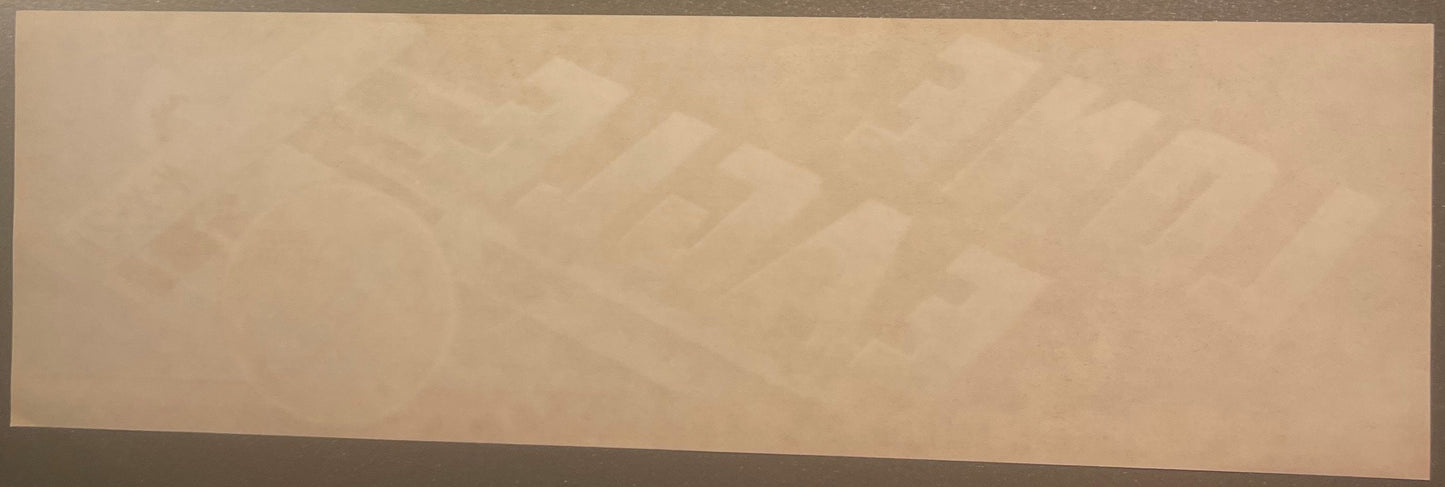
The back is plain paper, clean, with the lettering and the roundel showing through faintly in reverse. It was never pasted to a box.

  • Brand: Lone Eagle
  • Packer: Exeter Fruit Association
  • Marketing mark: Blue Anchor, California Fruit Exchange
  • Printer: A. Carlisle & Co., San Francisco
  • Also printed: PRODUCE OF U.S.A., REG. U.S. PAT. OFF.
  • Type: lug box crate label, lithographed on paper
  • Size: 13" x 4" ~
  • Condition: unused, never applied to a crate; clean back
  • Age: 1950s

N-X-211 and the Lone Eagle

On May 20, 1927, a 25-year-old airmail pilot named Charles Augustus Lindbergh took off from Roosevelt Field on Long Island in a single-seat, high-wing plane and flew alone across the Atlantic. Thirty-three and a half hours and about 3,600 miles later he landed at Le Bourget outside Paris and won the $25,000 Orteig Prize for the first nonstop flight between New York and Paris. The newspapers called him Lucky Lindy. The name that lasted was the Lone Eagle.

His plane was a California plane. Ryan Airlines of San Diego built the Spirit of St. Louis, a Ryan NYP, for New York to Paris, in 60 days at a cost of $10,580. It had a 46-foot wing and a Wright J-5C Whirlwind engine, and it carried the registration N-X-211 painted on its wings. The government gave it that number because it was a nonstandard design, and the X stood for experimental. My favorite part is that the paperwork trailed the plane: the official number assignment and the plane's identification plate were mailed to Lindbergh on June 12, 1927, a couple of weeks after he had already flown it to Paris. The Spirit of St. Louis hangs today in the Smithsonian's National Air and Space Museum in Washington. The artist who drew this label put that registration on the wing on purpose, so anyone who had followed the flight knew exactly whose plane it was.

A Brand Born in 1927

When the Exeter Fruit Association registered LONE EAGLE with the United States Patent Office in 1968, for fresh deciduous fruits and fresh grapes, it gave October 13, 1927 as the date the name was first used, less than five months after the flight. The registration was granted on August 13, 1968, and it has since lapsed. For four decades the association had been packing fruit under Lindbergh's nickname before it ever got around to the paperwork, and labels like this one were how buyers back East knew the brand. Cal Poly Pomona's Southern California Wine and Wine Industry Grape Crate Labels Collection holds a Lone Eagle label of the Exeter Fruit Association, cataloged as circa 1940-1970.

The REG. U.S. PAT. OFF. on the label sits on the orange band just to the right of the Blue Anchor roundel, and the anchor had been a registered trademark since 1923.

Exeter, California

Exeter sits on the east side of the San Joaquin Valley in Tulare County, about 47 miles southeast of Fresno as the crow flies, between Visalia and Sequoia National Park. The railroad had reached the valley by 1888, and a Southern Pacific representative named D. W. Parkhurst bought land from the settler John Firebaugh, whose grain field became the townsite, and named the new town after his hometown of Exeter, England. It incorporated on March 2, 1911.

The land around it made its name in fruit. Exeter calls itself the Citrus Capital of the World, and its citrus growers organized their own packing cooperative, the Exeter Citrus Association, in October 1925. It merged with the Ivanhoe Citrus Association in 2000 to become the Exeter-Ivanhoe Citrus Association, and it is still packing citrus in the Sunkist system today. The Exeter Fruit Association on this label was a different outfit: it packed deciduous fruit and grapes and marketed them through the California Fruit Exchange instead. Old-timers recall that at harvest the air in Exeter smelled of fruit moving through the packing sheds at all hours, and that growers argued over whose label art was best and which brand brought the top price in the Chicago and New York markets. Cattle mattered too: the Gill Cattle Company, based there, was once the largest cattle business in the United States. Today about 10,300 people live in Exeter, and 31 murals painted on its downtown walls tell the town's history to anyone who walks by.

The Blue Anchor and the California Fruit Exchange

The California Fruit Exchange was incorporated on May 1, 1901, by member associations from Loomis, Newcastle and Penryn in the Placer County foothills, as a cooperative to market California's deciduous fruit. George H. Cutter, one of its founders, suggested an anchor as its symbol as early as 1903, the Exchange first used it in 1904, and in 1923 the Blue Anchor was registered as a trademark for its highest quality fruit. The Exchange grew into the largest fruit growers' cooperative on the Pacific coast, bringing in packing associations up and down the state, Exeter's among them. At its peak the California Fruit Exchange represented about 1,000 growers of tree fruits and table grapes and sold in more than 300 towns and cities across North America; its National Register listing called it the world's largest deciduous fruit marketing cooperative.

In 1931 it built its headquarters in Sacramento, the Blue Anchor Building, a Spanish Colonial Revival design by the architects Starks and Flanders. The building was dedicated to the memory of George H. Cutter, the same founding member who came up with the anchor, and who was the Exchange's president for 16 years. The Exchange ran its business from there from the day it opened in 1932 until 1966, when the State of California bought it. The Exchange changed its name to Blue Anchor, Inc. in 1969, the anchor having long outgrown the company name. In 2000 Blue Anchor announced it was closing, calling itself one of the last mighty fruit marketing cooperatives, after nearly 100 years in business. The building was listed on the National Register of Historic Places on February 3, 1983, and today it houses the California Governor's Office of Planning and Research.

A. Carlisle & Co. of San Francisco

The tiny credit in the corner belongs to one of San Francisco's oldest printing houses. A. Carlisle & Co. billed itself as printers, lithographers and stationers since 1852. In 1916 Carlisle took over what remained of Britton & Rey, the lithographers founded in 1852 by Joseph Britton and Jacques Joseph Rey, whose prints recorded Gold Rush San Francisco and whose shop ran until at least the 1906 earthquake and fire. Carlisle's name turns up on labels for growers all over California. The name carried on in Nevada: A. Carlisle & Co. of Nevada, which traced its history back to the Gold Rush, was acquired by the Reno printer Reno Type in 2025.

The Crate Label Age

Crate labels began in the 1880s in California and Washington, when growers started shipping fruit east on the new transcontinental railroads and needed a way to make one wooden box stand out from the next in a wholesale market. Early labels were printed from stones; after about 1920 offset lithography took over. Sizes followed the fruit: a grape lug label ran about 13 by 4 inches, the size of this one, while apple box labels ran about 10 by 9. World War II squeezed both the crate makers' workforce and the printers' supplies, and through the 1950s growers went over to cheap cardboard cartons printed directly with simpler designs. The paper labels left over in packing sheds and printers' stock rooms are what collectors frame today.

Crate labels are a reminder of a bygone era, but the amazing lithography process is unparalleled even to this day. Museums and art institutes have galleries dedicated to them, and more and more collectors are seeking them out to preserve their history.

Lore: Lindy Hops the Atlantic

Lindbergh's name ended up on far more than fruit. The story goes that the Lindy Hop, the swing dance born in Harlem, got its name from him. At a dance marathon at Rockland Palace in 1928, a spectator is said to have asked George "Shorty" Snowden what he was doing, and Snowden answered that he was doing the Lindy, after the headline "Lindy Hops the Atlantic." Dance historians still argue over whether Snowden really named it, but the name stuck, and the dance went on to fill the Savoy Ballroom. A fruit brand and a dance craze, both christened by one flight.

Good For

  • Aviation and Lindbergh collectors
  • California crate label collections, especially Blue Anchor and San Joaquin Valley labels
  • Tulare County, Exeter and Central Valley history
  • A long, narrow frame over a kitchen doorway, a bar or a hangar office wall
  • A gift for a pilot or an aviation history buff

Questions People Ask

Is N-X-211 really Lindbergh's plane?
Yes. N-X-211 was painted on the wings of the Ryan NYP Lindbergh flew from New York to Paris on May 20 and 21, 1927.

How old is this label?
It is a 1950s label. The Lone Eagle brand itself goes back to October 13, 1927, the first-use date the Exeter Fruit Association gave for the name.

Who packed the fruit?
The Exeter Fruit Association of Exeter, California, as printed on the label, marketing through the California Fruit Exchange under its Blue Anchor mark.

Who printed it?
The San Francisco lithographers A. Carlisle & Co., whose credit is tucked into the bottom edge beside the Blue Anchor roundel.

Was it ever used on a crate?
No. It is unused, and the back is clean paper.

How big is it?
13" x 4" ~, the size of a California grape lug label.

My pictures seriously don't do it justice. Imagine this amazing vintage advertising hanging as home décor in any room of your home instead of a museum!

Shipping

🚚 Shipping & Handling

  • Shipping costs and timing are calculated at checkout.
  • Items curated and shipped directly by me include U.S. shipping at no additional cost, professionally packed to ensure safe arrival of your artifact.

Items from Vetted Pro Collectors
Shipping for items offered by vetted Pro Collectors is determined at checkout. All Pro Collector listings are reviewed to ensure fair, reasonable shipping practices.

For full details, please refer to our Shipping Policy.

Returns & Exchange

Take your time — you've got a full six months. If a piece isn't right for you, send it back the way it reached you and we're good.

In the first 30 days your money goes straight back the way you paid. After that it's store credit, so you can put it toward something you'd rather have.

Return shipping we sort out between us, case by case. I don't make this difficult.

If something arrives damaged, or it isn't what I said it was, send me a photo within 48 hours and I'll make it right.

Email info@vintageantiquesgifts.com or call 802-356-9872 — that's me answering, not a call center.

The only things I can't take back are custom or special-order pieces and gift cards.

View full details

Preserving History: Authentic Objects Across Eras

— Curated by Travis Weigel