Skip to product information
1 of 3

Vintage and Antique Gifts

Vintage 1970s Sheridan Wyoming Chief Special Police 🦅 Tin Litho Toy Badge Original NOS Card Japan

Vintage 1970s Sheridan Wyoming Chief Special Police 🦅 Tin Litho Toy Badge Original NOS Card Japan

Regular price $18.00 USD
Regular price Sale price $18.00 USD
Sale Sold out
Shipping calculated at checkout.

Size: 4" x 2 1/4"

🚚 Free US Shipping — ships within one business day. International shipping calculated at checkout.

Quantity

Who Was Chief of Police in Sheridan, Wyoming? 🦅 Sheridan, Wyoming, Chief of Police

Size: 4" x 2 1/4" ~ New Old Stock, still on its card.

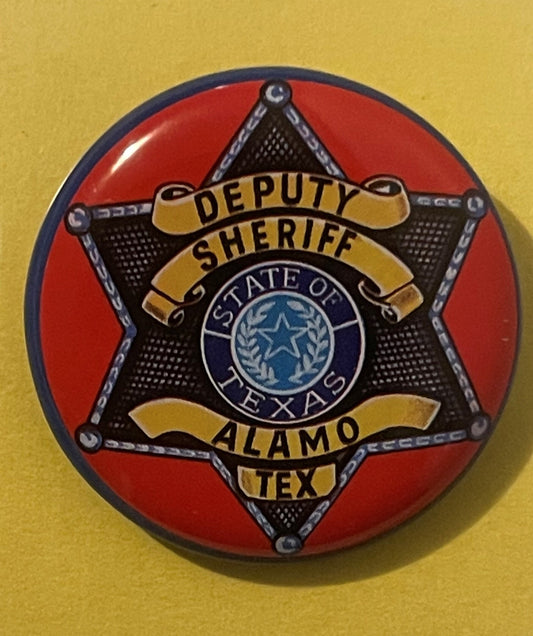
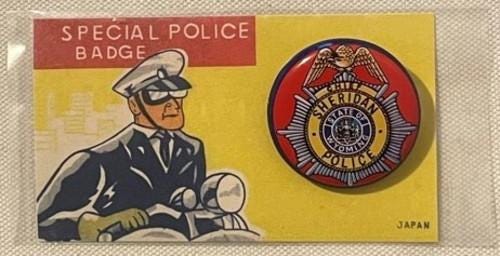
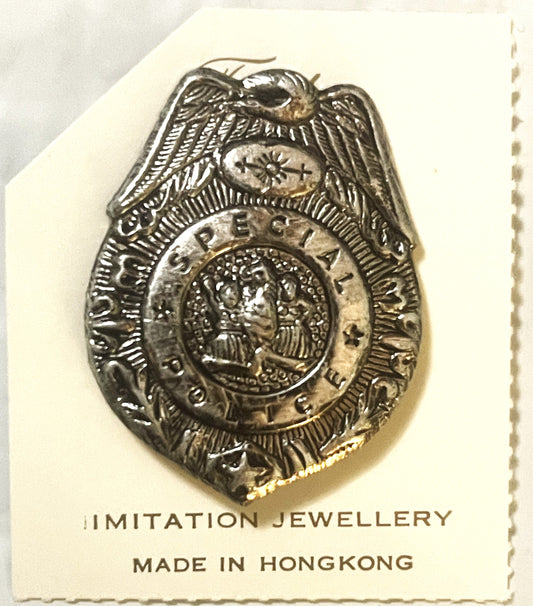
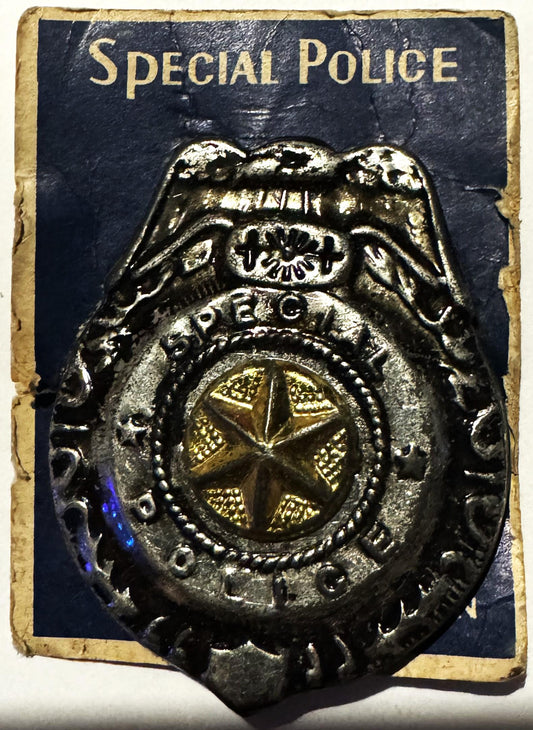
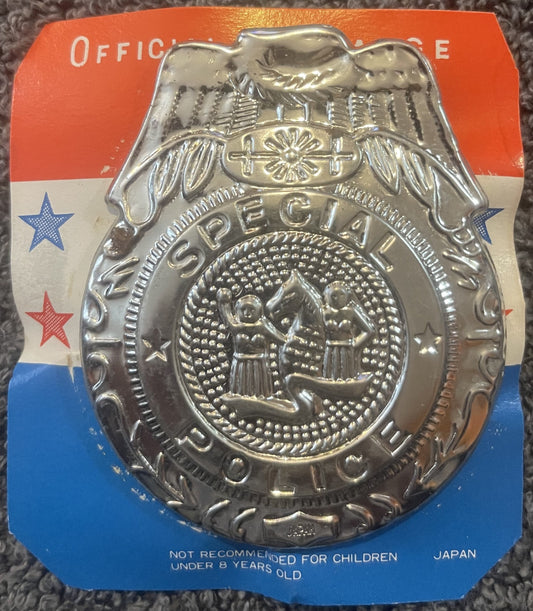
Here's a badge with a whole state seal packed onto it. It's a 1970s tin litho pinback, about an inch and a half across, with a starburst behind the lettering and an eagle on top, wings spread. Under the eagle, arched small, CHIEF, then SHERIDAN arched across the top of a ring and POLICE along the bottom. The center reads STATE OF WYOMING around a miniature of the state seal, tiny enough that you can only just make out its figures. These come still pinned to their cards and sealed in their sleeves, the way they hung on the rack. It's a toy, made for kids, and a good-looking one. And they're rare - carded or loose, a Sheridan one just doesn't come up for sale.

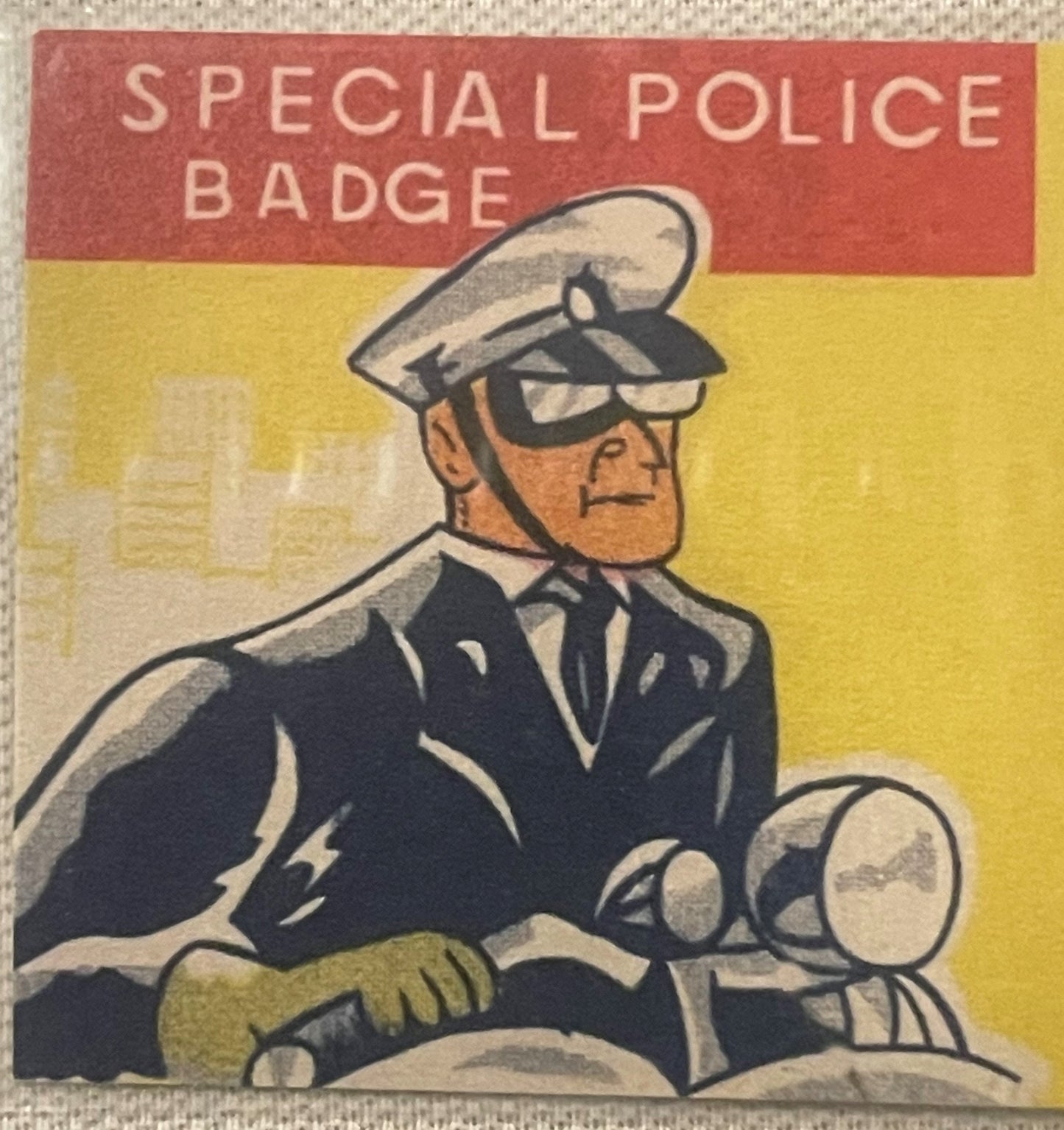
The card is half the fun. It shows a cartoon motorcycle cop, with a banner reading SPECIAL POLICE BADGE. Down in the corner, small letters: JAPAN. That's where these were tin lithographed for the American dime-store trade. Real police badges were a different animal, made by American badge houses like Blackinton, who've been making police badges in Attleboro Falls, Massachusetts since just after the Civil War, and out West, Ed Jones, which got its start in a backyard shed in Oakland, and Sun Badge down in Southern California.

🏔️ Sheridan, Wyoming — The Town on the Badge

You'll find Sheridan in north-central Wyoming, right under the Bighorns, and the man who laid it out is a story worth telling. John D. Loucks, a Civil War veteran, paid a trapper named George Mandel fifty dollars for forty acres. In spring 1882 he sat down on a hill above Goose Creek and platted the town, and the story goes that he drew the plat on a sheet of wrapping paper. He gave it the name of General Philip Sheridan, the man he had served under, then served as its first postmaster and first mayor and watched it incorporate in 1884. That same year Theodore Roosevelt left his ranch on the Little Missouri, out in the Dakota Badlands, for quite a long trip through the cattle country of southeastern Montana and northern Wyoming, and spent a fortnight hunting elk and bear up in these same Bighorns. He tracked a grizzly through their pine woods that he reckoned at about twelve hundred pounds, and wrote the whole thing up in Hunting Trips of a Ranchman, out the next year.

The Burlington and Missouri Railroad reached town in November 1892 and Sheridan took off - local business paid off thirty thousand dollars in bank loans in the first month, and the population climbed from 1,559 in 1900 to 8,408 by 1910, fueled by the coal mines at Dietz, Monarch and Acme. The Sheridan Inn opened its doors in 1893. Buffalo Bill Cody invested in it and made it his headquarters for tryouts, where he auditioned local cowboys and cowgirls for his Wild West show's European tours. It was reputed to be the finest hotel anywhere between Chicago and San Francisco, and its guests included Will Rogers, Ernest Hemingway and Calvin Coolidge. A Sheridan cattleman, John B. Kendrick, went on to be governor in 1914, and from 1917 until 1933 he served as a US Senator.

🦬 The State Seal on the Badge

What the badge copies is the real Great Seal of Wyoming, which was adopted in 1893 and revised in 1921: a draped woman holding up a banner that reads EQUAL RIGHTS (it was Wyoming Territory that gave women the vote, back in 1869, the first in the country to do it), flanked by two men representing livestock and mining, a star marked 44 standing for the 44th state, plus scrolls that read Oil, Mines, Livestock and Grain. Quite a lot of seal to shrink onto an inch-and-a-half button.

🗓️ When These Were Made

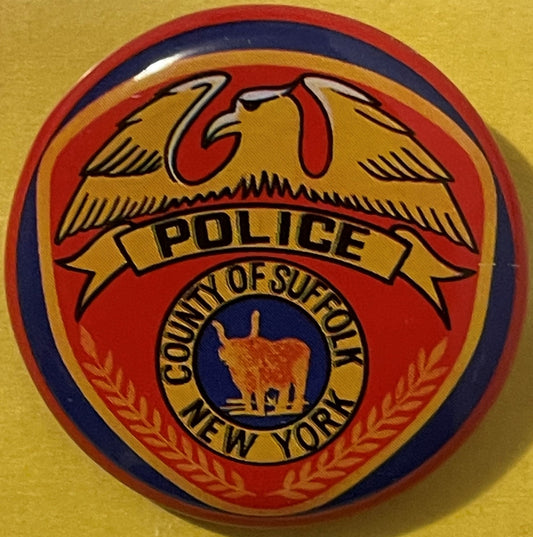
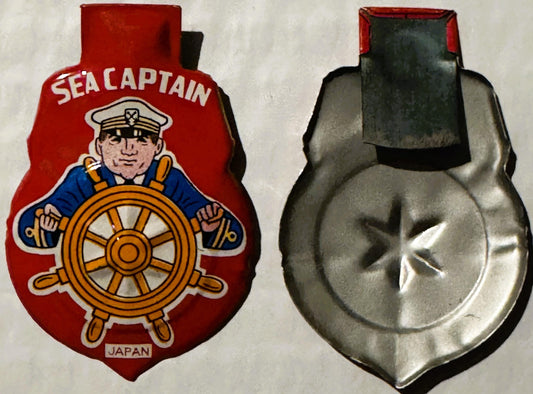
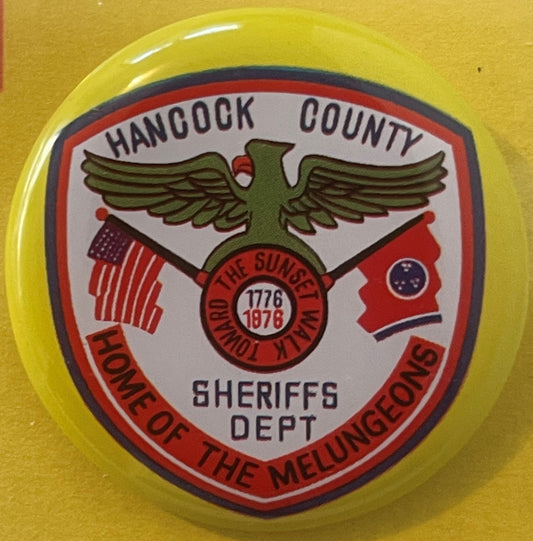
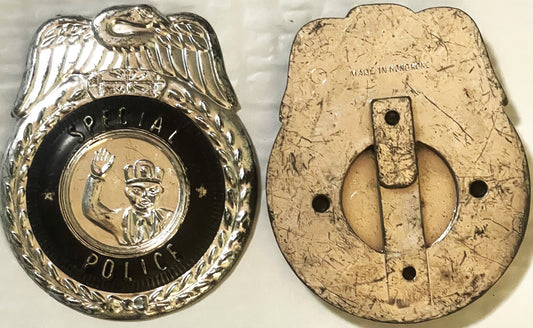
There's no date on the card itself, but the rest of the family gives it away. The same card design shows up with an NYPD button, which copies the patch New York adopted on July 1, 1971, with a San Francisco button, which copies the patch SFPD put on its uniform in 1970, and with a sheriff's button printed 1776-1976 for the Bicentennial. Loose buttons from the series have a cream plastic back moulded MADE IN JAPAN and PAT. NO. 1196679, a Japanese utility-model registration filed in November 1972 and granted in 1977. So this is a 1970s badge. The card and the badge name no maker or importer; whoever ran this line kept their name off it.

⭐ When Kids Really Did Get Badges from the Law

The American childhood this badge comes from was full of real badges given by real officers. Junior deputy programs let sheriffs swear in schoolkids as honorary deputies; school safety patrol programs, organized since the 1920s, put badges and belts on millions of children; police departments handed out badges at parades, fairs, and classroom visits as a matter of civic routine. Sheriffs also gave out tin badges of exactly this kind as prizes in their youth programs. Next to all that, a Sheridan, Wyoming Chief Special Police badge was the dime-store version, the one a kid could buy with pocket change. That documented world of junior programs is the backdrop this little survivor belongs to.

Shipping

🚚 Shipping & Handling

  • Shipping costs and timing are calculated at checkout.
  • Items curated and shipped directly by me include U.S. shipping at no additional cost, professionally packed to ensure safe arrival of your artifact.

Items from Vetted Pro Collectors
Shipping for items offered by vetted Pro Collectors is determined at checkout. All Pro Collector listings are reviewed to ensure fair, reasonable shipping practices.

For full details, please refer to our Shipping Policy.

Returns & Exchange

Take your time — you've got a full six months. If a piece isn't right for you, send it back the way it reached you and we're good.

In the first 30 days your money goes straight back the way you paid. After that it's store credit, so you can put it toward something you'd rather have.

Return shipping we sort out between us, case by case. I don't make this difficult.

If something arrives damaged, or it isn't what I said it was, send me a photo within 48 hours and I'll make it right.

Email info@vintageantiquesgifts.com or call 802-356-9872 — that's me answering, not a call center.

The only things I can't take back are custom or special-order pieces and gift cards.

View full details

Preserving History: Authentic Objects Across Eras

— Curated by Travis Weigel