Skip to product information
1 of 3

Vintage and Antique Gifts

Antique 1920s American Beauty Eatmor Cranberries Barrel Label โœจ NY, NJ, CHI

Antique 1920s American Beauty Eatmor Cranberries Barrel Label โœจ NY, NJ, CHI

Regular price $7.00 USD
Regular price Sale price $7.00 USD
Sale Sold out
Shipping calculated at checkout.

Size: 10" x 6 3/4"

๐Ÿšš Free US Shipping โ€” ships within one business day. International shipping calculated at checkout.

Quantity

Who Packed American Beauty Eatmor Cranberries? ๐ŸŒน American Beauty Brand, Eatmor Cranberries of New Jersey

Size: 10" x 6 3/4" ~ Little to no storage wear.

A big crimson rose on a cranberry label, and there's a reason for it. This is an antique 1920s American Beauty Brand label for a quarter-barrel box of Eatmor Cranberries of New Jersey, packed for the American Cranberry Exchange of New York and Chicago, never pasted on a box.

๐Ÿ” What's on it

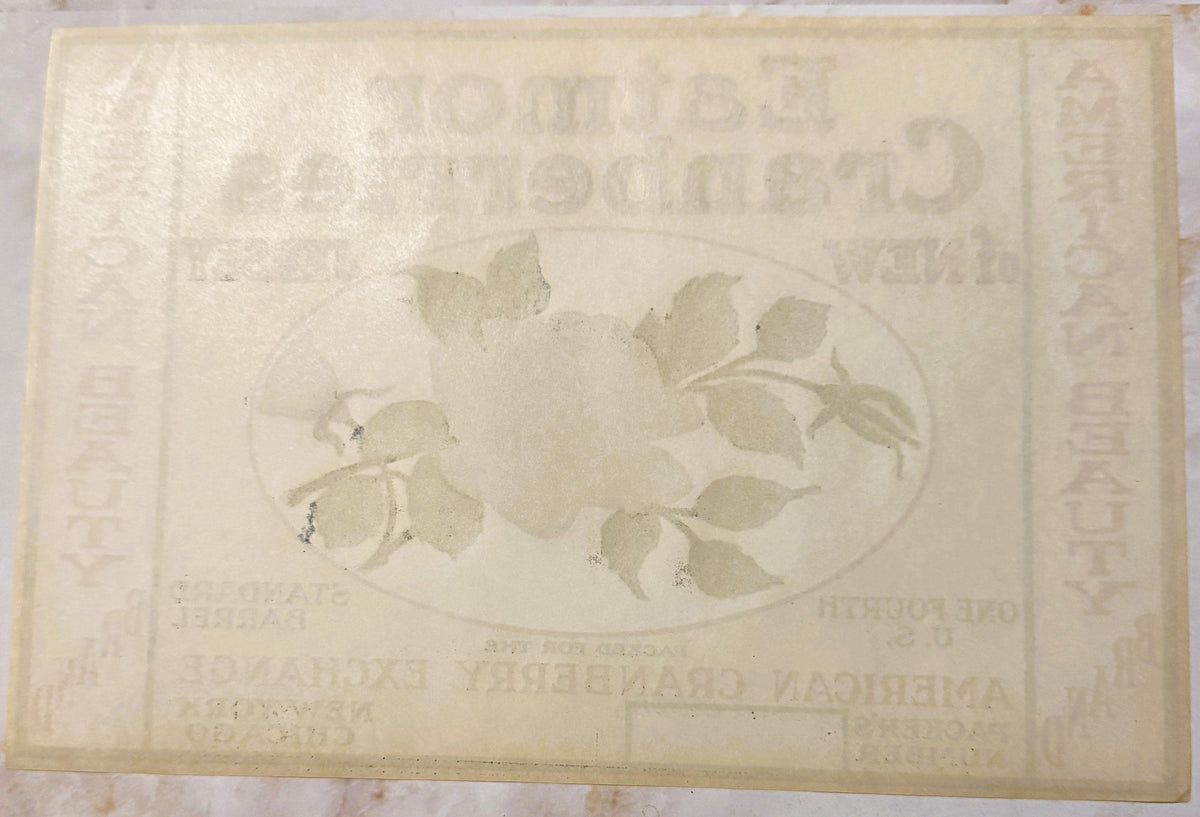
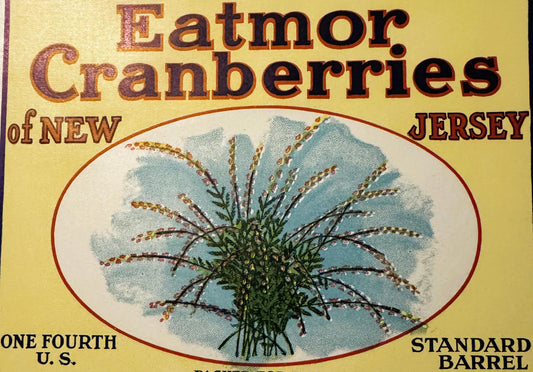
Eatmor Cranberries in big navy letters across the top, of NEW JERSEY under it, and in the middle an oval with a full red rose, a rosebud and dark green leaves. Down each side, in red on white, AMERICAN BEAUTY BRAND. Then ONE FOURTH U.S. STANDARD BARREL, PACKED FOR THE AMERICAN CRANBERRY EXCHANGE, NEW YORK, CHICAGO, and a blank box marked PACKER'S NUMBER, where the grower who packed the berries wrote in their own number. All of it on a soft yellow ground with red and navy borders. The back is plain, with the rose showing through.

Look closely and there's a second, tighter bud tucked in at the left end of the stem, too. That yellow ground wasn't just a pretty choice, either: the South Wood County Historical Museum in Wisconsin Rapids, which keeps a big public collection of cranberry labels, explains that once the growing regions began selling together, Wisconsin's labels went red, Massachusetts went blue and New Jersey's took on their own yellow.

๐ŸŒน Why a rose?

The brand is named for the most famous rose in America. It was bred in France in 1875 as 'Madame Ferdinand Jamin,' brought over and introduced here as the American Beauty in 1886, and it was the best-selling rose in the United States until the 1920s. At two dollars a stem or more, it was called the million-dollar rose. Naming your best cranberries after it was saying something.

The Frenchman who bred it was Henri Lรฉdรฉchaux. On this side of the ocean it was introduced under the American Beauty name by Bancroft and Field Bros. in 1886, and the big florists Bassett & Washburn started offering it to the rest of the trade in 1888. It was the rose of its day, and in 1925 the District of Columbia made the American Beauty its official flower, which it still is.

๐Ÿ… So, Who Packed American Beauty?

Here's the fun part. American Beauty wasn't one farm. It was a grade. The Whitesbog Preservation Trust explains in its own label records that cranberries were never sold by variety name the way apples are. Each variety was split into several brands by color, size and how well it kept on a long trip, with its own label for each grade, about 32 brand labels in all, most of them Eatmor. The New Jersey growers had gone over to pooling, grading and branding together, and the old one-farm brands went away.

And American Beauty sat near the top of that ladder. Its standard, which Whitesbog also records, was 90 percent colored and no more than 125 berries to the cup. Whitesbog's record for another New Jersey Eatmor brand, Heather, asks only 75 percent colored and allows up to 130 to the cup. So when the Exchange put the best-loved rose in America on a box, it was putting it on some of its best berries.

The actual farm is the one piece the label leaves blank on purpose. Whichever grower packed a box of American Beauty wrote his own number in that PACKER'S NUMBER square, and on this one it was never filled in.

๐Ÿ’ Eatmor and the American Cranberry Exchange

Cranberry growers in New Jersey and Massachusetts formed the Growers' Cranberry Company in 1895, with Joseph J. White of Whitesbog, New Jersey among its founders, and by 1896 it was even shipping cranberries to Europe. In 1911 the growers' groups of New Jersey, New England and Wisconsin came together as the American Cranberry Exchange, headquartered at 90 West Broadway in New York with a branch in Chicago, and White was its first president. The Exchange started using the name Eatmor in 1916 and put real money behind it, with national advertising in magazines like Good Housekeeping and Better Homes & Gardens. By its own count, those ads lifted the average price growers got from about $6 a barrel to nearly $10.

The other men who signed the Growers' charter with White in 1895 included Theodore Budd of Pemberton and C. W. Wilkinson of Philadelphia, and the company was run from Philadelphia, at 237 South Second Street and, from January 1906, in the Drexel Building. The trademark record for EATMOR gives its first use as July 26, 1916. That year the Exchange tried a $23,000 advertising test in Chicago, and in 1918 the growers raised $54,000 for the first national campaign. The exact figures the Exchange bragged about in 1936 were $6.08 a barrel before Eatmor and $9.95 after.

"Eatmor" wasn't just a name, it was a grade. Whitesbog, White's old cranberry village in the New Jersey Pine Barrens, keeps an American Beauty label in its collection, and its record gives the Eatmor standard: at least 90 percent colored berries, no more than 125 berries to the cup, and fruit that would hold up for 15 days of travel. Whitesbog is famous for another berry too: Joseph's daughter, Elizabeth C. White, worked with the USDA's Frederick Coville to bring in the first cultivated blueberry crop there in 1916.

The Exchange moved its headquarters to New Bedford, Massachusetts in 1951, renamed itself Eatmor Cranberries, Inc. in 1953, and voted to dissolve in Chicago on June 10, 1957. The name kept going even then: the Growers Cranberry Company of Pemberton was still shipping its berries as Eatmor after 1957.

๐Ÿ“… How old is it?

The quarter-barrel cranberry box came in around 1926, and the Boston Public Library dates this American Beauty label, along with its New Jersey sister labels, to the 1920s. Some American Beauty printings add a "Product of the U.S. of America" line and some say "Standard Cranberry Barrel"; this one reads plain "Standard Barrel," with no origin line.

That barrel is a real thing, by the way. New Jersey's congressman William E. Tuttle Jr. wrote the bill, and the Standard Barrel Act, signed March 4, 1915 and in force from July 1, 1916, gave cranberries their own legal barrel of 5,826 cubic inches, smaller than the 7,056-cubic-inch barrel for other dry goods. A quarter of it made a wooden box about 9 3/4 by 10 1/2 by 15 inches that held around 25 pounds of berries, and it was the standard shipping box by 1931. American Beauty came in a bigger size too: the Carver Public Library in Massachusetts has an Eatmor American Beauty label made for the "One Half U.S. Standard Barrel" box.

๐Ÿก Display

Imagine hanging this antique advertising on your wall as home decor in any room! It's perfect framed in a kitchen, and a great one to bring out every Thanksgiving.

Old labels like this are a reminder of a bygone era, and the lithography on them is unparalleled even to this day, in my opinion. Museums have galleries of them, and more and more collectors are seeking them out to preserve their history. There is no new press run coming. When the last of these are hanging in collections and galleries, they will be very hard to track down for sale.

Shipping

๐Ÿšš Shipping & Handling

  • Shipping costs and timing are calculated at checkout.
  • Items curated and shipped directly by me include U.S. shipping at no additional cost, professionally packed to ensure safe arrival of your artifact.

Items from Vetted Pro Collectors
Shipping for items offered by vetted Pro Collectors is determined at checkout. All Pro Collector listings are reviewed to ensure fair, reasonable shipping practices.

For full details, please refer to our Shipping Policy.

Returns & Exchange

Take your time โ€” you've got a full six months. If a piece isn't right for you, send it back the way it reached you and we're good.

In the first 30 days your money goes straight back the way you paid. After that it's store credit, so you can put it toward something you'd rather have.

Return shipping we sort out between us, case by case. I don't make this difficult.

If something arrives damaged, or it isn't what I said it was, send me a photo within 48 hours and I'll make it right.

Email info@vintageantiquesgifts.com or call 802-356-9872 โ€” that's me answering, not a call center.

The only things I can't take back are custom or special-order pieces and gift cards.

View full details

Rescuing American History Since 2007

โ€” Travis & the Kids