Skip to product information
1 of 6

Vintage and Antique Gifts

Antique 1920s Homestead Eatmor Cranberries Barrel Label Pair ✨ NY, NJ, CHI

Antique 1920s Homestead Eatmor Cranberries Barrel Label Pair ✨ NY, NJ, CHI

Regular price $9.00 USD
Regular price Sale price $9.00 USD
Sale Sold out
Shipping calculated at checkout.

Size: 10" x 6 3/4"

🚚 Free US Shipping — ships within one business day. International shipping calculated at checkout.

Quantity

Who Packed Homestead Eatmor Cranberries? 🏡 Homestead Brand Eatmor Cranberries of New Jersey, American Cranberry Exchange

Size: 10" x 6 3/4" each ~ Little to no storage wear.

This one's a pair - two of these Homestead Eatmor Cranberries labels come to you together.

Step back in time with this antique 1920s Homestead Eatmor Cranberries of New Jersey Barrel Label, a piece of history packed for the American Cranberry Exchange out of New York and Chicago. This label carries the legacy of a bygone era, connecting you to the rich history of cranberry farming in America.

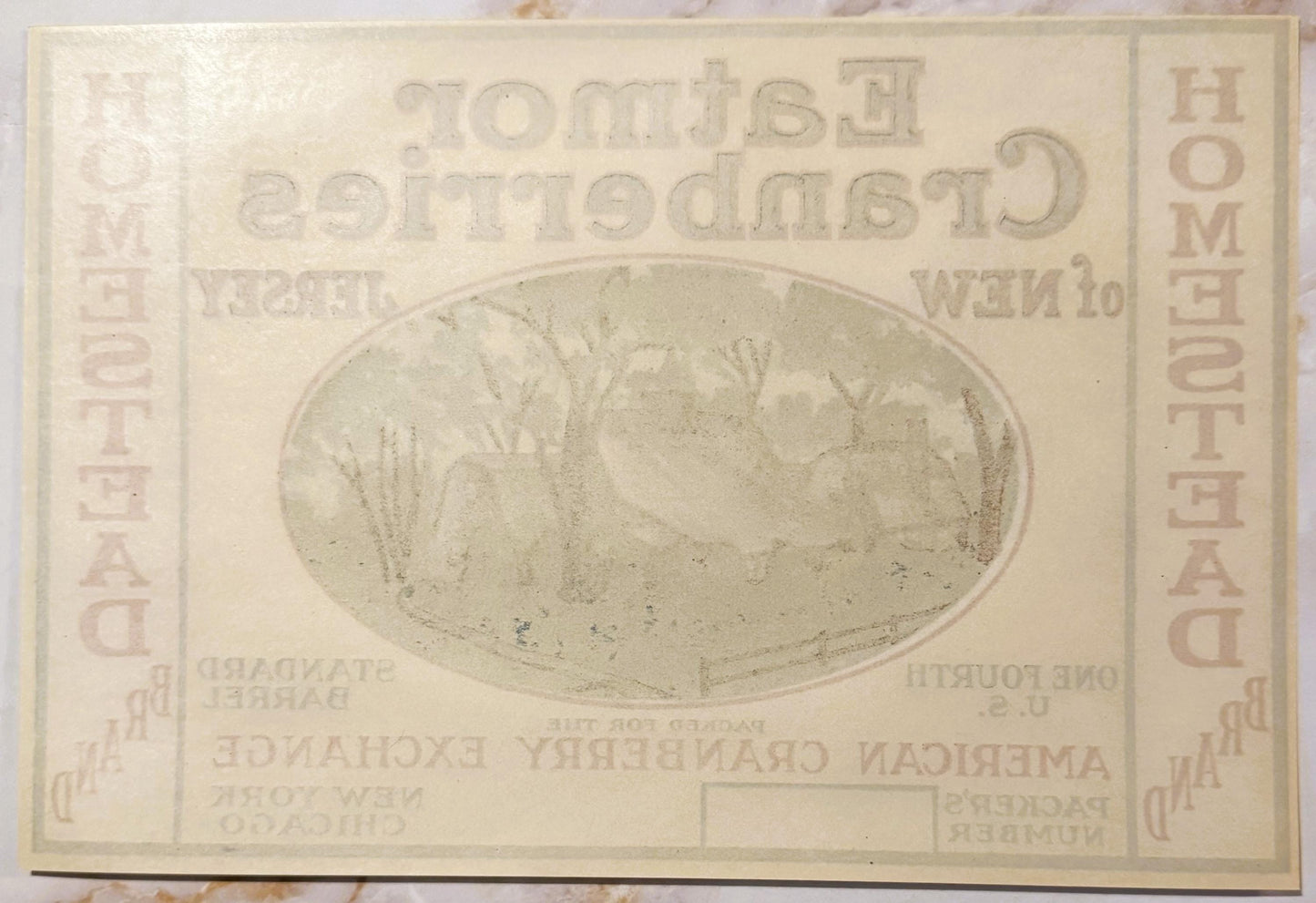
The picture is a real beauty: a cluster of weathered, shingled old farmhouses tucked under big shade trees, with a winding path, a split-rail fence and green lawns, all in an oval under Eatmor Cranberries in big red letters. HOMESTEAD BRAND runs down both sides in red panels.

I love the color on these. That warm yellow ground isn't an accident, either - more on that below.

🏷️ Every Word on the Label

  • Eatmor Cranberries of NEW JERSEY
  • HOMESTEAD BRAND, down both sides
  • ONE FOURTH U.S. STANDARD BARREL
  • PACKED FOR THE AMERICAN CRANBERRY EXCHANGE, NEW YORK, CHICAGO
  • PACKER'S NUMBER, with an empty box for the grower's number

The back is blank, with the design showing through faintly in reverse.

🏡 So, Who Packed Homestead?

Here's the answer, and I think it's a better story than one farm's name would be. Homestead was the Exchange's brand, not one family's. The New Jersey growers went over to pooling, grading and branding when they started selling together, and the old individual growers' brands went away; Cranberries magazine looked back on that change in 1940. The Whitesbog Preservation Trust puts it plainly in its own label records: cranberries were never sold by variety name the way apples are. Each variety was split into several brands by its color, its size and how well it kept on the road, with its own label for each grade, about 32 brand labels in all, most of them under the Eatmor name.

That's what the PACKER'S NUMBER box is for. The brand told the buyer the grade, and whichever grower actually filled the box wrote his own packer number in that empty square, so the Exchange always knew whose berries were whose, even with many bogs shipping under one brand. On both of these labels the square was never filled in. They never made it onto a box.

🎨 Why New Jersey Labels Are Yellow

Cranberry labels were color-coded by state. The South Wood County Historical Museum in Wisconsin Rapids, which keeps one of the big public collections of these labels, explains that once the three growing regions started selling together, Wisconsin's barrel labels took on a red color, New Jersey's took on their own yellow, and Massachusetts went with blue. That's where that sunny yellow on these Homestead labels comes from. The same museum keeps New Jersey Homestead quarter-barrel labels in its collection too, in this printing and in a later one with a "Product of the U.S. of America" line added.

🍒 Eatmor and the American Cranberry Exchange

The American Cranberry Exchange came together in the spring of 1911, when the Growers' Cranberry Company and the National Fruit Exchange, which the Wisconsin, New England and New Jersey cranberry sales companies had formed in New York in 1907, were consolidated under one name. Joseph J. White of Whitesbog was the first president of both Growers' and the Exchange. It sold cranberries from Wisconsin, New Jersey and Massachusetts under the Eatmor brand, first used in July 1916, and the cranberries were marketed in ladies' magazines such as Better Homes & Gardens and Good Housekeeping. By 1936 the Exchange was bragging that nineteen years of Eatmor advertising had lifted the average price of a barrel of berries from $6.08 to $9.95.

Eatmor was more than a name, too. It meant a grade: berries at least 90 percent colored, no more than 125 to a cup, and fit to travel for fifteen days. The Exchange moved to New Bedford in 1951, became Eatmor Cranberries, Inc. in 1953 and was dissolved in Chicago in 1957.

A little more on the people behind it. The Growers' Cranberry Company was incorporated back in 1895 by the bigger New Jersey and Massachusetts growers, with Joseph J. White of New Lisbon, Theodore Budd of Pemberton and C. W. Wilkinson of Philadelphia among the men who signed the charter, and it was run out of Philadelphia, first from 237 South Second Street and then, from January 1906, the Drexel Building. By July 1896 it was already shipping cranberries to Europe. White ran the Growers' for 25 years, until 1920, when his son-in-law Franklin S. Chambers took over. The Exchange itself kept its headquarters at 90 West Broadway in New York with a branch in Chicago, and after White its presidents were George R. Briggs, then A. U. Chaney until his death on December 2, 1941, then Ruel Gibbs from 1942.

The trademark record for EATMOR gives the first use as July 26, 1916, and first use in commerce as January 2, 1917. The Exchange tested the name that first year with a $23,000 advertising campaign in Chicago, and in 1918 the growers put up $54,000 for the first national campaign. The name even outlived the Exchange: after 1957 the Growers Cranberry Company of Pemberton was still shipping its berries as Eatmor.

📦 The Quarter Barrel

That ONE FOURTH U.S. STANDARD BARREL line is part of the story. The standard cranberry barrel came in through a New Jersey congressman's bill in 1915, and the quarter-barrel box came along in 1926, so every label like this one belongs to the years after that. Among the Exchange's New Jersey quarter-barrel labels, the ones with just STANDARD BARREL and no country line, like this Homestead, look to be the earlier form, and the Boston Public Library dates the sibling labels of this set to the 1920s.

The congressman was William E. Tuttle Jr. of New Jersey, and the Standard Barrel Act was signed on March 4, 1915 and went into force on July 1, 1916. It gave cranberries a legal barrel of their own, 5,826 cubic inches, smaller than the 7,056-cubic-inch barrel for other dry goods. A quarter of that made a wooden box about 9 3/4 by 10 1/2 by 15 inches holding around 25 pounds of berries, the standard shipping box by 1931, and this label was made for its end. By 1949 and 1950 about three quarters of fresh cranberries were going out in small consumer packages instead, and the box label's days were numbered.

🌲 Cranberries in the Pine Barrens

The economic success of the first growers in the region prompted other residents to start the cranberry business in New Jersey. Early pioneers included J. A. Fenwick and Joseph J. White near Pemberton, and the Budd family, and White showed that Pine Barrens soil was just right for bogs. His daughter Elizabeth C. White went on to grow the first cultivated blueberry crop with the botanist Frederick Coville in 1916, sold as Tru-Blu-Berries. And collectors have been saving these labels for a long time: back in December 1946, a writer in Cranberries magazine noted that the old barrel labels were already rare enough to be collected and put in the Middleboro Public Library.

🖼️ Display

Crate Labels are a reminder of a bygone era and a testament to the unparalleled lithography process. Museums and Art Institutes have galleries dedicated to them, and more and more collectors are seeking these out to preserve their history. Once the limited supply for sale is gone and on display with collectors or in galleries then they will be very difficult to acquire.

Imagine this amazing vintage advertising hanging as home decor in any room of your home instead of a museum! With two of them, one can go on the kitchen wall and the other to somebody with New Jersey roots for Thanksgiving.

Shipping

🚚 Shipping & Handling

  • Shipping costs and timing are calculated at checkout.
  • Items curated and shipped directly by me include U.S. shipping at no additional cost, professionally packed to ensure safe arrival of your artifact.

Items from Vetted Pro Collectors
Shipping for items offered by vetted Pro Collectors is determined at checkout. All Pro Collector listings are reviewed to ensure fair, reasonable shipping practices.

For full details, please refer to our Shipping Policy.

Returns & Exchange

Take your time — you've got a full six months. If a piece isn't right for you, send it back the way it reached you and we're good.

In the first 30 days your money goes straight back the way you paid. After that it's store credit, so you can put it toward something you'd rather have.

Return shipping we sort out between us, case by case. I don't make this difficult.

If something arrives damaged, or it isn't what I said it was, send me a photo within 48 hours and I'll make it right.

Email info@vintageantiquesgifts.com or call 802-356-9872 — that's me answering, not a call center.

The only things I can't take back are custom or special-order pieces and gift cards.

View full details

Rescuing American History Since 2007

— Travis & the Kids