Skip to product information
1 of 3

Vintage and Antique Gifts

Antique 1920s Monmouth Eatmor Cranberries Barrel Label ✨ NY, NJ, CHI

Antique 1920s Monmouth Eatmor Cranberries Barrel Label ✨ NY, NJ, CHI

Regular price $7.00 USD
Regular price Sale price $7.00 USD
Sale Sold out
Shipping calculated at checkout.

Size: 10" x 6 3/4"

🚚 Free US Shipping — ships within one business day. International shipping calculated at checkout.

Quantity

Why Is Molly Pitcher on a Cranberry Label? 💥 Monmouth Brand Eatmor Cranberries of New Jersey, Molly Pitcher at the Cannon

Size: 10" x 6 3/4" ~ Little to no storage wear.

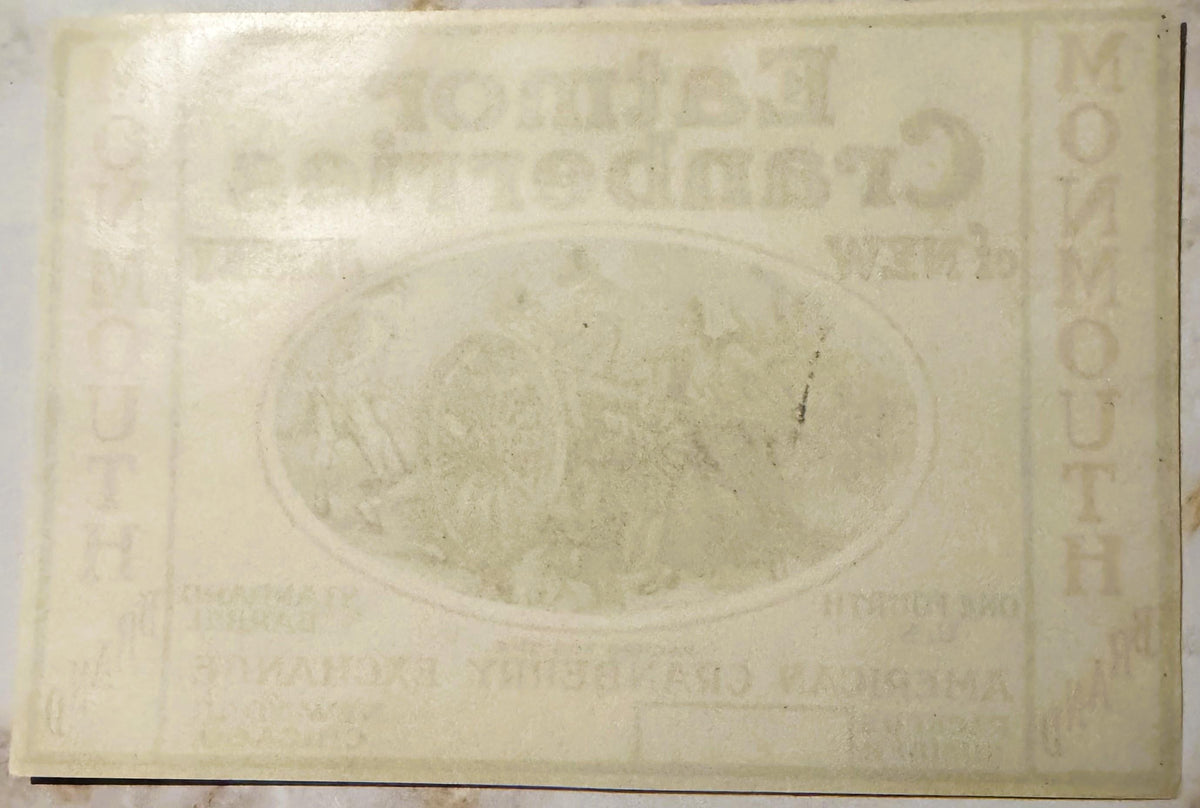
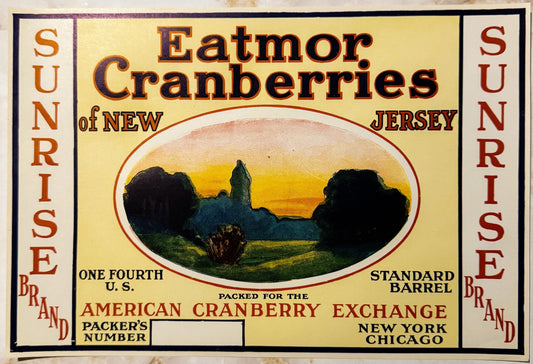
This is an antique 1920s Monmouth Eatmor Cranberries of New Jersey barrel label, packed for the American Cranberry Exchange out of New York and Chicago. The picture in the oval is pure Revolutionary War: a woman in a long red skirt and white cap throws her weight behind the rammer at a big field cannon while Continental soldiers in tricorn hats and blue coats work the gun around her. MONMOUTH BRAND runs down both side panels in red, and Eatmor Cranberries stretches across the top.

It is reproduced as magnets, posters, mugs, etc., and this is the original that started it all.

🏷️ What's Printed on It

  • Eatmor Cranberries of NEW JERSEY
  • MONMOUTH BRAND (down both sides)
  • ONE FOURTH U.S. STANDARD BARREL
  • PACKED FOR THE AMERICAN CRANBERRY EXCHANGE
  • PACKER'S NUMBER (an empty box for the grower's number)
  • NEW YORK, CHICAGO

The back is blank, with the design showing through in reverse. The Boston Public Library has this same Monmouth label in its print collection and dates it to about 1920 to 1929. Look down at the bottom of that oval, too: there's a gunner lying beside the cannon wheel, and that one detail tells you exactly which story the artist was painting.

💥 Molly Pitcher at Monmouth

Put a woman at a cannon on a label called Monmouth, and every New Jersey kid knows the story. The Battle of Monmouth was fought on June 28, 1778, near Monmouth Court House in what's now Freehold, New Jersey, George Washington's Continental Army against Sir Henry Clinton's British, in a heat wave where the temperature went over 90 degrees. The legend says a soldier's wife was carrying water to the gunners, and when her husband fell she took his place swabbing and loading the cannon, and George Washington himself commended her. She's most often identified as Mary Ludwig Hays, and one scholar has said "Molly Pitcher" is really a name for the hundreds, maybe thousands, of women who served in the war. The battle itself ended in a draw, but historians count it as the day the Continental Army came of age.

Mary was on that field because her husband was. William Hays was an artilleryman from Carlisle, Pennsylvania, and the story is that the gun crews would holler "Molly! Pitcher!" whenever they needed water, which is most likely where the name that stuck came from.

Now here's my favorite part, and it comes from a man who was standing right there. Joseph Plumb Martin, a private in the Continental Army, wrote in his memoir, published in 1830, that while a woman was working a gun an enemy cannon shot passed straight between her legs, tore away the lower part of her petticoat and did no other damage, and she just looked down, remarked on her luck, and went right back to it. I can't read that without grinning.

The story goes that Washington asked about the woman he'd seen at the cannon and made her a non-commissioned officer, and she was "Sergeant Molly" from then on. That part is legend, and a good one. The paperwork is real, though: on February 21, 1822, Pennsylvania voted her, by then Mary McCauley, forty dollars a year for her service. She's buried in the Old Graveyard in Carlisle, and a statue of Molly beside a cannon stands in the same cemetery. James E. Kelly put her on the Monmouth Battle Monument in Freehold in 1884, and in 1928, the battle's 150th year, the Post Office overprinted the everyday two-cent Washington stamp with MOLLY PITCHER.

The picture of Molly at the rammer was a favorite of printmakers long before it ever reached a cranberry box. Nathaniel Currier of New York was selling a hand-colored lithograph titled "The Women of '76. 'Molly Pitcher' The Heroine of Monmouth" by 1850; the American Antiquarian Society has one.

🍒 Eatmor and the American Cranberry Exchange

New Jersey's cranberry business grew up in the Pine Barrens. In 1895 New Jersey and Massachusetts growers formed the Growers' Cranberry Company, and in the spring of 1911 the growers' sales companies of New Jersey, New England and Wisconsin joined together as the American Cranberry Exchange, headquartered in New York with a Chicago branch, the two cities on this label. The Exchange put the Eatmor name on its best berries starting in 1916, began advertising nationally in 1917, and by the 1930s the Eatmor ads were running in Good Housekeeping and Better Homes & Gardens. The Exchange moved to New Bedford, Massachusetts in 1951, became Eatmor Cranberries, Inc. in 1953, and voted to dissolve in 1957.

The road to that 1911 merger ran through the regional sales companies: Wisconsin formed its own in 1906, New England and New Jersey followed in 1907, and that spring the three of them set up the National Fruit Exchange in New York. When it all came together as the American Cranberry Exchange, the office was at 90 West Broadway in New York, and the first president was Joseph J. White of New Jersey, a name you'll meet again just below.

Eatmor wasn't just a pretty name; it was a grade. A box could only go out as Eatmor if the berries were at least 90 percent colored, ran no more than 125 to the cup, and were sound enough for fifteen days on the road. The trademark claims its first use on July 26, 1916. That year the Exchange tried a $23,000 test campaign in Chicago, and in 1918 the growers raised $54,000 for the first national one. By 1936 the Exchange was bragging that years of Eatmor advertising had pushed the average price of a barrel from $6.08 to $9.95. And the name outlived the Exchange: after 1957 the Growers Cranberry Company of Pemberton was still shipping its berries as Eatmor.

🌲 Cranberries Out of the Pine Barrens

Among the early pioneers were J. A. Fenwick and Joseph J. White near Pemberton, and the Budd family, and it was White who showed that the sandy, boggy Pine Barrens ground was made for cranberry bogs. When the Growers' Cranberry Company was incorporated in 1895, Joseph J. White of New Lisbon, Theodore Budd of Pemberton and C. W. Wilkinson of Philadelphia were among the men who signed its charter. The company was run from Philadelphia, first at 237 South Second Street and from January 1906 in the Drexel Building, and in July 1896 it took on the business of shipping cranberries over to Europe.

The White family's bogs at Whitesbog have one more claim to fame. Joseph's daughter, Elizabeth C. White, worked with the government botanist Frederick Coville, and in 1916 they brought in the first crop of cultivated blueberries. The blueberry business got its start on a New Jersey cranberry farm.

📦 One Fourth U.S. Standard Barrel

That line split on both sides of the picture is federal law talking. The Standard Barrel Act, signed March 4, 1915, came out of a bill by New Jersey's own congressman, William E. Tuttle Jr., and it gave cranberries a legal barrel of their own, 5,826 cubic inches against 7,056 for the regular dry barrel. It took effect on July 1, 1916. A quarter of that barrel became the cranberry box: it came in during 1926, was the standard shipping box by 1931, measured about 9 3/4 by 10 1/2 by 15 inches and held around 25 pounds of berries, so a 10" by 6 3/4" label sat right on the end of it.

The PACKER'S NUMBER box in the corner is how the Exchange kept track of whose berries were whose. The grower who packed the box wrote his packer number in that square, and on this one it was never filled in.

People started saving these surprisingly early. Back in 1946 a writer in Cranberries magazine mentioned old cranberry labels being collected and kept at the Middleboro Public Library in Massachusetts, and by 1949 and 1950 about three quarters of fresh cranberries were going out in small consumer packages, so the wooden box and its label were already on their way out.

🖼️ Display

Crate Labels are a reminder of a bygone era but the amazing lithography process is unparalleled even to this day in my opinion. Museums and Art Institutes have galleries dedicated to them and more and more collectors are seeking these out to preserve their history. Nobody is ever going to print these again. The supply for sale is all there is, and once it is framed on collectors' walls and tucked into gallery collections, these labels will be very hard to come by.

Imagine this amazing vintage advertising hanging as home decor in any room of your home instead of a museum! It's perfect for a Thanksgiving table, a history lover's den or anybody from Monmouth County.

Shipping

🚚 Shipping & Handling

  • Shipping costs and timing are calculated at checkout.
  • Items curated and shipped directly by me include U.S. shipping at no additional cost, professionally packed to ensure safe arrival of your artifact.

Items from Vetted Pro Collectors
Shipping for items offered by vetted Pro Collectors is determined at checkout. All Pro Collector listings are reviewed to ensure fair, reasonable shipping practices.

For full details, please refer to our Shipping Policy.

Returns & Exchange

Take your time — you've got a full six months. If a piece isn't right for you, send it back the way it reached you and we're good.

In the first 30 days your money goes straight back the way you paid. After that it's store credit, so you can put it toward something you'd rather have.

Return shipping we sort out between us, case by case. I don't make this difficult.

If something arrives damaged, or it isn't what I said it was, send me a photo within 48 hours and I'll make it right.

Email info@vintageantiquesgifts.com or call 802-356-9872 — that's me answering, not a call center.

The only things I can't take back are custom or special-order pieces and gift cards.

View full details

Rescuing American History Since 2007

— Travis & the Kids