Skip to product information
1 of 5

Vintage and Antique Gifts

Vintage 1950s Empire Builder Apples Crate Label Pair 🍎 Cashmere, WA, Classic Americana!

Vintage 1950s Empire Builder Apples Crate Label Pair 🍎 Cashmere, WA, Classic Americana!

Regular price $9.00 USD
Regular price Sale price $9.00 USD
Sale Sold out
Shipping calculated at checkout.

Size: 9 3/4" x 8 3/4"

🚚 Free US Shipping — ships within one business day. International shipping calculated at checkout.

Quantity

Who Packed Empire Builder Apples? 🍎 Empire Builder Washington State Apples, Cashmere Pioneer Growers, Cashmere, Washington

Size: 9 3/4" x 8 3/4" each ~ little to no storage wear.

This one's a pair - two of these Empire Builder apple crate labels come to you together.

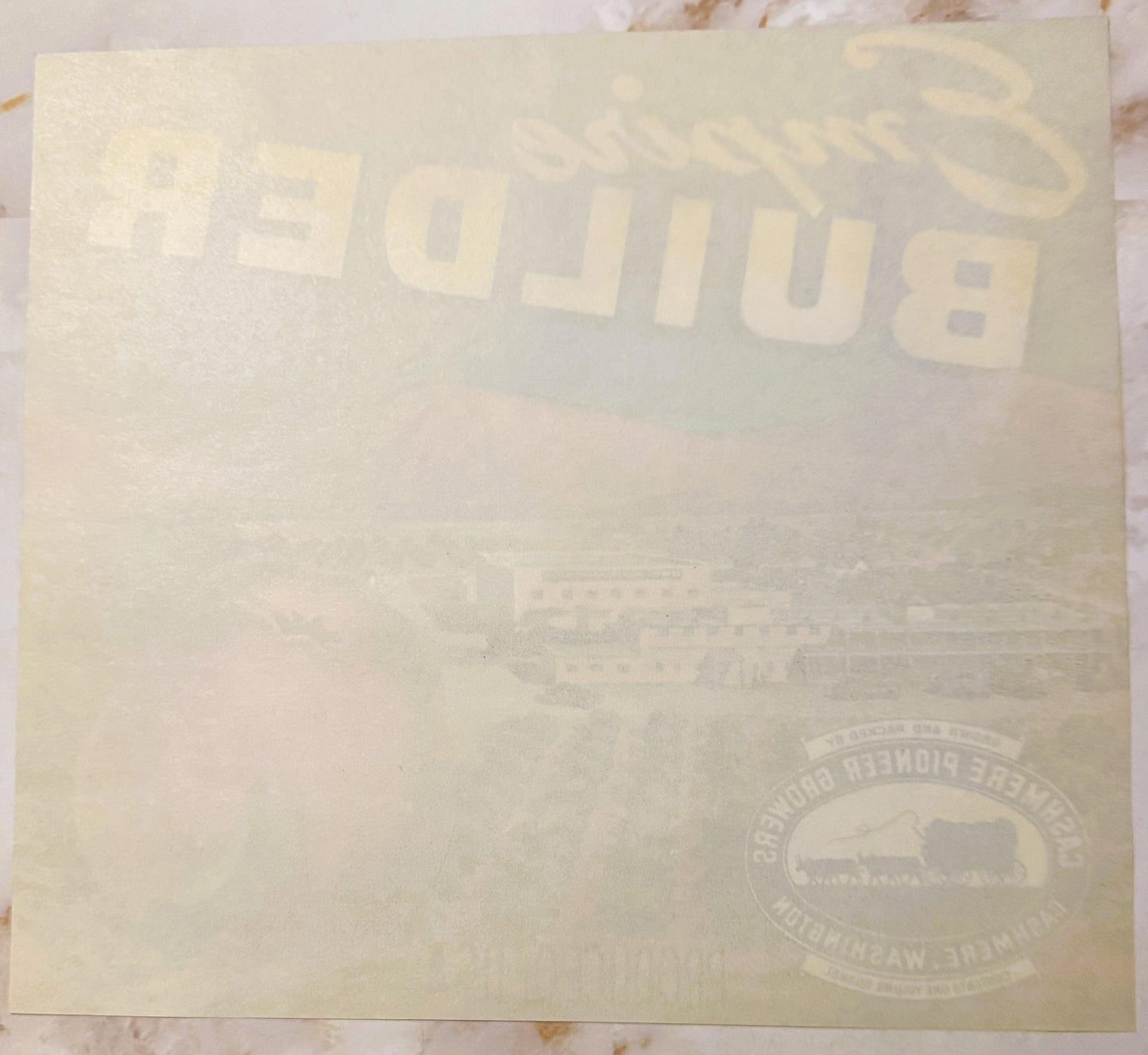
Now that's a Washington apple! This is a vintage 1950s Empire Builder crate label, grown and packed by the Cashmere Pioneer Growers of Cashmere, Washington. A giant shiny red apple with big green leaves fills the right side, and behind it the whole valley is laid out: rows of orchard trees running off in every direction, a long packing plant with trucks lined up at the loading dock, and purple and orange mountains rolling across the back under a deep blue sky. "Empire" swoops across the top in yellow script over a huge BUILDER in cream block letters. Down in the corner is the growers' own emblem, a covered wagon pulled by a team of oxen, which is exactly what you'd pick if you named your outfit the Pioneer Growers.

🏷️ What's Printed on It

  • Empire BUILDER
  • WASHINGTON STATE APPLES
  • GROWN AND PACKED BY CASHMERE PIONEER GROWERS
  • CASHMERE, WASHINGTON
  • CONTENTS ONE VOLUME BUSHEL
  • PRODUCE OF U.S.A.

Washington State University keeps two Empire Builder labels from Cashmere in its fruit crate label collection, dated about 1955 and about 1958, and the Cashmere Pioneer Growers were still running controlled-atmosphere apple storage as late as 1990.

🚂 The Empire Builder

The name Empire Builder has a story. It's what folks called James J. Hill, the railroad man behind the Great Northern, for the huge region his lines opened up and the way they ran its economy. Hill wanted people to settle along his tracks. The Great Northern's main line came right through the Cashmere valley in 1892, and on June 10, 1929 the railroad launched its crack passenger train and named it the Empire Builder, in honor of its founder. The train stopped at Wenatchee just down the line, and it's still running today under Amtrak, which took it over in May 1971. For a grower in Cashmere shipping apples east by rail, it's hard to beat that name.

Hill himself was quite a character. He was born on September 16, 1838, in Eramosa Township in Upper Canada, now Ontario, lost the sight in his right eye to a bow-and-arrow accident as a boy, and settled in St. Paul, Minnesota, at eighteen. His Great Northern reached Seattle on January 7, 1893, and it was the first line across the continent built without public money and with just a few land grants, which is exactly why Hill worked so hard to fill the country along it with farmers, running model farms of his own to show settlers how it was done. He died at his St. Paul home on May 29, 1916.

His train is still a big deal, too. Today the Empire Builder is Amtrak's busiest long-distance route, running from Chicago to Seattle or Portland, and the Seattle section climbs through the Cascade Tunnel and over Stevens Pass, stopping at Leavenworth and Wenatchee on either side of Cashmere. Those apples and that train have been sharing the same valley for close to a century.

🏔️ Cashmere, the Vale of Kashmir

Cashmere was platted as Mission in 1892, when the Great Northern came through, though it wasn't until 1900 that the trains would even stop there as a flag stop. Trouble was, half the Northwest seemed to have a town called Mission, and the mail kept going astray. So Judge James Harvey Chase (1831-1928), a former elocution teacher famous for his public readings, suggested a name out of a poem he loved, Thomas Moore's Lalla Rookh, which sings about the Vale of Kashmir. The town took the name Cashmere in 1904, officially adopted on July 1, and that November it incorporated under the new name as a city of the fourth class.

What turned the ranches into orchards was water. Pioneers started digging the Peshastin irrigation ditch in the 1890s, and once it was running, apples and pears took over the slopes. Cashmere sits in Chelan County on the south bank of the Wenatchee River, with 8,500-foot Mount Cashmere and the Cascades behind it, and it's still apple and pear country today. And if you've ever had Aplets & Cotlets, those fruit-and-nut candies come from Cashmere too.

That candy has a story worth telling. Liberty Orchards started out as an apple farm in 1918, run by two Armenian partners, Armen Tertsagian and Mark Balaban, and they turned the local apples and apricots into candy using a recipe for locoum, the confection most of us know as Turkish delight. In March 2021 the company announced it would close that June, and then, just days before the deadline, it was sold to new owners in late May.

📦 From the Wooden Box

Labels like this one were glued to the ends of the wooden crates Washington apples shipped in, each brand with its own colorful lithographed label. In the 1950s the apple industry switched to cardboard cartons, and the paper labels went out of production. These two never made it onto a box at all, and CONTENTS ONE VOLUME BUSHEL down on the growers' emblem is the reminder of the wooden bushel crate they were made for.

🏡 Display

Crate Labels are a reminder of a bygone era but the amazing lithography process is unparalleled even to this day in my opinion. Museums and Art Institutes have galleries dedicated to them and more and more collectors are seeking these out to preserve their history. Every label sold is one fewer left for sale anywhere. Nobody is printing more, and once these are on display with collectors or in galleries, they will be very difficult to acquire.

Imagine this amazing vintage advertising hanging as home decor in any room of your home instead of a museum! It's a natural for a kitchen, a train lover's den, or anybody from Cashmere, Wenatchee or the Great Northern country.

Shipping

🚚 Shipping & Handling

  • Shipping costs and timing are calculated at checkout.
  • Items curated and shipped directly by me include U.S. shipping at no additional cost, professionally packed to ensure safe arrival of your artifact.

Items from Vetted Pro Collectors
Shipping for items offered by vetted Pro Collectors is determined at checkout. All Pro Collector listings are reviewed to ensure fair, reasonable shipping practices.

For full details, please refer to our Shipping Policy.

Returns & Exchange

Take your time — you've got a full six months. If a piece isn't right for you, send it back the way it reached you and we're good.

In the first 30 days your money goes straight back the way you paid. After that it's store credit, so you can put it toward something you'd rather have.

Return shipping we sort out between us, case by case. I don't make this difficult.

If something arrives damaged, or it isn't what I said it was, send me a photo within 48 hours and I'll make it right.

Email info@vintageantiquesgifts.com or call 802-356-9872 — that's me answering, not a call center.

The only things I can't take back are custom or special-order pieces and gift cards.

View full details

Rescuing American History Since 2007

— Travis & the Kids