Skip to product information
1 of 3

Vintage and Antique Gifts

Antique Little Miss Broom Label 🧹 NOS Maid Sweeping in Red Apron Victorian Domestic Kitchen Art Made in USA

Regular price 7.00 USD
Regular price Sale price 7.00 USD
Sale Sold out
Shipping calculated at checkout.

Description

🧹 She Has Been Sweeping Since Before Your Grandmother Was Born, and She Has Never Touched a Floor

Broom labels were never meant to be looked at twice. A lithographer printed them by the thousand, a broom works pasted one onto a wooden handle, and the handle went out the door to be worn down to a stub in somebody's kitchen. The label went into the bin with the broom. That is the whole life cycle, and it is why so few survive in any condition at all — and why this one, never glued to anything, is a small piece of luck.

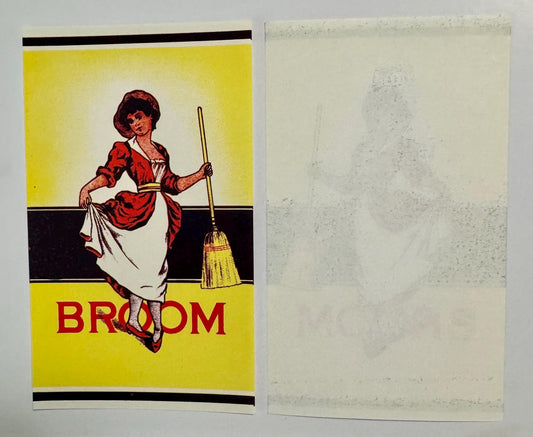
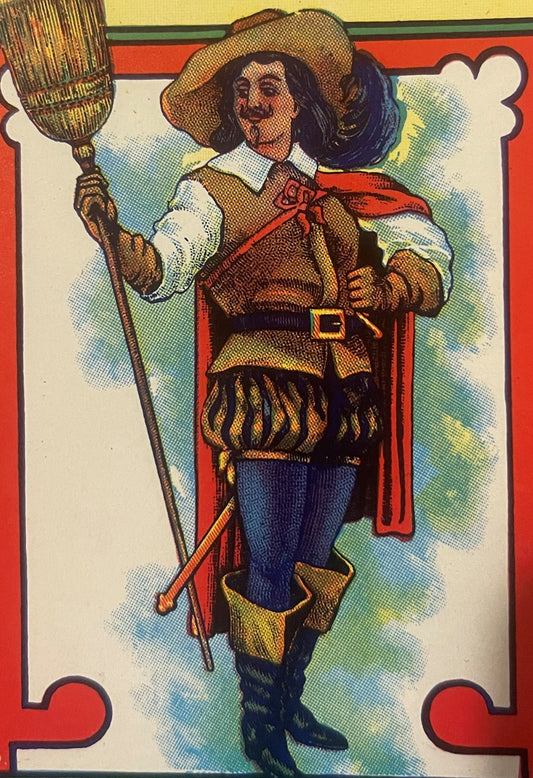
What you are looking at is commercial art made for a product nobody thought was worth decorating. Somebody still decorated it. A maid in a scarlet dress and a white pinafore, lace cap pinned to her hair, caught mid-stroke with a corn broom — drawn with real care, printed in strong flat colour inside a gold frame picked out in white dots. She was there to make a housewife reach for this broom instead of the identical broom beside it.

🏷️ What This Label Actually Says

Everything printed on this sheet, exactly as it appears:

  • LITTLE MISS — dark blue Roman capitals on a pale blue banner across the top
  • The maid herself, sweeping, on a green ground inside a gold ornamental border
  • MADE IN U. S. A. — small capitals along the very bottom edge
  • A second pale blue panel at the foot of the label — completely blank

That is the entire text. No maker. No city. No date. No printer's imprint. The back is clean cream paper, unused and ungummed to anything.

🕳️ The Empty Panel Is the Whole Story

That blank blue panel at the bottom is not a design choice and it is not damage. It is a reserved imprint space, and it tells you what kind of object this is.

Most small broom works could not afford to commission original artwork. Lithographers solved that by selling stock labels — handsome ready-made designs, printed in quantity, with one panel deliberately left empty. A broom maker bought the design he liked and had his own name and town struck into that reserved space. The same maid could turn up on brooms from three different states, each with a different name below her.

This example was never imprinted. The panel is still blank, which means this label was never assigned to a maker and never issued — it sat as printer's or jobber's overstock instead of going out on a broom handle.

That is almost certainly why it is still here. Gummed paper labels that reach a factory floor do not survive; labels that never leave the stack do. The blank panel is the reason you are able to own this at all.

🇺🇸 What "Made in U. S. A." Tells Us

The country-of-origin line is the only dating evidence the label itself offers, and it is worth being straight about how much weight it carries. Marking of this kind followed the tariff legislation of 1890, and American manufacturers leaned on it heavily as a selling point through the early decades of the twentieth century, when buying domestic carried real cultural weight. It sets a floor, not a date.

The rest of the dating is stylistic — the flat lithographic colour, the ornamental gold frame, and the maid's dress: a full ankle-length skirt, leg-of-mutton sleeve, high collar and a pinafore apron of a cut that had already passed out of daily fashion by the time this was printed. She is a nostalgic figure even for her own moment, the idealised domestic servant, which is exactly the register broom advertising wanted.

🧹 Why Broom Labels Are Scarce

Every category of paper ephemera has a survival rate, and broom labels sit near the bottom of it. Crate labels survived because unused crates were stacked in packing-house lofts by the thousand and forgotten. Cigar labels survived because the boxes themselves were kept. Broom labels had no such refuge — they were single-use, applied on receipt, and destroyed with the product.

What survives, survives the way this one did: unissued, in a stack, never applied. That is the ordinary provenance of nearly every broom label you will ever see offered, and it is why condition on the good ones tends to be startling.

🖼️ Display Ideas

  • 🖼️ Float-mount it on a neutral cream or grey ground so the scarlet border reads at full strength — the colour is the first thing anyone notices.
  • 🧺 Group it with other domestic and household advertising — soap wrappers, washing powder labels, kitchen tins — for a laundry-room or kitchen wall with genuine period depth.
  • 👗 Hang it alongside period fashion plates or sewing ephemera; the maid's costume is a dated document in its own right.
  • 🧹 If you have other broom labels, set the imprinted ones beside this blank one. The comparison shows the trade at work better than any caption could.

🎁 Who Collects These

Advertising and ephemera collectors come first — broom and brush labels are a small, well-defined niche where unused examples are the standard of the field. Kitchen and domestic-history collectors take them for the imagery. Graphic designers and illustrators buy period lithography for the palette and the lettering. And collectors of women's domestic history look at figures like this one as evidence of how household labour was pictured and sold.

❓ Frequently Asked Questions

Who made this broom label?

Nobody knows, and the label is honest about it. The panel where the maker's name belongs was left blank and was never imprinted. Anyone who tells you which broom works this came from is guessing — there is no mark on the sheet, front or back, to support a name.

Is the blank panel a flaw or damage?

Neither. It is how the label was printed. Stock designs were sold with a reserved space for the buyer's imprint, and this one never received one.

Is this an original or a reproduction?

Original, unused old stock. It is a period lithograph on period paper with the flat, layered colour of stone-based printing rather than the dot pattern of modern offset reproduction, and it has never been applied to anything.

What does NOS mean here?

New Old Stock — genuine period merchandise that was manufactured, stored, and never used or sold. It is not a condition grade; it is a description of the object's history. This label never made it onto a broom.

How should I store it?

Flat, out of direct light, in an acid-free sleeve or folder. Paper of this age is stable if it is kept dark and dry; light is what fades lithographic inks, and the reds go first.

Will it arrive as pictured?

Yes. Everything here is kept in the dark at under 40% relative humidity and a steady 72°F, climate controlled. Paper does not keep deteriorating on my watch.

Shipping

🚚 Shipping & Handling

  • Shipping costs and timing are calculated at checkout.
  • Items curated and shipped directly by me include U.S. shipping at no additional cost, professionally packed to ensure safe arrival of your artifact.

Items from Vetted Pro Collectors
Shipping for items offered by vetted Pro Collectors is determined at checkout. All Pro Collector listings are reviewed to ensure fair, reasonable shipping practices.

For full details, please refer to our Shipping Policy.

Returns & Exchange

Product Page Return Policy

  • 60-Day Returns – Items must be in original condition.
  • Refunds – Issued after inspection (excluding shipping costs).
  • Return Shipping – Customer is responsible unless item is damaged or incorrect.
  • Damaged/Incorrect Items – Contact us within 48 hours for a replacement or refund.
  • Easy Returns – Email [email protected] or call 802-356-9872 to initiate a return.

For full details, visit our Refund Policy.

View full details