Skip to product information
1 of 2

Vintage and Antique Gifts

Antique Hudson River Steamboat Broom Label NOS 🧹 1910s–20s Advertising Art 🚢

Antique Hudson River Steamboat Broom Label NOS 🧹 1910s–20s Advertising Art 🚢

Regular price 5.50 USD
Regular price Sale price 5.50 USD
Sale Sold out
Shipping calculated at checkout.
Quantity

When Did a Broom Label Become a Painting? 🎨 The Hudson River Steamboat Label That Survived Everything

There is a particular kind of collector's thrill that doesn't announce itself until you're already deep in it. You open a flat, brown envelope, slide out a piece of paper smaller than a paperback book, and something shifts. The colors hit differently than they had any right to. The composition is tighter, the detail finer, the whole thing more present than commercial printing from a century ago has any business being. That is the experience this label delivers, consistently and without apology. It was printed to be glued around a broom handle in a hardware store somewhere along the Eastern Seaboard. It was meant to advertise, to sell, to be used up, and to disappear. The fact that it is here — flat, vivid, and untouched — is exactly the kind of small, stubborn miracle that paper ephemera collectors understand immediately and everybody else finds quietly astonishing.

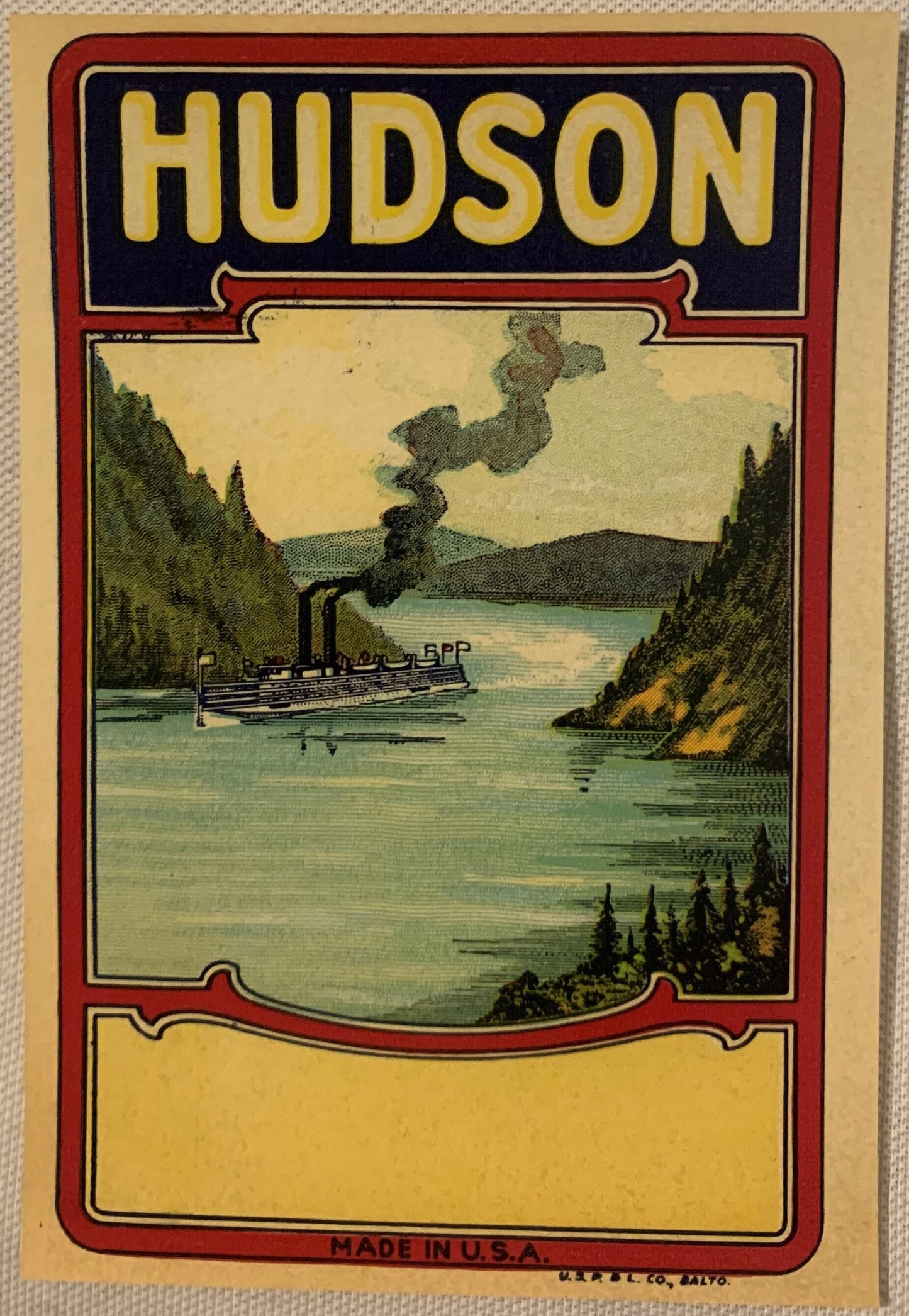
This piece carries something else, too. At its center, a Hudson River steamboat moves through a wide, calm river passage flanked by forested hillsides and rocky bluffs. Two smokestacks rise from the vessel, trailing dark plumes that dissolve into a hazy, yellowish sky. The water is rendered in horizontal bands of blue-green, catching light and depth in the way that only early commercial chromolithography achieves. Mountains roll in the distance. Bold yellow block letters in a deep navy banner announce the brand in a single, resonant word: HUDSON. The whole scene breathes with the scale and romance of nineteenth-century American landscape painting, filtered through the practical demands of early twentieth-century print production. It is a broom label. It is also, unmistakably, a piece of art.


🧹 What It Is — The Facts, Plainly Stated

This is an antique chromolithographed broom label from the 1910s–1920s, measuring 6 x 3.5 inches, printed in the United States. It is New Old Stock — NOS — meaning it was never applied to a product, never glued, never used. It has been stored flat and dry, and it shows: the colors are vivid, the paper is sound, and the surface is undamaged. A red decorative frame with cartouche-style cutouts at the top and bottom wraps the entire composition. At the bottom of the label, a blank yellow field appears — the space where a retailer or regional distributor would have had their name or store information added, either by stamp or by a local printer's overprint. That field is blank here, which is precisely what makes this NOS. It never reached that final step. It never got used. And so it arrived in the present tense, complete, intact, and extraordinary.

Chromolithography — the full-color stone or plate printing process that made commercial labels like this possible — was a labor-intensive, highly skilled craft. Each color was applied in a separate pass through the press, which meant that a label with the tonal range and atmospheric depth visible in this piece required multiple carefully registered printings. The blue-greens of the river, the warm haze of the sky, the bold contrast of the banner lettering — none of that happened in one impression. It happened in layers, planned and executed by press operators and lithographic artists whose names were almost never recorded. The Hudson label is a product of that anonymous craft tradition at its peak.


🌊 The Hudson River — The Geography That Made an Industry

The Hudson River runs roughly 315 miles from its source in the Adirondacks south to New York Harbor, and for most of American commercial history, that corridor was one of the most economically productive stretches of water on the continent. By the time this label was printed in the 1910s and 1920s, the Hudson had already been carrying passengers and freight for more than a century. Robert Fulton's Clermont made its famous run from New York City to Albany in 1807, demonstrating that steam could beat the current and the wind both, and from that moment forward the river was transformed. By the mid-nineteenth century, the Hudson was thick with steamboat traffic — side-wheelers, propeller vessels, day liners, night boats — carrying immigrants upriver, produce downriver, tourists to the grand resort hotels, and manufactured goods in every direction.

The landscape visible in this label — the wide, calm passage, the forested hillsides, the rocky bluffs, the rolling mountains behind — is not a generic river scene. It is recognizably, specifically the Hudson Valley. The Hudson Highlands, the Catskills visible from certain bends, the Palisades further south: this was terrain that had been painted, engraved, celebrated, and mythologized for a full century before any lithographer put it on a broom label. The Hudson River School — the great American landscape painting movement anchored by Thomas Cole, Frederic Church, and Albert Bierstadt — had made this particular river valley the visual shorthand for American natural grandeur. A broom company invoking that imagery in the 1910s wasn't being subtle. They were borrowing the full weight of that iconographic tradition to sell their product. It was sophisticated commercial strategy, and it worked, because people along the Eastern Seaboard knew exactly what that landscape meant.


🏭 The Broom Industry — American Manufacturing at the Household Scale

The American broom-making industry in the late nineteenth and early twentieth centuries was enormous by any measure, and it was deeply regional. Broomcorn — the sorghum cultivar whose stiff fibers make broom heads — was grown primarily in the Midwest, especially Illinois and Kansas, but it fed manufacturing operations scattered across the country. Hardware stores, general stores, and dry goods merchants across the Northeast would have stocked branded brooms, each wrapped in exactly this kind of labeled paper band that identified the manufacturer and their product line. The label was the brand. It was the only thing standing between an anonymous agricultural product and a named, trusted household staple.

Companies named their broom lines after local landmarks, regional geography, and aspirational imagery — rivers, mountains, landmarks, patriotic symbols. A name like Hudson carried obvious resonance along the Eastern Seaboard. It invoked commerce, industry, movement, and a specifically American sense of landscape. It connected a humble household tool to the full romantic and economic mythology of the river valley. Whether the manufacturer was based directly on the Hudson or simply invoking its imagery strategically, the choice was deliberate. Names meant something on a label. They were the only story a product got to tell.

Lore passed down among paper ephemera collectors holds that broom labels are among the rarest of the surviving commercial printing categories precisely because their survival was so structurally unlikely. Unlike cigar box labels, which were often saved by the boxes themselves, or canning labels, which sometimes survived in warehouse overstock, broom labels had almost no preservation mechanism. The broom was used, the paper frayed and soiled, and the whole thing went out with the trash. NOS broom label finds are almost always the result of a print shop remnant, a jobber's leftover stock discovered in a warehouse, or a single undisturbed cache in a forgotten storage room. They did not survive in attics. They survived in print shops, and then only barely.


🎨 Chromolithography and the Golden Age of American Commercial Art

Between roughly 1870 and 1930, American commercial printing achieved something remarkable. The industrial demand for branded packaging, advertising, and product labels created an enormous market for skilled lithographic work, and that market in turn supported a generation of press shops, stone grinders, color separators, and printing artists whose output — taken together — constitutes one of the great unheralded bodies of American visual culture. The labels they produced were not fine art. They were not meant to last. But the craft standards were genuinely high, because competitive markets rewarded quality. A label that looked vivid and professional at the point of sale sold products. A label that looked flat or muddy did not.

The Hudson label exemplifies the better end of this output. The atmospheric sky — that haze of yellow dissolving into the upper register of the composition — is the kind of effect that required careful color planning and precise press registration. The horizontal banding of the water, suggesting both movement and reflective depth, is a lithographic convention borrowed directly from landscape painting. The bold contrast of the navy banner against the warm tones of the river scene is excellent graphic design by any era's standards. None of this happened by accident. Someone planned this label, and someone executed it skillfully. We do not know their names. We have the label.

Local legend has it — and this circulates specifically in Hudson Valley paper collecting circles — that several of the river-themed broom and household goods labels from the 1910s and 1920s were produced by small regional print shops that operated in the river towns themselves: Newburgh, Kingston, Hudson, Catskill. These shops served local manufacturers, newspapers, and commercial clients, and they had both the equipment and the regional knowledge to produce chromolithographed labels that captured the Valley's particular light and landscape. Whether this label was produced by a Valley shop or by a larger trade printer supplying national broom manufacturers is not documented in the surviving record. But the specificity of the landscape rendering — the way the bluffs and hillsides feel like observed places rather than generic backdrop — lends that local legend a certain credibility.


🖼️ Display Ideas

  • 🖼️ Frame it alone, matted wide. At 6 x 3.5 inches, this label fits beautifully in a standard 5x7 or 8x10 frame with generous mat space. The horizontal composition reads like a landscape painting at any scale, and the mat gives the piece room to breathe and assert itself on a wall.
  • 🗺️ Group it with Hudson Valley maps and prints. Nineteenth-century river maps, steel engravings of the Valley, Hudson River School reproduction prints — this label holds its own in that company. A Hudson Valley gallery wall anchored by this piece would be striking in any home or vacation property in the region.
  • 🏠 Display it in a kitchen or mudroom with period context. Alongside other NOS household ephemera — seed packets, soap wrappers, trade cards — this label reads as part of a complete domestic material culture display. The broom context gives it a warm, grounded energy that works in lived-in spaces.
  • 🛶 Pair it with steamboat and transportation ephemera. Steamboat tickets, river freight bills, steamship company trade cards and timetables — the Hudson label anchors a transportation-themed display beautifully. It speaks directly to the river commerce era and holds its visual weight against printed pieces with far larger formats.
  • 🎁 Give it as a framed piece. Pre-framed and matted before gifting, this label becomes an immediately presentable piece of regional Americana. It is the kind of gift that rewards close looking — the more attention it gets, the more it gives back.
  • 📚 Incorporate it into a collector's reference display. Alongside documentation of the chromolithography era, regional printing history, or Hudson Valley commercial history, this label functions as primary source material — the actual artifact, in full color, making the history visible and tangible.

🎁 Who Collects These

Paper ephemera collectors are a specific and dedicated community, and broom labels occupy a respected niche within that world precisely because genuine NOS examples are uncommon. Collectors who focus on advertising trade cards and commercial labels understand that survival is its own form of rarity, and that a piece in this condition — vivid, flat, undamaged — represents the high end of what the category offers.

Hudson Valley collectors and Hudson River enthusiasts pursue this piece for obvious regional reasons. The imagery is hyperlocal in the best sense: it depicts a specific landscape that has inspired painters, writers, and travelers for two centuries, and it does so through the lens of American commercial art at its most confident. For someone with deep roots in the Valley, or deep affection for it, this label is both a piece of art and a piece of identity.

Antique advertising collectors who focus on American household goods — brooms, brushes, soaps, cleaning products — prize exactly this category of label because so little of it survived. The ephemeral nature of broom packaging means that NOS finds are genuinely rare, and chromolithographed examples with strong pictorial content are rarer still. This is not a generic stripe-and-lettering label. It is a full pictorial composition, and that puts it at the top tier of the form.

Chromolithography enthusiasts and printing history collectors value this piece as a technical and aesthetic artifact. It demonstrates the full range of what commercial stone and plate printing achieved in the pre-offset era, and it does so in a small, accessible, beautifully preserved format. For anyone building a collection that represents the breadth of American commercial printing, a NOS chromolithographed broom label with this level of pictorial quality belongs in it.

And then there are the decorators, the stylists, the homeowners who simply respond to the thing itself — the colors, the composition, the landscape, the quiet authority of that single bold word across the top. They are not wrong. The label is beautiful. It was designed to catch the eye, and it still does, more than a century later.


❓ Frequently Asked Questions

What does "New Old Stock" (NOS) mean for this label, and why does it matter?

New Old Stock means this label was produced during its original era — the 1910s to 1920s — but was never applied to a product or put into commercial use. It remained in storage, in whatever condition it left the print shop, untouched. For a broom label, this is a genuinely remarkable survival status. The entire structural logic of a broom label worked against its preservation: it was meant to be glued to a handle, used until the broom wore out, and discarded. NOS examples exist because print shop overruns, jobber remnants, or warehouse caches occasionally survived intact for decades. This label never went through any of those use stages. It is as it was printed, which is why the colors are vivid, the paper is sound, and the surface is undamaged.

The colors look incredibly vivid for something this old — is that accurate?

Yes, and it is one of the defining characteristics of well-preserved NOS chromolithography. Chromolithographic inks, once dry, are remarkably stable. They do not fade the way photographic prints or some later offset inks do. A piece that has been stored flat, dry, and away from sustained light exposure can emerge from a century of storage looking essentially as it did when it left the press. That is what you are seeing here. The vivid colors are not restored, treated, or enhanced. They are the original chromolithographic inks in the condition that proper storage preserved them.

How large is this label, and will it fit standard frames?

The label measures 6 x 3.5 inches. This is a horizontal format, slightly wider than it is tall, which suits the river landscape composition perfectly. It fits comfortably inside a standard 5x7 frame with minimal or no mat, or inside an 8x10 frame with a generous mat that gives the composition room to breathe. Both presentations work well. The wider mat tends to elevate the piece visually, giving it more of the presence of a framed print rather than a mounted label. Either way, this is an easy piece to frame without custom work, which makes it immediately displayable.

Is the blank yellow field at the bottom a printing defect or damage?

Neither. The blank yellow field at the bottom of the label is intentional — it is a standard feature of broom labels from this era. That space was reserved for a retailer's name, a regional distributor's overprint, or a store stamp. The label was printed as a generic branded label, with the HUDSON brand established in the banner, and the bottom field left open for localized customization at the point of distribution. The fact that this field is blank is precisely what confirms NOS status: the label never reached that final customization step. It never left the print shop's inventory. The blank field is not a flaw; it is the evidence of survival.

How is this different from a reproduction label or a modern reprint?

The printing process tells the story. Chromolithography — the multi-stone or multi-plate color printing process used for this label — produces a visual and tactile character that modern printing does not replicate. The slight texture of the ink layers, the specific way the colors interact at their edges, the weight and feel of period printing paper — these are all characteristics of the original process that are immediately apparent on close examination. Additionally, the paper itself ages in ways that are detectable and consistent with the 1910s–1920s dating. This is an original period piece, not a reproduction.

What is the best way to preserve and store this label if I'm not framing it immediately?

Flat storage in an archival-quality sleeve or folder, kept away from humidity, heat, and direct light, is the ideal approach. Archival polyester sleeves (Mylar or equivalent) or acid-free interleaving paper are the collector-standard choices. Keep it flat, keep it dry, keep it away from windows. The label has already survived a century in storage — proper archival housing will ensure it survives another one just as well.

Does the steamboat scene depict a specific vessel or a generic composite?

The label does not identify a specific vessel by name, and the composition reads as an idealized type rather than a portrait of a particular steamboat. The two-smokestack configuration, the hull proportions, and the general rendering are consistent with the large day liners and night boats that operated on the Hudson through the nineteenth and early twentieth centuries — vessels like those of the Hudson River Day Line, which ran grand passenger steamers between New York City and Albany. Whether the lithographic artist worked from a specific reference photograph or engraving, or composed the vessel from conventional elements, is not documented. What the image clearly communicates is the class and era of river travel it represents: the golden age of Hudson steamboat commerce, rendered with genuine affection for the subject. That legibility, that specific sense of place and period, is a significant part of what makes this label so compelling as both an artifact and a piece of art.

Shipping

🚚 Shipping & Handling

  • Shipping costs and timing are calculated at checkout.
  • Items curated and shipped directly by me include U.S. shipping at no additional cost, professionally packed to ensure safe arrival of your artifact.

Items from Vetted Pro Collectors
Shipping for items offered by vetted Pro Collectors is determined at checkout. All Pro Collector listings are reviewed to ensure fair, reasonable shipping practices.

For full details, please refer to our Shipping Policy.

Returns & Exchange

Take your time — you've got a full six months. If a piece isn't right for you, send it back the way it reached you and we're good.

In the first 30 days your money goes straight back the way you paid. After that it's store credit, so you can put it toward something you'd rather have.

Return shipping we sort out between us, case by case. I don't make this difficult.

If something arrives damaged, or it isn't what I said it was, send me a photo within 48 hours and I'll make it right.

Email info@vintageantiquesgifts.com or call 802-356-9872 — that's me answering, not a call center.

The only things I can't take back are custom or special-order pieces and gift cards.

View full details