Skip to product information
1 of 6

Vintage and Antique Gifts

Vintage 1940s 1950s Erie Railroad Stock Certificate ๐Ÿ“œ Blue Preferred NY Scripophily

Vintage 1940s 1950s Erie Railroad Stock Certificate ๐Ÿ“œ Blue Preferred NY Scripophily

Regular price $8.00 USD
Regular price Sale price $8.00 USD
Sale Sold out
Shipping calculated at checkout.

Size: 12" x 8"

๐Ÿšš Free US Shipping โ€” ships within one business day. International shipping calculated at checkout.

Quantity

What Was the Erie War on Wall Street? ๐Ÿš‚ A Vintage 1940s-1950s Erie Railroad 5% Preferred Series A Stock Certificate, Blue, American Bank Note Company

Size: 12" x 8" ~ They vary a little one to the next. Little to no storage wear.

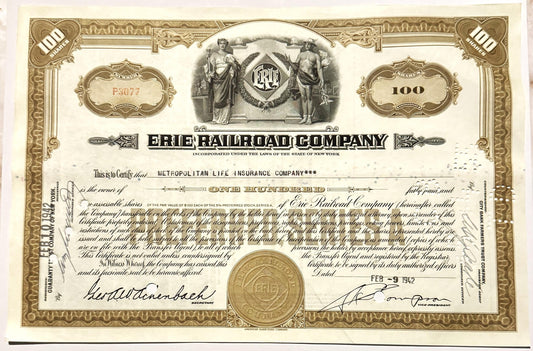
A real, issued certificate of the ERIE RAILROAD COMPANY, INCORPORATED UNDER THE LAWS OF THE STATE OF NEW YORK, for shares OF THE PAR VALUE OF $100 EACH OF THE 5% PREFERRED STOCK, SERIES A, with PREFERRED, SERIES A overprinted across it in big blue letters and CERTIFICATE FOR LESS THAN 100 SHARES in the top corners. It's engraved by the AMERICAN BANK NOTE COMPANY with a blue border, and up top a robed woman with a torch and Mercury with his caduceus stand on either side of the ERIE diamond in a laurel wreath. The registrar is Guaranty Trust Company of New York, the transfer agent City Bank Farmers Trust Company, and the round seal carries the ERIE diamond. Each one was filled in, signed and punch-cancelled.

There's a particular kind of quiet drama in a stock certificate - no explosions, no headlines, just a promise on paper that someone, somewhere, believed enough in a company to put real money behind it. This one belonged to the Erie Railroad, a name that once made bankers nervous and made history. By the time these were engraved and issued, the Erie had already lived several lifetimes - a broad-gauge gamble, a Wall Street scandal so notorious it earned the railroad a nickname, and a hard-won reorganization that let it start fresh right in the middle of a world war. Holding one of these today is holding a small, beautifully printed piece of all of that.

The certificate measures 12 x 8 inches (approximately 30.5 x 20.3 cm), printed on heavy cream stock in a combination of steel-engraved vignette work, a lithographed blue guillochรฉ border and crisp black letterpress text, with a stylized city skyline rising behind the two figures.

Certificates of this type were filled in for a holder in ink, countersigned by the transfer agent and registered by the registrar, then punch- or cut-cancelled when they were redeemed and retired. No two are alike: share counts, holder details, serial numbers, dates, signatures, stamps and punch patterns vary from example to example, so the photographs show the type rather than the exact sheet that ships.

๐Ÿ“œ Every one of these certificates had a working life, and it can show. Depending on the sheet, you may find staples or staple holes, cancellation punch holes (often right through the signatures), hand stamps from banks, brokers and transfer agents, real federal or state stock transfer tax stamps, handwriting or a filled-in transfer on the back, papers still attached, seals (a corporate seal pressed into the paper, a foil wafer seal, or a bank's signature-guarantee stamp signed across an endorsement), or a silver strip pasted over an officer's signature with the new officer's signature printed on top. That last one is what collectors call silvering: when the officers changed, the new signature could be pasted right over the old one on certificates already printed. None of that is damage. Each mark is part of the paper's own history, and they vary sheet to sheet, so no two are quite alike.

๐Ÿ“… 1940s-1950s

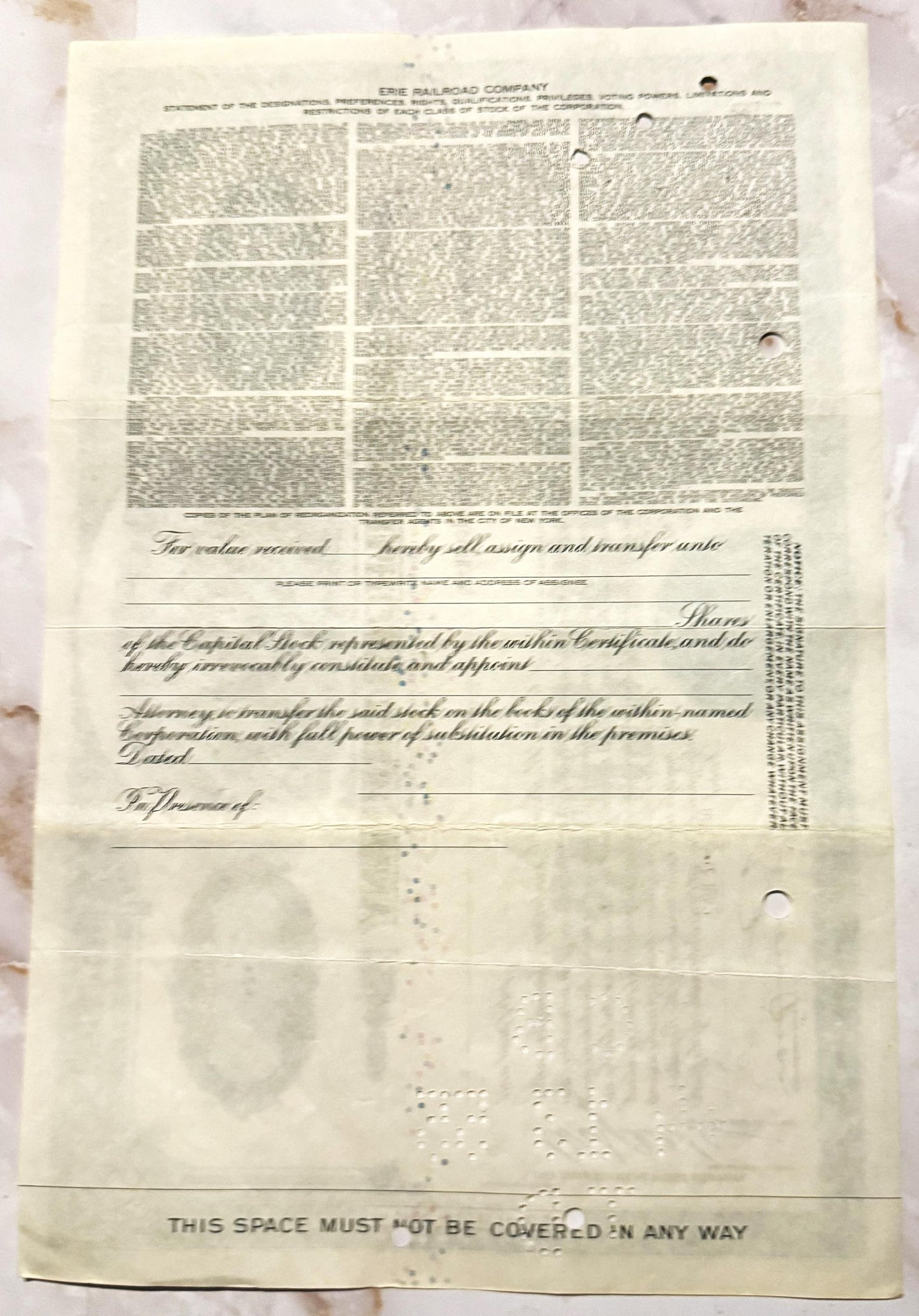
Nothing printed on the face gives a year, but the back does the dating. It reads "COPIES OF THE PLAN OF REORGANIZATION REFERRED TO ABOVE ARE ON FILE AT THE OFFICES OF THE CORPORATION AND THE TRANSFER AGENTS IN THE CITY OF NEW YORK," and the Erie's reorganization ran from 1938 to the end of 1941 - it filed for bankruptcy on January 18, 1938 and came out of it by December 1941 - so these come after it. Right under the assignment form the back also asks, in capitals, that "THIS SPACE MUST NOT BE COVERED IN ANY WAY." And the registrar printed on the front, Guaranty Trust, stopped existing under that name in 1959, when it merged with J.P. Morgan & Co. to become Morgan Guaranty. So this printing is from the 1940s and 1950s, and the one you get will carry its own date, number, owner, share count and stamps, and may look a little different from the one in my pictures.

๐Ÿ›ค๏ธ A broad-gauge gamble that became Wall Street legend

The New York and Erie was chartered in 1832 to do for the Southern Tier - Binghamton, Elmira, Hornell - what the Erie Canal had done for the towns up north, and run from the Hudson clear to Lake Erie. They started building in 1836 and laid the track six feet wide instead of the standard 4 feet 8 1/2 inches, believing it rode steadier - and since nobody else's cars could run on Erie rails, it cut the Erie off from the rest of the country's railroads for decades. When the line finally opened all the way in May 1851, President Millard Fillmore and his cabinet rode it end to end, and the story goes that Daniel Webster made the trip in a rocking chair lashed to a flatcar so he could enjoy the view.

The Erie was chartered on April 24, 1832, signed into law by New York Governor Enos T. Throop. The Erie Canal, finished in 1825, had turned the cities along its northern route into boomtowns, and the Erie Railroad was meant to connect New York City all the way out to Lake Erie, dragging the Southern Tier into the commercial age. The full route - 446 miles of it - was finally completed in May 1851, and the occasion was treated as a genuine national event, a level of ceremony few railroads of the era ever received. The thinking behind the six-foot gauge, collectors and rail historians have long noted, was that no competing line could ever run its cars on Erie track - a bold defensive move that isolated the Erie from the rest of the national rail network for decades.

The mainline made the Southern Tier. Binghamton, Elmira and Hornell all owed their growth to the railroad; Hornell became the site of the Erie's big repair shops and the town's largest employer, and it was where the mainline split, one route running northwest to Buffalo and the other west. The Erie leased the Atlantic and Great Western in 1868 and again in 1883, and reached Chicago through the Chicago and Atlantic, finished in 1880, becoming one of the great east-west carriers in the country.

โš”๏ธ The Erie War

Then came the fight that made the Erie famous. In 1867 and 1868 Commodore Cornelius Vanderbilt tried to buy control of the Erie, and Daniel Drew, who was using it to play the market, brought in Jay Gould and Jim Fisk to stop him. So the legend goes, the battle for the Erie involved secretly printed stock certificates, fleeing across state lines to escape arrest warrants, and enough courtroom and boardroom maneuvering that Wall Street began calling the Erie the Scarlet Woman of Wall Street - a railroad whose stock could never quite be trusted to behave. Gould and Fisk really did slip across the river to Jersey City with the company's books to dodge New York's courts. It's the kind of story that turns a simple corporate history into genuine American folklore.

Here's how the old story runs, in more detail. Daniel Drew, a former cattle drover turned financier, had gained control of the Erie and was using it as a personal stock-manipulation machine. Cornelius Vanderbilt, the "Commodore" and the single most powerful railroad man in the country, set out to seize it by quietly buying its stock on the open market. Drew didn't fight alone: he brought in Jay Gould and James "Big Jim" Fisk, and to stop Vanderbilt's takeover the three of them printed and sold some 50,000 new shares of Erie stock, flooding the market with paper faster than the Commodore could buy it. Vanderbilt got arrest warrants for all three. They fled across the Hudson to Jersey City with some $6 million in greenbacks, set up headquarters in Taylor's Hotel - "Fort Taylor," as the story goes - and then used the Erie's money to get the New York State Legislature, through Boss Tweed and Tammany Hall, to legalize the new shares after the fact. Vanderbilt settled, Gould won control of the Erie, and Drew, betrayed by his own partners, lost $1.5 million in 1870 when they drove the stock against him, and died nearly broke in 1879.

๐ŸŒ† The reformed Erie

The Erie went into bankruptcy in the Depression, and the company that came out of the 1938-1941 reorganization - the one on this certificate - got a fresh start, with new stock including this 5% Preferred Series A. It hauled coal, steel and war freight along the old Southern Tier line through the Second World War. In 1960 it merged with the Delaware, Lackawanna and Western to form the Erie Lackawanna, which went into Conrail in 1976.

In the 1920s the Van Sweringen brothers of Cleveland took control of the Erie and brought real operational improvements - standardizing locomotives, tightening up the operation, and launching the Erie Limited, the railroad's flagship passenger train, in 1929.

๐ŸŽจ Reading the vignette - Mercury, the torchbearer and the diamond

The engraving at the top of this certificate rewards a slow look. On one side stands a classically draped woman holding a torch, her hair bound in a laurel wreath - a figure of enlightenment and vigilance, the kind of allegorical presence security engravers of the era used to lend gravity and trust to a financial document. On the other side stands Mercury, winged helmet on his head, caduceus in hand, robe falling loose at the waist - the Roman messenger god, patron of trade, travel and commerce, a fitting emblem for a railroad whose entire business was the swift movement of goods and people. Between them sits the Erie's own laurel-wreathed diamond, and behind the whole scene a cityscape skyline - evoking New York, under whose state laws the Erie Railroad Company was incorporated. At the base of the certificate an embossed corporate seal repeats the same diamond, pressed directly into the paper.

๐Ÿฆ The engravers and the bankers

American Bank Note was the country's great security printer, and the Mercury-and-torchbearer design is theirs. Guaranty Trust was one of the biggest trust companies in the country, and City Bank Farmers Trust belonged to the old National City Bank family that became Citibank.

American Bank Note traces its work back to 1795, and for well over a century it was the gold standard of American security printing - trusted to engrave currency, postage stamps (including the famous 1893 Columbian issue), traveler's checks, and the stock and bond certificates of thousands of American corporations. Its steel-engraving technique, built on generations of craftsmen trained in the same hand-cut methods used for paper money, produced fine-line detail that was nearly impossible to counterfeit, which was the whole point. The combination on this certificate - a deeply engraved figural vignette paired with a lithographed guillochรฉ border of interlocking geometric lines - was their signature style. Every share issued under this design passed through two of New York's great trust institutions, Guaranty Trust Company of New York as registrar and City Bank Farmers Trust Company as transfer agent - proof that an ownership stake this small still moved through the same rigorous machinery as the largest transactions on Wall Street.

๐Ÿ“ˆ What "5% Preferred Stock, Series A" meant

It's a class of Erie stock carrying a fixed 5% preferred dividend on its $100 par value, paid ahead of the common stockholders, issued as part of the company's new stock structure after the early-1940s reorganization. Today it is collected for its history and its engraving, not as a live financial instrument - the independent Erie has been gone since 1960. On October 17, 1960 it merged with its old rival, the Delaware, Lackawanna and Western, to form the Erie Lackawanna, and Conrail took that over in 1976.

The original Erie name disappeared from the rails, but it never disappeared from collectors' shelves - its stock and bond certificates stay among the favorite pieces of railroad financial history because the company's story is so rich: a broad-gauge experiment, a Wall Street scandal for the ages, a Depression-era reorganization and a wartime workhorse, 128 years of it all bound up in one line of American rail. In the years these certificates were being issued, the Erie ran its business from Cleveland, Ohio, where it was headquartered from 1931 to 1960, sent the Erie Limited between New York City and Chicago, and on March 17, 1954 retired the last of its steam, running a fully diesel roster - the railroad was still changing right up to the end of its own name.

๐Ÿ–ผ๏ธ Display ideas

  • ๐Ÿ–ผ๏ธ Framed alone under glass, letting the Mercury-and-torchbearer vignette anchor a home office or study
  • ๐Ÿš‚ Paired with other railroad ephemera - timetables, playing cards or route maps - for a themed rail collection wall
  • ๐Ÿ’ผ Displayed in a financial history collection alongside other Wall Street-era stock and bond certificates
  • ๐Ÿ™๏ธ Set near New York-themed decor, playing off the cityscape engraved into the vignette itself
  • ๐ŸŽ“ Given as a milestone or graduation gift for anyone drawn to finance, economics or American business history
  • ๐Ÿ“š Used as a conversation-starting piece in a library or den, on a bookshelf or in a document frame

๐ŸŽ Who collects these

Erie Railroad certificates draw a wonderfully specific crowd - scripophily collectors chasing railroad and financial history, rail enthusiasts building out anything tied to the old Erie name, history buffs drawn to the Gould-Fisk-Vanderbilt saga, and framers looking for a handsome piece of engraved Americana for the wall. It's also a favorite for anyone with a personal or family tie to the Southern Tier towns the Erie once served, or to New York's Gilded Age financial world more broadly.

๐Ÿš‚ About these

They're 12 by 8 inches, engraved on heavy paper. Frame one for a train room, a Southern Tier family from Hornell or Port Jervis, or anybody who loves a good Wall Street scandal. The supply is finite - the Erie has been gone since 1960, nobody's issuing its stock again, and once these last ones are framed, they'll be very difficult to acquire.

Shipping

๐Ÿšš Shipping & Handling

  • Shipping costs and timing are calculated at checkout.
  • Items curated and shipped directly by me include U.S. shipping at no additional cost, professionally packed to ensure safe arrival of your artifact.

Items from Vetted Pro Collectors
Shipping for items offered by vetted Pro Collectors is determined at checkout. All Pro Collector listings are reviewed to ensure fair, reasonable shipping practices.

For full details, please refer to our Shipping Policy.

Returns & Exchange

Take your time โ€” you've got a full six months. If a piece isn't right for you, send it back the way it reached you and we're good.

In the first 30 days your money goes straight back the way you paid. After that it's store credit, so you can put it toward something you'd rather have.

Return shipping we sort out between us, case by case. I don't make this difficult.

If something arrives damaged, or it isn't what I said it was, send me a photo within 48 hours and I'll make it right.

Email info@vintageantiquesgifts.com or call 802-356-9872 โ€” that's me answering, not a call center.

The only things I can't take back are custom or special-order pieces and gift cards.

View full details
  • 5 stars: 2 (100%)
  • 4 stars: 0 (0%)
  • 3 stars: 0 (0%)
  • 2 stars: 0 (0%)
  • 1 star: 0 (0%)
_
_***k (11)

Arrived in a timely manor. Looks just as pictured. Thank you.

J
John

This is just what I thought it was.

Rescuing American History Since 2007

โ€” Travis & the Kids