Skip to product information
1 of 6

Vintage and Antique Gifts

Vintage Western Pacific Railroad Stock Certificate from the 1940s-50s

Vintage Western Pacific Railroad Stock Certificate from the 1940s-50s

Regular price 17.00 USD
Regular price Sale price 17.00 USD
Sale Sold out
Shipping calculated at checkout.
Quantity

Size: 12 x 8 inches ~ little to no wear. They vary a little one to the next.

🚂 Three Certificates, One Storied Railroad

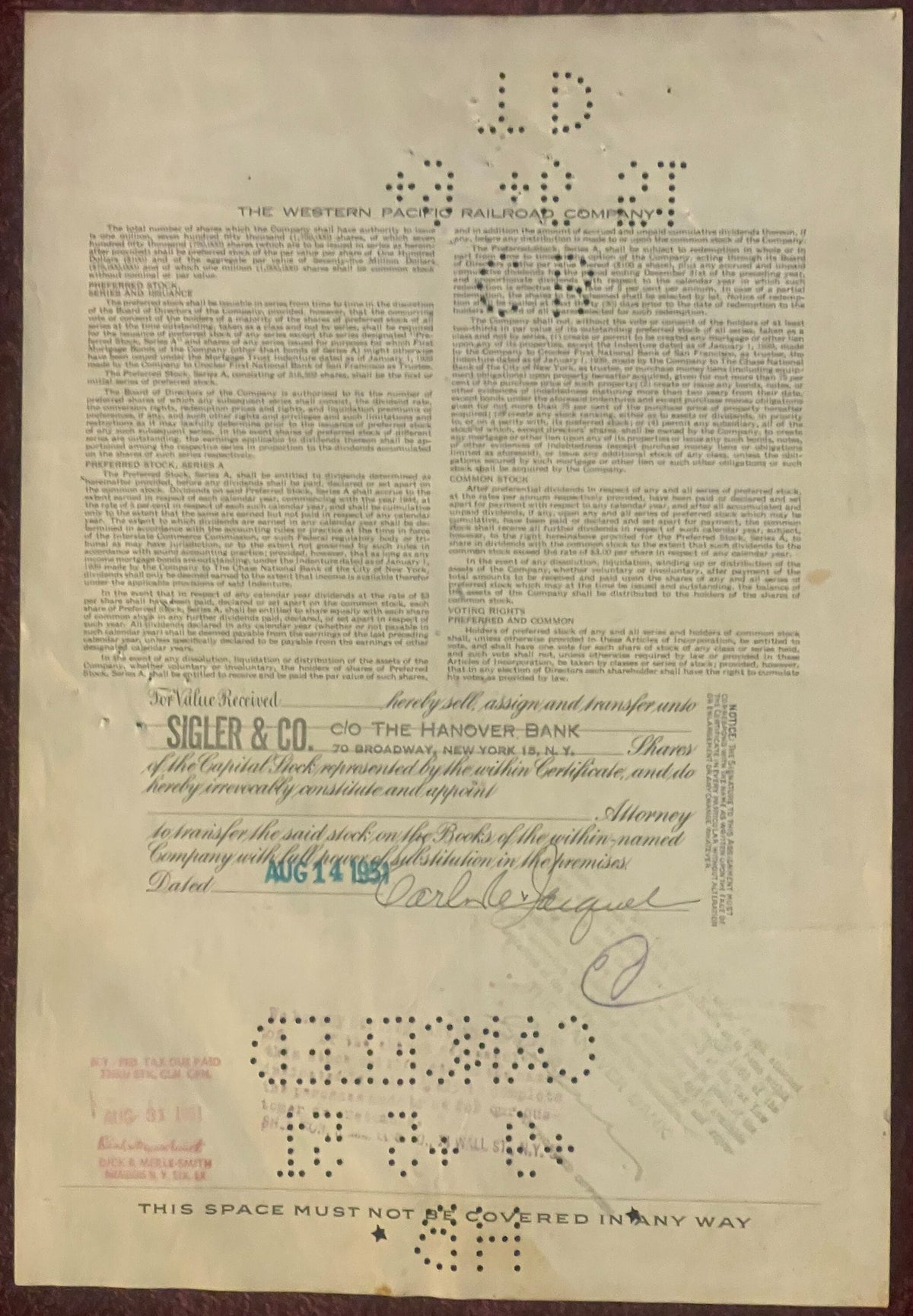
You get three different stock certificates from The Western Pacific Railroad Company, each one engraved by the Security Banknote Company with the same striking central image: a diesel streamliner locomotive framed in an oval, flanked by two classical allegorical figures. One is Preferred Stock, Series A (par value $100 a share), printed in rose-red. The other two are Common Stock with no par value, one in blue marked for under 100 shares and one in brown marked for a full 100 shares. Preferred shares stood first in line for dividends ahead of the common, so having both classes side by side is a nice way to see how the company was put together. Every sheet carries the company seal, facsimile signatures of the officers, a punch-hole cancellation, and the printed note that it's transferable in the City of New York or the City of San Francisco. The registrar, City Bank Farmers Trust Company, and the countersigning bank, Central Hanover Bank and Trust Company, are both named right on the sheet.

🗓️ What the Sheets Tell You About Their Age

The only year printed on these is on the seal: incorporated in California, June 3, 1916. But the names around it do the dating for you. Central Hanover Bank and Trust was formed in May 1929 and merged into Manufacturers Hanover in September 1961. City Bank Farmers Trust was the trust arm National City Bank set up in 1929, and it was folded into First National City Bank in 1963. The Security Banknote Company of Philadelphia merged with the Columbian Bank Note Company in 1957 and printed as Security-Columbian after that. Then there's the diesel streamliner in the vignette. Western Pacific was one of the first buyers of General Motors' FT road diesels in the early 1940s, and it became the first large western railroad to retire steam completely. Put that together and these sheets belong to the 1940s and 1950s, the railroad's streamliner years.

⛰️ The Feather River Route

The Western Pacific was built to give Oakland and San Francisco a second line east to Salt Lake City, in competition with the Southern Pacific's Overland Route. Its secret was grade. Instead of climbing over Donner Pass, it followed the Feather River Canyon to Beckwourth Pass, the lowest pass through the Sierra Nevada, for a ruling grade of 1 percent, half as steep as the Southern Pacific's. The line needed 41 steel bridges and 44 tunnels to do it. The last spike went in on November 1, 1909, at Keddie, California, home of the Keddie Wye, a three-legged bridge junction over a canyon that railfans still come to see. The original Western Pacific Railway went broke paying for all that. The company whose name is on these certificates is its 1916 reorganization, and it went through bankruptcy again in the Depression, filing in August 1935 and coming out of receivership on December 29, 1944.

🌄 The California Zephyr

This is the part people remember. On March 20, 1949, Western Pacific, the Denver & Rio Grande Western and the Chicago, Burlington & Quincy launched the California Zephyr between Chicago and Oakland. It was the first long-distance train to carry dome cars in regular service, five Vista-Domes to a train, and it was scheduled to run the most spectacular scenery on the route in daylight. Western Pacific's own Zephyrette ran alongside it between Oakland and Salt Lake City from 1950 to 1960. The last westbound run left Chicago on March 22, 1970. You can still see its last surviving dining car, and Western Pacific 805-A, the last of the railroad's passenger diesels, at the Western Pacific Railroad Museum in Portola, right up in the Feather River country.

🔚 Where It Ended Up

Western Pacific kept its own name until Union Pacific bought it. The purchase became official on December 22, 1982, and the line was folded into the Union Pacific system along with the Missouri Pacific. Union Pacific still runs a Western Pacific heritage locomotive, WP 1983, painted in the old colors. So these three certificates are the paper side of a railroad that's still out there in spirit, every time a train climbs the Feather River Canyon.

Shipping

🚚 Shipping & Handling

  • Shipping costs and timing are calculated at checkout.
  • Items curated and shipped directly by me include U.S. shipping at no additional cost, professionally packed to ensure safe arrival of your artifact.

Items from Vetted Pro Collectors
Shipping for items offered by vetted Pro Collectors is determined at checkout. All Pro Collector listings are reviewed to ensure fair, reasonable shipping practices.

For full details, please refer to our Shipping Policy.

Returns & Exchange

Take your time — you've got a full six months. If a piece isn't right for you, send it back the way it reached you and we're good.

In the first 30 days your money goes straight back the way you paid. After that it's store credit, so you can put it toward something you'd rather have.

Return shipping we sort out between us, case by case. I don't make this difficult.

If something arrives damaged, or it isn't what I said it was, send me a photo within 48 hours and I'll make it right.

Email info@vintageantiquesgifts.com or call 802-356-9872 — that's me answering, not a call center.

The only things I can't take back are custom or special-order pieces and gift cards.

View full details