
Skip to product information
1 of 11

Curated Gift Sets

Vintage 1970s Pennzoil United Debenture Bond 🛢️ Set of 3, $1,000 Orange, $5,000 Blue, $10,000 Purple, 5¼% Due 1996

Vintage 1970s Pennzoil United Debenture Bond 🛢️ Set of 3, $1,000 Orange, $5,000 Blue, $10,000 Purple, 5¼% Due 1996

Regular price $23.00 USD
Regular price Sale price $23.00 USD
Sale Sold out
Shipping calculated at checkout.

Size: 12" x 8"

Quantity

🛢️ What Did $1,000, $5,000 and $10,000 Buy in Pennzoil United? A Vintage Set of Three 5¼% Convertible Debenture Bonds, Orange, Blue and Purple

Size: $1,000 12" x 8", $5,000 12" x 8", $10,000 12" x 8" ~ Circulated but excellent shape, crisp and clean, with the stamps and cancellations of real use.

I love a certificate where the fine print turns out to be the best part. These are three denominations of one bond issue, the same promise from the same company in three colors: $1,000 in orange, $5,000 in blue and $10,000 in purple. That's $16,000 of face value on one wall, from a company whose name only lasted a few years, built by two brothers who went into the oil business with a young George H. W. Bush.

📜 One Promise, Three Denominations

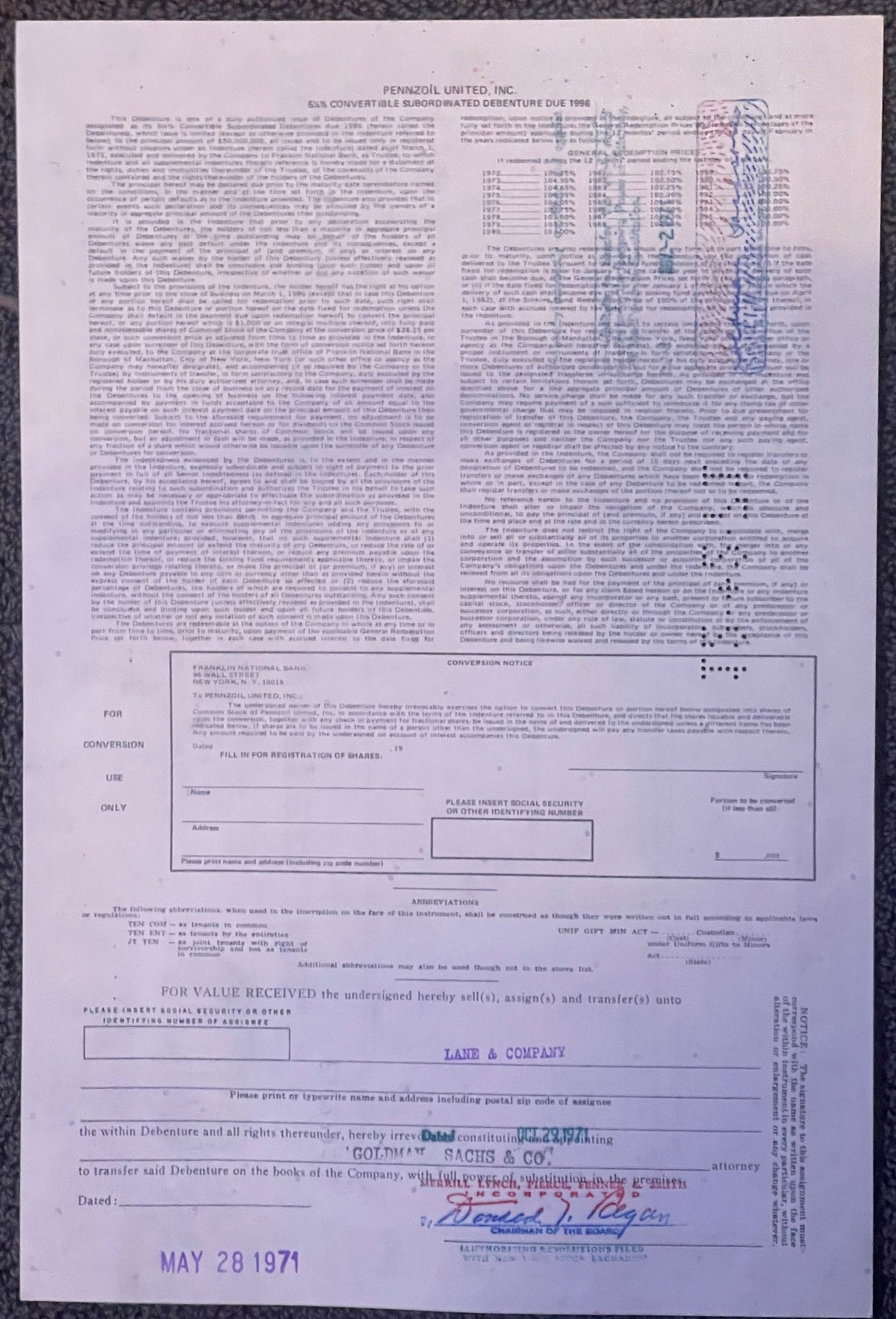
Each is a registered Pennzoil United, Inc. 5¼% Convertible Subordinated Debenture Due 1996. A debenture is a corporate bond backed by the company's promise rather than by a mortgage on any particular oil field, and "subordinated" means it waited in line behind the senior debt. The whole issue was capped at $50,000,000 under one indenture dated as of March 1, 1971, and the terms are printed out on the back: interest every March 1 and September 1, a redemption schedule stepping down a year at a time, and the right to swap for Pennzoil stock at $38.25 a share, in $1,000 pieces, any time before 1996. Do the arithmetic across this set and the orange one was good for about 26 shares, the blue about 130 and the purple about 261, if the stock ever climbed high enough to make it worth doing.

🏺 Look Close: That's a Chemist

Most financial engravings of this era hand you Commerce or Industry as a draped woman with a globe. Pennzoil's engraver at the American Bank Note Company did something better. A laurel-crowned man sits holding a test tube up to the light, a swan-neck glass retort on a burner at one hand and a microscope on the bench at the other, papers spilling across his lap. Behind him, instead of a classical skyline, are oil derricks and the cracking towers of a refinery. Same man, same bench, three different inks, and once you've got them side by side he's hard to stop looking at.

🏛️ 1889: A Rockefeller Company

The story starts on May 27, 1889, when a unit of John D. Rockefeller's Standard Oil formed South Penn Oil in the Pennsylvania oil country. Standard had been slow to get into pumping the stuff. Under its first president, Noah Clark, South Penn pushed across into the rich West Virginia fields, and by 1898 it was the top producer of all the Standard companies, at 7.6 million barrels a year. It came out of the 1911 breakup as one of the independent "Baby Standards," and in 1955 it bought out the Pennzoil Co. whose motor oil name it would eventually take as its own.

🎬 1953: Two Brothers and a Movie Marquee

In 1953 two brothers from Tulsa, J. Hugh Liedtke and William C. Liedtke, Jr., both working as lawyers in Midland, Texas, went into partnership with George H. W. Bush. They needed a name for the new company. Viva Zapata! was playing at the movie house, so they called it Zapata Petroleum. Ten years later, encouraged by J. Paul Getty, a big shareholder in South Penn, they merged Zapata and their Stetco Petroleum into it. They named the new outfit Pennzoil, with Hugh as chairman, and headquartered it in Houston.

⚡ The Takeover That Put "United" on These Bonds

Then the Liedtkes went after United Gas Corporation, a Gulf Coast natural gas company about eight times Pennzoil's size, run out of Shreveport, Louisiana, whose pipeline carried about 8 percent of the country's natural gas. In 1965 Pennzoil offered $41 a share for one million shares of United. Five million came pouring in, and Pennzoil bought every one of them, 42 percent of United's stock, borrowing $215 million of the $225 million it took. It was one of the early corporate raids, and in April 1968 Pennzoil forced the merger. The combined company took the name on this paper. By 1972 it was simply Pennzoil Company again, which is why you'll see a red NAME CHANGED TO PENNZOIL COMPANY stamp across the orange sheet in my pictures. William C. Liedtke, Jr., who was president from 1967 to 1977, is the printed signature on the sheets I photographed.

🏦 The Bank That Held the Promise

Every one of these names its trustee right on the face: Franklin National Bank, at 95 Wall Street. Three years after this indenture was signed, on October 8, 1974, Franklin National collapsed, the largest bank failure in American history up to that time. The Italian financier Michele Sindona had bought a controlling stake, and the bank lost $63 million in the first five months of 1974 alone. Sindona was later convicted, and in 1986 he died of cyanide poisoning in an Italian prison, four days after a life sentence. Not every bond gets to say its trustee had a story like that.

⚖️ Ten Billion Dollars

Hugh Liedtke's most famous fight came later. In 1984 Pennzoil had a handshake deal to buy part of Getty Oil, and Texaco swooped in and bought Getty instead. Pennzoil sued, and in November 1985 a Houston jury awarded it $10.53 billion, the largest civil verdict in American history at the time. Texaco went into bankruptcy in 1987 and settled with Pennzoil for $3 billion in 1988.

🏁 Yellow Cars at Indianapolis

Most folks know the name from racing. Pennzoil first painted its Indy car bright yellow in 1979 with Johnny Rutherford, the fans nicknamed it the "Yellow Submarine," and Rutherford won the 1980 Indianapolis 500 in it. Rick Mears drove yellow Pennzoil cars to Indy wins in 1984 and 1988. In 2002 Shell bought Pennzoil-Quaker State at $22 a share in cash, about $1.8 billion for the stock, and that closed the book on a company whose roots went back to 1889.

🖼️ About These Three

These are vintage 1970s pieces, each drawn from my stack, and no two are quite alike: who it was registered to, its number, its transfer stamps and the officers who signed it change from one to the next, so yours may differ from my pictures. They look great framed in order in an office, a den or a garage. There is no new press run coming. When the last of these are hanging in collections and galleries, they will be very hard to track down for sale.

Shipping

🚚 Shipping & Handling

  • Shipping costs and timing are calculated at checkout.
  • Items curated and shipped directly by me include U.S. shipping at no additional cost, professionally packed to ensure safe arrival of your artifact.

Items from Vetted Pro Collectors
Shipping for items offered by vetted Pro Collectors is determined at checkout. All Pro Collector listings are reviewed to ensure fair, reasonable shipping practices.

For full details, please refer to our Shipping Policy.

Returns & Exchange

Take your time — you've got a full six months. If a piece isn't right for you, send it back the way it reached you and we're good.

In the first 30 days your money goes straight back the way you paid. After that it's store credit, so you can put it toward something you'd rather have.

Return shipping we sort out between us, case by case. I don't make this difficult.

If something arrives damaged, or it isn't what I said it was, send me a photo within 48 hours and I'll make it right.

Email info@vintageantiquesgifts.com or call 802-356-9872 — that's me answering, not a call center.

The only things I can't take back are custom or special-order pieces and gift cards.

View full details

Preserving History: Authentic Objects Across Eras

— Curated by Travis Weigel