

Skip to product information
1 of 6

Vintage and Antique Gifts

Vintage 1960s John Weisert Tobacco Co 🍃 Cigar Clippings Chewing Bag St. Louis MO NOS

Vintage 1960s John Weisert Tobacco Co 🍃 Cigar Clippings Chewing Bag St. Louis MO NOS

Regular price $11.00 USD
Regular price Sale price $11.00 USD
Sale Sold out
Shipping calculated at checkout.

Size: 7" x 4 3/4"

🚚 Free US Shipping — ships within one business day. International shipping calculated at checkout.

Quantity

What's in a Bag of Cigar Clippings? 🍃 John Weisert Tobacco Co. Cigar Clippings Bag, "For Sweet Tasty Chewing," St. Louis, Missouri

Size: 7" x 4 3/4"

A plain brown paper chewing-tobacco bag, never filled: CIGAR CLIPPINGS in tall black letters over a tobacco plant, "FOR SWEET TASTY CHEWING" on a banner, MANUFACTURED BY JOHN WEISERT TOBACCO CO., ST. LOUIS, MO., then "Tobacco Factory No. TP-93-Mo." and SWEET CUTTINGS along the bottom flap. Turn it over and it promises "GUARANTEED TO BE CLEAN CIGAR CLIPPINGS only" and "PREPARED ESPECIALLY FOR SWEET TASTY CHEWING," with a little union label stamped on the seam. Yours will look just like this one.

✂️ What's in a Clippings Bag

Cigar clippings are just what they sound like - the ends trimmed off cigars at the factory. Sweetened up, they made a cheap chew, and "guaranteed to be clean" was the whole sales pitch, because nobody wanted to find out at the general store counter that they'd bought floor sweepings. The sweet part mattered too: Weisert's own history notes that chewers up north liked their tobacco heavily sweetened and flavored, most often with licorice.

🏭 The Last Tobacco Company in St. Louis

John Weisert was a German immigrant who started a tobacco company in Virginia in 1855 and by 1880 had moved it to St. Louis as the Weisert Brothers Tobacco Company, with his sons John Jr. and Albert as its officers. In 1902 his son John Weisert Jr. struck out on his own as the John Weisert Tobacco Company, first at 214 Pine Street - torn down later for the Gateway Arch grounds - and from 1903 in a new factory at 1120 South Sixth Street, with a south half added in 1922. St. Louis by then was a giant of tobacco: by 1879 it led the world in tobacco manufacturing and turned out a fifth of everything made in the country. Over four hundred tobacco firms were going in the city when the trade hit its peak around 1900. St. Louis sits just below the spot where the Missouri River empties into the Mississippi. Missouri's own leaf, grown mostly in the counties on both sides of the Missouri, went down the river to the New Orleans markets before the Civil War, and as the crop grew more of it came to St. Louis to be made into tobacco, along with leaf shipped in from Kentucky, Tennessee, Ohio and Virginia. The finished goods went right back out - in 1892 the city took in 25 million pounds of tobacco and shipped out just under 77 million pounds of finished tobacco.

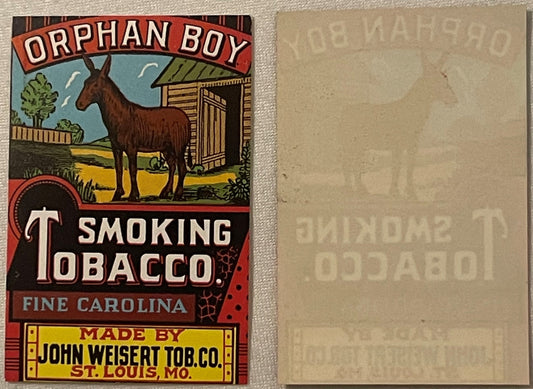
Weisert made fine cut and plug chewing tobacco, roll-your-own, snuff and hand-rolled cigars, and at its peak ran over 100 brands of chewing tobacco and cigars, a lot of them bought up as other firms folded - Drummer Boy, Orphan Boy, Joysmoke "the Happy Smoke," Blood Plug "Blood Will Tell," a Fraternity Pipe Mixture packed for Sigma Pi and Tau Kappa Epsilon, and a Cherry Diamond Club Special made just for the Missouri Athletic Club.

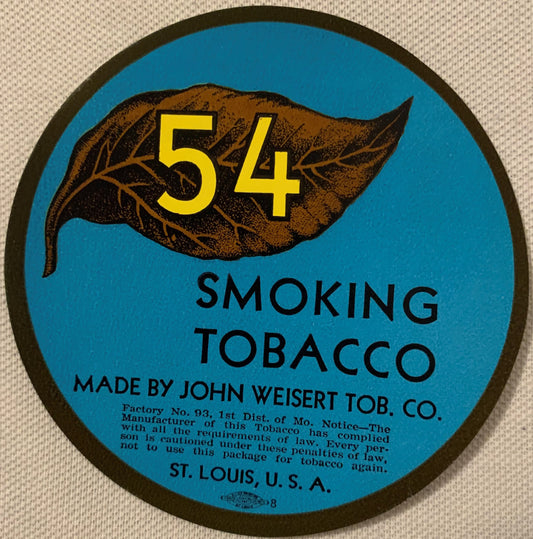
That "93" is an old friend. Older Weisert labels read "Factory No. 93, First District, Missouri," and back in 1911 one of the firm's leading brands was called "93" Cigar Clippings - the factory number made into a brand. It had to be on the bag, too: federal tobacco tax rules wanted every package to say which factory it came from. And that TP in front of the 93 dates the bag. Tobacco historian Tony Hyman's rule for dating cigar and tobacco packaging is that a T or TP in the factory number means after 1945, and probably after 1960. The factory permit behind that TP came in with the Excise Tax Technical Changes Act of 1958, and the union label on the seam belongs to the Tobacco Workers International Union, which merged into the Bakery, Confectionery and Tobacco Workers in 1978 - so for all its old-time look, this is a 1960s bag.

That little union label on the seam is the "Union Made" label of the Tobacco Workers International Union, and that union was born in St. Louis, when ten locals met there on May 25, 1895. Right from the start it took on the American Tobacco Company with a boycott, and encouraged the independent makers that let it organize to put its label in their products. Weisert was one of those independents. When James B. Duke's trust went after the plug business and bought up St. Louis firms like Drummond, Brown and Catlin, Weisert came through it still locally owned.

🕯️ The Last Man in the Building

The company stayed in the family to the very end, and so did the name. The John Weisert who was president in 1940 had been born in St. Louis in 1887, and on June 11 of that year he collapsed and died on a parking lot on Olive Street, just after leaving the dentist's office. His wife, two daughters and a son, John Weisert III, survived him.

When Liggett & Myers closed its St. Louis plant late in 1972, Weisert was the last tobacco maker left in the city. Then in 1976 Louis Applestein, the last cigar hand-roller in St. Louis, died at 83, and the cigars stopped. From then on it was roll-your-own and chewing tobacco, almost all of it made from cigar cuttings bought from other companies - and Walter Weisert, the founder's grandson, added the flavors to those cuttings himself. By the end he was president, staff and production crew all in one, until the company closed in the late 1980s after 133 years in the tobacco business. The building on South Sixth Street is on the National Register of Historic Places now; the old photo of it in the listing is there for the history and isn't included.

📜 The Stories

The lore around Weisert always comes back to the same thing: they outlasted everybody by staying small, independent and stubbornly local - selling close to home instead of fighting the national giants head-on. Local legend says the family never threw anything away that might be useful again and kept its stock rooms orderly and dry, so that when the doors finally closed there were rooms of old bags and labels nobody had touched in decades - and more than one dealer will tell you the unused ones floating around today came straight out of that building. There's even a story that some general stores whose grandfathers stocked Weisert tobacco in the 1880s were still reordering from the same family in the 1960s.

A neat one framed for anyone from St. Louis, or in a smoke shop or a den.

Shipping

🚚 Shipping & Handling

  • Shipping costs and timing are calculated at checkout.
  • Items curated and shipped directly by me include U.S. shipping at no additional cost, professionally packed to ensure safe arrival of your artifact.

Items from Vetted Pro Collectors
Shipping for items offered by vetted Pro Collectors is determined at checkout. All Pro Collector listings are reviewed to ensure fair, reasonable shipping practices.

For full details, please refer to our Shipping Policy.

Returns & Exchange

Take your time — you've got a full six months. If a piece isn't right for you, send it back the way it reached you and we're good.

In the first 30 days your money goes straight back the way you paid. After that it's store credit, so you can put it toward something you'd rather have.

Return shipping we sort out between us, case by case. I don't make this difficult.

If something arrives damaged, or it isn't what I said it was, send me a photo within 48 hours and I'll make it right.

Email info@vintageantiquesgifts.com or call 802-356-9872 — that's me answering, not a call center.

The only things I can't take back are custom or special-order pieces and gift cards.

View full details

Preserving History: Authentic Objects Across Eras

— Curated by Travis Weigel