

Skip to product information
1 of 2

Vintage and Antique Gifts

Vintage 1960s Tex Rio Tomatoes Crate Label 🍅 — Interstate Fruit & Vegetable Co., La Feria, Texas

Vintage 1960s Tex Rio Tomatoes Crate Label 🍅 — Interstate Fruit & Vegetable Co., La Feria, Texas

Regular price $8.00 USD
Regular price Sale price $8.00 USD
Sale Sold out
Shipping calculated at checkout.

Size: 13" x 5"

🚚 Free US Shipping — ships within one business day. International shipping calculated at checkout.

Quantity

Who Packed Tex Rio Tomatoes? 🍅 Tex Rio Tomatoes, Interstate Fruit & Vegetable Co., La Feria, Texas

Size: 13" x 5" ~ NOS unused stock, little to no storage wear.

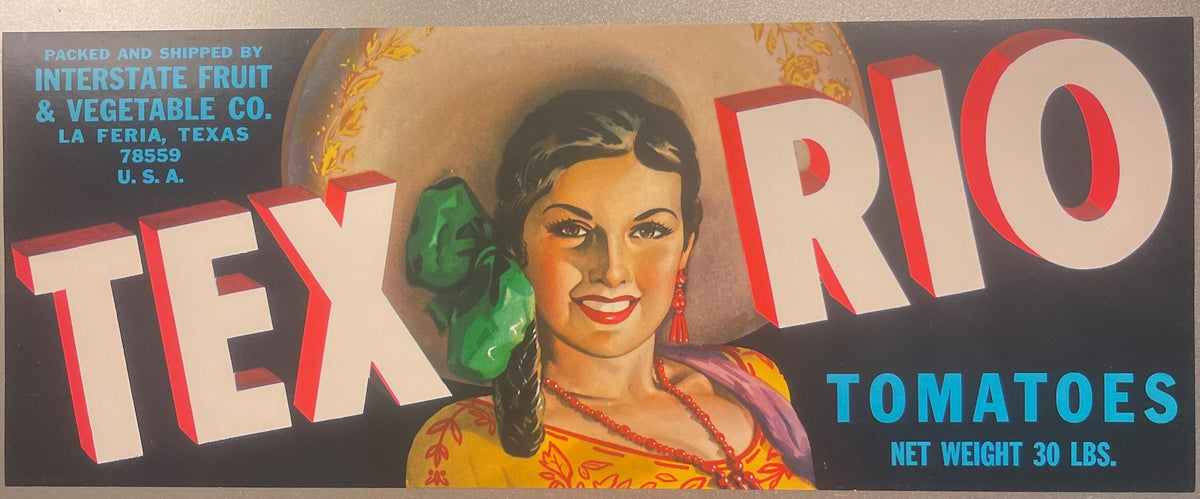
Amazing vintage beauty that can light up your home with her smile! This is a vintage 1960s Tex Rio Tomatoes crate label, packed and shipped by the Interstate Fruit & Vegetable Co. of La Feria, Texas, down in the Rio Grande Valley. She's got dark hair pulled into a long braid, a big green bow, a yellow blouse embroidered in red, a string of red beads, a tasseled earring and a lavender scarf over her shoulder, with a wide embroidered sombrero behind her. On either side of her, the brand in giant white letters trimmed in red: TEX and RIO, Texas and the Rio Grande in two words.

🔍 What's on it

A long black label made for the end of a tomato lug. Up in the corner: PACKED AND SHIPPED BY INTERSTATE FRUIT & VEGETABLE CO., LA FERIA, TEXAS, 78559 and U. S. A. On the right, TOMATOES in light blue capitals and NET WEIGHT 30 LBS. beneath. There's no printer's name and no year anywhere on it, and it was never pasted on a lug.

That little 78559 does the dating for us. It's La Feria's ZIP code, and five-digit ZIP codes started on July 1, 1963, so this label was printed in 1963 or later. That makes it something of a late bloomer. Texas Co-op Power, writing about Valley crate art, says paper labels had their heyday from the 1910s to about 1960, and that the sudden switch in the late 1950s to cheap preprinted cardboard boxes left mountains of unused labels behind. Tex Rio kept a paper label going after most of the Valley had given them up.

🍅 Fruit or Vegetable?

I always smile at a tomato label from a "Fruit & Vegetable Co.," because the tomato is the one that started the argument. A botanist will tell you it's a fruit. But in 1886 the Nix family imported a load of tomatoes from the West Indies, and the port of New York charged them the 10 percent duty the Tariff Act of 1883 put on vegetables. The Nixes said a tomato is a fruit and shouldn't be taxed as a vegetable, and the case went all the way to the U.S. Supreme Court. On May 10, 1893, in Nix v. Hedden, Justice Horace Gray wrote that the law used the words the way ordinary people use them in the kitchen, not the way botanists do - so in the eyes of the law, a tomato is a vegetable. Interstate Fruit & Vegetable had it covered either way.

🌴 The Magic Valley

La Feria is in Cameron County, one of the four counties of the Rio Grande Valley, along with Hidalgo, Willacy and Starr. For most of its history this was ranch country, but the St. Louis, Brownsville and Mexico Railway, built starting in 1903, and irrigation water pumped from the Rio Grande turned it into farmland. The land promoters of the early 1900s gave it a name to sell it: the Magic Valley. The Valley's big draw was a growing season that hardly stops, so it could ship fresh vegetables north in the winter months, when they brought premium prices. It's still the most important vegetable-growing area in Texas. That's the trade a long tomato label like this was made for: the end of a 30-pound lug.

🎪 La Feria, "the fair"

La Feria is Spanish for "the fair," and the town's name is older than the town. According to the Texas historical marker put up in 1971, the land was surveyed in 1777 for Spain's grants to Don Juan Hinojosa and José María Ballí, ancestors of the priest Padre Island is named for. The Handbook of Texas names the one Spain assigned the La Feria grant to as Rosa María Hinojosa de Ballí, and her family held it into the mid-1800s. The old rancho raised cattle, sheep and goats, and by the 1790s it had its own fairground for fiestas, horse racing and other sports, which is where the name comes from. After the Mexican War the Ballí heirs had their title confirmed by Texas, and in 1850 a cattleman named Nathaniel White, a reputed smuggler according to that same marker, opened Anglo ranching here. The town itself came later: a land developer named G. J. Schoenberg laid out La Feria in 1909, the year its post office opened.

My favorite La Feria story is how the town got its train station. When the St. Louis, Brownsville and Mexico Railway came through in 1911, it put its stop at a place called Bixby, about a mile from the new townsite. After all the legal ways of getting it moved had failed, the founders took care of it themselves; the Handbook of Texas says flat out that in July 1912 they "stole the Bixby depot." The way Eddie Gathings McNail told it in the town's Bicentennial History, written in 1975, a group of prominent men went out on a hot, sultry night, jacked the new depot up off its foundation, let it down onto rollers, rolled it onto a flatcar on the railroad's own tracks, and hitched two teams of horses to pull it east to La Feria. By 1915 the town had a bank, two churches and its own weekly paper, the La Feria Leader, La Feria incorporated in 1933 with 1,594 people and ninety businesses, and by 1967 it counted ninety industries: fruit and vegetable canneries, cotton trailer and liquid fertilizer makers, three cotton gins and, fittingly for a town named "the fair," carnival equipment makers. In 1976 it held its sixty-fourth annual fair.

🏡 Display

Crate Labels are a reminder of a bygone era but the amazing lithography process is unparalleled even to this day in my opinion. Museums and Art Institutes have galleries dedicated to them and more and more collectors are seeking these out to preserve their history. What is left is what there is. Once the last of these are on display with collectors or in galleries, they will be very difficult to acquire, and no one is printing more.

Imagine this amazing vintage advertising hanging as home decor in any room of your home instead of a museum! It's a long, narrow piece that looks great over a kitchen doorway or a window, and a perfect gift for anybody from the Rio Grande Valley, Cameron County or South Texas.

Shipping

🚚 Shipping & Handling

  • Shipping costs and timing are calculated at checkout.
  • Items curated and shipped directly by me include U.S. shipping at no additional cost, professionally packed to ensure safe arrival of your artifact.

Items from Vetted Pro Collectors
Shipping for items offered by vetted Pro Collectors is determined at checkout. All Pro Collector listings are reviewed to ensure fair, reasonable shipping practices.

For full details, please refer to our Shipping Policy.

Returns & Exchange

Take your time — you've got a full six months. If a piece isn't right for you, send it back the way it reached you and we're good.

In the first 30 days your money goes straight back the way you paid. After that it's store credit, so you can put it toward something you'd rather have.

Return shipping we sort out between us, case by case. I don't make this difficult.

If something arrives damaged, or it isn't what I said it was, send me a photo within 48 hours and I'll make it right.

Email info@vintageantiquesgifts.com or call 802-356-9872 — that's me answering, not a call center.

The only things I can't take back are custom or special-order pieces and gift cards.

View full details
  • 5 stars: 2 (100%)
  • 4 stars: 0 (0%)
  • 3 stars: 0 (0%)
  • 2 stars: 0 (0%)
  • 1 star: 0 (0%)
o
o***e (153)

Extremely pleased with purchase. A+++ seller!!

a
a***i (182)

Great seller! A pleasure to do business with! ⭐️⭐️⭐️⭐️⭐️

Rescuing American History Since 2007

— Travis & the Kids