



Skip to product information
1 of 8

Vintage and Antique Gifts

Antique Qing Dynasty Ox Horn Budai Pendant ✨ Chinese Laughing Buddha Talismanic Amulet, Good Fortune Charm

Regular price 34.00 USD
Regular price Sale price 34.00 USD
Sale Sold out
Shipping calculated at checkout.

Description

🧧 A Blessing You Can Hold in Your Palm

Some objects were never meant to sit on a shelf. They were meant to be carried — worn against the chest, kept close through the ordinary hours of a life. This is one of those. It is an antique pendant from the Qing dynasty, carved from ox horn, small enough to close your hand around and light enough to forget you are wearing it, and every millimeter of its two faces was given over to a single purpose: to carry good fortune with the person who wore it. On the front, the laughing monk Budai sits among his cloth sack, his prayer beads and a scatter of coins. On the back, a single flowing character — 佛, Buddha — fills the field beneath a tiny seal. This is not a reproduction of an amulet; it is the amulet itself, more than a century old, offered exactly as pictured.

What follows is the whole story of the piece: the figure and what he holds, the folklore that made him one of the most beloved images in Chinese culture, the meaning of the coins and the character, how we know for certain the material is genuine horn, and an honest account of its condition. Everything here is drawn from the object itself and the photographs you can see — no invented history, only the piece and the tradition it belongs to.


📿 The Figure on the Front — Budai and What He Carries

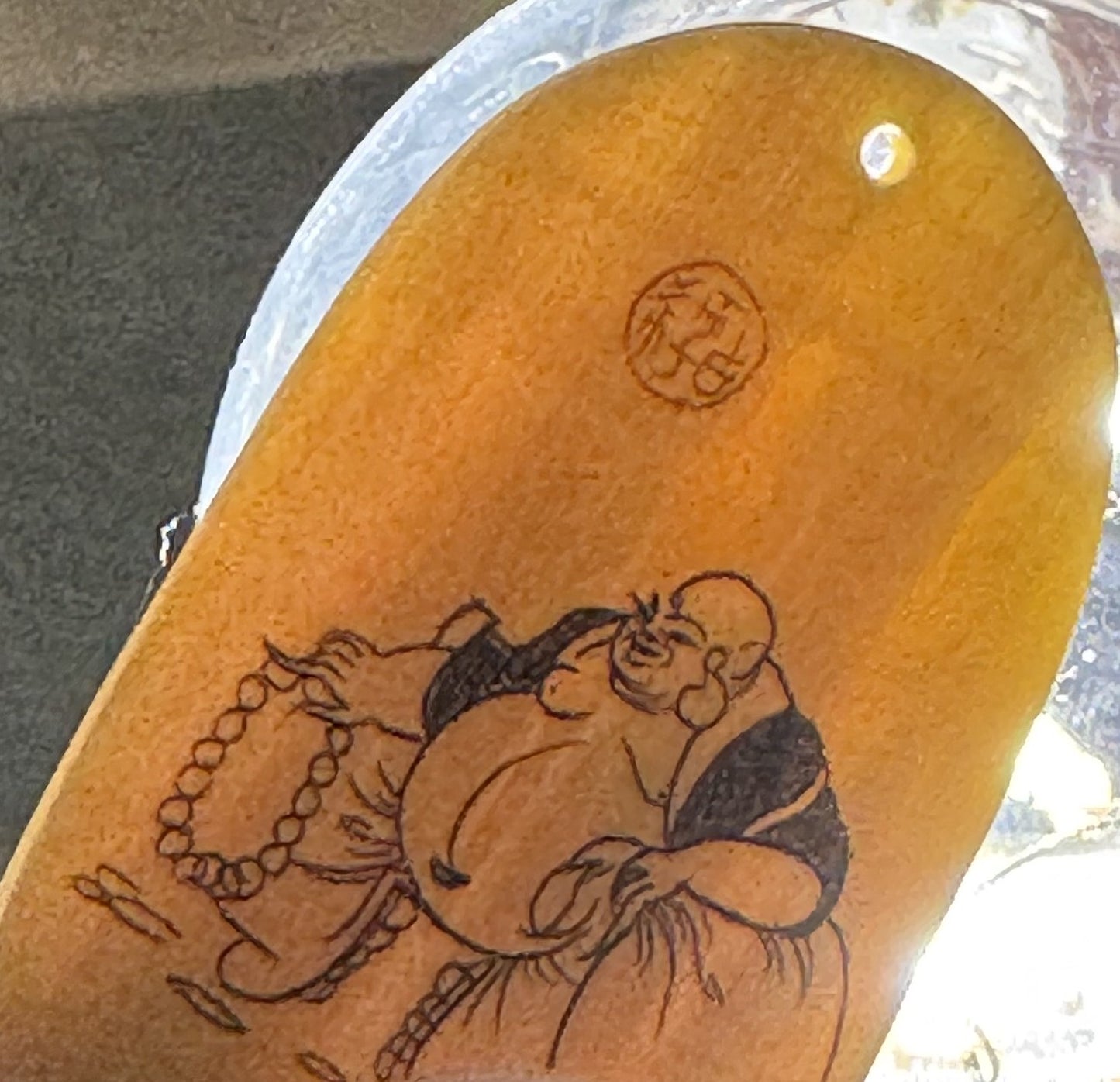
Turn the pendant to its face and you meet him at once: Budai, the Laughing Buddha, engraved in fine ink-filled line and settled into the warm amber of the horn as though he had always lived there. He is unmistakable. His head is bald and smooth, his earlobes long and heavy — the traditional mark of wisdom and spiritual attainment in Buddhist art. His robe has fallen open at the chest to bare the enormous, rounded belly that is his signature the world over, and his whole face is creased into open, delighted laughter. This is a figure caught mid-joy, and the artisan drew him that way on purpose.

Look at what surrounds him, because the composition is a small catalogue of blessings. In his hand he holds a looping strand of prayer beads — his Buddhist mala, the counting rosary used for meditation and the recitation of prayers — the round beads drawn one by one as they trail down and out from his grip. Beside him rests the great soft bundle of his cloth sack, the bottomless bag that gives him his name and his legend. And scattered across the ground at his feet lie coins, small ovals loosed as if spilled from that endless bag, the plainest possible shorthand for wealth freely given and freely received. Above his shoulder, set into the open field of the horn, is a small circular seal mark — the finishing touch of the hand that made him. Nothing on this face is idle. Every element earns its place in the blessing.


😄 Who Budai Is — The Story Behind the Laugh

To understand why anyone would carry this figure against their body for a lifetime, you have to know his story, because Budai is not a decoration — he is a folk saint. His name, 布袋 (Bùdài), means simply "cloth sack," and the legend behind it is one of the gentlest in Chinese religious tradition. He is said to have been a wandering monk who walked the roads of southern China generations ago, round and ragged and endlessly cheerful, carrying an enormous sack over his shoulder. Out of that sack he gave away whatever anyone needed — food, small treasures, sweets for the children who trailed after him wherever he went. However much he gave, the bag never emptied. He owned nothing and lacked nothing, and he laughed his way through a world that took itself far too seriously.

Only when he was dying, the story goes, did he leave a verse revealing what a few had already suspected: that this shabby, joyful beggar was in truth a manifestation of Maitreya, the Buddha yet to come, walking among ordinary people in the humblest disguise imaginable. That is why, to this day, the first figure a visitor meets at the gate of a Chinese Buddhist temple is so often Budai, seated and laughing. The message is deliberate and kind: the path does not begin in fear or severity — it begins in joy. To carry Budai was to keep that promise close: contentment, generosity, and an abundance that renews itself.


🪙 The Coins at His Feet — A Wish Made Visible

The coins scattered around Budai are not there by accident — they are the clearest thread tying this object to its purpose. In Chinese folk belief Budai is one of the great bringers of wealth and plenty, his bottomless sack imagined as forever full and forever spilling, and to show coins pouring out at his feet is to render that abundance in a form anyone could read at a glance. It is a wish carved into the horn: may your sack, too, never empty; may prosperity settle around you the way these coins settle around him. Paired with the mala in his hand, the meaning doubles — spiritual devotion and material blessing held together in a single small figure. For the person who wore this, that was the whole point: a talisman for a good life in every sense — enough in the hand, and peace in the heart.


🖌️ The Character on the Back — 佛, Buddha

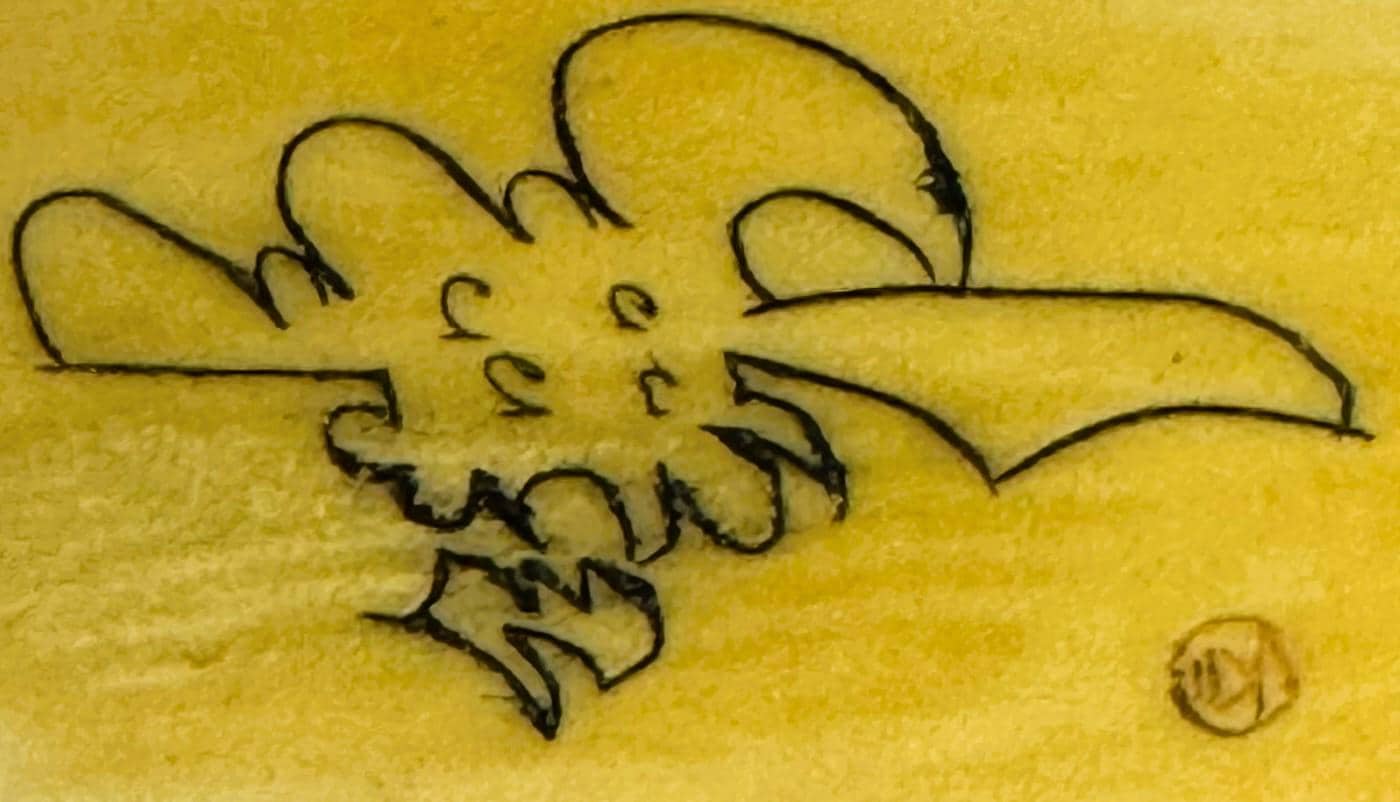
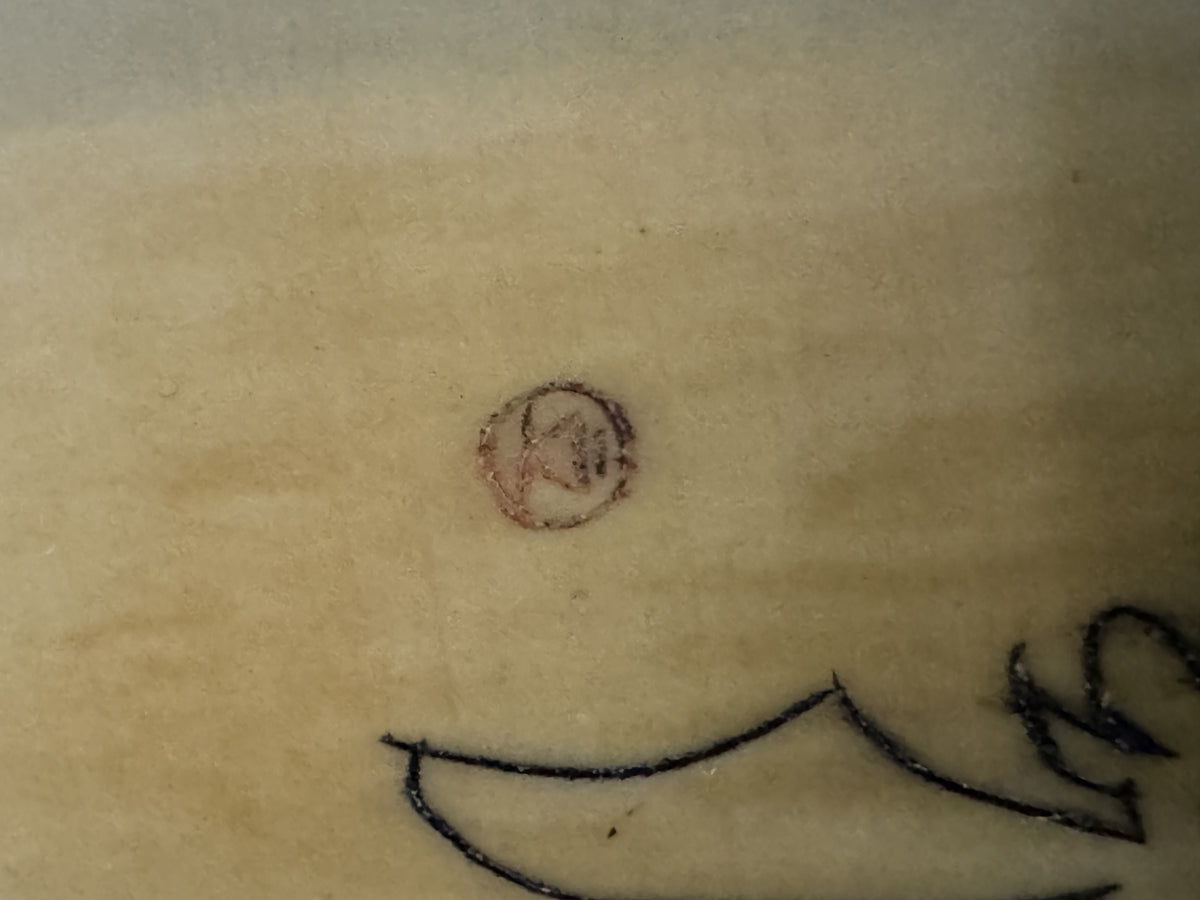
Turn the pendant over and the mood changes entirely. Where the front is busy with figure and story, the back is spare and monumental: a single large character, brushed and then ink-filled into the horn in a flowing, decorative calligraphic hand, sweeping nearly the full height of the plaque. The character is 佛 — fó — the Chinese word for Buddha itself. It is written in an ornamental, almost pictorial style, the strokes opening and curling like petals so that the sacred word doubles as a thing of visual beauty, and beneath it sits a second tiny circular seal, closing the composition the way a signature closes a scroll.

The two faces of the pendant were designed to speak to one another. The front gives you the person of the Buddha-to-come in his most human, laughing form, ringed by the good fortune he scatters; the back gives you the word, the essence, the single character that names what he is. Front and back together, the little plaque holds both the image and the idea — the smile you can see and the truth behind it — which is exactly what a devotional amulet was meant to do. It was not decoration to be admired from a distance. It was a complete blessing, front and back, made to be turned over in the fingers and kept near.


🔦 How We Know It Is Genuine Ox Horn

A claim about material is only as good as the test behind it, so here is exactly how this one was verified. The pendant was catalogued at a Chinese-antiques auction as Qing dynasty ox horn, and that identification has been confirmed by the simplest and most reliable test there is for horn: transmitted light. Held up to a backlight, the plaque does not stay dead and opaque the way bone or a modern resin would. It glows. Light passes through it and it lights up a warm, translucent amber, and running through that glow you can see the fine fibrous grain of the horn itself — the long, hair-like striations that are the unmistakable signature of genuine keratin. Bone, by contrast, blocks the light and reveals a dense, mottled structure of tiny channels; plastic glows flatly and evenly, with no grain at all. Only true horn does what this piece does: light up amber and show its fibers.

That backlit glow is the material telling the truth about itself, and it settles the question the way no description could. This is horn — warm, organic, once part of a living animal, worked by hand and aged for well over a century into the mellow tone you see here — the quiet foundation under everything else the pendant is.


🐂 Ox Horn — A Material That Warms With Age

Horn is one of the oldest working materials in human hands, prized for thousands of years because it does what no stone and no metal can. It goes warm to the touch almost at once, taking the heat of the body the moment it is held, and it can be worked to a deep, waxy, satin polish that seems to hold light beneath the surface rather than bounce it off the top. Best of all, it ages: a horn object does not merely survive the decades, it ripens through them, its color mellowing from pale toward a rich amber-honey and its surface softening to a glow only genuine age and handling can produce. You are seeing that long ripening here — the creamy amber body, the darker translucent brown gathering at the edges, the luminous grain running through the whole. No synthetic material imitates it convincingly, because none of them lives the way horn does. That quiet coming-alive under the light is exactly why horn was chosen for an object meant to be worn against the skin and carried through a life.


🏯 The Amulet Tradition It Belongs To

This pendant was made during the Qing dynasty, the long final imperial age of China that ran from 1644 to 1912, and it belongs to a deep and living tradition of the worn charm. Across the whole span of that era and long before it, small carved amulets like this one were part of everyday spiritual life — worn on a cord at the neck or waist, sewn into clothing, carried in a pouch, given at births and weddings and new years, passed from a grandparent to a child. They were not abstractions. They were working objects of belief, chosen to invite specific blessings into a specific life: this one for the abundance and the deep contentment that Budai embodies, the wealth of his scattered coins and the peace of his endless laughter, sealed on the reverse by the very name of the Buddha.

The drilled hole at the crown of the plaque is the plain physical proof of that purpose. This was never a plaque for a cabinet or a frame; it was pierced to be strung and worn, and it was worn — carried close to a body long gone, through a century now passed, until it came to rest still whole, still legible, still radiating the same simple wish. To hold it now is to take up your place in that long line of people who kept Budai near.


🔍 An Honest Look at the Condition

We would always rather tell you exactly what you are getting than let a photograph flatter it, so here is the plain state of the piece, described from the same images you can see.

The overall condition is excellent for its age. The surfaces are smooth and warmly aged, worn to a soft satin from a century of handling, with the natural vertical grain and faint streaking of genuine horn running through the amber — the character of the material, not damage. The ink-filled engraving is crisp and fully legible on both faces: Budai's laughing face, the beads, the sack, the coins and the seal on the front all read clearly, and the great 佛 and its little seal stand sharp on the back. The drilled suspension hole at the top is clean, intact and open, ready for a cord. The edges carry the deeper, translucent brown that horn naturally takes on at its margins, and the plaque is a genuinely thin, flat form — you can see its slim profile where it lies beside the coin.

As with any object that has lived more than a hundred years, the surface shows the honest, minor incidents of a long life: the faintest natural marks and tonal variation across the horn, the mellowing that time gives. No cracks, splits or losses are visible in the photographs, and nothing has been added, restored or disguised. A US quarter appears in several images so you can judge the scale yourself — a small, wearable piece, roughly two and a quarter inches tall. Offered exactly as pictured, with nothing hidden.


🎐 How to Wear It, and Live With It

An object like this asks to be used, not shut away, and it slips easily into a modern life in more ways than one.

  • 🧵 Wear it as it was made to be worn — strung on a simple leather cord, a silk thread or a fine chain through the original drilled hole, resting at the chest as a genuine antique talisman with real meaning behind it.
  • 🙏 Keep it as a personal charm of contentment and abundance, carried in a pocket or a bag, a small daily reminder of Budai's promise that a good life begins in generosity and good humor.
  • 🖼️ Display it upright in a small stand or a shallow frame where both faces can be turned and seen — the laughing figure on one side, the flowing 佛 on the other — a two-sided object that rewards being handled.
  • 🎋 Let it anchor a small altar or a shelf of meaningful things, among incense, a bit of jade, a candle, where its warm amber glow and fine engraving hold their own quiet presence.
  • 💛 Or simply keep it close and enjoy the fact of it: a real Qing-dynasty amulet that a real person once wore for luck, still carrying its blessing forward into your hands.

🎁 Who This Belongs With

This pendant will mean the most to a handful of very different people. There is the collector of Chinese antiques and worn amulets, who knows how uncommon it is to find a genuine Qing-dynasty horn charm still whole, still sharp, still readable on both faces. There is the lover of Buddhist art and folk devotion, who will recognize Budai at a glance and understand what the mala, the sack, the coins and the reverse character mean together. There is the collector of antique horn, who prizes the warmth, the translucency and the honest ageing that no substitute can fake. And there is the seeker of a talisman with real history and meaning, who would rather wear a small object that has carried a blessing for a hundred years than a new thing made yesterday. For any of them, this is a single, one-of-a-kind piece, and there is only the one.


❓ Questions Worth Answering

Is it really Qing dynasty and really ox horn?

Yes. It was catalogued at a Chinese-antiques auction as Qing dynasty ox horn, and the horn identity has been confirmed by the definitive backlight test: held to a light it glows translucent amber and shows the fine fibrous grain that only genuine horn produces. The warm, mellowed tone, the hand-worked engraving and the century of honest surface age are all consistent with that identity.

What is on each side?

The front carries the ink-filled engraving of Budai, the Laughing Buddha — bald, long-eared, laughing, with his bare rounded belly, his strand of prayer beads, his cloth sack and coins scattered at his feet, beneath a small circular seal. The back carries a single large flowing character, 佛 (Buddha), with a tiny circular seal mark below it.

Who is Budai, exactly?

Budai is the round, laughing monk of Chinese folk Buddhism, understood as a manifestation of Maitreya, the future Buddha. He is the great figure of contentment, generosity and abundance — the one who gives endlessly from a bag that never empties — which is why his image was carried as a charm for a happy, prosperous life.

Can I wear it?

Yes. The drilled hole at the top is intact and open, exactly as it was made to be, and the piece is small and light. It can be strung on a cord, thread or chain and worn as the talisman it has always been, or simply carried and kept close.

How big is it?

It is a small, wearable pendant — a thin, flat plaque of roughly two and a quarter by one and a third inches. A US quarter is shown beside it in several photographs so you can gauge the exact scale directly from the images.

What condition is it in?

Excellent and honest for its age: smooth, warmly aged surfaces with the natural grain of the horn, crisp legible engraving on both faces, and a clean, intact suspension hole. No cracks, splits or losses are visible, and nothing has been added or restored. Offered exactly as pictured.


✨ Why It Matters

Some objects are worth having because they are rare; this one is worth having because it is real, and because of what it was made to do. It is a genuine Qing-dynasty amulet, carved from true ox horn and worn on a cord for the better part of a lifetime, carrying the laughing Budai with his coins and bottomless sack on one face and the single flowing word for Buddha on the other — a complete blessing, front and back, sealed by the hand that made it and mellowed by a century of being kept close. It needs no invented pedigree and has none. What it offers is the thing itself: a small, warm, luminous object of belief that once brought contentment and abundance to a person whose name we will never know, still whole, still glowing amber to the light, ready to carry the same wish forward. Take it up, and you are keeping a piece of that world, close, the way it was always meant to be kept.

Shipping

🚚 Shipping & Handling

  • Shipping costs and timing are calculated at checkout.
  • Items curated and shipped directly by me include U.S. shipping at no additional cost, professionally packed to ensure safe arrival of your artifact.

Items from Vetted Pro Collectors
Shipping for items offered by vetted Pro Collectors is determined at checkout. All Pro Collector listings are reviewed to ensure fair, reasonable shipping practices.

For full details, please refer to our Shipping Policy.

Returns & Exchange

Product Page Return Policy

  • 60-Day Returns – Items must be in original condition.
  • Refunds – Issued after inspection (excluding shipping costs).
  • Return Shipping – Customer is responsible unless item is damaged or incorrect.
  • Damaged/Incorrect Items – Contact us within 48 hours for a replacement or refund.
  • Easy Returns – Email [email protected] or call 802-356-9872 to initiate a return.

For full details, visit our Refund Policy.

View full details