Skip to product information
1 of 3

Vintage and Antique Gifts

Vintage 1960s-1970s Special Police Badge 🚔 Suffolk County NY Tin Litho Pin-Back Button NOS on Display Card Made in Japan

Vintage 1960s-1970s Special Police Badge 🚔 Suffolk County NY Tin Litho Pin-Back Button NOS on Display Card Made in Japan

Regular price 20.00 USD
Regular price Sale price 20.00 USD
Sale Sold out
Shipping calculated at checkout.
Quantity

Do You Remember When a Tin Badge Could Make You Feel Like the Most Important Person on the Block? 🚔

There is something about holding a piece of tin this small that somehow carries the weight of an entire era. You turn it over in your hand and something shifts — the colors, the crispness of the lithography, the sheer confidence of the design — and suddenly you are standing in a five-and-dime store somewhere on Long Island, or maybe in a drugstore in any American town, looking up at a spinning rack full of wonder for pennies. That feeling is exactly what this piece delivers, and it delivers it intact, still on its original display card, the way it left the shop floor.

This is one of those combinations that almost never survives. The badge and the card, together, undisturbed — a genuine New Old Stock survivor from a chapter of American consumer culture that most collectors only read about in reference books.

---

🔍 What You Are Actually Looking At

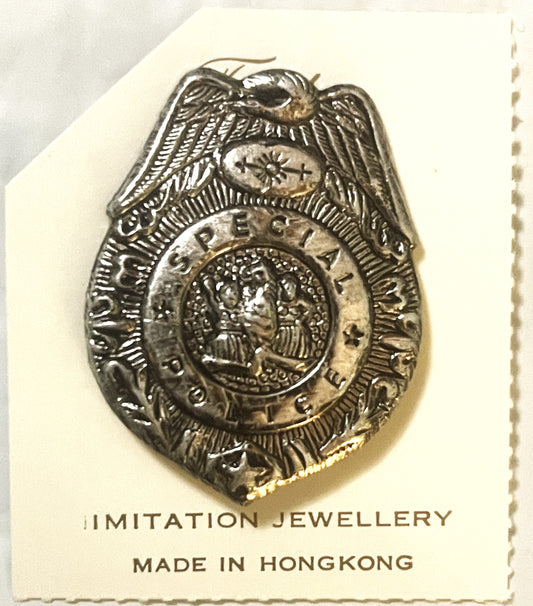
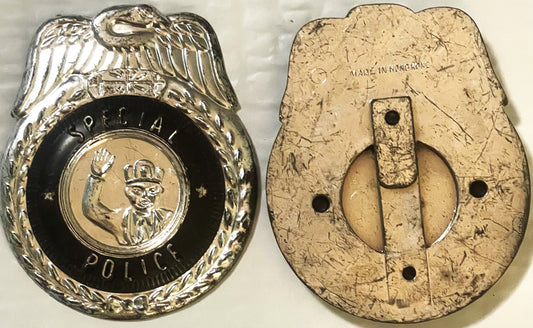
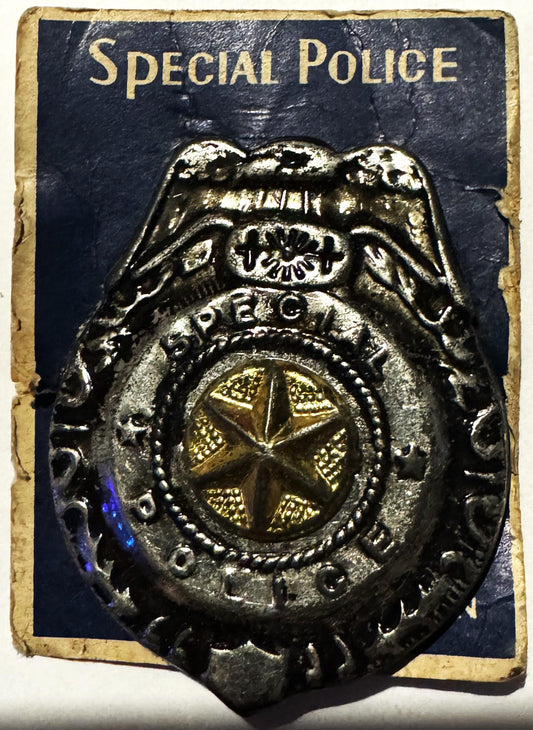
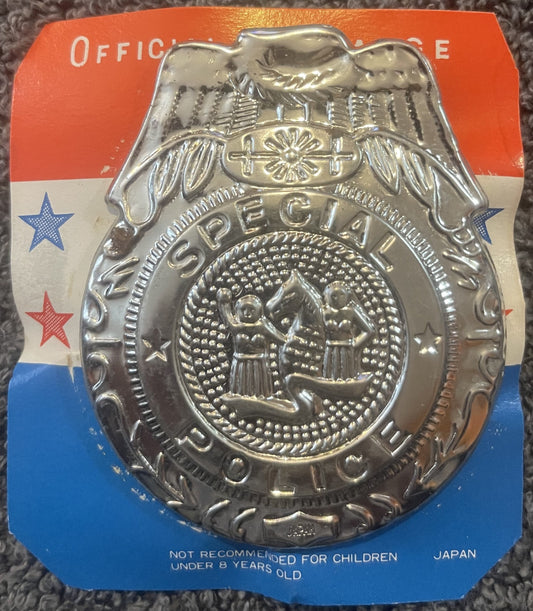
This is a Special Police Badge novelty pin-back button, a tin lithograph piece still mounted on its original illustrated display card — New Old Stock (NOS), meaning it made the full journey from the factory floor to a shop rack to wherever it was carefully kept, and it arrived here with both pieces still together. The badge itself measures approximately 1.5 inches in diameter. The display card measures approximately 4 × 2.25 inches. Together they tell a story that neither could tell alone.

The badge face is a masterwork of small-scale lithography. Bold red and gold dominate the composition, with a crisp navy blue ring framing the outer edge. At the top, a spread-winged eagle commands the design — wings fully extended, head turned sharply in profile, feathers rendered with genuine detail at a scale that should not be able to hold this much character. Beneath the eagle, a flowing ribbon banner carries the word POLICE in strong block lettering. Below that, a circular seal reads COUNTY OF SUFFOLK — NEW YORK, with the silhouette of a Suffolk bull at its center, set against a field of deep navy blue. Flanking the lower portion of the design, two symmetrical laurel branches fan outward in gold against the red — a classical heraldic touch that gives the whole composition a gravity far beyond its humble novelty origins.

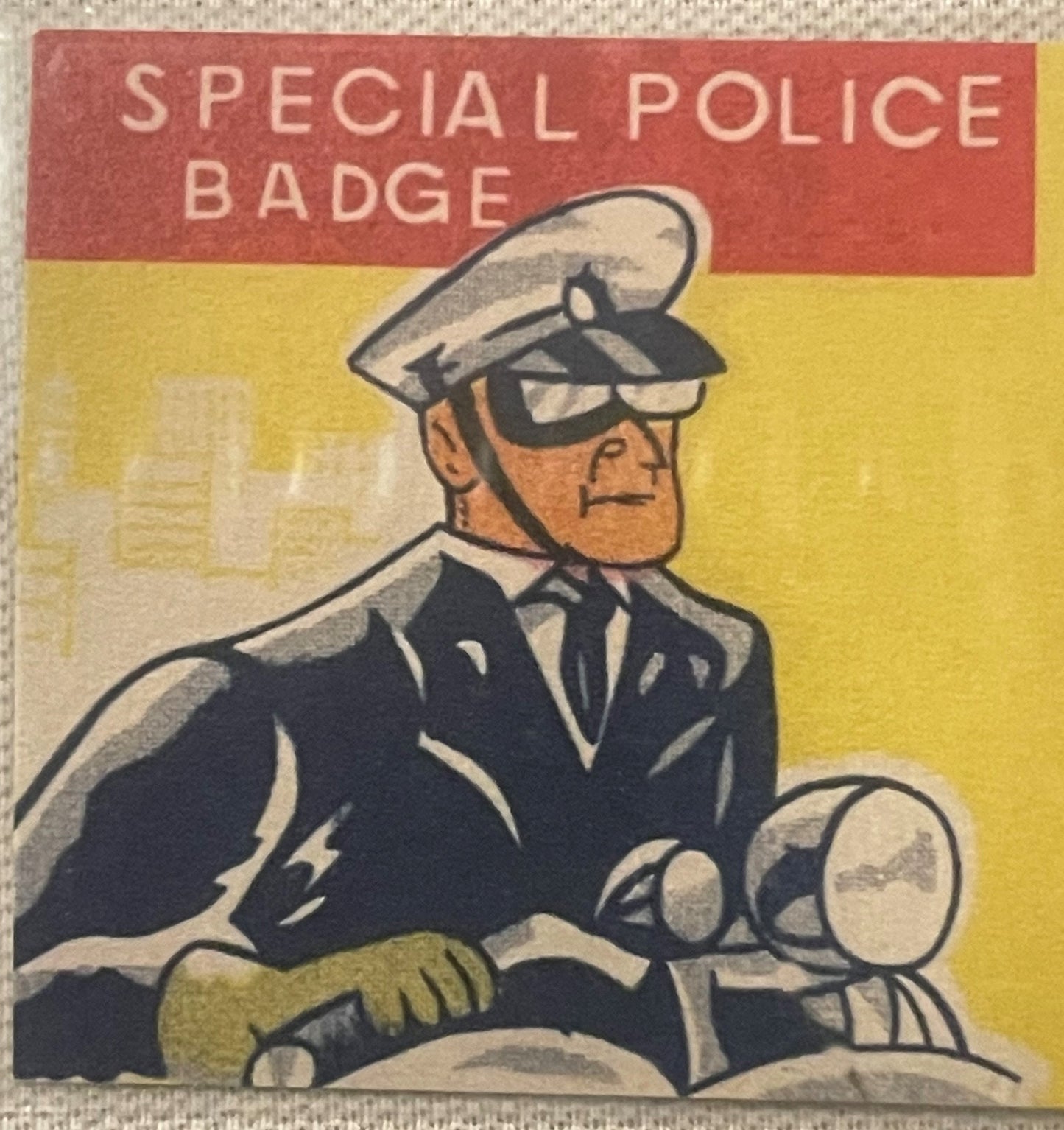
The display card is its own piece of mid-century graphic art. A bold illustrated motorcycle officer dominates the left side — navy uniform, white peaked cap, dark glasses, jaw set with the kind of cool authority that mid-century illustrators did better than anyone before or since. He is riding into the frame with real attitude, hands on the bars, shoulders squared. The header above him reads SPECIAL POLICE BADGE in white lettering on a red field. At the lower right corner of the card, a single word: JAPAN. That word opens a remarkable story.

---

🌏 Made in Japan — And Why That Word on the Card Matters So Much

To a casual eye, "Japan" stamped on the card of an American novelty item might seem like a footnote. To a collector, it is a chapter heading. In the years following World War II, Japan's industrial manufacturing base had been largely dismantled, and an extraordinary effort was undertaken to rebuild it — to restore the workshops, the presses, the lithography lines, and the skilled labor that had made Japan a manufacturing force before the war. Among the first industries to come back online were the tin toy and novelty factories — small and mid-sized workshops with deep roots in Japanese craft tradition, now finding a vast and ready American audience hungry for cheerful, inexpensive consumer goods.

These novelty badge sets — a tin lithograph badge, a colorful illustrated card, the whole package sealed and racked — became one of the signature exports of that rebuilding era. They showed up on spinner racks in five-and-dime stores, in drugstores, in corner shops and variety stores from the Atlantic coast to the Pacific. Children bought them for pennies. Parents tucked them into birthday bags. Halloween costumes got their finishing touch. Most were played with, bent, pinned to shirt fronts, and eventually lost to time. A tiny fraction survived still mounted on their original cards.

Lore passed down among collectors of postwar Japanese tin novelties holds that General Douglas MacArthur and the Allied occupation administration specifically championed the restart of export manufacturing as a path to Japanese economic self-sufficiency — and that novelty tin items, including carded badge sets exactly like this one, were among the earliest products flowing out of rebuilt Japanese factories and into American hands. The story goes that MacArthur understood, with a general's clarity, that economic recovery and political stability were the same project — and that getting cheerful, harmless consumer goods onto American store shelves was a way to accomplish both at once. Whether that precise policy connection can be traced in official documents or not, the result is sitting right here: a Japanese-made novelty that landed on an American rack, was never sold, and has survived complete.

The specific factory that produced this badge remains unidentified — and that is entirely typical of the category. Japan's postwar novelty and toy export trade was built on hundreds of small, largely anonymous workshops. Items were marked with the country of origin as required by US customs law, and the importer or distributor sometimes appeared on packaging, but the actual factory almost never did. What we know is the craft: the color lithography on tin at this scale, with this registration and this color saturation, represents the accumulated skill of a manufacturing tradition that peaked in the mid-century decades and has never quite been replicated since. You are not looking at mass production in the modern sense. You are looking at hand-guided craft at industrial scale — a distinction that every serious collector of this material understands the moment they hold a piece.

---

🗺️ Suffolk County, New York — The Name on the Badge and What It Carried

The seal on this badge reads County of Suffolk, New York, and that specific geography gives the piece its local anchor and its collector appeal. Suffolk County occupies the eastern two-thirds of Long Island — a place whose history runs from the earliest English settlements in the American colonies through the explosive postwar suburban expansion that made Long Island one of the most consequential pieces of American real estate in the mid-twentieth century. The iconic Suffolk bull at the center of the county seal is a direct reference to that agricultural heritage, a reminder that before the subdivisions and the highways, eastern Long Island was farming country, and the bull was its emblem.

By the mid-century era when badges like this were being produced, Suffolk County was in the middle of a profound transformation. The postwar housing boom was reshaping the western end of the county — Levittown was just over the Nassau border, and the energy of that expansion was spreading east. A new generation of Long Islanders was growing up in brand-new houses on brand-new streets, and the culture around them — the five-and-dimes, the drugstore racks, the novelty goods — reflected an America that was prosperous, confident, and thoroughly in love with its own iconography. A child in Brentwood or Hauppauge or Bay Shore could walk into a shop and buy a badge that named their own county. That specificity mattered. It still does.

It is worth being clear, because the question does come up: this badge carries the County of Suffolk name and seal as decorative heraldry, not as official police insignia. No law enforcement agency issued it, no officer ever wore it on duty. It was a novelty — a beautifully made, geographically specific piece of Americana designed to delight a child and, decades later, to delight a collector. The Suffolk County Police Department as a consolidated county-wide agency came together around 1960; before that, policing across the county was handled by a patchwork of town and village departments and the New York State Police. A badge reading "County of Suffolk" in this era was reaching for an aspiration as much as a reality — which, in its own way, is a very American thing to do.

Local legend in Long Island collector circles holds that these Suffolk County badge novelties were particularly popular on the Island itself — that they sold especially well in the shops along Sunrise Highway and Jericho Turnpike, the commercial spines of mid-century suburban Long Island, where a kid could spend a Saturday afternoon browsing the racks and come home with something that felt like it belonged specifically to here. Whether that particular story can be traced to a specific shop or a specific rack, the geographic instinct behind it is real: these regionally branded novelties had a pull that generic designs simply did not.

---

🎨 The Art of Tin Lithography — Why This Printing Process Makes It Special

Color lithography on tin is a process that demands precision at every stage, and the results, when the craft is at its best, are unlike anything a later printing technology produces. The ink is applied to the metal surface in successive passes, each color registered to the others with tolerances that, at this scale, required genuine skill to hold. The result is a surface that is simultaneously part of the metal and sitting on top of it — the colors have a depth and a solidity that paper printing cannot match, and the slight curve of a pin-back button adds a dimension that makes the design read differently as the light angle changes.

Look closely at the eagle on this badge and you will see what I mean. The feather detail, the turn of the head, the tension in the wing position — these are not photographic reproductions. They are the work of an illustrator and an engraver translating a design through a medium that forgives nothing. Every line that is there had to be put there deliberately. Every color boundary had to be held. At 1.5 inches in diameter, the margin for error was essentially zero. The fact that the design reads as clearly and confidently as it does is a testament to a level of craft that the mid-century novelty trade produced routinely — and that we now recognize, with the distance of time, as genuinely remarkable.

---

🖼️ Display Ideas

  • 🗃️ Frame it as a card: A small shadow-box or deep frame with archival backing lets both the display card illustration and the badge face show together — the combination is the artifact, and it deserves to be seen whole.
  • 📌 Pin board grouping: Mounted on a linen or cork board alongside other mid-century carded novelties, tin badges, and dime-store ephemera, this piece anchors a display that tells the full story of postwar American consumer culture.
  • 🏛️ Local history vignette: Pair it with a vintage Long Island map, a mid-century Suffolk County postcard, and a period photograph of a local main street — the badge becomes the centerpiece of a curated slice of Island history.
  • 📚 Collector's reference shelf: Propped against a row of books on tin toy history, Japanese postwar manufacturing, or American novelty trade history, the badge becomes both decoration and primary source material.
  • 🎠 Toy and novelty themed display: Group it with other NOS carded Japanese novelties of the era — cap guns, tin cars, celluloid toys — for a display that captures the full visual energy of the mid-century dime-store aesthetic.
  • 🖼️ Law enforcement Americana wall: Alongside vintage police photography, precinct ephemera, and period badge reproductions, this piece adds a dimension of folk Americana to any collection focused on American law enforcement history and iconography.
---

🎁 Who Collects These

The collector base for a piece like this is genuinely wide, and that breadth is part of what makes NOS carded novelties so consistently sought after. Tin lithography collectors come first — people who understand the process, who can read the registration and the color work and immediately recognize what they are looking at. For them, a NOS carded example in this condition of survivorship represents exactly the kind of find that reference books describe but shops rarely produce.

Japanese postwar toy and novelty collectors form another strong constituency. The mid-century export trade produced an extraordinary range of material, and serious collectors of that world seek out examples from every product category — tin cars, friction toys, celluloid novelties, and carded badge sets like this one. The "Made in Japan" mark on a piece of this character is a provenance marker, not a diminishment.

Long Island and Suffolk County local history enthusiasts bring a third angle entirely. For a collector whose family has roots in Brentwood, Smithtown, Huntington, or anywhere across the eastern Island, a mid-century piece bearing the County of Suffolk seal is a direct connection to the geography and the era of the place they love. These buyers are not necessarily tin specialists — they are place specialists, and this badge speaks their language.

Law enforcement Americana collectors round out the picture. The iconography here — the eagle, the banner, the bull seal, the motorcycle officer on the card — draws from the same visual tradition as genuine badge design, and collectors who focus on police Americana appreciate the folk-art dimension of a novelty that so earnestly and lovingly mimics the real thing. It belongs in that conversation, even as it sits proudly outside it.

And then there is the straightforward nostalgia collector — someone who grew up on Long Island, who remembers the five-and-dime, who had a badge like this once and lost it to childhood, and who wants it back. For that person, this piece is not an artifact. It is a memory made physical.

---

❓ Frequently Asked Questions

Is this an actual Suffolk County Police Department badge?

It is not, and I want to be completely straightforward about that because it matters. This is a novelty pin-back badge — a beautifully made tin lithograph piece produced for the American dime-store and variety-store market, carrying the County of Suffolk name and seal as decorative heraldry. No police agency issued it, no officer wore it on duty, and it carries no law enforcement authority of any kind. What it is is a genuinely wonderful piece of mid-century Americana — a folk-art object that drew from the visual language of real badge design and produced something that, decades later, tells its own story with complete integrity. Collectors value it for exactly what it is.

What does "New Old Stock" (NOS) mean for this piece?

New Old Stock means this badge and display card survived together, unmounted and unsold, from their original retail context — they were never separated, never put into play, never displayed as anything other than what they were when they left the factory. In a category where most examples were purchased, pinned to a child's shirt, and eventually lost, an NOS carded example represents a genuinely uncommon survival. The card and the badge together are the artifact; the combination is what the collector is acquiring, and it is the combination that almost never makes it through the decades intact.

What era does this piece come from?

The "JAPAN" mark on the card — rather than "Made in Occupied Japan," which was required specifically during the Allied occupation period ending in 1952 — places this piece in the post-occupation export era, the period when Japanese novelty and toy manufacturing was operating at full strength and shipping to American retailers in volume. The graphic style of the display card illustration — that bold, confident mid-century commercial art approach, the motorcycle officer with the dark glasses and the squared shoulders — is entirely consistent with the visual culture of that same period. Style and manufacture mark together tell a coherent story.

Who made it, and can the specific factory be identified?

The specific manufacturer is not identified on the piece, and this is characteristic of the category rather than a gap in research. Japan's postwar novelty export trade was built on a network of small and mid-sized workshops, many of which marked only the country of origin on their goods as required by US customs regulations. The importer or distributor sometimes appeared on packaging or master cases, but the factory itself rarely did. What we know is the craft tradition — color lithography on tin at this scale and with this level of detail represents the accumulated skill of a manufacturing culture that had been developing these techniques for generations. The anonymity is part of the historical character of the piece.

What is the Suffolk bull on the county seal, and why is it there?

The bull on the County of Suffolk seal is a direct reference to the agricultural heritage of eastern Long Island. Before the mid-century suburban expansion transformed the western end of the county, Suffolk was farming country — and the Suffolk breed of cattle, which takes its name from the English county that gave many Long Island place names their origin, was a recognized part of that agricultural identity. The seal's use of the bull reaches back to that older, rural Suffolk County, the one that existed before Levittown and the parkways and the postwar housing boom. It is a piece of genuine heraldic history embedded in what is, on one level, a child's novelty badge — and that layering is exactly what makes these pieces worth studying.

How should I store or display this piece?

The cardinal rule for paper-backed tin novelties like this is to keep them away from humidity and direct light. Both the card stock and the tin lithography respond poorly to moisture over time, and prolonged direct sunlight will affect the color saturation of any printed surface. A shadow box with UV-filtering glazing is the gold standard for display — it lets you show the piece in full while protecting both components. If you are storing rather than displaying, acid-free materials are your friend: an archival sleeve or envelope for the card, a stable environment with consistent temperature and humidity. The piece has made it this far; the right storage keeps it going.

Is this the kind of piece that tends to appreciate in collector value over time?

NOS carded novelties from the postwar Japanese export era have shown consistent collector interest, and the specific appeal of regionally identified pieces — those carrying a named American city, county, or institution — tends to run stronger than generic designs. A badge that says "County of Suffolk, New York" speaks to Long Island collectors, law enforcement Americana collectors, tin lithography specialists, and postwar Japanese toy enthusiasts all at once. That breadth of audience is meaningful. Beyond market dynamics, though, what I can say with confidence is this: pieces like this are becoming genuinely harder to find in NOS carded form. The supply is finite. The collectors who understand what they are looking at are not decreasing in number. That combination tends to tell its own story over time.

⭐ When Kids Really Did Get Badges from the Law

The mid-century American childhood this badge comes from was full of real badges given by real officers. Junior deputy programs let sheriffs swear in schoolkids as honorary deputies; school safety patrol programs, organized since the 1920s, put badges and belts on millions of children; police departments handed out badges at parades, fairs, and classroom visits as a matter of civic routine. A Suffolk County badge was the dime-store cousin of all that — the badge a kid could buy with pocket change. That documented world of junior programs is the backdrop this little survivor belongs to.

Shipping

🚚 Shipping & Handling

  • Shipping costs and timing are calculated at checkout.
  • Items curated and shipped directly by me include U.S. shipping at no additional cost, professionally packed to ensure safe arrival of your artifact.

Items from Vetted Pro Collectors
Shipping for items offered by vetted Pro Collectors is determined at checkout. All Pro Collector listings are reviewed to ensure fair, reasonable shipping practices.

For full details, please refer to our Shipping Policy.

Returns & Exchange

Take your time — you've got a full six months. If a piece isn't right for you, send it back the way it reached you and we're good.

In the first 30 days your money goes straight back the way you paid. After that it's store credit, so you can put it toward something you'd rather have.

Return shipping we sort out between us, case by case. I don't make this difficult.

If something arrives damaged, or it isn't what I said it was, send me a photo within 48 hours and I'll make it right.

Email info@vintageantiquesgifts.com or call 802-356-9872 — that's me answering, not a call center.

The only things I can't take back are custom or special-order pieces and gift cards.

View full details