
Skip to product information
1 of 4

Vintage and Antique Gifts

Vintage 1960s Buy American Not Japan Pin 🔧 Wesco Westinghouse NOS 2¼" Made in USA

Vintage 1960s Buy American Not Japan Pin 🔧 Wesco Westinghouse NOS 2¼" Made in USA

Regular price $9.00 USD
Regular price Sale price $9.00 USD
Sale Sold out
Shipping calculated at checkout.

Size: 2 1/4"

🚚 Free US Shipping — ships within one business day. International shipping calculated at checkout.

Quantity

Buy American, Not Japan? 🔧 Vintage 1960s Wesco Westinghouse Pin, NOS 2¼"

Size: 2 1/4"

🔧 Four words, a flag and a heavy black X. This vintage 1960s "BUY AMERICAN NOT JAPAN" pinback button carries one of the longest-running slogans in American trade politics, and it says it without a single soft edge: bold blue letters, the red-disc national flag of Japan boxed and crossed out, and MADE IN U.S.A. printed across the bottom. Turn it on its side and the rolled edge carries the name WESCO with an Indianapolis telephone number. WESCO was the Westinghouse Electric Supply Company, the electrical supply arm Westinghouse founded in 1922, the same Westinghouse whose factories hung the "We Can Do It!" poster in 1943. It is a big 2 1/4 inch button, and it is new old stock, never worn.

The button takes a side. The history behind it is worth telling straight, because the slogan is older than the pin, outlived it, and had consequences that reached far beyond a lapel.

🧰 What Is Printed on the Pin

Across the top arc, in blue capitals, the button reads BUY AMERICAN, with NOT set beneath it. In the center a black-outlined box holds a red disc on a white field, the national flag of Japan, struck through corner to corner by two rough black brush strokes. Under the box the word JAPAN is printed small in red, and the bottom arc reads MADE IN U.S.A. in blue.

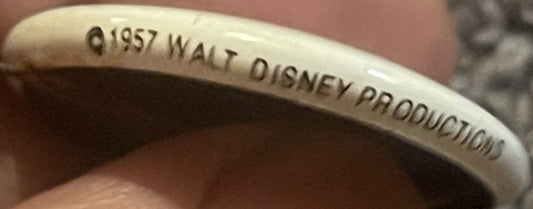
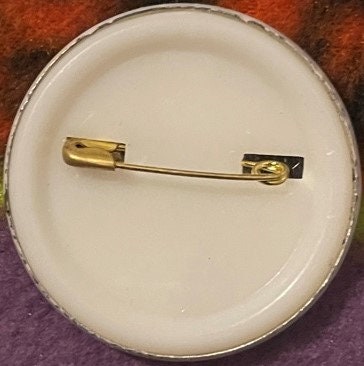
The printed face sits under a clear glossy cover crimped around a metal shell. The back is bright bare metal with a straight pin bar and clasp. Turn the button on its side and the printed face wraps over the rolled edge, where the name WESCO is printed, followed by a telephone number in Indiana's 317 area code.

🏭 WESCO: Westinghouse's Own Electrical Supply Company

The name on the rim belongs to one of the great American electrical companies. WESCO was the short name of the Westinghouse Electric Supply Company, founded in 1922 as the distribution arm of the Westinghouse Electric & Manufacturing Company to sell and distribute Westinghouse lighting and electrical products.

The short name is old. On December 9, 1948, the Westinghouse Electric Supply Company, "Wesco," moved into a new building on Pittsburgh's North Shore, and for years a large orange and blue sign on the Wesco roof carried the company slogan: "You can be sure...if it's Westinghouse." Westinghouse replaced it with a computer-controlled sign in June 1967, and that sign stood until the building came down in the autumn of 1998.

WESCO stayed a Westinghouse company for more than seventy years. The parent renamed itself Westinghouse Electric Corporation in 1945, and in February 1994 it sold the distribution business to the private equity firm Clayton, Dubilier & Rice, which set it up as Wesco Distribution. WESCO still runs a branch in Indianapolis.

The telephone number on the curl does the locating. Area code 317 was one of the original area codes laid out in 1947. From 1948 it covered central Indiana, with Indianapolis at its heart, and it kept that territory until February 1, 1997, when the outlying counties moved to 765. Today the 862 exchange is assigned to Acton, in the southeast corner of Marion County, a community that has been part of the city of Indianapolis since the Unigov law of 1969.

🎖 Westinghouse and "We Can Do It!"

The WESCO name ties this button to the company behind "We Can Do It!" In 1942, Westinghouse's War Production Coordinating Committee, one of hundreds of labor-management committees organized under the national War Production Board, hired Pittsburgh artist J. Howard Miller to create a series of posters for its plants.

One of them was "We Can Do It!" It was scheduled to hang for two five-day work weeks starting Monday, February 15, 1943, in Westinghouse factories in East Pittsburgh and the Midwest, and no more than 1,800 copies were printed. It was made for workers already on the job, not for recruiting, and after the war it disappeared for nearly four decades. In 1982 it was reproduced in a Washington Post Magazine article about posters in the National Archives, and it was soon widely reproduced and tied for good to the name Rosie the Riveter. The National Archives holds it today.

Told as Westinghouse history, this button sits between the company's wartime "We Can Do It!" poster and the louder Buy American fights of the 1970s and 1980s. The wartime poster was about keeping production up to win a war. By the 1960s the worry had turned to keeping factory orders and jobs at home, and a crossed-out flag on a button carrying the WESCO name put that worry on a lapel.

📻 Westinghouse on the Store Shelf

Westinghouse felt the Japanese imports on its own shelf space. In 1960 only 2,000 imported televisions were sold in the United States; by 1969 nearly 2 million of the 13.3 million sold came from abroad, largely from Japan. In 1960, 7.5 million of the 24.4 million radios sold here were imported, and in 1969 imported radios reached 29 million units, the first time foreign-made radios topped half of all radios sold. Shelves once dominated by RCA, Zenith, Admiral, Westinghouse, GE, Emerson, Motorola and Philco filled with cheaper sets from Aiwa, Hitachi, Kenwood, Pioneer, Sansui, Sharp, Sanyo and Toshiba.

The American television industry and its workers fought back. On March 10, 1971, the Treasury found that Japanese television sets were being dumped in the United States, and the Committee to Preserve American Color Television, representing members of the U.S. television industry and its workers, went to court against the April 28, 1980 settlement of those dumping duties.

📚 A Slogan Older Than the Pin

"Buy American" did not begin with Japan. In late 1932 and early 1933, at the bottom of the Depression, William Randolph Hearst turned his 27 daily newspapers, with a combined circulation of 5.5 million, into a Buy American campaign that ran editorials, testimonials, articles and cartoons every day for three months under the message "Buy American and spend American."

The idea became federal law almost at once. President Herbert Hoover signed the Buy American Act on March 3, 1933, his last full day in office, requiring the United States government to prefer U.S.-made products in its own purchases.

⚖️ Why Japan

After the Second World War, Japan rebuilt its economy on exports, and the United States was its major market. The first quarrel was over clothing. The Japanese "dollar blouse" of the mid-1950s glutted American stores so thoroughly that it soon sold for well under a dollar, American protests followed in 1956, and in 1957 Japan agreed to restrain its cotton textile exports to the United States for five years.

The quarrels then moved from industry to industry. Japanese steelmakers began restraining their exports to the United States in January 1969. President Richard Nixon opened talks on synthetic and wool textiles in 1969, and that agreement was signed in January 1972. Colour televisions were placed under an orderly marketing agreement in 1977, and in 1981 Japan agreed to restrain its car exports to the United States, a limit that ran until 1994. In October 1985 the Plaza Accord was adopted at a meeting of G-5 finance ministers to correct the trade imbalances, and in 1986 the two countries signed their first semiconductor agreement.

A pin like this one put that whole argument on a lapel. "Buy American" was the demand, "not Japan" named the rival, and "Made in U.S.A." on the bottom arc made the button its own example.

🔨 The Anger Beyond the Button

By the early 1980s the argument had turned physical in the auto towns. On March 3, 1981, members of United Auto Workers Local 588 from Ford's stamping plant in Chicago Heights, Illinois, took sledgehammers and bars to a 1975 Toyota Corolla at a rally against buying foreign-made products. Autoworkers smashing Japanese cars in protest became the picture of the "Japan-bashing" trade friction of the 1980s.

The cost fell on people who had nothing to do with any of it. On June 19, 1982, in Highland Park, Michigan, Vincent Chin, a 27-year-old Chinese American draftsman, was beaten by a Chrysler plant supervisor and a laid-off autoworker who took him for Japanese, and he died four days later. The two men were sentenced to three years' probation and $3,000 fines, with no jail time, and the Detroit Chinese Welfare Council called the sentence "a $3,000 license to kill." A federal civil rights conviction followed in 1984, was overturned on appeal in 1986, and ended in acquittal on retrial.

That is why a button like this belongs in a history collection. It records how ordinary Americans argued about factories, jobs and imports for half a century, and it is a reminder of where that argument could lead.

🎖 Size and Condition

The button measures 2 1/4 inches across, a large size with real presence next to the one-inch campaign buttons most people picture. It is new old stock: never worn, never pinned to a jacket, with its pin bar and clasp intact and its blue, red and black printing bright.

❓ Questions People Ask

What does the crossed-out flag on this pin mean?

The red disc on white is the national flag of Japan. Crossed out beneath "BUY AMERICAN NOT," it turns the button into a trade-protest slogan urging buyers to choose American goods over Japanese imports.

What does WESCO on the edge of this button mean?

It is the short name Westinghouse used for its distribution business, set up in 1922 and sold in 1994. On this button it is printed on the rolled edge beside an Indianapolis telephone number.

What does this button have to do with the "We Can Do It!" poster?

Both belong to Westinghouse history. J. Howard Miller made "We Can Do It!" for Westinghouse's War Production Coordinating Committee, and it hung in Westinghouse factories in February 1943. The rim of this button names the company's supply arm.

Is this pin new old stock?

Yes. It has never been worn, and the pin bar and clasp are intact.

How big is the button?

2 1/4 inches across.

When did "Buy American" campaigns target Japan?

The slogan dates to the Hearst newspapers' campaign of late 1932 and the Buy American Act of 1933. Japan became its target as trade disputes moved from textiles in the 1950s to steel, televisions and cars in the decades that followed, peaking in the car-smashing rallies of the early 1980s.

🧷 Good For

Collectors of protest, political and labor buttons; Westinghouse and electrical-industry memorabilia; Indiana and Indianapolis memorabilia; anyone teaching or studying the history of U.S.-Japan trade and the American auto industry; a shadowbox beside union pins, campaign buttons or a "We Can Do It!" print; or wearing on a denim jacket, a work shirt or a bag.

You will receive one vintage 1960s WESCO slogan button, 2 1/4 inches across, new old stock.

Shipping

🚚 Shipping & Handling

  • Shipping costs and timing are calculated at checkout.
  • Items curated and shipped directly by me include U.S. shipping at no additional cost, professionally packed to ensure safe arrival of your artifact.

Items from Vetted Pro Collectors
Shipping for items offered by vetted Pro Collectors is determined at checkout. All Pro Collector listings are reviewed to ensure fair, reasonable shipping practices.

For full details, please refer to our Shipping Policy.

Returns & Exchange

Take your time — you've got a full six months. If a piece isn't right for you, send it back the way it reached you and we're good.

In the first 30 days your money goes straight back the way you paid. After that it's store credit, so you can put it toward something you'd rather have.

Return shipping we sort out between us, case by case. I don't make this difficult.

If something arrives damaged, or it isn't what I said it was, send me a photo within 48 hours and I'll make it right.

Email info@vintageantiquesgifts.com or call 802-356-9872 — that's me answering, not a call center.

The only things I can't take back are custom or special-order pieces and gift cards.

View full details
  • 5 stars: 1 (100%)
  • 4 stars: 0 (0%)
  • 3 stars: 0 (0%)
  • 2 stars: 0 (0%)
  • 1 star: 0 (0%)
S
Stacy

Seller is fast, great packaging, love the note!

Preserving History: Authentic Objects Across Eras

— Curated by Travis Weigel