Skip to product information
1 of 4

Vintage and Antique Gifts

Vintage Large 1960s-70s Silver Special Police Toy Badge ๐Ÿš” Nostalgic Memorabilia

Vintage Large 1960s-70s Silver Special Police Toy Badge ๐Ÿš” Nostalgic Memorabilia

Regular price $10.00 USD
Regular price Sale price $10.00 USD
Sale Sold out
Shipping calculated at checkout.

Size: 3 1/4" x 2 3/4"

๐Ÿšš Free US Shipping โ€” ships within one business day. International shipping calculated at checkout.

Quantity

Who Was the Cop With His Hand Up? ๐Ÿฆ… Vintage Special Police Toy Badge, Made in Hong Kong

Size: 3 1/4" x 2 3/4"

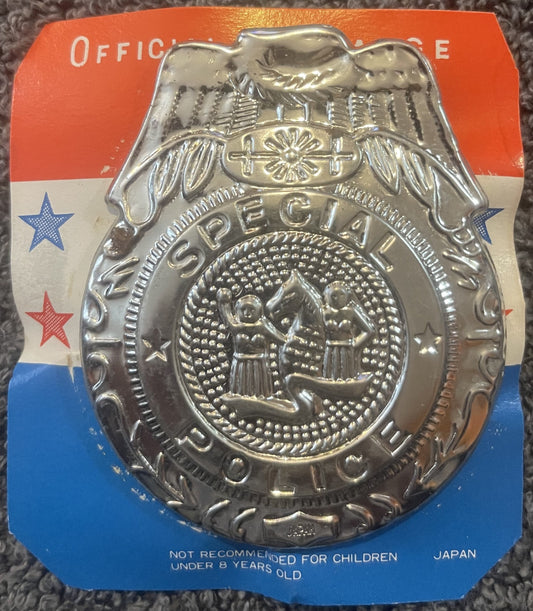
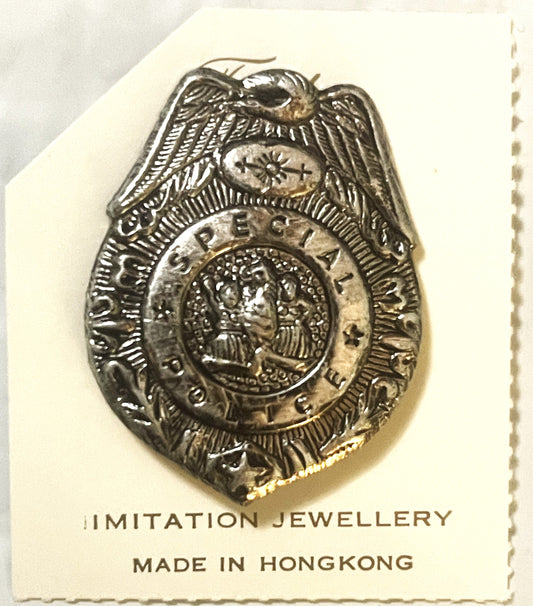
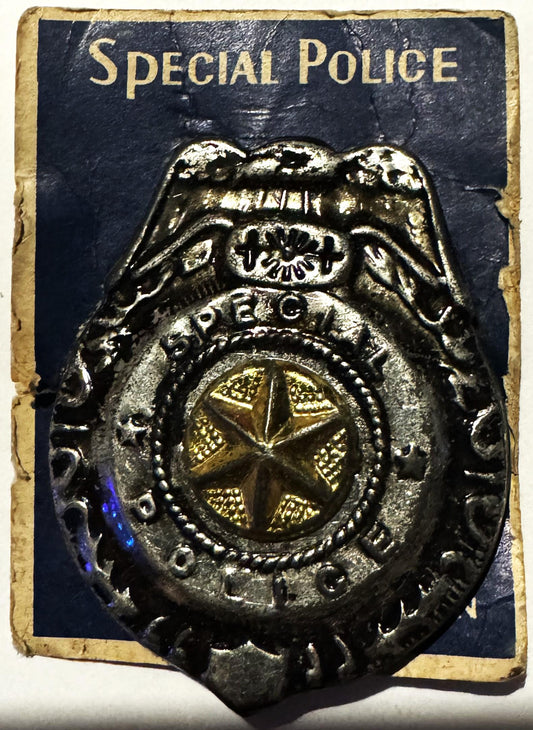
This is a big one. A dime-store Special Police badge, three and a quarter inches tall, with a spread-winged eagle across the top, a laurel wreath running all the way around the edge, and SPECIAL over POLICE on a black ring with a little star at each side. Right in the middle is my favorite part: a round-faced traffic cop in a peaked cap with his palm held up flat. Stop!

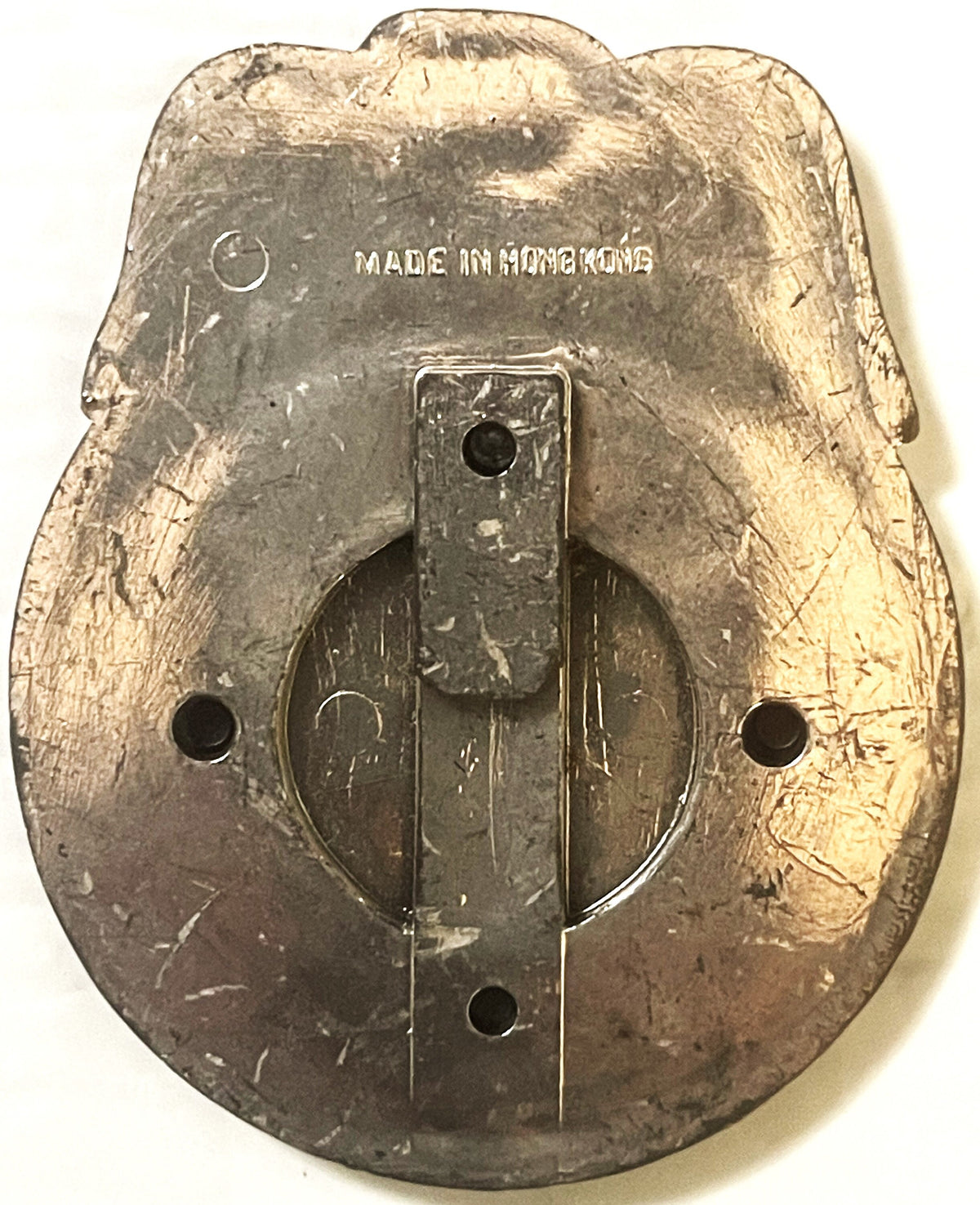
It is plastic, molded and finished in bright silver so it would shine like the real thing on a kid's shirt. Turn it over and MADE IN HONG KONG is raised right in the plastic, with the clip molded into the back. A toy, plain and simple, never police issue, and that is the whole charm of it.

๐Ÿ‘ฎ The Traffic Cop

Before there was a signal light on every corner, a policeman stood in the middle of a busy intersection and ran it with his arms, and when his hand went up, everything stopped. The first electric traffic signal went up in Cleveland in 1914, but it was decades before lights reached every town, so for a kid growing up the traffic cop was the most visible policeman there was.

The hand signal is older than any light. London tried the first red-and-green signal outside the Houses of Parliament in 1868, John Peake Knight's invention, with a police constable working its semaphore arms by hand, and it was taken down in January 1869 after it blew up. In 1912 a Salt Lake City policeman named Lester Wire came up with an electric traffic light, in 1914 the American Traffic Signal Company put one up on Euclid Avenue in Cleveland, and in 1920 William Potts of Detroit built the first four-way, three-color light, the one that added the amber. Even then an officer often sat at the controls, switching the signals by hand, and it took until the 1920s for automatic timers to start replacing him.

๐Ÿšจ What "Special Police" Meant

The words were not made up for the toy. Towns all over the country swore in special police, auxiliaries and reserves to help when the regular force was stretched thin. San Jose, California is a good example: the day after Pearl Harbor, Chief John N. Black called for a civilian emergency police unit, and the department's own badge history says those early Auxiliary, Reserve or "Special Police" badges were made from chrome, tin and nickel, because other metals had to be saved for the war effort.

This badge is not one of those, and the back of it tells you so.

๐Ÿญ Made in Hong Kong

Hong Kong was under Japanese occupation from December 1941 until August 1945, so nothing made there reached American shops during the war. After it, industrialists forced out of mainland China by the civil war settled in Hong Kong and opened plastic factories, most of them a few hundred square feet with a handful of hand-set pressing machines. By the mid-1950s plastic toys were catching on, and after 1965 they took over completely. Hong Kong became known as the "Kingdom of Plastic Toys".

The first big plastics firms there, China Plastic Company and Kadar, were set up in 1946 and 1947, but most of the industry was cottage work in tenement buildings and ground-floor shops, often started on a few thousand dollars. In the early 1960s a lot of those shops went over to plastic flowers, then toys took over, and by 1972 Hong Kong was the biggest toy exporter in the world.

A badge like this came out of those little workshops and went straight to the five-and-dime toy counter, next to the cap guns and the toy handcuffs.

๐Ÿค  Heroes of the Day

Kids who pinned one of these on were playing out the heroes they heard on the radio and saw at the Saturday matinee, like The Lone Ranger and Dick Tracy. Both got their start in Detroit: Dick Tracy first chased crooks in the Detroit Mirror in 1931, and The Lone Ranger rode onto the air at WXYZ in 1933.

Chester Gould's Dick Tracy first ran on October 4, 1931, and Gould wrote and drew him until 1977. Tracy went on the radio in 1934, and on January 13, 1946 he strapped on his famous 2-Way Wrist Radio, decades before anybody wore a phone on their wrist. The Lone Ranger premiered on WXYZ on January 31, 1933, dreamed up by station manager George W. Trendle and writer Fran Striker, and ran for 2,956 radio episodes before Clayton Moore put on the mask for television from 1949 to 1957. A kid with a silver badge on his shirt and a cap gun on his hip was one of them for the afternoon.

๐Ÿ“ฆ What You Get

You will get one like the one shown. It measures 3 1/4" x 2 3/4". Frame it with other dime-store badges, pin it on a jacket for fun, or give it to anybody who grew up playing cops and robbers. The supply is finite - nobody's making these Special Police toy badges again, and once these last ones are gone, they'll be very difficult to acquire.

Shipping

๐Ÿšš Shipping & Handling

  • Shipping costs and timing are calculated at checkout.
  • Items curated and shipped directly by me include U.S. shipping at no additional cost, professionally packed to ensure safe arrival of your artifact.

Items from Vetted Pro Collectors
Shipping for items offered by vetted Pro Collectors is determined at checkout. All Pro Collector listings are reviewed to ensure fair, reasonable shipping practices.

For full details, please refer to our Shipping Policy.

Returns & Exchange

Take your time โ€” you've got a full six months. If a piece isn't right for you, send it back the way it reached you and we're good.

In the first 30 days your money goes straight back the way you paid. After that it's store credit, so you can put it toward something you'd rather have.

Return shipping we sort out between us, case by case. I don't make this difficult.

If something arrives damaged, or it isn't what I said it was, send me a photo within 48 hours and I'll make it right.

Email info@vintageantiquesgifts.com or call 802-356-9872 โ€” that's me answering, not a call center.

The only things I can't take back are custom or special-order pieces and gift cards.

View full details

Rescuing American History Since 2007

โ€” Travis & the Kids