Skip to product information
1 of 7

Vintage and Antique Gifts

Vintage 1990 TMNT Movie Pinback Button 🐀 Splinter Teenage Mutant Ninja Turtles Button-Up Troy MI

Vintage 1990 TMNT Movie Pinback Button 🐀 Splinter Teenage Mutant Ninja Turtles Button-Up Troy MI

Regular price 6.00 USD
Regular price Sale price 6.00 USD
Sale Sold out
Shipping calculated at checkout.
Quantity

🐀 Do You Remember the First Time Splinter Looked You Right in the Eye From a Movie Poster?

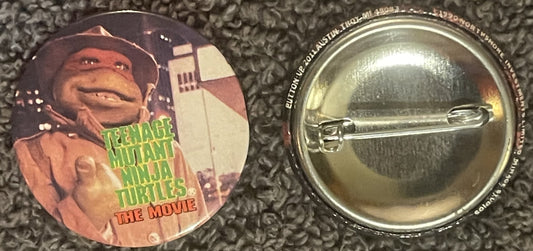
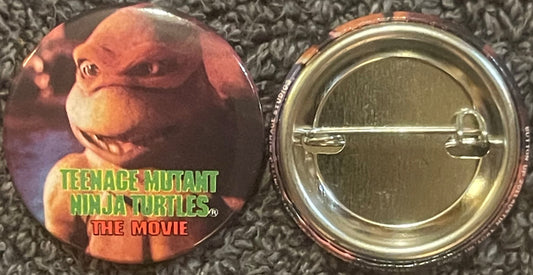
There's a particular kind of hush that fell over kids in 1990 when the lights went down and a life-sized, breathing, real Master Splinter shuffled into frame for the first time. Not a cartoon. Not a cel-animated rat with a friendly, rounded muzzle — a genuinely eerie, whiskered, hunched old sensei who looked like he'd stepped straight out of a fever dream and a dojo at the same time. That's the exact moment frozen on this little pin: Splinter's face, close and shadowed, caught mid-gesture as if he's about to speak. If you were a kid clutching a movie ticket stub or begging your mom for one more spin through the toy aisle that year, this button was part of your world, whether you owned it then or are only now getting to hold one.

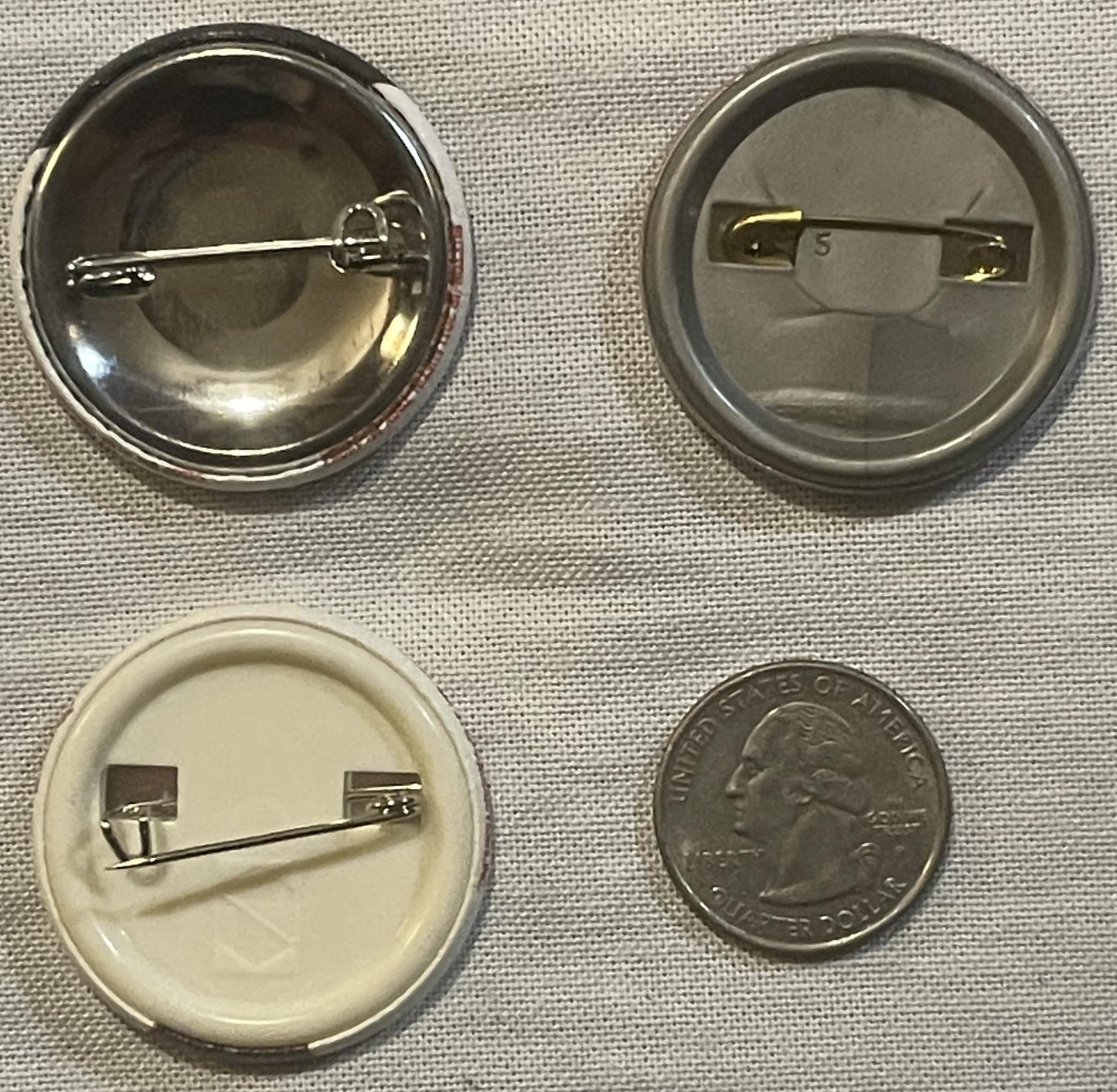
This is a New Old Stock pinback button from the "Button-Up" novelty line, produced to promote the 1990 live-action Teenage Mutant Ninja Turtles — The Movie, issued out of Troy, Michigan. It measures 1.5 inches (approximately 3.8 cm) across — a compact, wearable disc sized exactly like the collar pins, jacket pins, and backpack pins kids traded and stacked by the dozen back in the day.

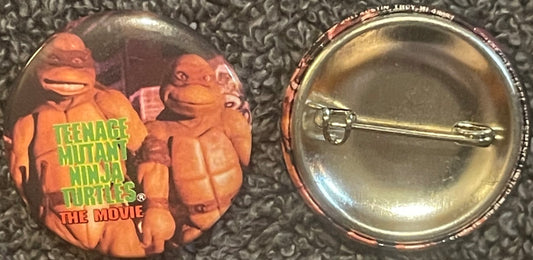
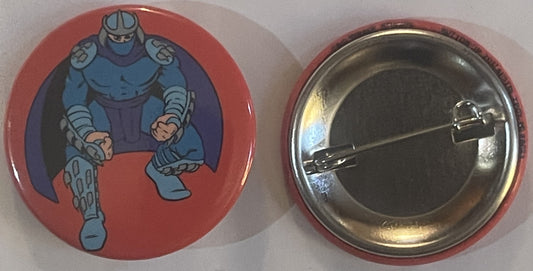
The face of the button is dominated by a tight, moody close-up of Splinter — his dark fur, his long trailing whiskers catching amber light, one clawed paw raised near his face — printed in offset lithography on tin in a palette of black, brown, green, yellow, and red. Below his portrait, the title runs in two punchy lines: "TEENAGE MUTANT NINJA TURTLES" rendered in a jagged, dripping green font outlined in yellow — that instantly recognizable "sewer-cool" lettering the whole franchise was built on — followed by "THE MOVIE" in bold red block letters underneath.

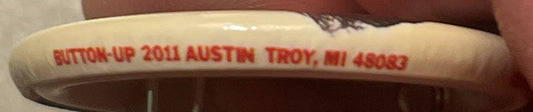
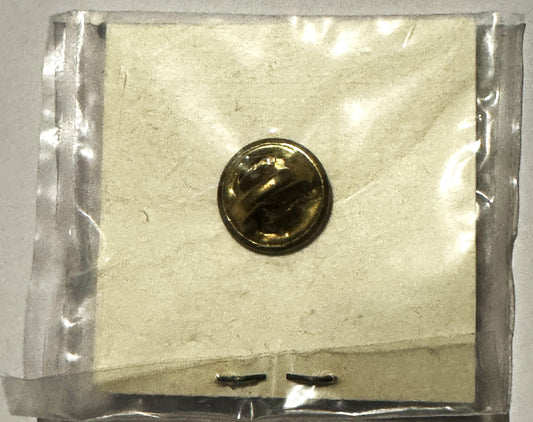
Around the rolled metal rim, in small printed text, the piece carries its own paperwork: the manufacturer's name and Michigan address, and the film's own copyright line. This one has never been worn, never been pinned to a jacket — it's been sitting exactly as it left the card decades ago, which is what "new old stock" means: unused retail stock, not a still-sealed promise of perfection, but genuine, unworn stock from the original run.


🎬 From Sewer Lair to Silver Screen: The Movie Behind the Button

To understand why this little button mattered so much to a kid in 1990, you have to understand how unlikely the movie behind it actually was. The Turtles had started years earlier as a scrappy, self-published black-and-white comic dreamed up by two young artists, Kevin Eastman and Peter Laird, who — as the story goes — sketched the idea in one loose, joking evening, with Laird pitching the notion of a team of four brothers, each one built around a different weapon. What began as something close to a one-off parody of gritty '80s comics (a mutated ninja rat sensei training four mutated ninja turtles in a New York sewer — how could that not be a joke?) instead struck a nerve, and by 1987 the characters had been licensed for a toy line that would go on to sell roughly $1.1 billion worth of action figures between 1988 and 1992 alone, making the Turtles one of the best-selling toy properties of all time up to that point.

The leap to a live-action feature film was, by most accounts, a genuine gamble. Major studios reportedly passed on distributing it, wary that turtles in ninja masks simply wouldn't translate to a two-hour movie audiences would pay to see. It took a then-small independent outfit, New Line Cinema, stepping in partway through production to get the film to theaters at all. Filming happened in North Carolina and New York City through 1989, under director Steve Barron, with a script credited to Todd W. Langen and Bobby Herbeck, and a cast led by Judith Hoag as April O'Neil and Elias Koteas as Casey Jones. When it finally opened, it didn't just do fine — it became the highest-grossing independent film of its era, pulling in more than $200 million worldwide against a reported production budget of around $13.5 million, and landing as one of the top-grossing films of 1990 overall. Nobody — least of all the studios who'd said no — saw that coming.

One quiet, poignant detail collectors and film buffs often pass along about this exact production: the elaborate, expressive turtle and Splinter costumes seen on screen were built by Jim Henson's Creature Shop, and this film is remembered as one of the very last projects Henson himself was involved with before his death shortly after the movie's premiere.

Every time you look at this button's close, textured portrait of Splinter, you're looking at a snapshot of that puppetry-and-practical-effects craftsmanship — the last gasp of a certain kind of movie magic before computer animation took over the next decade of blockbuster filmmaking.It isn't a toy company or a novelty printer — it was the UK-based rights-holding entity set up specifically to carry copyright for the first two Turtles feature films.That's exactly the line stamped around this button's edge, and it's a small but genuine piece of licensing history — proof that whoever printed this pin was doing so under the real, contractually correct chain of rights that ran from Mirage Studios' comic-book creators, through the film's production entity, down to a novelty item small enough to pin on a backpack strap.

It's the kind of tiny legal fingerprint that serious collectors love to find, because it dates and authenticates a piece more precisely than almost anything else could.


🏭 Button-Up and the Turtle Merchandising Explosion

By the time this pin rolled off the press, the Turtles weren't just a movie or a toy line — they were, quite simply, everywhere. Fans and historians of the era describe a merchandising wave so total that Turtle likenesses turned up on Pez dispensers, skateboards, breakfast cereal, video games, school supplies, bed linens, towels, cameras, even toy shaving kits. Buttons like this one were a small, inexpensive, endlessly collectible corner of that same tidal wave — the kind of item a kid could actually afford with allowance money, trade with a friend at recess, or pin to a jean jacket next to a dozen others.

The "Button-Up" name printed on this piece belonged to a real, retail-distributed novelty pinback line built specifically around the 1990 movie license — sold in multi-packs on card backs at the toy counters and five-and-dimes of the day, right alongside the action figures, cereal boxes, and lunchboxes. It's a modest kind of company by design: not a studio, not a Hollywood licensor, but one of the many small novelty operations that existed purely to turn a hot property into something a kid could hold in one hand for pocket change. Those operations rarely left behind the kind of corporate paper trail that Hollywood studios or toy giants did — no annual reports, no trade magazine profiles — which means the surest record of a company like Button-Up having existed at all is often the pin itself, still carrying its own maker's mark seventeen letters wide around a tin rim. That's part of what makes a surviving example like this one worth holding onto: it may be one of the more complete records left of a business that otherwise left barely a footprint.


📍 Troy, Michigan and the Novelty Button Trade

The address stamped on this button's rim places its maker in Troy, Michigan — a Detroit-area suburb that, through the postwar decades, built its own identity as a hub for small manufacturing, tooling, and specialty-goods operations feeding the greater Motor City economy. It's the kind of town where a business making pinback buttons for a Hollywood movie license and a business machining automotive parts might have sat blocks apart from one another, both quietly doing their part in a regional economy built on precision, small production runs, and quick turnaround. Old-timers around southeastern Michigan have long spoken of the area's knack for exactly this kind of niche manufacturing — nimble little operations that could take on a licensed run, a seasonal order, a promotional tie-in, and turn it around fast enough to hit a movie's release date. A Turtles novelty pin stamped with a Troy address fits that story well, even if the full details of this particular outfit's own history have mostly gone unrecorded, as so many small novelty and promotional-goods shops of the era have.


🐢 The People Who Made Turtlemania Real

Every face and name behind this little pin has its own story worth remembering. Kevin Eastman and Peter Laird are the two who first put pen to paper, spinning a joke sketch into a global phenomenon almost by accident. Steve Barron directed the film that finally brought Splinter and his four adopted sons to life-size, flesh-and-blood reality on movie screens. Judith Hoag and Elias Koteas anchored the human side of the cast as April O'Neil and Casey Jones. And Jim Henson's Creature Shop — in one of its final projects under Henson's own guidance — built the physical, puppeteered Splinter and Turtle costumes that made this whole story feel tactile and real instead of cartoonish, which is exactly why this button's close-up portrait of Splinter still has such presence: it's photographing genuine craftsmanship, not an illustration.

Collectors and old fans alike have long passed along a bit of insider chatter about just how far the Turtles' story would eventually run — whispers, even back in the pin-trading days, that this wasn't going to be the last time audiences saw these characters on the big screen. Whatever the exact final tally of Turtles films turns out to be across the decades, the fact that fans were already speculating about sequels and future reboots the moment this first movie hit theaters tells you everything about how big Turtlemania felt in the moment this pin was printed.


💥 Turtle Power Then and Now

The Turtles' commercial arc from a scrappy black-and-white comic to a billion-dollar toy phenomenon to a genuine box-office underdog story is one of the great pop-culture Cinderella tales of the era — and pieces like this button are the tangible, pocket-sized fossils of that arc's absolute peak. The property's ownership itself would eventually change hands entirely, moving well beyond its original creators in the years that followed, a reminder of just how far a joke sketched out on a kitchen table can travel. For collectors today, a surviving 1990 movie tie-in piece like this one isn't just Turtles nostalgia — it's a small, honest artifact of a specific cultural moment: the exact year an independent film outgambled the major studios, an animatronic rat sensei stared down millions of moviegoers, and a novelty button shop in a Michigan suburb got to be part of it all.


🖼️ Display Ideas

  • 🎞️ Pin it to a framed shadow box alongside a 1990 movie ticket stub or lobby card for an instant "opening weekend" tribute display.
  • 🧢 Clip it to a canvas messenger bag or denim jacket lapel exactly the way kids wore these back when the movie first hit theaters.
  • 🗄️ Set it in a small tabletop button stand or dedicated pin display case as the centerpiece of a growing TMNT collection.
  • 📚 Rest it on a bookshelf beside your original comics, action figures, or VHS copy of the film for a full-shelf 1990 tableau.
  • 🎁 Give it as a nostalgic gift to a lifelong Turtles fan who remembers exactly where they were the first time they saw Splinter on the big screen.
  • 🖼️ Frame it solo in a small round shadow-box frame — its close, moody portrait of Splinter holds up beautifully as a standalone piece of pop art.

🎁 Who Collects These

This little pin tends to find its way into a few very specific collections. First and most obviously, longtime Teenage Mutant Ninja Turtles fans building out a complete run of 1990 movie-era memorabilia — the ones chasing down action figures, cereal boxes, VHS tapes, and every pinback button they can find to round out that exact snapshot in time. Second, pinback and button collectors more broadly, who prize movie promotional buttons as a well-established sub-category of the hobby, sitting alongside political buttons and advertising pins as small, affordable slices of history. Third, collectors specifically drawn to Jim Henson's Creature Shop work, who value this piece as a rare printed close-up of one of Henson's last practical-effects creations. And finally, anyone shopping for a nostalgic gift for a specific person — a sibling, a spouse, a friend — who was exactly the right age in 1990 to have wanted one of these pinned to their backpack and never got the chance.


❓ FAQ

Is this an original 1990 piece, or a modern reproduction?

This button carries the film's own 1990 copyright line printed directly on its rim, confirming it as a genuine period piece tied to the original movie's release rather than a later reprint.

What condition is it in?

It's new old stock — meaning it's genuine unused retail stock from the original release, never pinned or worn.

How big is the button?

It measures 1.5 inches (about 3.8 cm) across, the classic size for movie and character pinback buttons of this era.

Who made this button?

It was produced under the "Button-Up" novelty line, based in Troy, Michigan, as a licensed tie-in to the 1990 Teenage Mutant Ninja Turtles film.

Does it depict a specific scene from the movie?

It features a close, atmospheric portrait of Master Splinter rather than a specific movie scene — the kind of striking single-character image commonly used for promotional buttons of this kind.

Is this a good gift for a Turtles fan?

It's an easy, meaningful gift for anyone who grew up with the 1990 film or who collects licensed movie memorabilia from that exact era — small, wearable, and instantly recognizable.

The maker's stamp on these pins rides the rim of the button itself — the same Mirage Studios rim marking that the entire series carries — while the back face is plain. Movie-style or cartoon-style, the artwork on the front is what tells you which release you are holding.

Shipping

🚚 Shipping & Handling

  • Shipping costs and timing are calculated at checkout.
  • Items curated and shipped directly by me include U.S. shipping at no additional cost, professionally packed to ensure safe arrival of your artifact.

Items from Vetted Pro Collectors
Shipping for items offered by vetted Pro Collectors is determined at checkout. All Pro Collector listings are reviewed to ensure fair, reasonable shipping practices.

For full details, please refer to our Shipping Policy.

Returns & Exchange

Take your time — you've got a full six months. If a piece isn't right for you, send it back the way it reached you and we're good.

In the first 30 days your money goes straight back the way you paid. After that it's store credit, so you can put it toward something you'd rather have.

Return shipping we sort out between us, case by case. I don't make this difficult.

If something arrives damaged, or it isn't what I said it was, send me a photo within 48 hours and I'll make it right.

Email info@vintageantiquesgifts.com or call 802-356-9872 — that's me answering, not a call center.

The only things I can't take back are custom or special-order pieces and gift cards.

View full details
  • 5 stars: 1 (100%)
  • 4 stars: 0 (0%)
  • 3 stars: 0 (0%)
  • 2 stars: 0 (0%)
  • 1 star: 0 (0%)
L
Lisa

Great purchasing experience. Fast to ship and receive. Purchase was exactly as expected.