Skip to product information
1 of 8

Vintage and Antique Gifts

Vintage 1970s Alcor Supply No. 2 Warehouse Broom Label 🦅 NOS Eagle, Miamisburg Ohio

Vintage 1970s Alcor Supply No. 2 Warehouse Broom Label 🦅 NOS Eagle, Miamisburg Ohio

Regular price $7.00 USD
Regular price Sale price $7.00 USD
Sale Sold out
Shipping calculated at checkout.

🚚 Free US Shipping — ships within one business day. International shipping calculated at checkout.

Quantity

🦅 Why Did a Miamisburg, Ohio Supply House Put an American Eagle on a Warehouse Broom?

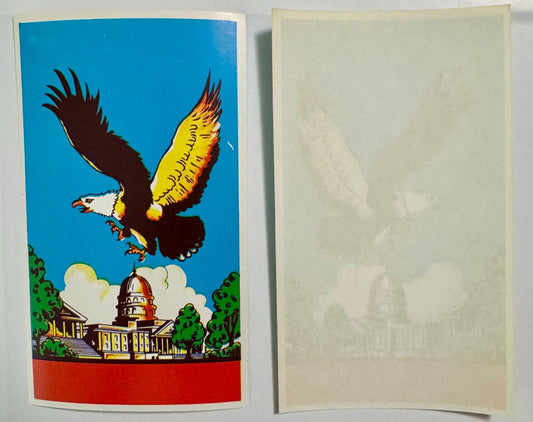
Size: 6" x 3 1/2" ~ New Old Stock, little to no wear.

Somewhere in a stockroom, behind a lunch counter, or at the end of a loading dock there was always a broom standing in the corner, and somebody once decided it deserved a bald eagle. That decision is what I'm offering here: an eagle in full cry, made to announce a working broom and nothing grander. I love paper like this because it was never meant to be art. It was meant to say this is a good one, and it said so with the biggest symbol in the American vocabulary.

This is a vintage No. 2 Warehouse broom label carrying the imprint of Alcor Supply of Miamisburg, Ohio. It is New Old Stock (NOS), an unused label from old inventory and an excellent example of 20th-century American advertising art. It dates to the 1970s, and the Alcor section below shows how. At 6 x 3 1/2 inches (about 15 x 9 cm) it is a natural size for framing.

No. 2 Warehouse is the grade, and Warehouse meant a heavy broom for big floors and hard use.


🏢 Alcor Supply: The Name on the Label

Alcor isn't a vanished name. It is a Miamisburg business that is still going. According to his obituary and the Dayton Daily News coverage when he died in September 2021, Joe R. Harrison founded Alcor in 1970. He was born in Waterloo, Iowa, in 1942, joined the Army at seventeen and married Rita Judd in 1963. He spent about ten years as a locksmith and in other jobs at Miamisburg's Mound Laboratories, the atomic plant. Then he invested successfully in ice cream trucks, which led him into restaurant supply and distribution, the world Alcor still lives in.

Harrison also bought and restored many commercial buildings downtown, including the Historic Plaza Theatre building. Former mayor Dick Church credited him with a big part in reviving downtown Miamisburg. So the supply house that put its name on this label belonged to a man who spent his working life keeping the town's old buildings in use.

Today the Better Business Bureau profile says Alcor represents about 600 manufacturers of wholesale paper, chemicals and restaurant equipment. Explore Miamisburg calls it a Dayton-area distributor of janitorial supplies and foodservice disposables, equipment and textiles. Its own Facebook page calls it family-owned. A heavy broom sits comfortably in that catalog.

Dating the label. Nothing printed on it is a date, so the dating comes from clues. The imprint's two-letter "OH" and ZIP-code format began in 1963, but Alcor wasn't founded until 1970, and that sets the true starting line. The (513) area code sets the finish. Miamisburg and the rest of the Dayton area moved to area code 937 in September 1996. The company's seven-digit number carried over under the new code, so the label records an old area code for a phone line that still rings. The label narrows itself, too. That small 75 beside PRINTED IN U.S.A. is a stock design number, and the numbered series it belongs to turns up dated in the mid-1970s, on a Memphis broom label marked "Now 31 Years" from a company founded in 1944. Put that next to Alcor's 1970 start and this label lands in the 1970s.


🦅 The Eagle: Arrows, Olive Branch and Torches

The eagle on this label is a cousin of the Great Seal of the United States, not the Seal itself. Congress adopted the Seal on June 20, 1782. Charles Thomson, Secretary of Congress, reshaped an earlier design and swapped a small white eagle for the native bald eagle. Thomson wrote that the olive branch and arrows "denote the power of peace & war which is exclusively vested in Congress." The State Department's diplomacy museum adds that the Seal's eagle always looks toward the olive branch, a preference for peace while staying ready to defend. On the Seal, the shield rides on the eagle's breast. On our label the eagle perches on a starred flag with the olive leaves and arrows at its feet. That is the Seal's vocabulary rearranged by a commercial artist, and I love it for that.

The eagle's journey onto everyday goods began almost at once. The State Department's ShareAmerica site traces how the bald eagle spread through American culture after 1782 as a symbol of freedom and patriotism. By the time a printer reached for one to dress a broom label, the bird had been working on trade cards, crates and shop signs for generations.

The torches deserve a word too. The National Park Service explains the Statue of Liberty's torch as a symbol of enlightenment, from the monument's official name, Liberty Enlightening the World. Two flaming torches flanking an eagle speak the same language of liberty.

In 1963 only 417 nesting pairs remained in the lower 48. Federal listing as endangered followed in 1978, and the species came off the list in 2007 (U.S. Fish and Wildlife Service; Smithsonian National Zoo).


🏘️ Miamisburg: A Warehouse Town

Miamisburg began as Hole's Station around 1797, when Zachariah Hole came from Virginia and built a stockade, and the settlement took his name. The best-loved story is in the city's own 1949 history foreword, held in the Miamisburg Historical Society archive. It quotes an 1801 IOU to Dr. Hole promising "a winter's smoking of tobacco or five venison hams" as payment for medical care. That one line shows how the frontier paid its bills.

On February 20, 1818, four Pennsylvanians auctioned 90 lots to lay out the town: Emanuel Gebhart, Jacob Kercher, and Drs. John and Peter Treon. The name means "town of the Miamis," after the Miami people.

The Miami and Erie Canal ran through the middle of town, and the Dayton Metro Library's 73 lantern slides from about 1890–1910 show what it fed. They show tobacco warehouses (Gans, Dodds & Mays, Shupert's, Tietig's, Toedtmann's and Linder's), buggy makers, wheel works and a binder-twine plant. James Kuhn's July 1904 photograph, in the Toledo Lucas County Public Library's Images in Time collection, catches two canal boats on the canal just north of town. Tobacco turns up in the 1801 IOU and again in the warehouses a century later. So Miamisburg was filling warehouses long before this Warehouse broom label carried its name.

Two landmarks set Miamisburg apart. The Miamisburg Mound is the largest conical burial mound in Ohio. The Adena culture (800 BC–AD 100) raised it, and it measures 877 feet around and was originally over 70 feet tall (Ohio Memory; Ohio Guide Collection). Mound Laboratory took its name from those nearby mounds. The Library of Congress's historic building survey calls it the first permanent atomic-energy facility built after World War II, started in 1948 to make polonium triggers for atomic bombs. Its historical marker credits it with inventing the radioisotope power generator used on spacecraft, and says it fueled about 2,500 heat sources. Those powered missions to the moon and Mars and flybys of Uranus and Neptune. Alcor's founder worked there before he went into business for himself.


🧹 The Years This Label Lived In

The 1970s took in 1976, when the eagle was everywhere. The Ohio History Connection notes that critics called the commercialized Bicentennial the "Buy-centennial." An eagle on a broom would have been in good company that year.

The broom trade was changing, too. Illinois, once the heart of broomcorn country, had almost stopped growing it by 1967 (Purdue), and through the 1970s wall-to-wall carpeting cut into broom sales (Plainsman Herald). A heavy Warehouse grade belongs to a different kind of floor, though. It's easy to picture one in a stockroom, a loading dock or a restaurant's back kitchen, the trade Alcor grew up in.

The town has a later memory, too. On July 8, 1986, a Baltimore & Ohio train carrying phosphorus derailed in Miamisburg. Between 25,000 and 40,000 people were evacuated, the largest train-accident evacuation in the U.S. at the time. Alcor's phone kept its 513 number through all of it.


🦅 About these

This listing is for one label, and the photographs show a representative example. The little 75 beside PRINTED IN U.S.A. isn't a date; it's the stock design number a broom maker ordered it by. And the eagle finally got its due: the bald eagle was formally named the national bird in December 2024, more than two centuries after it went on the Great Seal. The supply is finite - once these last unused Alcor labels are gone, they'll be very difficult to acquire.

Shipping

🚚 Shipping & Handling

  • Shipping costs and timing are calculated at checkout.
  • Items curated and shipped directly by me include U.S. shipping at no additional cost, professionally packed to ensure safe arrival of your artifact.

Items from Vetted Pro Collectors
Shipping for items offered by vetted Pro Collectors is determined at checkout. All Pro Collector listings are reviewed to ensure fair, reasonable shipping practices.

For full details, please refer to our Shipping Policy.

Returns & Exchange

Take your time — you've got a full six months. If a piece isn't right for you, send it back the way it reached you and we're good.

In the first 30 days your money goes straight back the way you paid. After that it's store credit, so you can put it toward something you'd rather have.

Return shipping we sort out between us, case by case. I don't make this difficult.

If something arrives damaged, or it isn't what I said it was, send me a photo within 48 hours and I'll make it right.

Email info@vintageantiquesgifts.com or call 802-356-9872 — that's me answering, not a call center.

The only things I can't take back are custom or special-order pieces and gift cards.

View full details

Preserving History: Authentic Objects Across Eras

— Curated by Travis Weigel