Skip to product information
1 of 5

Vintage and Antique Gifts

Vintage 1992 Bram Stoker's Dracula Pin Back Button - Francis Ford Coppola Film Promo - Gothic Vampire Horror Movie Collectible Pinback 📌

Vintage 1992 Bram Stoker's Dracula Pin Back Button - Francis Ford Coppola Film Promo - Gothic Vampire Horror Movie Collectible Pinback 📌

Regular price 8.00 USD
Regular price Sale price 8.00 USD
Sale Sold out
Shipping calculated at checkout.
Quantity

Do you remember the hush that fell over the theater lobby the first time that demon-bat face stared back at you from the poster wall? 🦇

There was a particular kind of thrill to movie-going in the early '90s that's hard to explain to anyone who wasn't there for it. You'd walk past the ticket booth, past the popcorn smell, and there on the wall would be that image — the golden armored demon with the flowing hair and the fangs bared wide — and you knew, instinctively, that whatever was playing behind those doors was not going to be a gentle evening. Bram Stoker's Dracula hit theaters in 1992 like a velvet-gloved fist, and pieces like this little pin-back button were part of the ripple effect — the small, wearable, pocketable proof that you'd seen it, that you were part of the moment, that gothic romance had crawled back out of the crypt and into the multiplex.

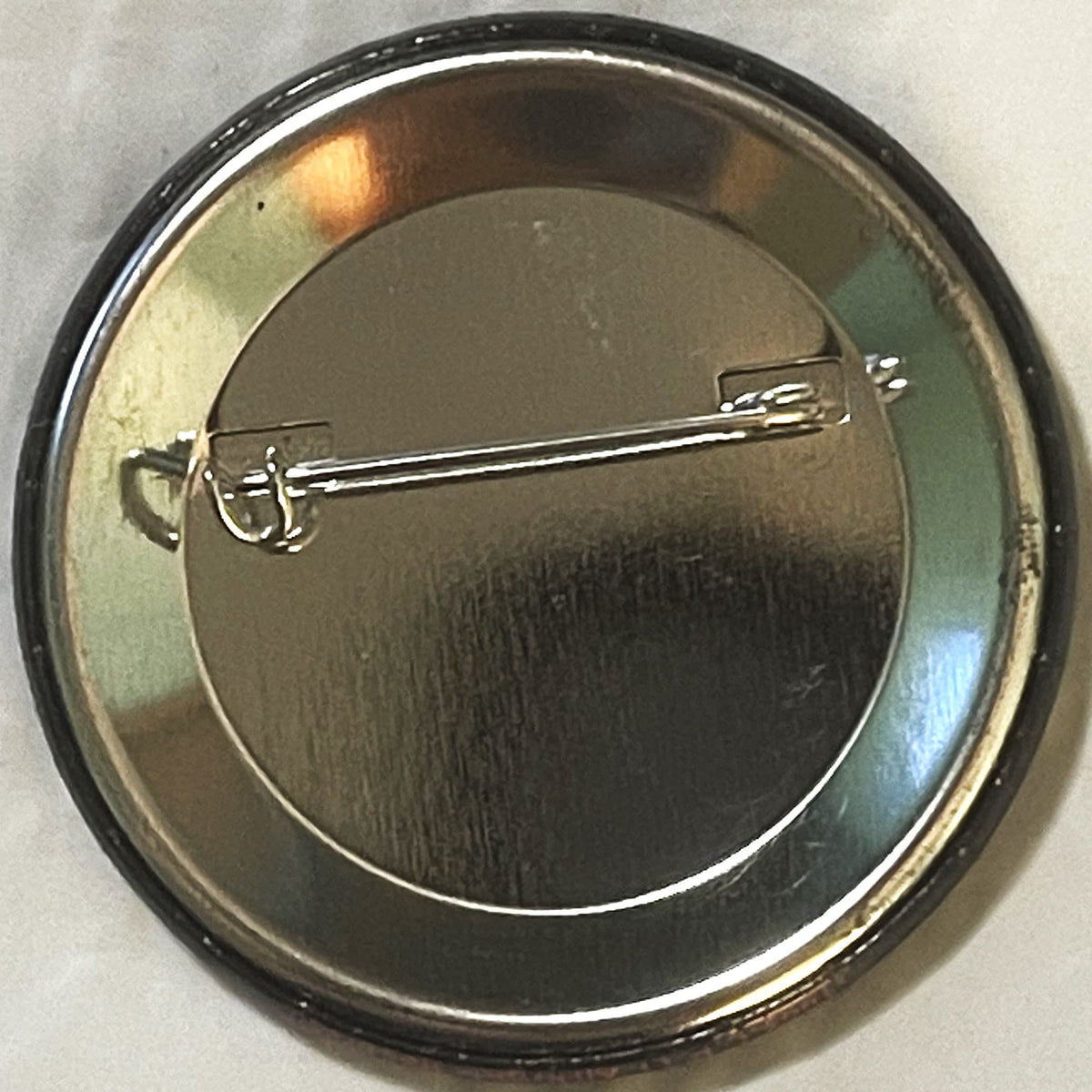
What you're looking at here is an original Bram Stoker's Dracula movie promotional pin-back button, carrying a maker's mark of CPII along its edge alongside the line "1992 CPII All Rights Reserved" — the copyright imprint that anchors this piece firmly to the year the film itself premiered.

It measures a true 2¼ inches (about 5.7 cm) across, a substantial, satisfying size for a collectible button — big enough to command real attention on a jacket lapel or a corkboard, not a tiny afterthought. The front artwork is a striking piece of gothic graphic design: a demonic, bat-eared face rendered in warm tans and aged golds, fanged mouth open in a silent roar, flanked on either side by twisting, wing-like appendages that seem to grow directly out of the skull like something carved from old bone or cast in tarnished brass.

Below that haunting face, the title unfurls in dripping, blood-red script — "Dracula" — with "BRAM STOKER'S" set in smaller red lettering just above it, and along the bottom edge, in clean white block capitals, the credit line reads "A FRANCIS FORD COPPOLA FILM." Black dominates the background, letting the tan face and the red type do all the talking.

This piece is offered as New Old Stock (NOS) — meaning it comes from unsold or unused promotional inventory that was never worn, never pinned to a jacket, and has simply been sitting quietly since the film's original release, waiting for someone who remembers.


🎬 Coppola's Gothic Gamble

By 1992, Francis Ford Coppola had already given the world The Godfather and Apocalypse Now, but Bram Stoker's Dracula was a different kind of risk entirely — a lush, unapologetically theatrical, almost operatic vampire romance shot through with practical effects, in-camera trickery, and a visual density that critics either adored or found overwhelming. Rather than lean on the computer-generated effects that were starting to creep into Hollywood at the time, Coppola and his crew famously reached backward instead of forward, using forced perspective, double exposures, and old-fashioned theatrical illusion — techniques that would have felt at home in silent-era filmmaking — to conjure Dracula's shifting shadow, his shrinking and swelling form, his transformation into mist and rats and wolves. The result was a film that felt simultaneously brand new and impossibly old, which was exactly the point: this was Dracula as timeless myth, not just another horror franchise entry.

The costume design, created by the legendary Eiko Ishioka, became just as iconic as the performances themselves — that towering red armor, the flowing robes, the impossibly ornate gowns Winona Ryder's Mina wears through the film's Victorian London sequences. Ishioka would go on to win the Academy Award for her work here, and it's not a stretch to say that armor is baked directly into the visual DNA of the demon-face artwork you see staring out from this very pin. The film was produced under Coppola's own American Zoetrope banner and released by Columbia Pictures, arriving in theaters that November to become one of the defining gothic horror releases of the decade — a film that didn't just adapt Stoker's novel, but seemed determined to out-gothic every vampire picture that came before it.

🧛 The Count Behind the Curtain — Where the Legend Really Comes From

Long before Coppola ever picked up a camera, long before Bram Stoker ever sharpened a pencil, there was a real prince ruling over Wallachia in the fifteenth century whose reputation for cruelty against invading Ottoman forces earned him a nickname that would echo down the centuries — Vlad Tepes, "Vlad the Impaler," son of Vlad Dracul, "Dracul" meaning dragon or devil in the old Romanian tongue. Local legend in the Carpathian villages held for generations that the dead didn't always stay buried, that certain unquiet souls returned as strigoi, wandering the countryside and needing to be kept at bay with garlic, with wild rose, with a stake driven through the heart before proper burial — old-world superstitions that predate any single storyteller and that Stoker, writing in London in 1897, wove into something entirely new: a Gothic epistolary novel that took the folklore of the Carpathians and set it loose on Victorian England.

Stoker never traveled to Transylvania himself — by most accounts he built his Count from library research, travelers' journals, and his own restless imagination — but the association stuck so completely that the region has carried the Dracula legend as a permanent part of its identity ever since. Collectors and horror fans have long passed down the rumor that the real Vlad's fortress ruins still stand in the Carpathian foothills, drawing pilgrims who want to stand where the legend supposedly took root, whether or not the history lines up as neatly as the tourist brochures suggest. Coppola's film leaned into that lineage more explicitly than almost any adaptation before it, opening with a prologue that ties Dracula directly back to Vlad's battles against the Turks — a choice that thrilled Stoker purists and vampire-lore devotees alike, because it finally put the historical prince and the fictional Count on screen together.

🩸 Reading the Artwork on This Pin

Spend a minute really looking at the face on this button and you start to notice how much is packed into such a small canvas. The bat-eared silhouette isn't just decoration — it's built to evoke both a bat in flight and a demon's skull at once, the ears sweeping upward and outward like folded wings, the whole shape dissolving at the edges into shadow so that it seems to emerge from darkness rather than sit on top of it.

The face itself is rendered in aged, sepia-toned tans, giving it the look of old parchment or tarnished gold rather than flesh — a deliberate choice that ties this artwork to the film's obsession with antique textures, old letters, candlelight, and crumbling stone. The eyes are sunken into near-total black, and the mouth is open wide enough to show a full set of fangs, top and bottom, an image built for maximum impact at a glance — exactly what a promotional button needs to do its job across a crowded lobby or a movie magazine insert.

The dripping red script of "Dracula" below it borrows directly from the film's own title treatment, blood rendered as calligraphy, romance and horror fused into a single font. It's a compact piece of 1992 movie-poster design distilled down to button size, and it holds up remarkably well as graphic art in its own right, gothic horror poster design from an era when studios still poured real craft into a marketing campaign's visual identity.

📌 Pins, Buttons, and a Vanishing Kind of Movie Marketing

The pin-back button itself has a surprisingly long pedigree — the basic celluloid-covered button design traces back to a patent registered by the Whitehead & Hoag Company in the 1890s, and by the time Hollywood studios were promoting summer and fall tentpoles a century later, the format had become a staple of movie marketing departments everywhere.

Studios in the late '80s and early '90s leaned hard on these little collectibles: buttons handed out at press junkets, tucked into promotional press kits sent to theater chains and magazine editors, given away at fan conventions, or bundled with video store displays when the film hit home release. They weren't sold on store shelves the way a t-shirt or a poster might be — they moved through a quieter channel, meant for insiders, exhibitors, journalists, and the occasional lucky fan who happened to be standing in the right lobby at the right moment.

That's part of what makes surviving examples like this one feel special today: they were never built for mass retail in the first place, which means far fewer of them made it out into the world compared to something printed for a store shelf. Movie buttons from this exact period — the last real gasp of pre-internet studio marketing, before online buzz and social media took over the job — carry a particular nostalgia for collectors who remember exactly what it felt like to walk out of a theater in November 1992 clutching a ticket stub and maybe, if you were fortunate, one of these.

🎭 The Faces Behind the Fangs

The film's cast reads like a wish list nobody thought would actually come together: Gary Oldman as the Count himself, delivering a performance that swung from ancient warrior to charming Victorian gentleman to feral monster within a single scene; Winona Ryder as Mina Harker, a role she reportedly championed and helped bring to Coppola in the first place; Anthony Hopkins as the fierce, eccentric Van Helsing, fresh off his own iconic turn as Hannibal Lecter the year prior; and a young Keanu Reeves as Jonathan Harker, holding his own in a cast of towering, theatrical performances.

Behind the camera, Coppola surrounded himself with a crew determined to make every frame feel like a moving painting — cinematographer Michael Ballhaus, production designer Thomas Sanders, and of course Eiko Ishioka's extraordinary costumes all combined to give the film a texture that felt handmade in an era when handmade was starting to feel like a lost art.

It's worth remembering, too, that this was very much a passion project for Coppola, made at a point in his career when he could have coasted on his earlier triumphs — instead he threw himself into reviving a nineteenth-century ghost story with the same intensity he'd once brought to war epics and crime sagas.

💫 Why This Film — and This Pin — Still Matters

More than three decades on, Bram Stoker's Dracula still gets cited constantly as one of the great gothic horror achievements of American cinema — film students study its in-camera effects work as a masterclass in what practical filmmaking could accomplish before CGI took over the industry, and costume historians still point to Ishioka's designs as some of the most influential horror-fashion work ever put on screen. The film helped fuel a broader gothic revival that rippled through fashion, music, and pop culture through the rest of the '90s, and it cemented Gary Oldman's reputation as one of the era's most transformative screen actors. A small promotional piece like this button is a direct physical link back to that specific cultural moment — the exact month and year audiences first encountered this version of the Count, before it became a cult classic endlessly quoted and referenced, back when it was simply the strange, sumptuous, slightly dangerous new release everyone was talking about.


🖼️ Display Ideas

  • 🦇 Pin it directly to a denim or leather jacket lapel the way movie fans did the moment they walked out of the theater in 1992
  • 🖤 Set it on a small stand or easel alongside other gothic horror and vampire movie memorabilia for a themed shelf
  • 🎃 Add it to a rotating Halloween display case that swaps out seasonally with your other horror-film collectibles
  • 📌 Group it on a cork or felt pin board with other early-'90s movie promo buttons for an at-a-glance timeline of the era
  • 🩸 Frame it in a small shadow box alongside a ticket stub or lobby card replica for a true "opening weekend" display
  • 🎬 Clip it to a backpack or bag strap for a bit of everyday gothic flair that starts conversations

🎁 Who Collects These

This little button tends to find its way into a few very specific kinds of collections. Horror movie memorabilia collectors chase it as one of the more affordable, tangible pieces of Bram Stoker's Dracula ephemera still floating around, especially compared to costume pieces or production props that live in far higher price brackets. Dracula and vampire-genre completists want it because it represents a genuine turning point in how the Count was portrayed on screen. Francis Ford Coppola devotees and cinephiles building out a shelf dedicated to his filmography reach for it as a small but meaningful footnote to a director better known for very different kinds of films. And then there's the simplest group of all — people who saw this movie in a theater in 1992 and have never quite stopped thinking about it, who want one small physical object that brings that memory back every time they glance at it.


❓ FAQ

What size is this pin?

It measures a true 2¼ inches (approximately 5.7 cm) across, a substantial size that gives the artwork real presence.

Is this an original 1992 piece, or a later reproduction?

The edge of the button carries a copyright line reading "1992 CPII All Rights Reserved," directly tying it to the year Bram Stoker's Dracula premiered in theaters.

What does "CPII" refer to?

It's the maker's mark printed along the button's edge as part of the copyright line. Collectors of studio-era movie promo pieces generally recognize this kind of imprint as shorthand tied to the film's copyright holder at the time of release, printed as a standard part of licensed movie merchandise.

What condition is this pin in?

It's offered as New Old Stock — meaning it comes from surplus promotional inventory that was never worn or displayed, preserved since the film's original release.

Was this sold in stores, or given away?

Promotional buttons like this one moved through marketing and fan-distribution channels tied to the film's release rather than standard retail shelves, which is part of why originals like this one are less commonly found today.

Does the artwork depict a specific actor from the film?

No — the design is a stylized demonic bat face used as part of the film's broader gothic visual branding, rather than a portrait of Gary Oldman or any other cast member.

How should I wear or display it?

It works equally well pinned to a jacket or bag as it does displayed on a pin board or in a small case alongside other horror-film memorabilia — a piece flexible enough for everyday wear or dedicated display.

Shipping

🚚 Shipping & Handling

  • Shipping costs and timing are calculated at checkout.
  • Items curated and shipped directly by me include U.S. shipping at no additional cost, professionally packed to ensure safe arrival of your artifact.

Items from Vetted Pro Collectors
Shipping for items offered by vetted Pro Collectors is determined at checkout. All Pro Collector listings are reviewed to ensure fair, reasonable shipping practices.

For full details, please refer to our Shipping Policy.

Returns & Exchange

Take your time — you've got a full six months. If a piece isn't right for you, send it back the way it reached you and we're good.

In the first 30 days your money goes straight back the way you paid. After that it's store credit, so you can put it toward something you'd rather have.

Return shipping we sort out between us, case by case. I don't make this difficult.

If something arrives damaged, or it isn't what I said it was, send me a photo within 48 hours and I'll make it right.

Email info@vintageantiquesgifts.com or call 802-356-9872 — that's me answering, not a call center.

The only things I can't take back are custom or special-order pieces and gift cards.

View full details
  • 5 stars: 0 (0%)
  • 4 stars: 1 (100%)
  • 3 stars: 0 (0%)
  • 2 stars: 0 (0%)
  • 1 star: 0 (0%)
J
JOSE ANTONIO PEREZ RAMOS

the article is very nice

So why four stars and no response to my messages to try to assist? Etsy considers anything with fewer than five stars as a negative review. I can't perform customer service if I am not allowed to. I would happily have assisted. If I can't even communicate with you, how can we have a relationship? I have to protect me and the kids. No Soup For You!